Iran’s $7.8 billion crypto economy faces new risks as US–Israel strikes threaten the power grid sustaining Tehran’s digital lifeline. | Credit: CCN.com
Share
Key Takeaways
Iran built a $7.8B crypto ecosystem to bypass U.S. sanctions, powered by state-backed Bitcoin mining and stablecoins.
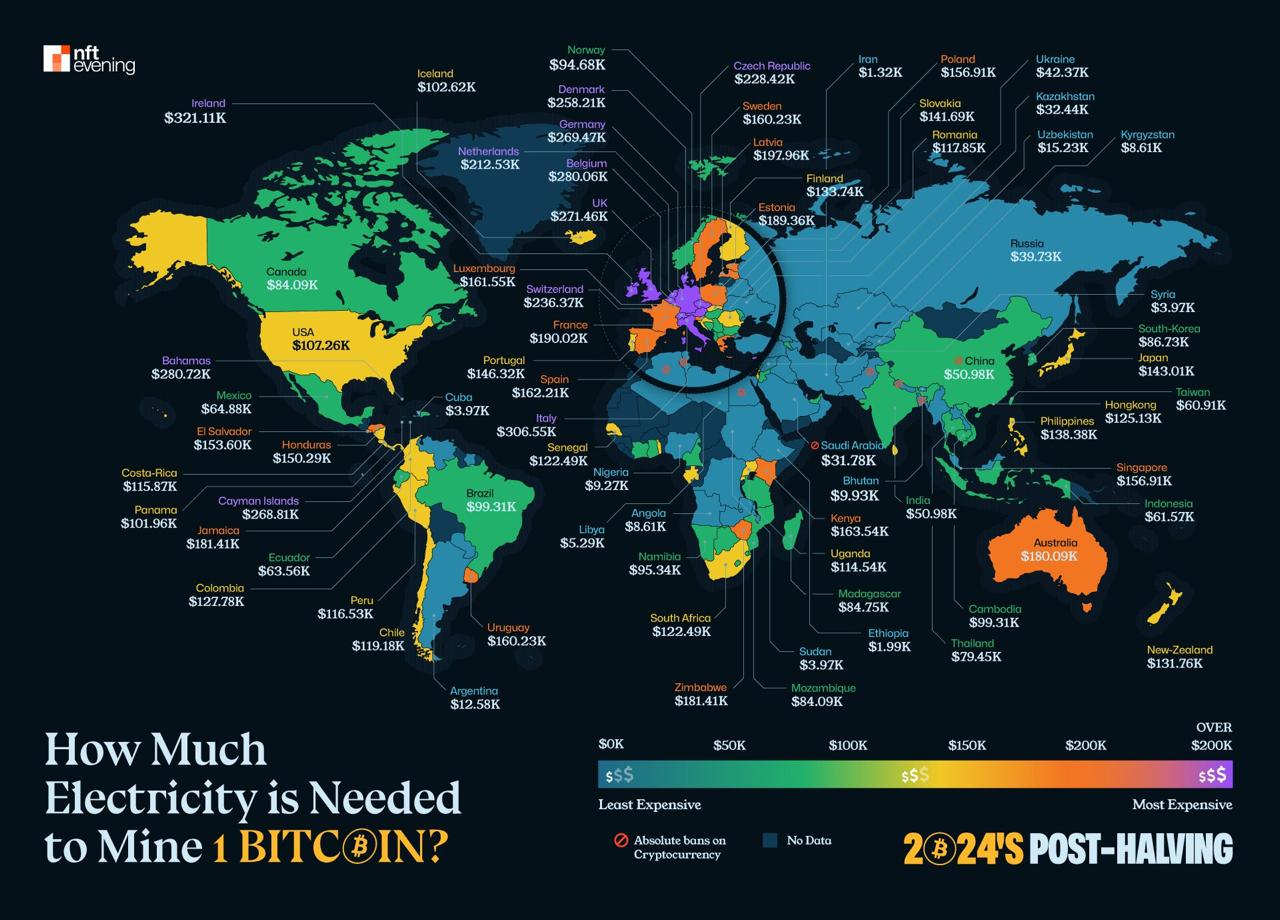
The regime converts subsidized electricity into Bitcoin, mining BTC at an estimated $1,300 per coin and selling at market prices.
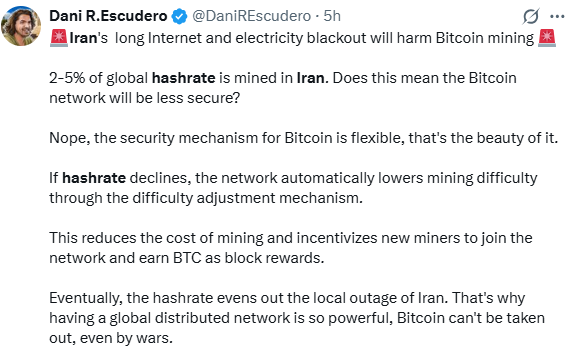
Iran controls an estimated 2%-5% of global Bitcoin hash rate, making it a meaningful player in the network’s supply dynamics.
Oil markets are pricing war risk, but Bitcoin markets may not yet be pricing hash rate disruption tied to geopolitical escalation.
Fresh U.S. and Israeli strikes on Iran have put oil markets on edge, rattled global equities, and strengthened the U.S. dollar. But beneath the headlines about missiles and centrifuges lies a lesser-known battlefield: Iran’s multibillion-dollar crypto economy.
For years, Tehran has quietly built a parallel financial system powered by state-sponsored Bitcoin mining and stablecoins.
Designed to bypass the U.S.-dominated dollar system and blunt the impact of sanctions, this crypto infrastructure has become a crucial lifeline, both for the regime and for ordinary Iranians navigating economic collapse.
Licensed miners were permitted to use subsidized electricity in exchange for selling mined Bitcoin (BTC) to the central bank. That BTC could then be deployed for trade settlement outside the traditional dollar system.
In simple terms, Iran engineered a conversion mechanism:
May be validated by machines operating inside Iran.
Each block represents more than computational output. It represents energy converted into a portable, censorship-resistant asset.
Iran’s $7.8 Billion Crypto Shadow Economy
Blockchain analytics firm Chainalysis estimates that Iran’s crypto ecosystem reached $7.78 billion in 2025, comparable to the GDP of small sovereign nations.
IRGC-linked wallets accounted for more than 50% of total inflows in Q4 2025.
Activity spikes correlate with military escalations and domestic unrest.
These figures reflect only publicly sanctioned wallets. The actual footprint could be materially larger.
Nobody in crypto is talking about the $1 billion Bitcoin operation that gets wiped out if the bombs fall.
Iran mines Bitcoin at $1,320 per coin on subsidized electricity and sells it at $68,000. A 50x gross margin. Not a hedge fund return. Not a venture multiple. Fifty times on… pic.twitter.com/ePP4dxJF8r
For the IRGC specifically, crypto offers a flexible financial corridor across its commercial fronts and affiliated networks.
Why USDT Is Central to Iran’s Sanctions Workaround
Bitcoin mining is only half the strategy.
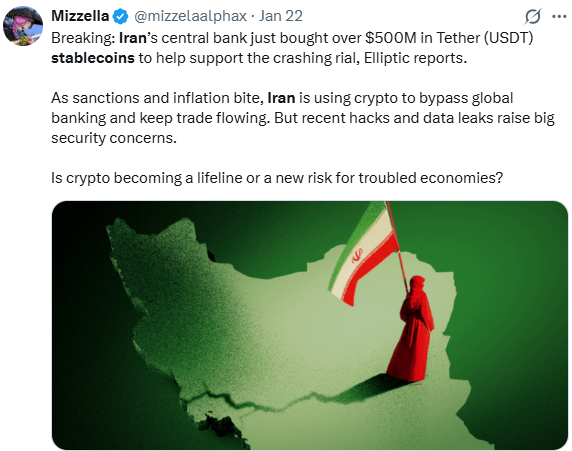
Stablecoins, particularly USDT, have become a parallel settlement layer. According to Elliptic, Iran’s central bank accumulated at least $507 million in USDT in 2025.
Exchange withdrawals spike during protests and internet blackouts.
Funds move into private wallets to avoid capital controls.
Crypto in Iran serves dual purposes:
State tool for sanctions evasion
Citizen tool for financial survival
Iran’s Power Grid Is A Fragile Foundation
All of this depends on electricity.
Bitcoin mining is energy-intensive and highly sensitive to power instability. Even brief outages can:
Force rigs offline
Damage hardware
Interrupt block production
Estimates suggest:
700,000 mining rigs operating nationwide
2,000 megawatts consumed daily
Electricity equivalent to a mid-sized city
Some reports indicate that up to 95% of mining activity may be unauthorized, with large operations linked to the IRGC operating with preferential access to electricity.
Meanwhile:
Hospitals experience rolling blackouts.
Households endure seasonal energy shortages.
Authorities impose periodic mining bans to ease strain.
The mining ecosystem is built atop a grid that is already fragile.
What Happens If the Hashrate Drops?
If sustained military strikes degrade grid capacity by 30%-50%, mining operations may not simply scale down proportionally; they could collapse entirely.
The regime loses a key unsanctionable hard-currency pipeline
Trade settlement flexibility narrows
Financial pressure intensifies
Oil markets are pricing in risk. Brent has surged toward $80, with projections above $100 if escalation continues.
Yet few investors are pricing in geopolitical risk to Bitcoin’s supply side.
Dollar Strength and Inflation Pressures
Following the strikes:
The U.S. dollar strengthened against most G10 currencies
Treasury yields climbed
Equities declined
Crude oil spiked
Rising energy prices are introducing renewed inflationary pressures. Stronger-than-expected producer price data has already complicated the Federal Reserve’s outlook.
Few dashboards track geopolitical risk as directly as Bitcoin’s hash rate chart.
Conflict Could Last For Weeks: What Does It Mean For The Markets?
Donald Trump has warned that the bombing campaign against Iran could drag on for weeks, doubling down on his demand that the country’s leadership surrender. Tehran, however, is showing no sign of backing down, with the nation’s security chief flatly rejecting the idea of negotiations.
Instead, Iran appears to have gone on the offensive with explosions reportedly heard across Bahrain, the UAE, and Qatar, as Gulf states moved to intercept missiles fired in retaliation.
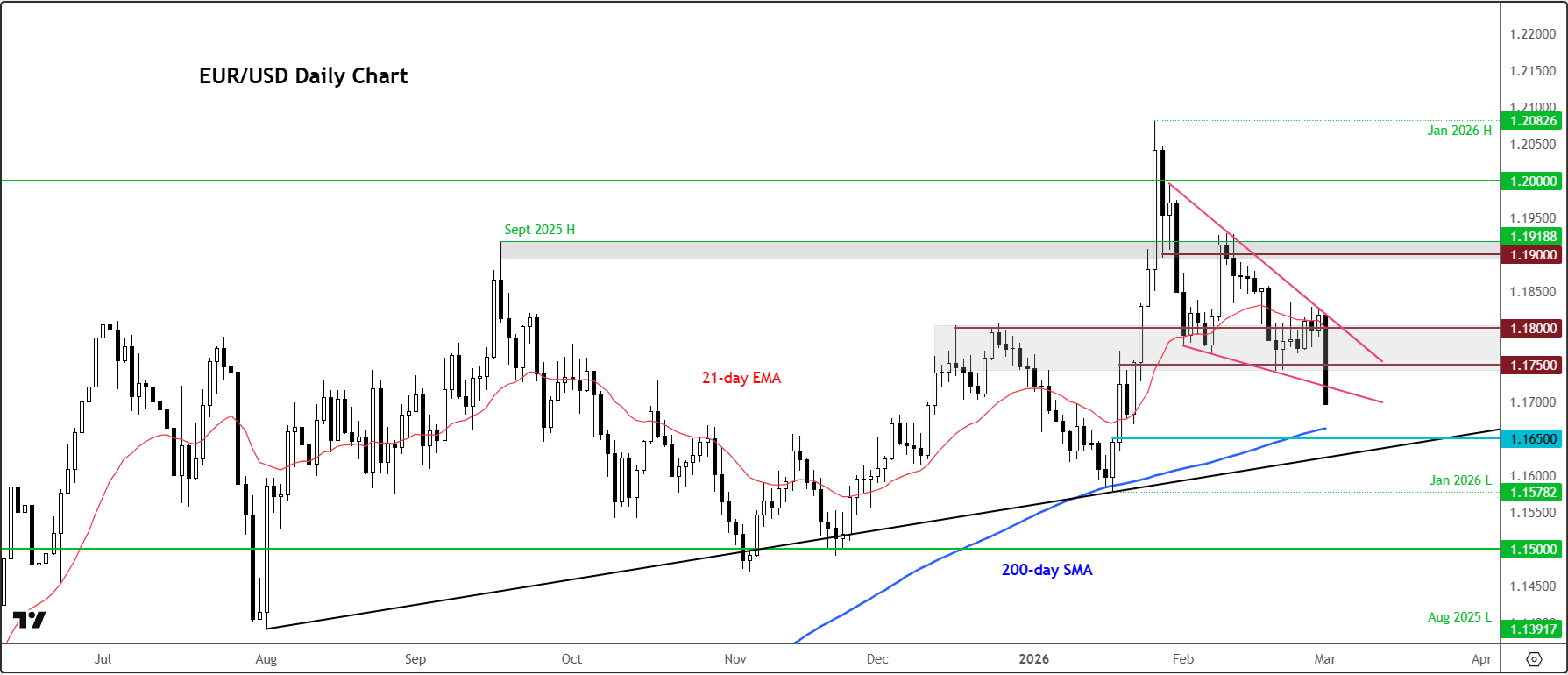
For Fawad Razaqzada of StoneX, “The FX backdrop has turned distinctly dollar-positive today because of two major reasons: energy prices surging and haven demand rising as energy markets and global equities drop.”
EUR/USD daily chart. | Credit: StoneX
“The U.S. remains largely energy independent, while Europe and much of Asia are not. If tensions in the Middle East persist, and it certainly feels premature to price in de-escalation right now, elevated oil and gas prices will increasingly weigh on energy-importing economies,” the analyst told CCN.
“I think if crude oil were to go above $100 per barrel and hold there for a few weeks at least then that could significantly weigh on the euro and yen in favour of the dollar.”
“But a sustained period of dollar strength is difficult to foresee only three days into the conflict. Still, any downside for the greenback is likely to remain small until markets gain clarity on how and when this conflict might resolve.“
In short, the risk balance in FX has shifted. For now, energy remains the dominant driver – and that keeps the dollar in the driving seat. While the dollar’s safe-haven credentials have been questioned at times this year, this particular shock, energy-driven and inflationary, arguably plays more to the U.S. advantage than Europe’s.
But A Bigger Question Remains
For more than five years, Iran has quietly used Bitcoin and stablecoins to sidestep the dollar system partially.
Its strategy has relied on:
Subsidized electricity
Regulatory legalization of mining
Centralized accumulation of mined BTC
Stablecoin adoption for trade settlement
This architecture allowed Tehran to convert sanctioned energy into unsanctionable capital.
Now that architecture sits atop a grid vulnerable to war.
If substations fail and transmission lines fall, the impact will extend beyond oil terminals and military facilities.
It will reach industrial warehouses filled with mining rigs, machines that transform electrons into blocks.
Oil markets are pricing an escalation. Currency markets are pricing dollar strength. Bitcoin’s supply dynamics may soon reflect it too. When the grid goes, the hash rate goes with it.
And with it, one of Iran’s quietest financial lifelines.
Blockchain analytics firm Chainalysis estimates Iran’s crypto ecosystem reached approximately $7.8 billion in 2025. IRGC-linked wallets alone reportedly received more than $3 billion in inflows last year. These figures likely underestimate total activity, as they reflect only publicly identified addresses.
What role does the IRGC play in Iran’s crypto sector?
The Islamic Revolutionary Guard Corps (IRGC) is believed to control or influence major mining operations and associated financial flows.
Why aren’t markets pricing this into Bitcoin yet?
Oil markets immediately reflect geopolitical risk because supply disruptions directly affect prices. itcoin’s supply mechanism is more technical and distributed. A 2%-5% hash rate drop is meaningful geopolitically but manageable technically, which may explain why markets are not yet reacting strongly.
Is Bitcoin helping Iran evade sanctions?
Bitcoin and stablecoins can make sanctions enforcement more complex, particularly when counterparties remain opaque.
Disclaimer:
The information provided in this article is for informational purposes only. It is not intended to be, nor should it be construed as, financial advice. We do not make any warranties regarding the completeness, reliability, or accuracy of this information. All investments involve risk, and past performance does not guarantee future results. We recommend consulting a financial advisor before making any investment decisions.
Giuseppe Ciccomascolo began his career as an investigative journalist in Italy, where he contributed to both local and national newspapers, focusing on various financial sectors.
Upon relocating to London, he worked as an analyst for Fitch's CapitalStructure and later as a Senior Reporter for Alliance News. In 2017, Giuseppe transitioned to covering cryptocurrency-related news, producing documentaries and articles on Bitcoin and other emerging digital currencies. He also played a pivotal role in establishing the academy for a cryptocurrency exchange website. Crypto remained his primary area of interest throughout his tenure as a writer for ThirdFloor.


 Easy
Easy