Home / Education / Crypto / Investing / Bitcoin Price at Critical Levels as Stock Futures Sink, Hormuz Crisis Threatens 20% of Global Oil Supply — What to Watch
Bitcoin is on alert as U.S. futures reopen amid Iran’s Hormuz threat. With 20% of global oil at risk and Brent surging, markets brace for volatility. | Credit: CCN.com
Share
Key Takeaways
Over 20% of the global oil supply moves through the Strait of Hormuz.
Brent crude has jumped sharply to around $80, with forecasts above $100/barrel if escalation continues.
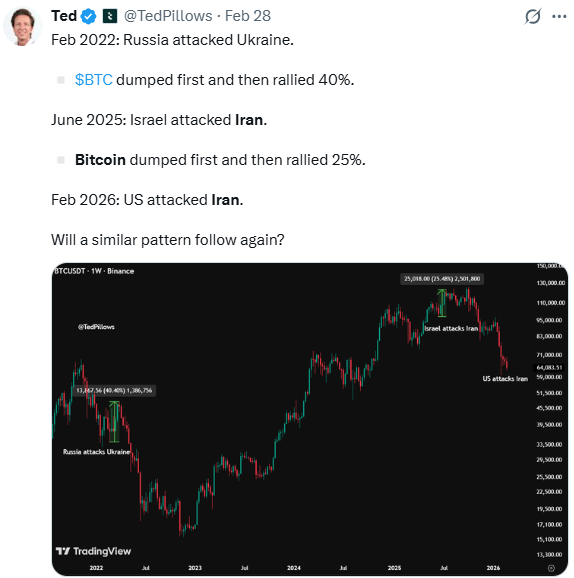
Bitcoin pumped initially on war headlines, a behavioral shift from past risk-off reactions.
Energy instability may lead to fiat stress, which usually means a stronger Bitcoin hedge narrative.
Global markets are headed into what could be one of the most volatile futures opens in recent memory. A dramatic escalation between the U.S., Israel, and Iran has converged with mounting disruptions in the Strait of Hormuz, the world’s most critical oil chokepoint, setting up a high-stakes Sunday night session for equities, commodities, and crypto alike.
At the center of it all: Bitcoin.
With U.S. futures showing a notable decline in American stocks and 20% of global oil supply potentially at risk, traders are bracing for extreme price swings. The following 24-48 hours could determine not only short-term market direction but also broader economic expectations for 2026.
🚨 THE BIGGEST MARKET CRASH IS COMING TOMORROW
Iran is closing the Strait of Hormuz.
Over 20% of global OIL SUPPLIES ARE HALTED.
And this is impacting other markets as well:
– Bonds – Stocks – Crypto – US Dollar
If you are holding any assets YOU MUST READ THIS NOW:
The immediate catalyst for market anxiety is the escalating crisis in the Strait of Hormuz.
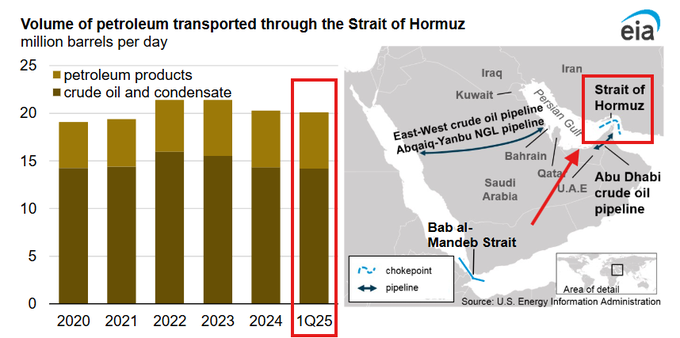
Iran has reportedly attacked an oil tanker named Skylight near the Strait, while Reuters reports that Tehran has begun notifying vessels that it is closing the Strait of Hormuz. If fully enforced, this would disrupt more than 20 million barrels per day, over 20% of global oil supply.
Volume of petroleum transported through the Strait of Hormuz. | Credit: EIA
For context, the Strait of Hormuz has never fully closed in modern history. Yet shipping data now shows oil and gas tankers avoiding the passage. Major shipping firm Maersk has suspended shipments through the strait. War-risk insurers are issuing cancellation notices for vessels operating in the region, with premiums expected to rise as much as 50% in the coming days.
While an estimated 6.5-7.5 million barrels per day could be rerouted through pipelines, that would still imply a roughly 65% drop in affected flows, equating to a potential loss of about 13% of global oil supply.
The world is heavily dependent on seaborne crude transport, and Iran knows it.
Energy Market Shock: Oil and Shipping Costs Flash Inflation Warning
Energy markets have reacted swiftly.
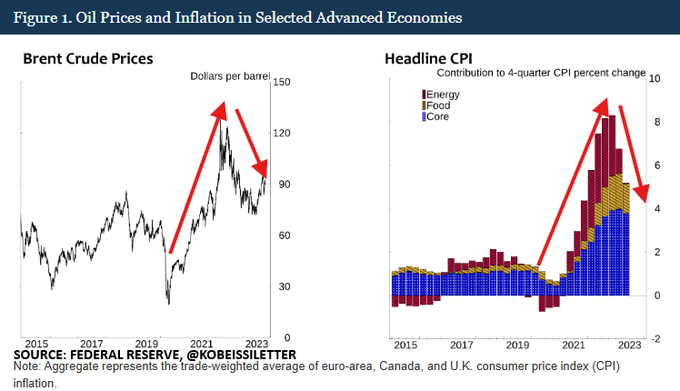
Brent crude has surged roughly 10% to around $80 per barrel, with some analysts projecting a move above $100 if disruptions persist. The cost of shipping 2 million barrels of crude from the Middle East to China has spiked to approximately $200,000 per day, the highest level since the 2020 pandemic and up 584% since early January.
Oil prices and inflation in selected advanced economies. | Credit: Federal Reserve, The Kobeissi Letter
Major oil importers, including China, Japan, and India, source 70-80% of their oil through this route. A prolonged disruption would hit Asian economies particularly hard, amplifying global inflation pressures.
And that’s the key: oil is not just about energy. It is a structural input into inflation, shipping costs, trade balances, currency stability, and central bank policy worldwide.
If oil spikes and remains elevated, inflation expectations will rise, just as global markets were beginning to price in stabilization and potential easing cycles in 2026.
Middle East Tensions Escalate as Iran Leadership Shake-Up Raises Market Risks
The oil crisis is inseparable from the broader geopolitical shift underway.
Joint U.S.-Israeli strikes reportedly killed Iran’s Supreme Leader, Ayatollah Ali Khamenei, prompting Tehran to declare a 40-day mourning period and retaliate across U.S. military bases in the Gulf, including Qatar, Kuwait, the UAE, Bahrain, and Jordan.
Arafi is described as a deeply entrenched regime loyalist who has held influential roles within Iran’s religious and political establishment for decades. The Assembly of Experts will ultimately determine whether he becomes the permanent Supreme Leader.
This leadership transition introduces a new layer of uncertainty. “Regime change” has not occurred, and that ambiguity may be one of the most destabilizing factors for markets.
The U.S. position has been publicly calm, with President Trump stating he is “not concerned about anything” regarding the Strait situation. However, markets tend to react to risk probabilities, not rhetoric.
The question now: does this become a short-lived confrontation, like prior flare-ups, or the beginning of a prolonged regional war?
Volatility Warning: Futures Could Trigger Global Risk-Off Wave
Historically, President Trump has often made market-moving announcements on Friday nights, setting up dramatic Sunday futures opens.
This weekend may be no different.
U.S. stock futures are reopening after direct strikes on Iran, retaliatory missile launches, shipping disruptions, and a potential oil chokepoint closure.
— 𝙲𝚘𝚕𝚒𝚗 𝚃𝚊𝚕𝚔𝚜 𝙲𝚛𝚢𝚙𝚝𝚘 🪙 (@ColinTCrypto) March 1, 2026
This divergence suggests two possible interpretations:
1. Sentiment Bottom Theory (Bullish)
Bitcoin may already have priced in extreme pessimism. When even a significant geopolitical escalation fails to trigger a sharp downside, it can signal that sellers are exhausted.
A similar dynamic occurred in November 2022 during the FTX collapse. Despite catastrophic headlines, the drop was less severe than feared, and a long-term bottom formed shortly after.
If that pattern repeats, Bitcoin’s resilience could indicate underlying accumulation and strengthening market structure.
2. Weekend Move Trap (Cautious)
Alternatively, the move may be a low-liquidity weekend rally that lacks conviction. Once U.S. futures open and institutional capital re-engages, BTC could face heavy downside pressure if equities gap lower.
In other words, the real test begins Sunday night.
Cryptocurrencies Drift as War Engulfs the Middle East
Chris Beauchamp, Chief Market Analyst at investing and trading platform IG, told CCN: “The diminished appeal of cryptocurrencies has been underlined by the lack of movement in the asset class over the past 48 hours despite the biggest geopolitical development in four years.”
“While prices dropped initially on the news breaking, they swiftly recovered, but have been unable to do much else. Instead, attention has been focused on the oil surge, plus the continued push higher in gold prices.”
For Beauchamp, it’s fair to say that every other event this week has been pushed down the rankings in terms of importance. Even Friday’s payrolls report may struggle for attention if the war in the Middle East continues to develop as it has over the past two days.
“While stocks tumble as investors cut back exposure and gold surges on safe haven buying, bitcoin and its peers will be hard-pushed to make their voices heard,” he added.
Bitcoin Price Coils in Tight Range — Breakout Levels to Watch
From a price action perspective, Bitcoin is consolidating in a well-defined range:
A break above $71,800 could signal a bullish breakout; a relief rally is likely.
A break below $62,600 is a bearish breakdown; $60,000 or lower is highly possible.
Nobody in crypto is talking about the $1 billion Bitcoin operation that gets wiped out if the bombs fall.
Iran mines Bitcoin at $1,320 per coin on subsidized electricity and sells it at $68,000. A 50x gross margin. Not a hedge fund return. Not a venture multiple. Fifty times on… pic.twitter.com/ePP4dxJF8r
Historically, rapid inflation spikes have not been friendly to risk assets, including crypto, in the short term.
However, in the long term, structural inflation and currency debasement narratives can strengthen Bitcoin’s appeal as a hedge against fiat instability.
The immediate reaction will depend on whether markets view this as a temporary shock or a sustained shift in the energy regime.
Global Risk Matrix Widens as Iran Targets US and Israeli Assets
While nuclear tensions may be the headline justification for conflict, energy leverage is the deeper structural issue.
Iran holds roughly 208 billion barrels of oil reserves and 1,200 trillion cubic feet of natural gas. Its geographic control over the Strait of Hormuz provides enormous strategic influence over global energy flows.
If Iran gains increased military or nuclear leverage, it strengthens its ability to influence oil supply dynamics, directly impacting global macro stability.
However, it’s worth noting that this is no longer a bilateral conflict.
Is Bitcoin going to rally after the U.S.-Israeli attack to Iran? | Credit: Ted Pillows X profile
Iran has declared U.S. and Israeli assets legitimate targets. Gulf states have condemned Tehran’s actions and pledged solidarity with countries under attack.
If additional Middle Eastern nations are drawn into the conflict, supply chains, shipping lanes, and regional alliances could be reshaped.
Markets do not wait for confirmation. They price probabilities.
And right now, probability distributions are widening.
What to Watch in the Next 24–48 Hours
Over the next 24–48 hours, markets will focus on the U.S. futures open, Brent’s ability to hold above key levels, and whether the Strait of Hormuz disruption becomes formal or remains temporary. Shipping insurance flows and Washington’s next policy move will further shape risk sentiment, while Bitcoin’s break above $71,800 or below $62,600 is likely to define near-term crypto direction.
U.S. futures reaction: A sharp gap down could accelerate global risk-off flows.
Oil price action: Does Brent break $90? $100? Or does it fade if diplomatic signals emerge?
For investors and traders, volatility equals opportunity, but also heightened risk.
The next 24-48 hours may shape not just short-term charts, but inflation expectations, central bank policy paths, and global growth forecasts for 2026.
Bitcoin is on alert. Oil is on edge. Futures are about to open.
And markets are about to decide how much of this geopolitical shock is already priced in, and how much is still to come.
Why is the Strait of Hormuz so important to global markets?
The Strait of Hormuz is one of the world’s most critical energy chokepoints. Roughly 20% of global oil supply (over 20 million barrels per day) passes through it. If shipping is disrupted, even temporarily, oil prices can spike sharply, affecting inflation, global trade, and financial markets.
Has the Strait of Hormuz ever fully closed before?
No. In modern history, the Strait of Hormuz has never been fully closed. However, partial disruptions, tanker attacks, military warnings, or insurance cancellations can still severely impact oil flows and pricing, even without an official closure.
Why would higher oil prices affect Bitcoin?
Oil price spikes often lead to higher inflation expectations. In the short term, this can cause investors to sell risk assets, including crypto, especially if stock markets fall. However, over the longer term, persistent inflation and geopolitical instability can strengthen Bitcoin’s narrative as a hedge against fiat currency risk.
Why is the U.S. futures market open so important?
U.S. stock index futures (S&P 500, Nasdaq, Dow) are the first major markets to reopen after weekend geopolitical events. If futures open sharply lower, it can trigger global “risk-off” moves across equities, commodities, and crypto markets. Because crypto trades 24/7, Bitcoin often reacts immediately, sometimes even before traditional markets open.
Disclaimer:
The information provided in this article is for informational purposes only. It is not intended to be, nor should it be construed as, financial advice. We do not make any warranties regarding the completeness, reliability, or accuracy of this information. All investments involve risk, and past performance does not guarantee future results. We recommend consulting a financial advisor before making any investment decisions.
Giuseppe Ciccomascolo began his career as an investigative journalist in Italy, where he contributed to both local and national newspapers, focusing on various financial sectors.
Upon relocating to London, he worked as an analyst for Fitch's CapitalStructure and later as a Senior Reporter for Alliance News. In 2017, Giuseppe transitioned to covering cryptocurrency-related news, producing documentaries and articles on Bitcoin and other emerging digital currencies. He also played a pivotal role in establishing the academy for a cryptocurrency exchange website. Crypto remained his primary area of interest throughout his tenure as a writer for ThirdFloor.


 Easy
Easy