Is the 4-year Bitcoin halving cycle losing relevance? Explore the new 2-year cycle theory, what’s changed, and how market structure may be shifting. | Credit: CCN.com
Share
Key Takeaways
Bitcoin’s traditional 4-year halving cycle is no longer a reliable timing tool, even though it still matters structurally over the long term.
Early cycles were effective because miner supply shocks were substantial and markets were immature, making halvings more pronounced in their impact on price.
Today’s Bitcoin market is driven more by liquidity, derivatives, and institutional flows than by changes in block issuance.
Going forward, investors should focus on liquidity regimes, macroeconomic signals, and positioning, rather than fixed calendar timelines.
For more than a decade, one idea has dominated the thinking of the Bitcoin market: the 4-year halving cycle. Every four years, Bitcoin’s issuance is cut in half, supply tightens, price rises, and a new bull market follows.
The pattern seemed so reliable that it became a kind of financial folklore, with charts circulated endlessly, and entire strategies were built around waiting patiently for the “post-halving pump.”
However, Bitcoin in 2025-2026 is not the same as the Bitcoin of 2012, 2016, or even 2020.
The market is larger, faster, more liquid, and deeply entangled with global macro forces. ETFs exist. Derivatives dominate. Institutions move size. And information spreads instantly.
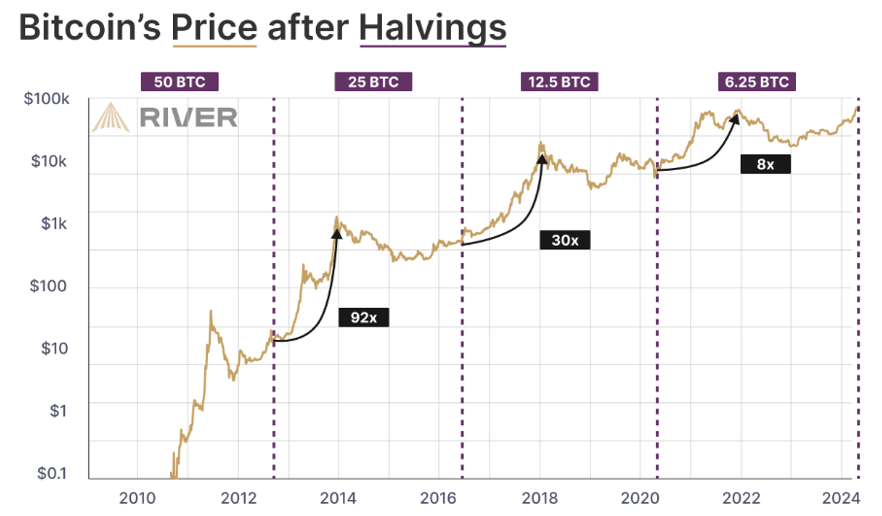
Bitcoin’s halving refers to the event where the block subsidy paid to miners is halved, roughly every four years. Historically, these events have lined up closely with major bull markets:
2012 halving brought a 2013 bull market.
2016 halving brought a 2017 bull market.
2020 halving brought a 2021 bull market.
In Bitcoin’s early years, this made intuitive sense. Issuance accounted for a large share of total daily volume, miners were forced sellers, and halving new supply created a genuine supply shock. Demand didn’t need to rise much for the price to move dramatically.
Bitcoin tends to create a bull market after halvings. | Credit: River
Early-cycle charts reinforced this belief. Each cycle looked eerily similar: accumulation, halving, parabolic rally, crash, long winter, repeat. With only three major data points, it was easy to extrapolate a clean, repeatable pattern.
But there was a hidden flaw: small-sample bias. Three clean cycles in a young, rapidly changing market do not guarantee permanence.
Structural Changes That Undermine a Clean 4-Year Bitcoin Halving Cycle
Several significant structural changes now challenge the idea that halvings alone can time markets.
First, Bitcoin issuance is no longer the dominant force. Daily miner issuance is relatively small compared to the total trading volume. Even a full halving now removes far less supply pressure than it did a decade ago.
Second, derivatives dominate price discovery. Futures, options, and perpetual swaps now drive marginal price moves more than spot supply-demand dynamics. Traders can express bullish or bearish views without touching actual BTC.
Third, ETFs and institutional access smooth demand. Large pools of capital no longer wait years to enter; they can allocate instantly. This front-runs anticipated events, including halvings.
Fourth, global macro liquidity increasingly sets the tempo. Interest rates, dollar liquidity, and central bank policy now have a significant influence on Bitcoin’s price, often overshadowing crypto-native fundamentals.
Finally, information travels faster. Everyone knows the halving schedule years in advance. In efficient markets, predictable events get priced in early, compressing their impact.
Bitcoin Performance Patterns: Tracking the Halving Cycle Theory
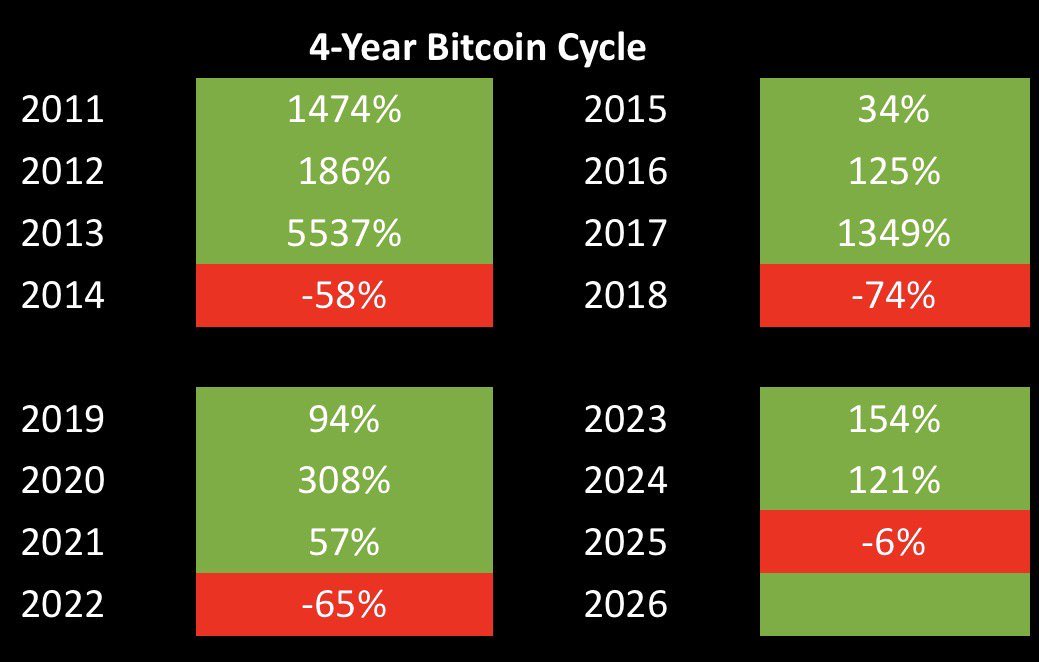
The image organizes Bitcoin’s annual percentage returns into four distinct “blocks” of four years:
The green years (Years 1, 2, and 3): These represent periods of recovery and massive “bull runs.” Year 3 (e.g., 2013, 2017, 2021) has historically been the “blow-off top” year, though 2021 was a notable outlier with a much smaller gain (+57%) compared to previous cycles.
The red years (Year 4): These represent the “Crypto Winter” or bear market. Historically, every fourth year (2014, 2018, 2022) saw a major price correction, usually dropping between 58% and 74%.
2024 (+121%): Matches the “Year 2” growth pattern, fueled by the launch of Bitcoin Spot ETFs and the April 2024 halving.
2025 (-6%): This is interesting because, according to the strict 4-year pattern shown in the previous three blocks, 2025 should be a green year. The red highlight here suggests a departure from the historical trend or perhaps a “front-run” cycle where the peak happened earlier than expected.
2026: The block is green but empty, indicating the expectation that the market might return to growth after a cooling-off period.
Is 4-year Bitcoin cycle dead? | Credit: Simon Dixon X profile
Experts Who Say the 4-Year Cycle Is “Dead” or Less Relevant
1. Willy Woo
Willy Woo has long argued that Bitcoin is transitioning from a speculative asset into a macro liquidity asset. He suggests that halvings matter less over time as issuance becomes negligible compared to demand flows and capital rotation.
2. Arthur Hayes
Arthur Hayes consistently frames Bitcoin cycles through the lens of global liquidity, not issuance. In his view, central bank easing and tightening cycles now dominate timing far more than block rewards.
3. Lyn Alden
Lyn Alden emphasizes Bitcoin’s growing correlation with macro conditions. She sees halvings as structurally bullish over long horizons but cautions against using them as short-term timing tools in a mature market.
4. Tom Lee
Tom Lee has pointed out that institutional adoption, ETFs, and corporate treasuries pull demand forward. In that environment, waiting for a post-halving rally may mean missing much of the move.
5. Mike McGlone
Mike McGlone often highlights Bitcoin’s evolution into a risk-sensitive macro asset, increasingly influenced by liquidity cycles, volatility regimes, and cross-asset correlations rather than isolated crypto events.
The ‘New’ 2-Year Bitcoin Cycle Thesis Explained
If the old model is weakening, what replaces it?
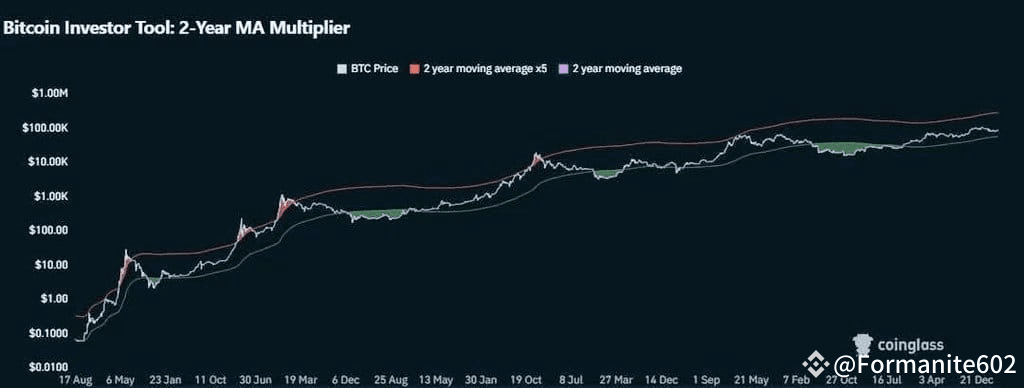
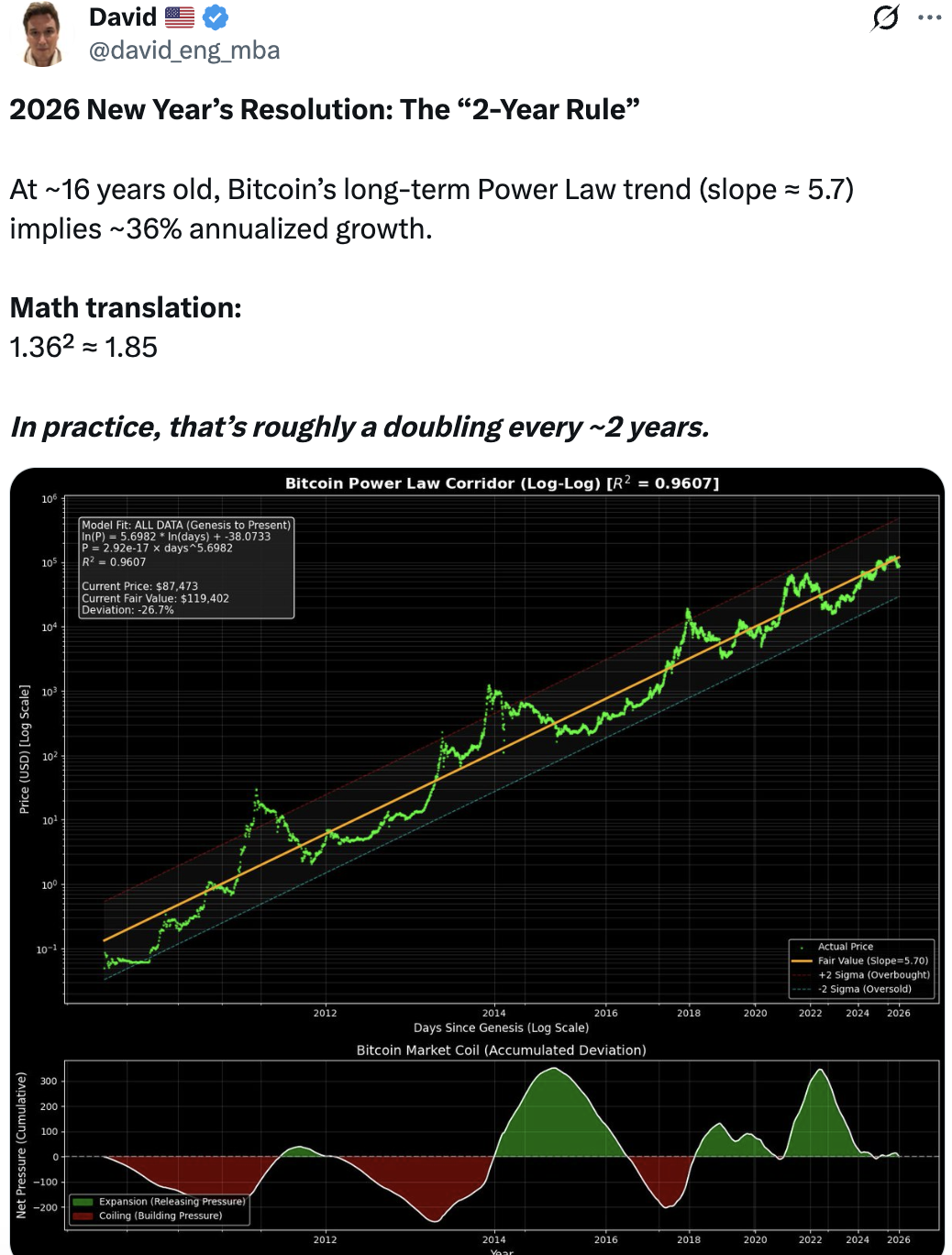
A growing number of analysts now argue that Bitcoin operates on a compressed, roughly 2-year cycle driven by liquidity regimes rather than calendar halvings.
In this view:
Markets front-run halvings, pricing them in earlier.
Peaks and troughs align more closely with liquidity expansion and contraction.
Acts as a powerful psychological anchor for narratives.
Shapes miner economics at stress extremes.
But its role has shifted. The halving is no longer a precise trigger: it’s a background condition.
Halving as a Background Condition, Not a Timing Tool
In a mature market, predictable supply changes don’t shock prices the way they once did. Instead, they slowly tilt long-term supply dynamics, while liquidity, leverage, and macroeconomic forces determine the timing.
Thinking of the halving as a clock rather than a constant leads to false precision.
Risks of Clinging to the Old Halving Model
Relying too heavily on the classic cycle introduces real risks:
Bitcoin has matured into a macro-sensitive, institutionally traded asset. Its future likely belongs to shorter, overlapping cycles shaped by liquidity, leverage, and reflexivity, with halvings quietly setting the stage in the background.
Understanding that shift isn’t abandoning Bitcoin’s past.
The Bitcoin halving cycle is not broken, but it is no longer a reliable timing tool. While halvings still reduce new Bitcoin supply over time, price movements are increasingly driven by liquidity, derivatives, and macroeconomic conditions rather than the halving alone.
Why did the 4-year Bitcoin halving cycle work in the past?
The 4-year cycle worked historically because Bitcoin issuance was a large share of daily trading volume, markets were immature, and miners were major forced sellers. Cutting issuance in half created real supply shocks that strongly influenced price.
What is the “2-year Bitcoin cycle” theory?
The 2-year cycle theory suggests that Bitcoin markets now move in shorter, compressed cycles driven by liquidity expansion and contraction rather than fixed halving dates. Institutional access and faster information flow cause markets to front-run halvings and recover more quickly.
What factors matter more than halvings for Bitcoin price today?
Key drivers now include global liquidity conditions, interest rates, ETF flows, derivatives positioning, and macroeconomic risk appetite. These factors often overwhelm crypto-specific events in the short to medium term.
Disclaimer:
The information provided in this article is for informational purposes only. It is not intended to be, nor should it be construed as, financial advice. We do not make any warranties regarding the completeness, reliability, or accuracy of this information. All investments involve risk, and past performance does not guarantee future results. We recommend consulting a financial advisor before making any investment decisions.
Giuseppe Ciccomascolo began his career as an investigative journalist in Italy, where he contributed to both local and national newspapers, focusing on various financial sectors.
Upon relocating to London, he worked as an analyst for Fitch's CapitalStructure and later as a Senior Reporter for Alliance News. In 2017, Giuseppe transitioned to covering cryptocurrency-related news, producing documentaries and articles on Bitcoin and other emerging digital currencies. He also played a pivotal role in establishing the academy for a cryptocurrency exchange website. Crypto remained his primary area of interest throughout his tenure as a writer for ThirdFloor.


 Easy
Easy