Is Bitcoin’s 21M Supply Cap a Lie? — Here’s How Derivatives Hijacked BTC Price Discovery
Share
Key Takeaways
Bitcoin’s 21 million cap still exists on-chain, but not in price discovery.
Futures, perpetual swaps, options, ETFs, and structured products routinely exceed spot volume, shifting price movements away from physical supply and demand.
A single coin can back ETFs, futures, options, lending, and structured products simultaneously, creating a synthetic supply that temporarily weakens scarcity.
Liquidations, funding rates, options hedging, and basis trades now matter more than on-chain flows during most market moves.
For more than a decade, Bitcoin’s core narrative has been simple and powerful: only 21 million coins will ever exist. That hard cap, enforced by code, is the foundation of Bitcoin’s claim to digital scarcity and one of the main reasons it has been compared to gold.
On-chain, that rule has not changed. There will never be more than 21 million BTC. And yet, in today’s markets, Bitcoin no longer trades like a strictly scarce asset.
Price behavior increasingly feels detached from on-chain flows, long-term holders, or even spot buying and selling. Rallies are capped abruptly. Sell-offs accelerate without obvious spot pressure. Volatility clusters around funding rates, options expiry, and liquidation events rather than wallet activity.
🔴 BTC is still facing strong selling pressure in the derivatives market.
The Net Taker Volume, on a monthly average basis, has turned negative again.
💥 After a period of calm between November and January, when buyers briefly regained some control (~$36M), we are now back to… pic.twitter.com/FJsNftjvVt
This has led to a controversial but increasingly common argument: while Bitcoin’s supply cap still exists on-chain, it has been effectively broken at the level of price discovery.
The reason is not a protocol failure. It is financialization.
How Bitcoin Derivatives Are Distorting BTC Supply, Demand and Price
In Bitcoin’s early years, price discovery was relatively straightforward. The market was dominated by spot exchanges. Buyers needed real BTC. Sellers had to actually deliver coins. If demand rose and supply was unavailable, prices moved sharply upward.
This structure mirrored a physical commodity market with limited paper overlays.
But as Bitcoin matured, a second layer formed above the blockchain: a financial layer designed to trade exposure to Bitcoin rather than Bitcoin itself.
Today, daily derivatives turnover often dwarfs spot trading. Perpetual swaps alone routinely exceed spot volume by multiples during periods of volatility.
Why Bitcoin’s 21 million supply is no longer maximum supply. | Credit: Mr. Crypto Whale X profile
Once that happens, price stops being set primarily by physical supply and demand. Instead, it becomes a function of:
In simple terms, Bitcoin’s price now moves less because someone is buying or selling actual coins, and more because traders are forced to adjust or unwind leveraged positions.
This is why prices can fall sharply even when on-chain data shows little spot selling. The pressure is coming from the derivatives layer, not the blockchain.
Synthetic Supply and the ‘Paper Bitcoin’ Problem
Here is where the 21 million narrative starts to fracture, not in code, but in markets. One real BTC can now simultaneously support multiple layers of financial exposure:
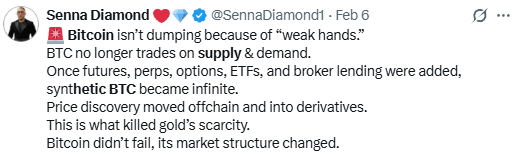
Bitcoin is no longer trading on supply and demand. | Credit: Senna Diamond X profile
That is one coin on-chain, but many claims in the order book. This phenomenon is known in traditional finance as synthetic float expansion. It does not increase physical supply, but it increases tradable exposure far beyond the underlying asset.
Gold experienced the same shift in the 1980s, when futures, options, and unallocated gold accounts became dominant. Physical scarcity did not disappear, but its influence on short-term price discovery weakened dramatically.
Bitcoin is now undergoing a similar transformation.
Spot vs Derivatives: Why Bitcoin Price Can Move Without On-Chain Selling
Bitcoin’s price doesn’t always move because people are buying or selling BTC on-chain. In fact, most short-term price action today is driven by derivatives markets, not spot.
Spot markets involve real Bitcoin changing hands and appearing in on-chain data such as exchange flows and wallet balances. But while spot matters for long-term trends, it no longer dominates day-to-day price discovery.
That role belongs to derivatives.
Perpetual futures, futures, and options allow traders to gain BTC exposure without touching the underlying asset. These markets:
As a result, price can move sharply with no meaningful on-chain activity.
How price moves without coins moving:
Liquidations: Overleveraged positions get wiped out, forcing market orders that push price further.
Funding rate shifts: Crowded longs or shorts unwind rapidly.
Options hedging: Dealer hedging around key strikes can pull the price up or down.
All of this happens through contracts, not coin transfers.
It’s common to see strong long-term holder behavior and low exchange inflows during price drops. That usually means derivatives traders are repositioning faster than spot holders are selling, not that on-chain data is wrong.
Derivatives move Bitcoin in the short term. Spot confirms it over time. If you expect every price move to show up on-chain, you’re missing how modern crypto markets actually work.
Bitcoin Isn’t Scarce Anymore — Paper BTC Is Crashing the Market
Scarcity only matters when demand must compete for a limited resource. But in a derivatives-dominated market, demand can be absorbed synthetically. Instead of bidding up spot BTC, traders express bullishness via leveraged contracts. Market makers hedge via futures. Exposure is created without requiring new coins to change hands.
As a result:
Rallies are often met with aggressive shorting via derivatives.
Leverage builds faster than spot accumulation.
Liquidations drive abrupt moves both up and down.
Volatility increases even when on-chain flows are quiet.
This does not mean Bitcoin has an infinite supply on-chain. It means that short-term price discovery no longer reflects scarcity as Bitcoin’s original thesis assumed.
Why Bitcoin Price Can Crash Without Spot Selling
This structure explains a puzzle that confuses many investors: why Bitcoin sometimes falls hard with no obvious catalyst.
None of these requires large spot sales. In other words, Bitcoin can sell off violently even if long-term holders are not selling.
Bitcoin’s Protocol Has Not Changed — Market Structure Has
It is important to be precise. Bitcoin’s protocol has not changed. The 21 million cap is intact. Self-custodied BTC is still scarce. Long-term supply dynamics still matter over long horizons.
What has changed is the market structure.
Bitcoin is no longer just a peer-to-peer monetary experiment. It is a fully financialized asset, embedded in global capital markets, traded by institutions that specialize in extracting yield, volatility, and fees rather than preserving scarcity narratives.
Wall Street did not adopt Bitcoin to protect its purity. It adopted Bitcoin to trade it.
Can Bitcoin’s Scarcity Narrative Be Restored?
There is only one mechanism that meaningfully constrains synthetic expansion: removing coins from the collateral pool.
When BTC sits on centralized exchanges, custodians, or ETF vaults, it can be rehypothecated, referenced, and hedged repeatedly. When it is held in self-custody, it cannot.
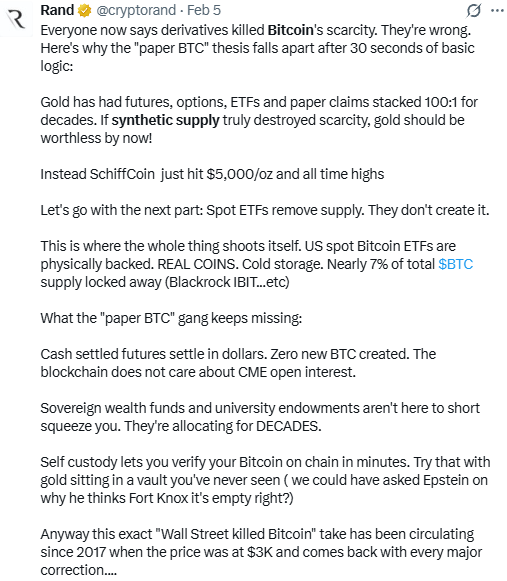
Why the “paper BTC” thesis falls apart. | Credit: Cryptorand X profile
This is why long-term Bitcoin advocates emphasize:
Self-custody
Exchange outflows
Reduced rehypothecation
Lower leverage in the system
These forces do not eliminate derivatives, but they reduce the likelihood that paper exposure will overwhelm physical supply.
Bitcoin’s 21 million supply cap is not a lie in the protocol sense.
But in modern markets, price discovery is no longer governed by that cap alone. Bitcoin now trades like a financialized commodity, where derivatives, leverage, and positioning dominate short-term behavior. Scarcity still matters, but mostly over longer timeframes, when leverage resets, and paper claims collapse back toward the underlying asset.
Understanding this distinction is essential.
If you are trading Bitcoin as if it were still a pure spot-driven market, you are trading a market that no longer exists.
If you are investing long term, the scarcity thesis still holds—but only if you recognize that the path there will be shaped less by miners and holders, and more by the invisible machinery of modern finance.
Bitcoin didn’t lose its supply cap. It lost its monopoly on price discovery.
Is Bitcoin’s 21 million supply cap actually broken?
No. On-chain, Bitcoin’s monetary policy is unchanged. The protocol still enforces a hard cap of 21 million BTC, and no mechanism exists to create additional coins. What has changed is how Bitcoin’s price is discovered in financial markets, not how many coins exist on the blockchain.
So why do people say Bitcoin now has “infinite supply”?
They are referring to synthetic supply, not real BTC. Through futures, options, ETFs, lending, and structured products, the same underlying BTC can support multiple price claims simultaneously. This expands tradable exposure without increasing on-chain supply, weakening scarcity’s influence on short-term price movements.
What is “paper Bitcoin”?
“Paper Bitcoin” is an informal term for cash-settled or synthetic exposure to BTC price that does not require ownership or delivery of real BTC. Examples include perpetual swaps, CME futures, options, and structured notes. These instruments trade Bitcoin’s price, not Bitcoin itself.
Why do derivatives matter so much for Bitcoin now?
Because derivatives volume often exceeds spot volume. Once that happens, price responds more to leverage, positioning, funding rates, and liquidations than to physical buying and selling of coins. This is a standard evolution in maturing financial markets.
Disclaimer:
The information provided in this article is for informational purposes only. It is not intended to be, nor should it be construed as, financial advice. We do not make any warranties regarding the completeness, reliability, or accuracy of this information. All investments involve risk, and past performance does not guarantee future results. We recommend consulting a financial advisor before making any investment decisions.
Giuseppe Ciccomascolo began his career as an investigative journalist in Italy, where he contributed to both local and national newspapers, focusing on various financial sectors.
Upon relocating to London, he worked as an analyst for Fitch's CapitalStructure and later as a Senior Reporter for Alliance News. In 2017, Giuseppe transitioned to covering cryptocurrency-related news, producing documentaries and articles on Bitcoin and other emerging digital currencies. He also played a pivotal role in establishing the academy for a cryptocurrency exchange website. Crypto remained his primary area of interest throughout his tenure as a writer for ThirdFloor.


 Easy
Easy