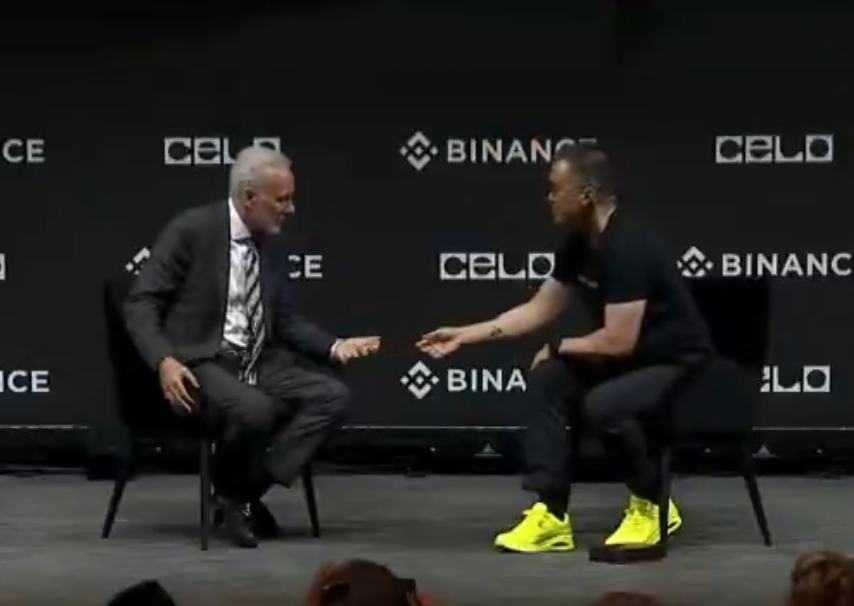
CZ and gold advocate Peter Schiff faced off live in Dubai, sparring over Bitcoin, gold, and tokenized assets. | Credit: CCN.com
Share
Key Takeaways
Peter Schiff introduced T-Gold.com, which combines physical gold with blockchain-based tokens.
CZ agreed that tokenization improves gold’s usability but emphasized the unique advantages of digital assets like Bitcoin.
Schiff views Bitcoin as a wealth-transfer mechanism that generates no economic utility.
Both agreed gold’s monetary premium is also partly based on belief and tradition, not just industrial use..
At Binance Blockchain Week, one of the crypto industry’s most anticipated debates finally unfolded: Binance founder Changpeng Zhao (CZ) versus long-time gold advocate and Bitcoin critic Peter Schiff.
What began as a technical discussion about tokenized gold quickly spiraled into a philosophical debate over what gives money value, even featuring a dramatic real-time gold-bar authenticity test that left the audience stunned.
The conversation, full of playful jabs, economic theory, and impromptu theatrics, offered rare insight into how two influential voices perceive the future of money.
Tokenized Gold: Schiff’s Attempt to Bring Gold On-Chain
The debate began with Schiff explaining his latest venture: T-Gold.com, a platform for purchasing vaulted physical gold and silver, which will soon be paired with blockchain-based tokenized representations. For decades, Schiff has argued that gold is a superior form of money.
Tokenization, he believes, enhances gold’s monetary properties without altering its fundamental value.
GOLD CANNOT PROVE IT IS GOLD
Yesterday in Dubai, Peter Schiff held a gold bar on stage.
CZ asked one question: “Is it real?”
Schiff’s answer: “I don’t know.”
The London Bullion Market Association confirms there is only one method to verify gold with 100% certainty: fire… pic.twitter.com/dswgvx4W3y
He laid out his vision simply: gold remains in a vault, fully allocated, segregated, and redeemable at any time. A digital token serves as the claim check.
“The token isn’t the gold,” Schiff said. “But it is redeemable for the gold. Just like a coat-check ticket isn’t a coat, but it gets you your coat.”
Tokenization, he argued, solves several longstanding problems:
Gold becomes easily divisible, even into tiny fractions.
Transfers of ownership occur instantly, without shipping bars.
It becomes transportable globally, without the risk of confiscation.
It remains fundamentally backed by a scarce physical commodity.
Schiff emphasized that for monetary use, tokenized gold is “better than physical gold,” so long as the vault and issuer are trustworthy.
CZ largely agreed that tokenized gold improves gold’s utility. But he also saw an opportunity.
Schiff Says “I Don’t Know” Over a 1kg Gold Bar: The Viral Moment
Midway through the conversation, CZ surprised Schiff by pulling out a heavy box on stage. Inside was a 1 kg gold bar, allegedly gifted to him by the president of Kyrgyzstan.
🔥 CZ WON THE BITCOIN DEBATE IN LESS THAN A MINUTE
CZ pulled out a gold bar during the Bitcoin v. Gold debate and asked Peter Schiff to verify if it was real. Schiff was unable to verify it without having extra tools.
Schiff squinted and without an assay, said, “I don’t know.” He compared its color to his own gold bracelet. He frowned. “The color looks a little off. I’d have to assay it. I’ve never heard of this mint.”
The audience erupted in laughter.
CZ showed a gold bar to Peter Schiff. | Credit: Binance
CZ grinned: “It might be your bracelet that’s off.”
The moment was symbolic: even one of the world’s most seasoned gold dealers couldn’t immediately verify a bar’s authenticity.
CZ seized on it.
If he transferred Bitcoin to Schiff, everyone could instantly verify its authenticity, provenance, and balance. But with gold? Even experts can’t be sure without lab equipment.
CZ: “Bitcoin Doesn’t Exist — And That’s Why It Works”
Schiff insisted Bitcoin is “backed by nothing.” CZ countered with a conceptual perspective rarely articulated so plainly on stage: “There is no Bitcoin on the blockchain. All there is are records of transactions.”
Value, CZ argued, does not depend on physical existence. The internet has no physical form, yet trillions of dollars in value sit on platforms like Google, X, or Facebook.
Schiff conceded that intangible assets can have value, but maintained Bitcoin has no inherent utility: “When I transfer Bitcoin to you, I’ve transferred nothing. You can’t do anything with it.”
For Schiff, gold’s value is derived from its physical uses, such as jewelry, electronics, and dentistry, as well as its role in central bank reserves. Because gold does not decay, he argues its present value reflects all future utility “from now until the end of time.”
CZ pushed back: What matters is not physical use, but economic demand. The world recognizes Bitcoin as valuable. And unlike gold, Bitcoin’s supply is truly fixed.
CZ countered: “We don’t know how much gold exists. Tomorrow, someone might discover a giant mine.”
Synthetic gold may someday exist. New extraction technologies could appear. Gold supply is uncertain. Bitcoin’s supply is not.
“We know exactly how much Bitcoin there will be, forever.”
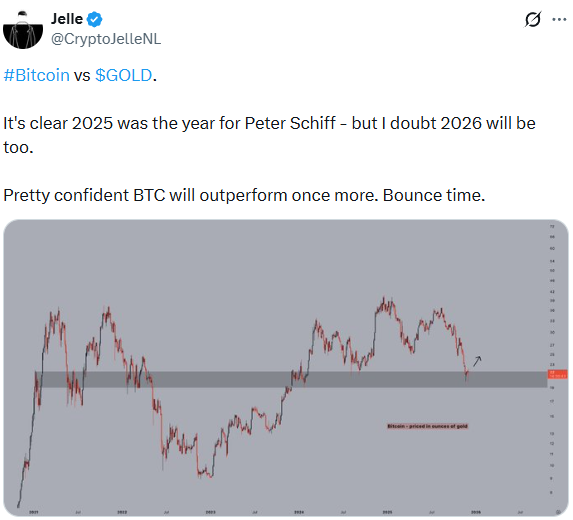
Bitcoin vs. gold in 2025. | Credit: Jelle X profile
This difference, CZ argued, makes Bitcoin more predictable than gold across centuries.
Schiff replied that scarcity is meaningless if there is no underlying utility. Bitcoin’s demand, he said, is purely speculative: “People want it because they think the price will go up. That’s not real demand.”
To prove his point, Schiff compared Bitcoin to gold over the last four years:
When Bitcoin hit $69,000, it could buy 37.2 ounces of gold.
Today, at around $90,000 per BTC, it buys 22.15 ounces.
By Schiff’s framing, Bitcoin is down 40% in gold terms.
He then posed the rhetorical question: If Bitcoin can’t outperform gold during a period of unprecedented hype, ETFs, corporate accumulation, and global media attention, why should it succeed going forward?
Do People Really Use Bitcoin? CZ Says Yes, Schiff Says No
CZ redirected the debate to a more foundational question: Do people use Bitcoin? Yes, he argued.
CZ shared a story from an African Binance user: Before crypto, paying monthly bills required a three-day walk. After Bitcoin and stablecoins: three minutes.
“That materially improved his life,” CZ said.
Schiff acknowledged the improvement but argued it had nothing to do with Bitcoin specifically.
“He can use stablecoins. He can use tokenized gold.”
CZ responded that all crypto infrastructure was built because Bitcoin pioneered the space. Bitcoin remains the most secure, most decentralized asset and the most recognized brand. For millions, it is the on-ramp to financial empowerment.
Schiff, however, remained unmoved: “Nobody needs Bitcoin. People want it only because they think the price will go up.”
Speculation or Technological Revolution?
For Schiff, Bitcoin’s entire history is a wealth transfer:
Early adopters sold high.
Late adopters subsidized their profits.
Bitcoin generates no cash flow, has no industrial use, and offers no consumption value.
Therefore, it creates no economic wealth; instead, it redistributes it.
CZ countered that this is also true of gold’s monetary premium. Industrial demand for gold represents only a fraction of its value; the rest is driven by belief, tradition, and market acceptance.
Bitcoin functions similarly, but globally, digitally, and instantly.
Will the Next Generation Choose Bitcoin or Gold?
CZ challenged Schiff on generational trends: “Do you think the younger generation will like gold more or Bitcoin more?”
Schiff predicted young people will prefer gold after “they lose money on Bitcoin.”
The crowd laughed, knowing Schiff’s son is famously a Bitcoiner.
Schiff admitted: “He already sold.”
CZ concluded with an observation hard to ignore: Bitcoin went from worth nothing in 2010 to $90,000 today.
Over 15 years, no asset in human history has grown so much, so fast, so broadly.
Schiff acknowledged early adopters made fortunes, but insisted the music will stop. CZ insisted the opposite: Bitcoin’s utility, adoption, and global relevance continue to expand.
A Debate That May Define an Era
The CZ-Schiff debate encapsulated a clash between two monetary philosophies:
Schiff believes money must be a physical commodity with intrinsic use.
CZ believes value arises from network adoption, verifiability, portability, and technological utility.
The gold-bar mishap perfectly symbolized the moment: even gold requires trust, expertise, and physical verification. Bitcoin involves none of these.
Whether Bitcoin becomes the “better gold” or whether Schiff’s warnings come true remains one of the defining questions of modern finance.
But one thing is clear: the future of money will be shaped not by metal or paper, but by ideas, and those ideas are still fiercely contested.
The debate centered on the future of money, focusing on Bitcoin versus gold, and the role of tokenized gold in a digital economy. It evolved from technical discussions about blockchain-based gold tokens to philosophical arguments about what gives money its value.
How did the gold-bar authenticity test unfold?
CZ presented a 1 kg gold bar on stage. Schiff inspected it but couldn’t verify its authenticity without lab equipment. CZ used the moment to highlight a key advantage of Bitcoin: its authenticity is instantly verifiable on the blockchain, unlike physical gold.
How did the debate address generational trends?
CZ suggested younger generations are more likely to adopt Bitcoin due to its accessibility and technological utility. Schiff predicted young people might turn to gold after experiencing Bitcoin’s volatility, though he admitted his own son is a Bitcoiner.
What was the significance of the debate?
The debate showcased a clash of monetary philosophies and highlighted the evolving definitions of money in the digital age. It also illustrated how new technologies like tokenized gold and Bitcoin challenge traditional notions of trust, scarcity, and utility in finance.
Disclaimer:
The information provided in this article is for informational purposes only. It is not intended to be, nor should it be construed as, financial advice. We do not make any warranties regarding the completeness, reliability, or accuracy of this information. All investments involve risk, and past performance does not guarantee future results. We recommend consulting a financial advisor before making any investment decisions.
Giuseppe Ciccomascolo began his career as an investigative journalist in Italy, where he contributed to both local and national newspapers, focusing on various financial sectors.
Upon relocating to London, he worked as an analyst for Fitch's CapitalStructure and later as a Senior Reporter for Alliance News. In 2017, Giuseppe transitioned to covering cryptocurrency-related news, producing documentaries and articles on Bitcoin and other emerging digital currencies. He also played a pivotal role in establishing the academy for a cryptocurrency exchange website. Crypto remained his primary area of interest throughout his tenure as a writer for ThirdFloor.


 Easy
Easy