Key Takeaways
- Peter Schiff blamed Wall Street’s embrace of Bitcoin for its underperformance.
- Some analysts have compared Bitcoin’s current price action to early 2022’s bear market.
- Others say 2022 parallels are misplaced.
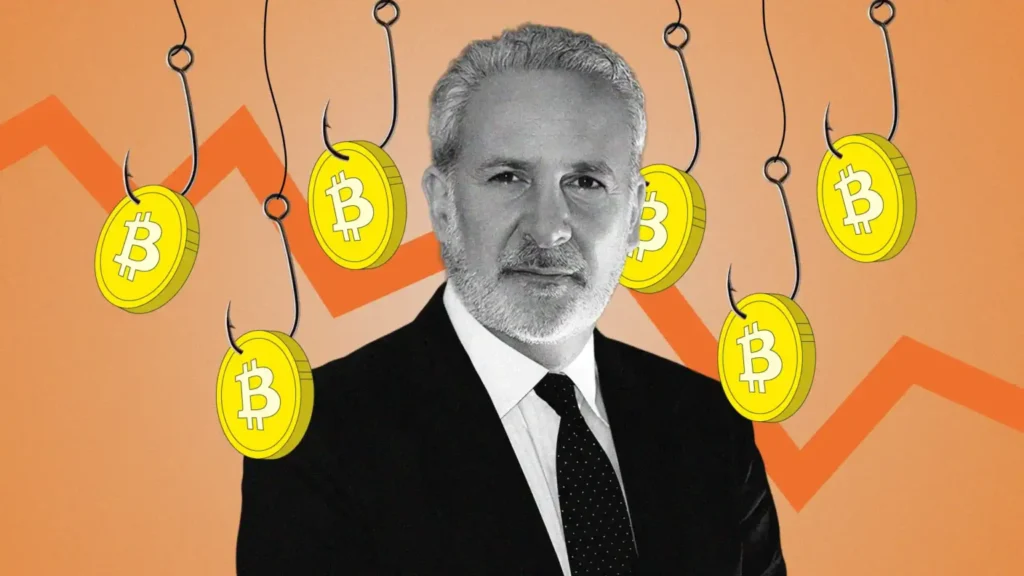
Bitcoin (BTC) is again under renewed pressure from prominent gold advocate Peter Schiff after he blamed Wall Street’s growing involvement for its underperformance.
Schiff’s remarks came as precious metals surged to record highs and as some market commentators warned that Bitcoin’s recent weakness could echo the 2022 bear market that followed its November 2021 peak.
Other analysts, however, pushed back against the comparison, arguing that today’s macroeconomic backdrop and investor structure differ sharply from those of 2022.
Schiff Blames Wall Street Adoption
Schiff, a long-time Bitcoin critic, said on X that Bitcoin’s strongest gains occurred before it became widely adopted by institutional investors.
“Bitcoin was the best performing asset during a time period when hardly anyone owned it,” Schiff wrote.
“But ever since Wall Street embraced it and most people bought it, it’s been one of the worst-performing assets.”
In a separate post, he highlighted Bitcoin’s performance relative to gold since its all-time high.
“Since its peak in November 2021 Bitcoin is now down over 50% priced in gold. Let that sink in,” he said.
Schiff also contrasted Bitcoin’s recent moves with gains in precious metals, pointing to what he described as a rotation into “real money.”
“Silver and gold are at new record highs, precious metals mining stocks are exploding, and the dollar is tanking. Meanwhile, Bitcoin is down again,” Schiff wrote.
“Bitcoin not crashing yet isn’t the real problem for HODLers. It’s all the gains they’re missing out on by continuing to hold Bitcoin.”
In another post, Schiff highlighted how capital was increasingly flowing into mining stocks.
“It looks like real money just started moving into precious metals mining stocks. It’s about time. I expect the pace of price appreciation to accelerate rapidly from here,” he wrote.
Bear Market Comparisons Resurface
Schiff’s comments come as some analysts and traders have drawn parallels between Bitcoin’s current price behavior and patterns seen in early 2022.
Four years ago, tightening monetary policy, rising inflation and declining liquidity triggered a steep sell-off across crypto markets.
Bitcoin lost more than 60% of its value in 2022 as central banks raised interest rates aggressively and risk appetite evaporated, leading to widespread liquidations and the collapse of several major crypto firms.
Analysts Push Back on 2022 Comparison
Other analysts have rejected the comparison, arguing that both macroeconomic conditions and Bitcoin’s market structure have fundamentally changed.
In an essay posted on X, crypto analyst and commentator Garret Bullish said focusing on short-term chart similarities risks ignoring deeper drivers.
“Yes, short-term price patterns might look somewhat similar. But when you look at the long-term picture, the comparison is completely absurd,” he wrote.
Garret said the macro backdrop in 2022 was defined by surging inflation and interest rates, while today’s environment is markedly different.
“Currently, the macro environment is the opposite,” he said, pointing to declining inflation and renewed liquidity injections by central banks.
He also argued that technological developments, particularly in AI, increase the likelihood of long-term disinflation.
“Under the AI-driven technological revolution, long-term disinflation is a high-probability outcome,” Bullish wrote, adding that Bitcoin has historically performed better during disinflationary periods.

Kurt Robson is a London-based reporter at CCN, specialising in the fast-moving worlds of crypto and emerging technology. He began his career covering local news in Cornwall after graduating from Falmouth University with First Class Honours in Journalism. There, he cut his teeth on everything from council meetings to missing swans.
He quickly rose through the ranks to become a frontline journalist at several of the UK’s leading national newspapers. Over the years, he has interviewed musicians and celebrities, reported from courtrooms and crime scenes, and secured multiple front-page exclusives.
Following the upheaval of the COVID-19 pandemic, Kurt shifted his focus to technology journalism—just ahead of the AI boom. With a natural curiosity and a trained eye for emerging trends, he has found a new rhythm in reporting on innovation.
At CCN, Kurt's work focuses on the cutting edge of crypto, blockchain, AI, and the evolving digital world. Drawing on his background in people-first reporting and his deep interest in disruptive tech, Kurt delivers stories that are insightful, entertaining, and human-centric.