The U.S. dollar slides to 2022 lows as policy uncertainty, yen intervention talk, and shutdown risks revive fears of a disorderly dollar decline. | Credit: CCN.com
Share
Key Takeaways
Mark Thornton argues the global economy is in an “everything bubble.”
Years of ultra-low interest rates, quantitative easing, and political pressure on central banks have distorted capital allocation across nearly every major asset class.
Real estate, private equity, AI infrastructure, government debt, and financial assets are all exposed to the same underlying monetary distortions.
Trillions in rolling debt combined with currency depreciation fears raise the risk of bond market stress and policy-driven monetization.
Dr. Mark Thornton, a senior fellow at the Mises Institute, argues the global economy is sitting atop an “everything bubble” created by years of central bank intervention, artificially low interest rates, and political incentives that reward debt and financialization.
In a recent discussion, Thornton framed today’s macro environment through the lens of Austrian economics, an approach that emphasizes how monetary policy distorts investment decisions, sets off boom-bust cycles, and shifts wealth toward politically connected sectors.
Thornton’s warning is not about one single fragile market. It’s about the conditions that make many markets fragile at the same time.
Why Mark Thornton Says the Global Economy Is in an “Everything Bubble”
Thornton’s starting point is the gap between optimistic forecasts and what he sees as a deteriorating foundation. While many economists expect solid growth, high employment, and moderating inflation into 2026, he describes a world economy weighed down by “big government,” financial repression, and persistent paper-money inflation.
Outside the U.S., he argues, many major regions, Europe, Japan, China, Canada, are experiencing low or negative growth, even as central banks continue easing.
He points to several overlapping forces setting the stage:
Global rate-cutting cycle: Multiple central banks easing at once, expanding liquidity.
Legacy distortions from post-2008 policy: Near-zero rates and quantitative easing that never fully reset.
Policy-driven capital allocation: Trade and industrial policy pushing investment by necessity, not efficiency.
Long-run misallocation from energy policy: Capital flowing to electrification and alternatives while extractive industries are “starved.”
The deeper problem, in his view, is the pattern that followed the last crisis. After the housing bubble and the 2008 financial meltdown, Thornton says central banks avoided allowing markets to clear. Instead, they stabilized banks, pushed rates toward zero, and expanded balance sheets. The result, he argues, was not a clean reset but a prolonged cycle of distorted signals.
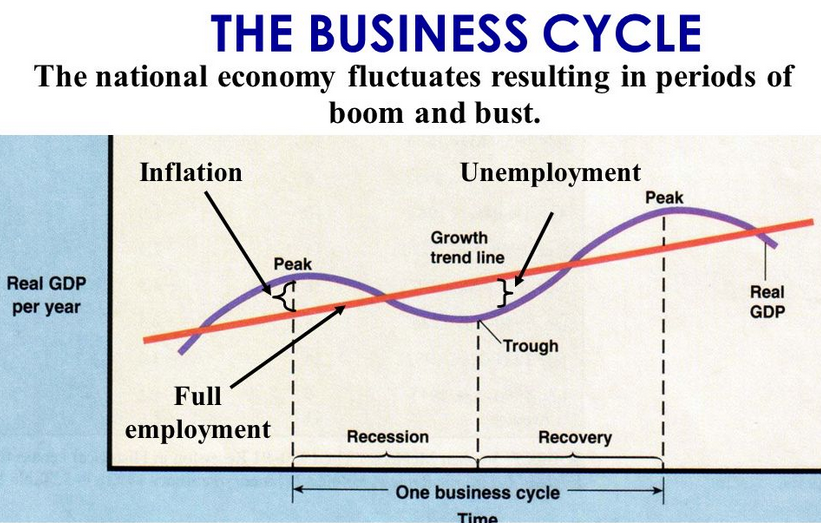
In Austrian business cycle theory, those signals matter. When central banks suppress rates, borrowing appears cheaper than it “should” be, which encourages projects that might not make sense under market-determined interest rates.
The business cycle. | Credit: Quizlet
Thornton calls these “malinvestments”, capital allocated not by profit-and-loss discipline, but by policy incentives and cheap credit.
Black Swan Risks and Systemic Contagion in Today’s Financial Markets
Thornton stresses that the hard part isn’t imagining risks; it’s predicting which risk breaks first. He describes a “flock of swans”, potential failure points created by the same underlying distortions. In that sense, the “black swan” is simply the first crack that reveals how widespread the imbalances really are.
Among the areas he flags:
Commercial real estate (CRE): Stress that may have been “rolled forward,” leaving refinancing and valuation risk unresolved.
Housing and residential real estate: A rapid shift from shortage narratives to signs of oversupply and weak tenant demand in some segments.
Private equity: Valuation opacity and delayed repricing risk because assets don’t trade continuously like public markets.
AI data centers and chip capex: Massive spending driven by narrative and cheap funding, with uncertain cash-flow outcomes.
Government debt: Rollover risk and investor concerns about inflation and currency depreciation over long horizons.
This is where his systemic risk argument becomes sharper: any one of these markets could be manageable in isolation, but in an environment built on leverage and correlated optimism, stress can spread. Thornton notes that “contagion” is a word policymakers prefer to avoid, yet it’s precisely what makes multi-asset bubbles dangerous.
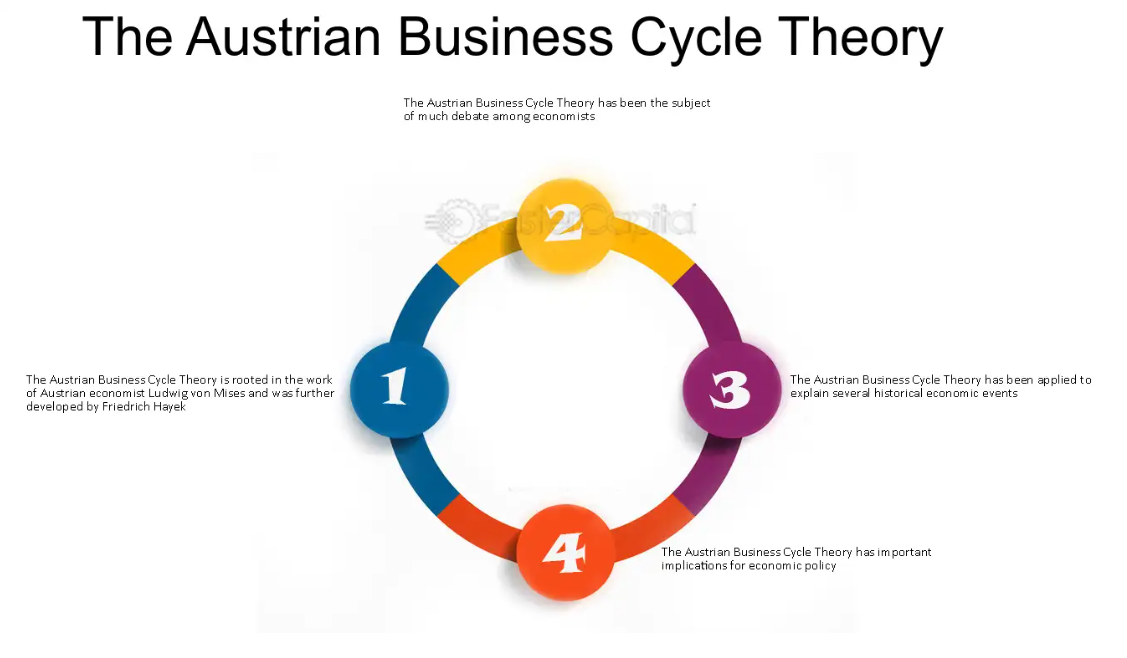
Austrian Business Cycle Theory: How Fed Rate Cuts Create Boom-Bust Cycles
In this view, central bank rate cuts inject money through credit markets. Lower rates encourage borrowing and discourage saving, creating a temporary “best of both worlds” illusion: more investment and more consumption at the same time.
The Austrian business cycle theory. | Credit: FasterCapital
Thornton argues that, in a free market, higher investment typically requires temporarily lower consumption and the reallocation of resources. Artificially low rates blur that tradeoff, producing the signature boom: rising asset prices, plentiful jobs, and widespread confidence.
Thornton describes a typical sequence:
Asset prices rise first (stocks, real estate, venture-style bets).
Commodities follow as demand expands and supply constraints appear.
Consumer prices rise as higher costs filter through.
Wages adjust last, often lagging behind living costs.
He argues the distributional effects are central: those closest to cheap credit benefit first, governments, large banks, and major corporations, while households face higher costs before their incomes catch up. Eventually, malinvestments show up as “clusters of errors,” producing concentrated waves of bankruptcies and stress rather than scattered, isolated failures.
Federal Reserve Policy Outlook for 2026 and Rising Inflation Risks
Looking ahead, Thornton expects a more dovish Federal Reserve posture, especially if political pressure rises to cut rates to support markets and growth. He argues that rate cuts are often presented as protection, proof that policymakers are “watching over” the economy, but history shows they don’t always stop downturns in stocks or credit.
More importantly, he says rate cuts plant the seeds of the next cycle by reintroducing the same distortions.
His main concern is credibility and feedback loops:
If inflation ticks up while rates fall, bond investors may demand higher yields.
Higher yields raise government borrowing costs, worsening deficits.
That can intensify calls for monetary accommodation, reinforcing the cycle.
This is where Thornton introduces the tail risk of hyperinflation. He calls it socially destructive and historically real, arguing that it is rarely intentional but can emerge when governments accumulate too much debt and feel trapped into printing money.
In his view, the U.S. is “on the on-ramp” if debt expansion continues and political leadership lacks the will to impose painful discipline.
Gold, Silver, Bitcoin and the Shift Toward Sound Money
Thornton interprets rising gold and silver prices as a signal of distrust in fiat systems. When the fiat price of gold becomes unstable, he argues, what you’re really seeing is instability in government policy: spending, borrowing, and money creation.
He suggests the precious metals bull market may still be early and points to a broader drift toward “sound money” behavior:
Institutions reintroducing gold allocations in portfolio guidance.
On Bitcoin, Thornton says it fits Austrian themes, scarcity, private issuance, resource-costly “mining”, but differs because it lacks intrinsic non-monetary use.
He suggests that if Bitcoin suffers a significant drawdown while metals rise, younger investors could rotate toward tokenized gold and silver, keeping crypto’s transfer advantages while anchoring value in commodities.
Why Fed-Driven Markets Face Growing Downside Risk
Thornton’s “everything bubble” warning is fundamentally a story about incentives. When money is cheap, debt is politically convenient, and intervention is expected, markets can look strong while becoming more brittle.
In that world, the most significant risk is not identifying a single catalyst; it’s recognizing that many assets may be priced for a stability that policy itself has undermined.
Whether one agrees with his Austrian diagnosis or not, his framework forces a practical question: if the system has been trained to depend on perpetual easing, what happens when the costs, inflation, debt, and misallocated capital start to overwhelm the benefits?
What does Mark Thornton mean by an “everything bubble”?
Thornton uses the term to describe a situation where multiple asset classes are simultaneously overextended, stocks, real estate, private equity, tech infrastructure, and even government debt, due to years of artificially low interest rates and monetary intervention.
Is this different from past bubbles like housing or dot-com?
Yes. Past bubbles were often concentrated in one sector. Thornton argues today’s risk is systemic, meaning distortions exist across many markets at once, increasing the chance of contagion when stress appears.
What role does the Federal Reserve play in this framework?
From an Austrian economics perspective, the Fed’s artificially low interest rates and liquidity injections distort price signals, encourage excessive borrowing, and push capital into projects that may not be viable under market-determined conditions.
Why does Thornton say the ‘black swan’ doesn’t really matter?
Because the specific trigger is less important than the underlying fragility. Any one stressed sector, real estate, private equity, AI capex, or government debt, could be the first to crack and expose broader imbalances.
Disclaimer:
The information provided in this article is for informational purposes only. It is not intended to be, nor should it be construed as, financial advice. We do not make any warranties regarding the completeness, reliability, or accuracy of this information. All investments involve risk, and past performance does not guarantee future results. We recommend consulting a financial advisor before making any investment decisions.
Giuseppe Ciccomascolo began his career as an investigative journalist in Italy, where he contributed to both local and national newspapers, focusing on various financial sectors.
Upon relocating to London, he worked as an analyst for Fitch's CapitalStructure and later as a Senior Reporter for Alliance News. In 2017, Giuseppe transitioned to covering cryptocurrency-related news, producing documentaries and articles on Bitcoin and other emerging digital currencies. He also played a pivotal role in establishing the academy for a cryptocurrency exchange website. Crypto remained his primary area of interest throughout his tenure as a writer for ThirdFloor.


 Easy
Easy