Home / Education / Crypto / Investing / Bitcoin Near $70,000: Peter Schiff Says Sell and Turn Crypto Into Gold via BitPay — Is the BTC Critic Quietly Warming Up to Crypto?
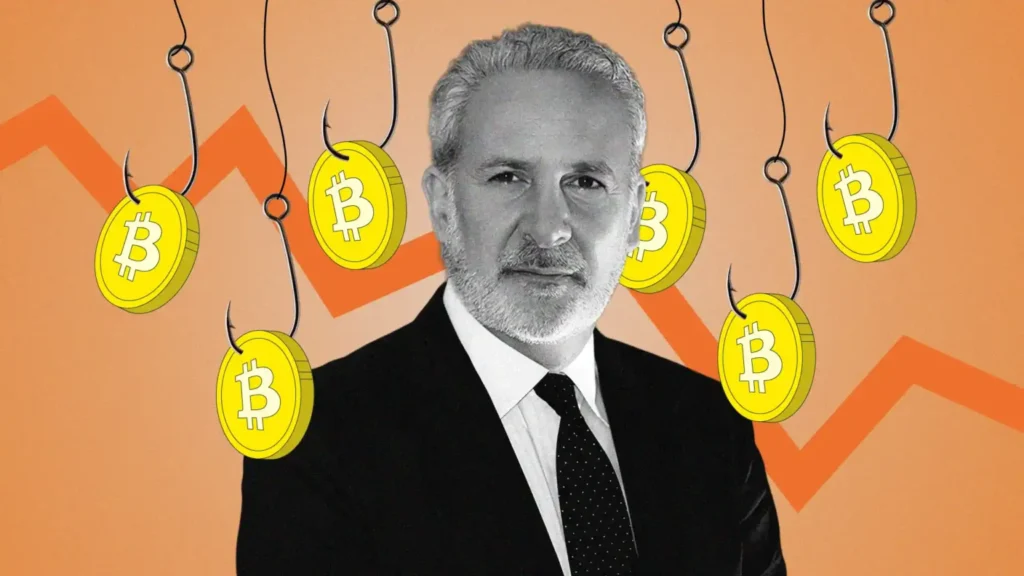
Peter Schiff suggest investors to sell Bitcoin and buy gold. Is he right? | Credit: CCN.com
Share
Key Takeaways
Peter Schiff says sell Bitcoin near $70,000 and convert gains into gold or silver
Schiff Gold accepts crypto via BitPay, but the Bitcoin is instantly converted to dollars.
The investor believes US debt and Fed policy are the real risks, not Bitcoin, and sees gold as the safer long-term hedge.
Despite being a longtime Bitcoin critic, Schiff is indirectly benefiting from crypto adoption by accepting BTC payments.
Bitcoin is once again approaching $70,000, and longtime crypto critic Peter Schiff has an immediate recommendation: sell.
In a recent post, Schiff wrote: “Bitcoin is getting close to $70,000 again. It’s a good opportunity to sell. You can kill two birds with one stone if you buy gold or silver at the same time. Just select BitPay when you check out at Schiff Gold.”
Bitcoin is getting close to $70,000 again. It’s a good opportunity to sell. You can kill two birds with one stone if you buy gold or silver at the same time. Just select BitPay when you check out at Schiff Gold. https://t.co/GGNU9tTHuo
For years, Schiff has been one of Bitcoin’s most vocal skeptics, consistently arguing that gold, not crypto, is the superior store of value. But his latest comments have sparked an interesting debate:
If Schiff is encouraging people to use Bitcoin to buy gold through BitPay, is he quietly warming up to crypto, or simply using it as a payment rail?
With Bitcoin nearing $70,000 again, Schiff sees it as a selling opportunity rather than validation of crypto’s long-term value.
His suggestion is straightforward: convert Bitcoin gains into gold or silver. Through his company, Schiff Gold, customers can pay using BitPay, a crypto payment processor, which converts Bitcoin into dollars before transferring funds to complete the metal purchase.
Schiff clarified: “We were one of the first companies to use BitPay. We never see any of the Bitcoin. It’s sold by BitPay, then the dollar proceeds are sent to Schiff Gold to pay for the metals purchased.”
In other words, Schiff Gold does not hold Bitcoin. The crypto is immediately liquidated.
This distinction matters.
What Is BitPay and Why Does It Matter?
BitPay is a crypto payment processor. It allows merchants to accept cryptocurrency without having to hold it.
For merchants concerned about volatility, this eliminates price risk.
So Schiff isn’t embracing Bitcoin as a store of value; he’s leveraging its liquidity.
From a business perspective, this makes sense. Bitcoin holders represent a pool of potential buyers. Accepting crypto expands the company’s customer base without requiring it to speculate on Bitcoin’s future.
But it also creates an ironic twist: a prominent Bitcoin critic benefits from Bitcoin’s ecosystem.
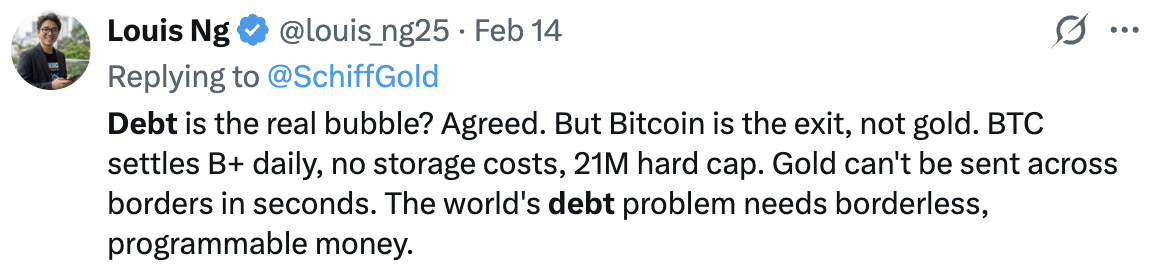
Schiff’s Bigger Warning: “Debt Is the Real Bubble”
Schiff’s latest comments are part of a broader macroeconomic thesis.
In this framework, Bitcoin is not a solution to monetary instability. Gold is.
Is debt the real bubble? | Credit: Louis NG X profile
Schiff recently claimed: “Gold is back above $5,000. In case you hadn’t noticed, gold doesn’t go that far below $5,000, and when it does, it doesn’t stay there very long. $5,000 is the new floor.”
Whether one agrees with his pricing outlook or not, the message is clear: he sees gold as structurally undervalued relative to global debt expansion.
To Schiff, Bitcoin rallies are speculative waves. Gold rallies reflect monetary reality.
Is Schiff Softening on Crypto?
This is where things get interesting.
On the surface, Schiff remains deeply critical of Bitcoin’s long-term viability. He continues to describe it as lacking intrinsic value and failing as a true inflation hedge.
These positions suggest a nuanced stance: Schiff may not believe in Bitcoin as money, but he recognizes it as an asset class with buyers.
That’s different from outright dismissal.
In earlier years, Schiff often framed Bitcoin as destined for collapse. Today, his tone appears more tactical. Rather than predicting imminent failure, he positions it as an asset to trade, then exit.
Schiff’s strategy reflects capital preservation. Bitcoin investors often seek asymmetric upside.
Can Both Gold and Bitcoin Co-exist?
An important point often overlooked in this debate: Gold and Bitcoin are not mutually exclusive.
Some institutional investors now allocate to both:
Gold for macro stability.
Bitcoin for growth exposure.
Even some former Bitcoin critics now acknowledge that digital assets may function as “digital gold” in certain scenarios, though Schiff himself rejects that comparison.
But the existence of crypto payment rails at Schiff Gold highlights a broader reality: financial ecosystems adapt.
It’s not necessary to believe in Bitcoin’s long-term dominance to monetize its current popularity.
Bitcoin’s Growing Acceptance in Traditional Finance
Perhaps the most interesting development isn’t Schiff’s price call.
A decade ago, a gold dealer publicly integrating crypto payments would have seemed contradictory.
Today, it’s pragmatic.
Schiff may not be warming up to crypto philosophically. But he is operating within a financial world where crypto is too large to ignore.
And that, in itself, says something about Bitcoin’s staying power.
Peter Schiff’s latest message is consistent with his worldview:
Sell Bitcoin near $70,000. Buy gold near $5,000. Prepare for a debt-driven reckoning.
But beneath the rhetoric lies a subtle evolution.
Bitcoin is no longer dismissed as fringe. It is treated as liquid capital. It is integrated into mainstream commerce. And it is acknowledged, even by critics, as financially relevant.
Whether Bitcoin ultimately outperforms gold or not remains to be seen. But the fact that one of its most persistent critics now actively facilitates crypto transactions, even indirectly, highlights a broader truth: in modern markets, skepticism and participation are no longer mutually exclusive.
Why is Peter Schiff telling people to sell Bitcoin near $70,000?
Schiff believes Bitcoin is a speculative asset and sees price rallies as opportunities to exit. He argues investors should convert gains into gold or silver, which he views as safer long-term stores of value.
Is Peter Schiff accepting Bitcoin now?
Not exactly. Schiff Gold accepts payments through BitPay, which immediately converts Bitcoin into US dollars. Schiff Gold does not hold Bitcoin on its balance sheet.
What is BitPay?
BitPay is a crypto payment processor. It allows businesses to accept cryptocurrency while automatically converting it into traditional currency to avoid volatility risk.
Does using BitPay mean Schiff supports Bitcoin?
No. It means he recognizes Bitcoin holders as potential customers. Accepting crypto payments expands his market reach without requiring him to believe in Bitcoin as an investment.
Disclaimer:
The information provided in this article is for informational purposes only. It is not intended to be, nor should it be construed as, financial advice. We do not make any warranties regarding the completeness, reliability, or accuracy of this information. All investments involve risk, and past performance does not guarantee future results. We recommend consulting a financial advisor before making any investment decisions.
Giuseppe Ciccomascolo began his career as an investigative journalist in Italy, where he contributed to both local and national newspapers, focusing on various financial sectors.
Upon relocating to London, he worked as an analyst for Fitch's CapitalStructure and later as a Senior Reporter for Alliance News. In 2017, Giuseppe transitioned to covering cryptocurrency-related news, producing documentaries and articles on Bitcoin and other emerging digital currencies. He also played a pivotal role in establishing the academy for a cryptocurrency exchange website. Crypto remained his primary area of interest throughout his tenure as a writer for ThirdFloor.


 Easy
Easy