America Is Drowning in Debt — Is Crypto Becoming the Plan B?
Share
Key Takeaways
U.S. debt is soaring, and interest costs are compounding daily.
Crypto isn’t a cure-all, but it can reduce payment friction, settlement times, and tax reporting.
Tokenized Treasuries can expand investments into a 24/7, global buyer base to bring in liquidity.
Operational risks mean public entities should focus on simple solutions (stablecoins, Bitcoin) over complex ones (decentralized finance).
America’s debt burden is accelerating at a pace that is hard to ignore. The federal deficit is approaching $1.8 trillion, and higher interest rates are pushing the cost of servicing national debt further upward.
The United States added $1 trillion in new debt in just two months in 2025, pushing the total to roughly $38 trillion. As interest payments alone reach about $1.2 trillion annually, or more than $3 billion per day, the financial strain compounds quickly.
In this environment, policymakers, institutions, and investors are assessing alternative tools that can ease the pressure, not replace traditional finance, but strengthen it. Cryptocurrency and blockchain-based financial instruments are increasingly being discussed as part of that toolkit. While digital assets cannot erase debt, they can improve liquidity access, speed up settlement cycles, expand the investor base for U.S. securities, and reduce friction in payments and tax compliance.
Tokenized Treasuries, stablecoin settlement networks, and regulated Bitcoin and Ethereum ETFs are examples of how crypto infrastructure has moved from speculative fringe to functional financial plumbing. The core idea is not that crypto “fixes” the debt crisis; it’s that incremental gains matter, especially when compounded over trillions of dollars.
These efficiencies do not solve the federal budget imbalance, but they can make the system run faster, cheaper, and more globally accessible, helping to stabilize the balance sheet at the margins. This makes crypto less of a rebellion against the system and more of a gradual upgrade to it.
US National Debt Surpasses $38 Trillion in 2025: Key Figures and Economic Impact
The United States gross national debt number is pretty straightforward: $38 trillion as of late October 2025. $1 trillion of that debt was added in the last two months alone, considering the US hit $37 trillion in August 2025, according to PBS, which pulled these numbers from the latest Treasury Department report.
Just as notable is the flow into debt. From July to September 2025, the Treasury reported $1.058 trillion in privately-held net marketable debt, ending the quarter with an $891 million balance. The department estimated $1.007 trillion back in July, but realized the figure was higher due to a larger ending balance and debt flows it didn’t account for.
Overall, the monthly Treasury statement shows the financial year 2025’s deficit at $1.8 trillion, according to a reading from the Committee for a Responsible Federal Budget.
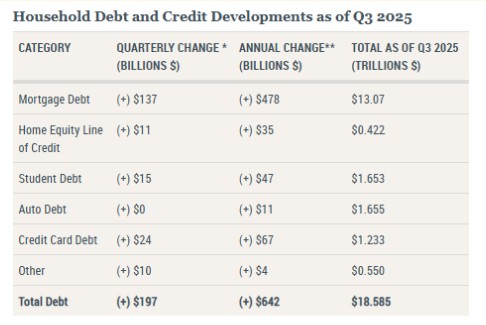
For reference, that $1.058 trillion borrowed in a single quarter is similar to that of all U.S. credit-card balances, which totaled $1.23 trillion in quarter 3. Different balance sheets, but the comparison helps you understand the scale at which federal debt is growing.
Source: Federal Reserve Bank of New York
As for interest on that money borrowed, the report details about $1.2 trillion. For reference, that’s about $3 billion per day piled on top of existing debt.
New Trending Crypto Wallet Offers
Sponsored
Disclosure
We sometimes use affiliate links in our content, when clicking on those we might receive a commission at no extra cost to you. By using this website you agree to our terms and conditions and privacy policy.
How Crypto and Bitcoin Can Serve as a Strategic Plan B for Government Debt Management
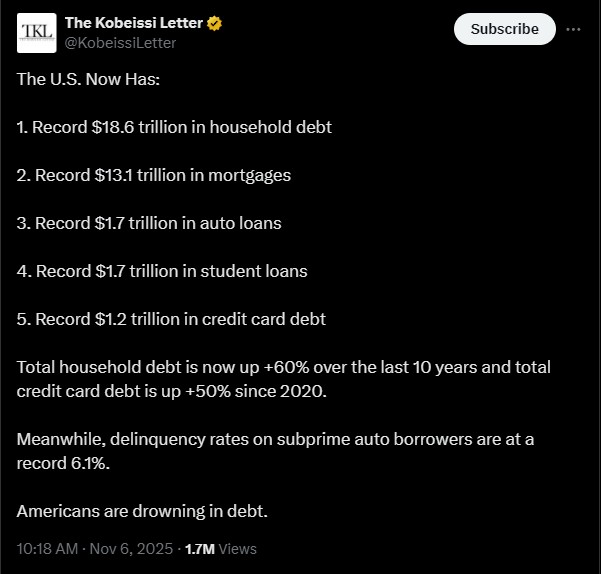
Two factors contribute to crypto working as a reliable plan B, assuming one understands that digital assets will not erase debt, but can provide a bit of life support: availability (governmental entities can actually use it) and scale (proven assets that solve real problems).
Source: @KobeissiLetter
Availability
Meeting traders where they are: Regulated exchange-traded fund (ETF) access due to developments like the SEC approving the listing and trading of spot Bitcoin allows for exposure to Bitcoin without holding the underlying asset. Ethereum ETFs are now seeing some interest as well, with more cryptocurrencies potentially on their way.
Aside from allowing exposure without direct investment, ETFs are also available where an investor’s other financial instruments exist: on brokerage apps like Fidelity, where these investors already hold S&P 500 or other funds.
Global reach: On-chain liquidity, otherwise known as tokenized funds, involves wrapping Treasuries into on-chain shares that operate 24/7. Near-immediate settlements and constant availability expand investment opportunities to a global scale. Tokenized funds also allow for fractional holdings of a fund and their use as collateral on decentralized finance (DeFi) platforms. Essentially, a broader, always-on base can increase demand and contribute to bringing down debt, if ever so slightly.
Scale
Companies like BlackRock are holding Bitcoin and other cryptocurrencies at scale. BlackRock’s iShares Bitcoin Trust (IBIT) holds around $80 billion in assets as of November 7, 2025. Meanwhile, stablecoins could generate additional dollar demand, up to $1.4 trillion by 2027, JPMorgan predicts.
Stablecoins allow for practical financial improvements like lower transaction costs and faster transfers, especially cross-border, regardless of bank hours or holidays. Government vendors and aid programs can settle payments in reliable, dollar-backed tokens with near-instant finality. Lower fees can add up to save quite a few chunks of change, especially when it comes to interest.
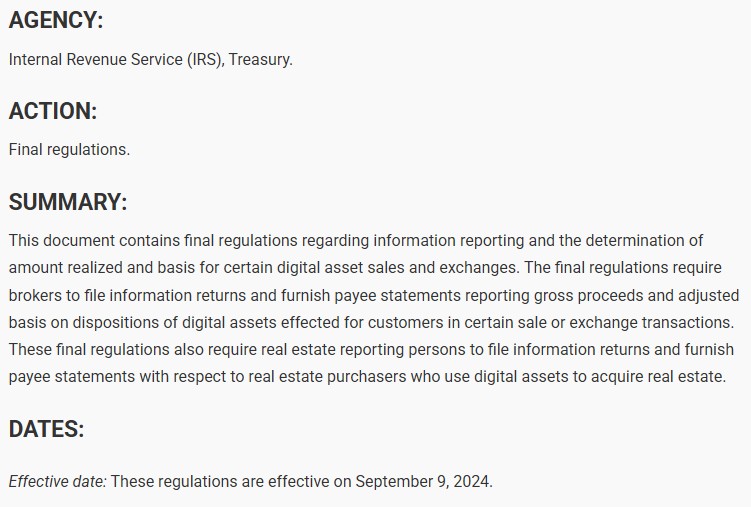
A byproduct of such popularity is better tax reporting. In June 2024, the IRS finalized tax reporting by brokers on sales and exchanges of cryptocurrencies, starting in 2025. A unified reporting method boosts compliance and accurate payments, meaning billions the government collects.
Source: The Federal Register
Basically, the math driving up Washington’s balance sheet is brutal. Higher rates push up interest costs, which expand deficits and cause entities to print more money. Printing more money means inflating the dollar. This feedback loop, also known as a “debt doom spiral,” doesn’t guarantee a financial crisis, but it certainly adds to the spending struggle.
Anything that widens the investor base, cuts transaction friction, or improves tax collection can help with governmental margins. Crypto’s promise is not a catch-all solution, but incremental relief through better funding avenues and expanded demand.
Latest Macro and Crypto Market Conditions Strengthening Crypto as the “Plan B” Case
The fiscal pressure on the United States is mounting at a faster pace than in prior tightening cycles. Projections from the Congressional Budget Office show the federal deficit nearing $1.9 trillion for FY 2025, with public debt on track to climb toward 118% of GDP within the next decade. Debt service is now a central budget cost: higher interest rates mean a growing share of federal spending goes not to programs, but simply to paying interest on past borrowing.
At the same time, the composition of U.S. debt buyers is changing. Treasury International Capital reports indicate that while foreign investors still hold a large share of U.S. government bonds, their participation has gradually declined over the past ten years. Major holders such as China and Japan have reduced their Treasury exposure as they prioritize domestic currency stability and reserve diversification. This shift increases reliance on domestic buyers and short-term funding markets, tightening the system’s liquidity profile.
Meanwhile, the crypto market has experienced a structural shift of its own. Institutional participation has accelerated sharply: U.S. spot crypto ETFs drew over $29 billion in net inflows through August 2025, and single-day flows have recently exceeded $400 million.
Total crypto fund assets under management reached $167 billion in mid-2025, marking the strongest sustained institutional accumulation period outside of bull-market speculation. These inflows reflect a market treating digital assets not as fringe instruments, but as allocable, portfolio-level exposure.
The global liquidity environment makes this intersection notable. When traditional capital channels become more expensive to operate — due to higher interest costs and tighter dollar availability — any system that enables faster settlement, broader access, or lower friction becomes valuable at the margins. Crypto’s role is therefore not to replace the U.S. bond market, but to offer new rails through which capital can move more efficiently.
The macro backdrop is becoming more strained just as crypto infrastructure is maturing. This timing is what makes the “Plan B” framework increasingly relevant.
Key Risks and Limitations of Using Cryptocurrency as a Financial Backstop
Of course, no solution is without its downsides:
Volatility: Bitcoin is a limited, volatile asset, at least for now. Allocators using it as a “plan B” must size positions accordingly and prepare for surprise downturns.
Regulatory risk: While regulations seem to point in crypto’s favor as of late, the rules are in an early enough state that they can swing at any time. Clear, durable protections matter most.
Operational risk: Cross-chain technology like bridges, and clear, secure custody remain the Achilles’ heel of on-chain finance, especially when it comes to DeFi. Should governmental crypto investments extend beyond Bitcoin and stablecoins, proper DeFi policies will matter.
Crypto as an Incremental Upgrade to the Financial System, Not a Complete Debt Solution
Crypto has moved from fringe to mainstream: regulated ETFs, institutional-grade custody, and compliant reporting have become the norm. That said, America’s debt problem won’t be solved by Bitcoin or blockchains, but crypto can attract global capital, tighten up settlement cycles, and shave costs that compound over time.
Digital assets are not America’s miracle, but that’s what can make them a reliable plan B. They’re real, with pros and cons and struggles to work through.
Interestingly, this stance also makes crypto less of a hedge against the system and more of an upgrade to it.
FAQs
Does weekend, on-chain settlement really help that much?
Yes. Paying vendors or moving funds instantly, especially when it comes to international payments, can reduce banking fees and bring more spending money into the picture.
Will new IRS crypto rules make filing taxes easier or harder?
Easier for most people. Brokers should be sending standardized forms with your trade information.
Are crypto payments cheaper than bank wires for small amounts?
Often, yes. Especially across borders, though fees vary by network and wallet.
Could the government pay vendors with stablecoins?
Yes, in theory. If rules allow it and the stablecoins meet strict reserve and compliance standards.
Disclaimer:
The information provided in this article is for informational purposes only. It is not intended to be, nor should it be construed as, financial advice. We do not make any warranties regarding the completeness, reliability, or accuracy of this information. All investments involve risk, and past performance does not guarantee future results. We recommend consulting a financial advisor before making any investment decisions.
Max Moeller is a Chicago‑based writer and video editor passionate about games, tech, and crypto. Whether it’s crafting clear, insightful articles or piecing together engaging video retrospectives, he’s driven by curiosity and takes pride in keeping things human. Since 2017, Max has been published in a variety of notable crypto magazines.


 Easy
Easy