Home / Education / Crypto / Investing / Bitcoin $250K Price Prediction Faces ‘Sell in May’ Pressure as Analysts Warn of Deeper Decline: What Comes Next for BTC
Bitcoin climbs above $63,000 after a sharp rebound from June lows. Can BTC break the $67K resistance as ETF flows and macro sentiment improve? | Credit: CCN.com
Share
Key Takeaways
Veteran trader Peter Brandt and others warn current price structure does not yet support a major bullish breakout .
Bitcoin is trading in a channel pattern, typically associated with consolidation, not a strong bottoming formation .
Historical midterm election years saw BTC drawdowns of over 60%, raising concerns for 2026 .
High interest rates, a strong US dollar, and rising yields continue to pressure risk assets, including Bitcoin .
Bitcoin’s long-term narrative remains one of exponential upside, but in the near term, cracks are beginning to emerge.
As predictions calling for $250,000 BTC in 2026 continue to circulate, a growing number of analysts are pushing back, warning that macroeconomic pressure, seasonal patterns, and weakening technical signals could trigger a deeper correction before any sustained rally resumes.
From veteran trader Peter Brandt’s skepticism to renewed attention on the ‘Sell in May’ phenomenon, the market is entering a critical phase. The question is no longer just how high Bitcoin can go, but whether it must be corrected first.
Bitcoin $250K Price Prediction vs Reality: Are Bullish Targets Overstated?
Ambitious price targets are nothing new in crypto cycles. The idea that Bitcoin could reach $250,000 by 2026 is largely rooted in historical halving cycles, accelerating institutional adoption, and long-term scarcity dynamics.
However, not all analysts are convinced that the current setup supports such a trajectory, at least not yet.
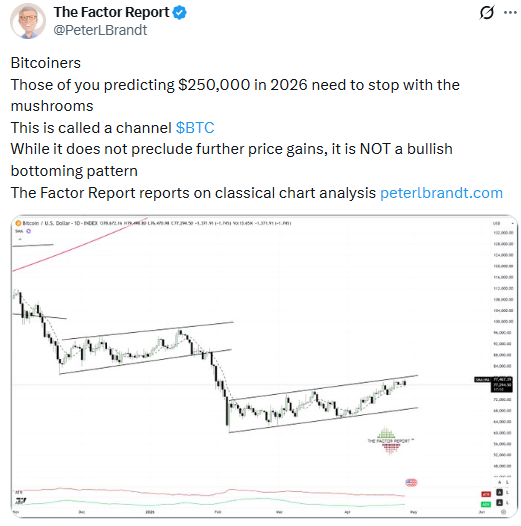
Veteran trader Peter Brandt dismissed these forecasts in blunt terms, warning that market participants may be misreading the current structure. According to Brandt, Bitcoin is trading within a channel pattern, rather than forming a classic bullish reversal.
Brandt says $250,000 is an impossible target for this year. | Credit: The Factor Report X profile
This distinction is critical. While channels can support gradual upward movement, they do not inherently signal explosive upside. In technical analysis, true bottoming formations, such as double bottoms or inverse head-and-shoulders patterns, typically precede strong breakouts.
Channels, by contrast, often suggest consolidation and can just as easily resolve to the downside.
Brandt’s takeaway is straightforward: further upside is possible, but far from assured.
‘Sell in May’ Bitcoin Strategy: Does BTC Crash in Midterm Election Years?
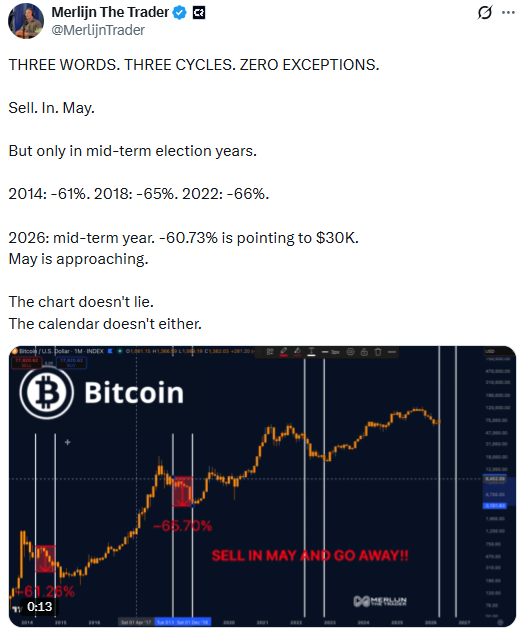
Adding to the cautious tone is the resurgence of a well-known market adage: ‘Sell in May and go away.’ Traditionally applied to equities, some traders argue that Bitcoin has exhibited similar seasonal weakness, particularly during US midterm election years.
Analysts suggest to sell in May. | Credit: Merlijn The Trader X profile
Each of these sharp drawdowns occurred during midterm years, raising concerns that 2026 could follow a comparable path. Based on this historical precedent, some projections suggest Bitcoin could decline by as much as 60%, potentially revisiting the $30,000 range.
While such forecasts may appear extreme, they highlight a broader reality: seasonality and macro cycles are playing an increasingly important role in crypto price action.
How US Midterm Elections Impact Bitcoin and Crypto Markets
To fully understand the ‘Sell in May’ thesis, it’s essential to zoom out and examine the broader macro backdrop, particularly the influence of US midterm elections.
Historically, markets tend to exhibit three key characteristics during midterm years:
Stronger rallies closer to and after the election period.
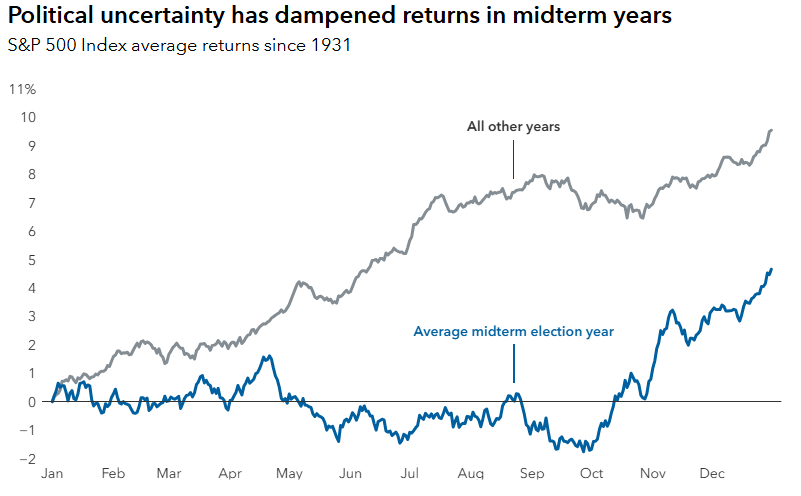
Data spanning more than 90 years shows that equities often struggle early in midterm years, as uncertainty around policy direction and political control weighs on sentiment.
Politcal uncertainty has dampened returns in midterm years. | Credit: Capital Group
Crypto markets, while structurally different, are increasingly tied to these same forces. As Bitcoin becomes more embedded in institutional portfolios, particularly through ETFs, it is growing more sensitive to traditional macro drivers.
These include interest rates, inflation expectations, and geopolitical risk.
Bitcoin Price Outlook: How Interest Rates, Fed Policy, and the Dollar Affect BTC
At the core of Bitcoin’s current outlook is monetary policy.
Bitfinex analysts expect the US Federal Reserve to hold rates in the 3.50%-3.75% range, reflecting a cautious stance as inflation remains sticky and geopolitical risks persist. While a rate hold may appear neutral, the real impact lies in the Fed’s forward guidance.
A hawkish hold, where policymakers signal rates will stay higher for longer, could trigger a cascade of effects:
This transmission mechanism is increasingly important. Bitcoin’s price is now heavily influenced by ETF demand and exchange liquidity, both of which are sensitive to macro conditions.
Under a hawkish scenario, Bitcoin could remain capped near key resistance levels, particularly around the $72,000 zone, where recent rallies have stalled.
Conversely, a dovish shift, hinting at future rate cuts, could revive risk appetite, potentially opening a move toward the $80,000-$84,000 resistance band.
Bitcoin ETF Flows and Institutional Demand: Are Investors Pulling Back?
Recent data suggests institutional sentiment may already be softening.
Bitcoin ETFs recorded $263 million in outflows, marking the first negative flow in two weeks. While not yet a sustained trend, the shift is notable given the central role ETFs now play in driving demand.
ETF flows act as a real-time gauge of institutional conviction. Strong inflows provide consistent support for price, while outflows can quickly weaken momentum.
Recent tensions, including stalled negotiations between the US and Iran, have increased the risk of prolonged instability in the Middle East. In such environments, capital tends to rotate toward traditional safe havens like gold and the US dollar, often at the expense of risk assets like Bitcoin.
At the same time, global central banks face increasingly complex trade-offs:
The Bank of Japan has hinted at potential tightening.
Inflation remains persistent across major economies.
Energy markets remain volatile amid geopolitical disruptions.
Together, these factors create a challenging backdrop for Bitcoin, which typically performs best in liquidity-rich, risk-on environments.
Key Bitcoin Price Levels to Watch: $72K Resistance and $30K Downside Risk
$72,000: Immediate resistance tied to recent price squeezes.
$80,000-$84,000: A major resistance cluster requiring strong inflows to break.
$30,000-$40,000: A potential downside zone in a severe correction scenario.
The channel structure identified by Brandt suggests that Bitcoin may continue to trade within a defined range, unless a decisive breakout or breakdown shifts the trend.
Will Bitcoin Crash Again? Comparing Current Market to Past BTC Corrections
While bearish narratives are gaining traction, it is important to maintain context.
Bitcoin has historically undergone multiple drawdowns exceeding 50% within broader bull cycles. These corrections, while significant, have often served as resets that ultimately paved the way for new highs.
The current environment shares several similarities with previous cycles:
Elevated expectations following strong rallies
Macro tightening constraining liquidity
Growing institutional participation
However, it also differs in meaningful ways, particularly the influence of ETFs and the increasing maturity of the market.
Bitcoin Price Forecast 2026: What Factors Will Drive the Next Move?
Looking ahead, Bitcoin’s direction will likely hinge on three core factors:
Monetary policy direction: A shift toward dovish policy could unlock further upside, while prolonged tightening may suppress price action or trigger corrections.
ETF flow dynamics: Sustained inflows remain critical for maintaining bullish momentum. Continued outflows would signal weakening institutional demand.
Macro and geopolitical stability: Easing geopolitical tensions and clearer global growth signals could improve overall risk sentiment.
However, the $250,000 Bitcoin narrative is not invalid, but it may be premature.
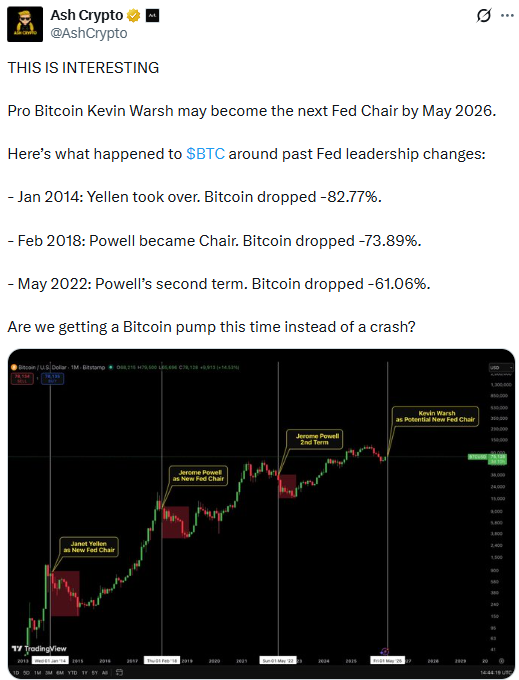
How will Bitcoin react to the next Fed chair appointment? | Credit: Ash Crypto X profile
In the near term, a combination of technical caution, seasonal patterns, and macro headwinds is creating a more fragile market environment. The re-emergence of the ‘Sell in May’ thesis, combined with midterm election uncertainty, suggests that volatility could intensify in the months ahead.
For investors, the key is balance. While long-term fundamentals remain intact, the path forward is unlikely to be smooth or linear.
Bitcoin may still reach new highs, but first, it may need to endure another period of stress.
Bitcoin at a Turning Point: Macro Trends Reshaping the Crypto Market
What makes this moment particularly significant is that Bitcoin is no longer a fringe asset operating outside the global financial system. It now sits at the intersection of macro policy, institutional capital flows, and geopolitical risk, a position that amplifies both its upside potential and its downside exposure.
This evolution means that simple cycle-based predictions, such as extrapolating past bull runs to justify a $250,000 target, may no longer be sufficient. Today’s Bitcoin market is shaped as much by Federal Reserve policy and bond yields as it is by halvings and on-chain data.
At the same time, skepticism from experienced traders like Peter Brandt highlights an enduring truth: market structure still matters.
Technical patterns, liquidity zones, and positioning can override even the most compelling narratives in the short term.
Bitcoin Strategy 2026: How to Navigate Volatility, ETF Flows, and Macro Risks
For traders and investors, the coming months may require a more disciplined and flexible approach:
Expect volatility: Midterm dynamics, macro uncertainty, and seasonal trends could drive sharp swings in both directions.
Monitor liquidity signals: ETF flows, exchange reserves, and dollar strength will likely act as leading indicators.
Remain narrative-agnostic: Both bullish and bearish outcomes remain plausible depending on how macro conditions evolve.
Rather than a straight trajectory toward $250,000, Bitcoin’s path may unfold as a series of expansions and contractions, shaped by forces that extend far beyond the crypto ecosystem.
While some analysts believe Bitcoin could reach $250,000 based on historical cycles and institutional adoption, others argue the current market structure and macro conditions do not yet support such aggressive targets. The timeline may be longer than expected.
What does ‘Sell in May’ mean for Bitcoin?
‘Sell in May’ is a traditional market strategy suggesting weaker performance during summer months. Some analysts claim Bitcoin has followed similar patterns in US midterm election years, with past cycles showing significant declines during this period.
Why are midterm election years important for Bitcoin?
Midterm years tend to bring higher volatility and weaker returns early in the year due to political uncertainty. As Bitcoin becomes more correlated with traditional markets, these macro trends are increasingly influencing crypto price action.
How do interest rates affect Bitcoin prices?
Higher interest rates typically strengthen the US dollar and increase bond yields, making risk assets like Bitcoin less attractive. Lower rates, on the other hand, tend to boost liquidity and support crypto prices.
Disclaimer:
The information provided in this article is for informational purposes only. It is not intended to be, nor should it be construed as, financial advice. We do not make any warranties regarding the completeness, reliability, or accuracy of this information. All investments involve risk, and past performance does not guarantee future results. We recommend consulting a financial advisor before making any investment decisions.
Giuseppe Ciccomascolo began his career as an investigative journalist in Italy, where he contributed to both local and national newspapers, focusing on various financial sectors.
Upon relocating to London, he worked as an analyst for Fitch's CapitalStructure and later as a Senior Reporter for Alliance News. In 2017, Giuseppe transitioned to covering cryptocurrency-related news, producing documentaries and articles on Bitcoin and other emerging digital currencies. He also played a pivotal role in establishing the academy for a cryptocurrency exchange website. Crypto remained his primary area of interest throughout his tenure as a writer for ThirdFloor.


 Easy
Easy