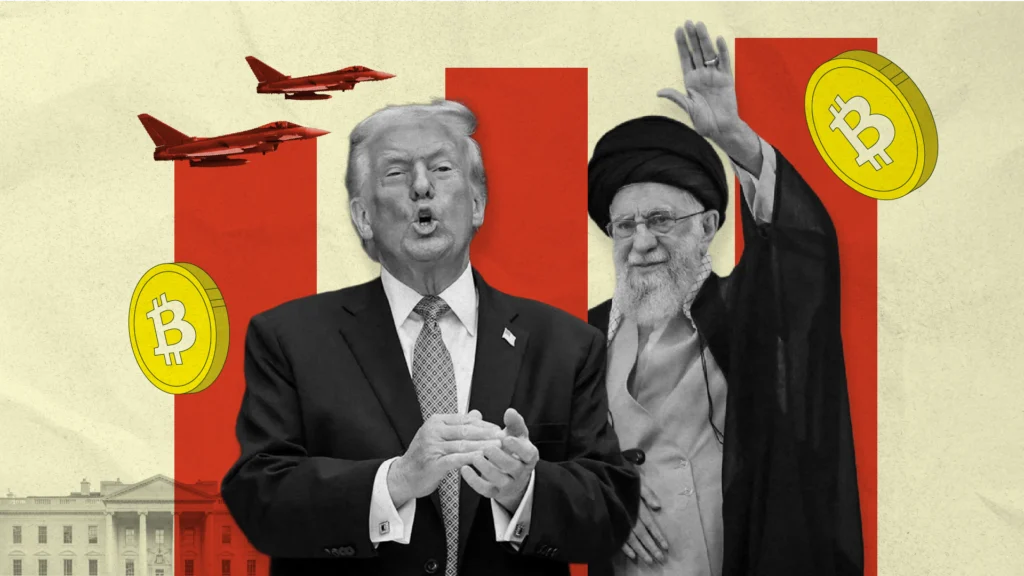
Bitcoin has defied expectations during the latest Middle East conflict, rising alongside heightened geopolitical tensions in a move that some leading industry heads say could reshape how the crypto is valued.
Bitwise Chief Investment Officer Matt Hougan, who previously said Bitcoin could reach $1 million, claimed the tensions in Iran were showing how Bitcoin is beginning to offer a dual-use role.
Sponsored
Disclosure
We sometimes use affiliate links in our content, when clicking on those we might receive a commission at no extra cost to you. By using this website you agree to our terms and conditions and privacy policy.
Since US and Israeli airstrikes began on Feb. 28, Bitcoin has climbed about 12%, outpacing both traditional safe havens and risk assets.
Over the same period, the S&P 500 has edged down roughly 1% while gold has fallen around 10%, according to market data cited by Bitwise Chief Investment Officer Matt Hougan.
The stark divergence has challenged the long-held view that Bitcoin behaves primarily as a high-risk asset that should decline during geopolitical shocks.
Hougan argued that Bitcoin’s recent strength is not incidental.
In a post on X, he said investors are effectively making “two bets” when buying Bitcoin — one that it will mature into a digital store of value competing with gold, and another that it could eventually function as an apolitical currency.
While the “digital gold” narrative has dominated in recent years, Hougan said the second use case is gaining credibility as global financial systems become increasingly fragmented.
He pointed to the growing weaponization of financial infrastructure, including the removal of Russia from the SWIFT network in 2022.
“I mused at the time that the weaponization of SWIFT might one day open up space for bitcoin: If countries grew reluctant to deal in dollars, it stood to reason that they might prefer an apolitical alternative at some point,” he wrote.
Adding: “And indeed, during the Iran conflict, we saw one of the earliest (and more uncomfortable) examples of this happening,” referencing reports of Iran collecting oil transit fees in Bitcoin through the Strait of Hormuz.
He likened Bitcoin’s potential role as a currency to an “out-of-the-money call option” that gains value as both the likelihood of adoption and global financial volatility increase.
The $1 Million Thesis
Hougan has separately argued that Bitcoin could reach $1 million per coin within the next decade, primarily through its role as a store-of-value asset.
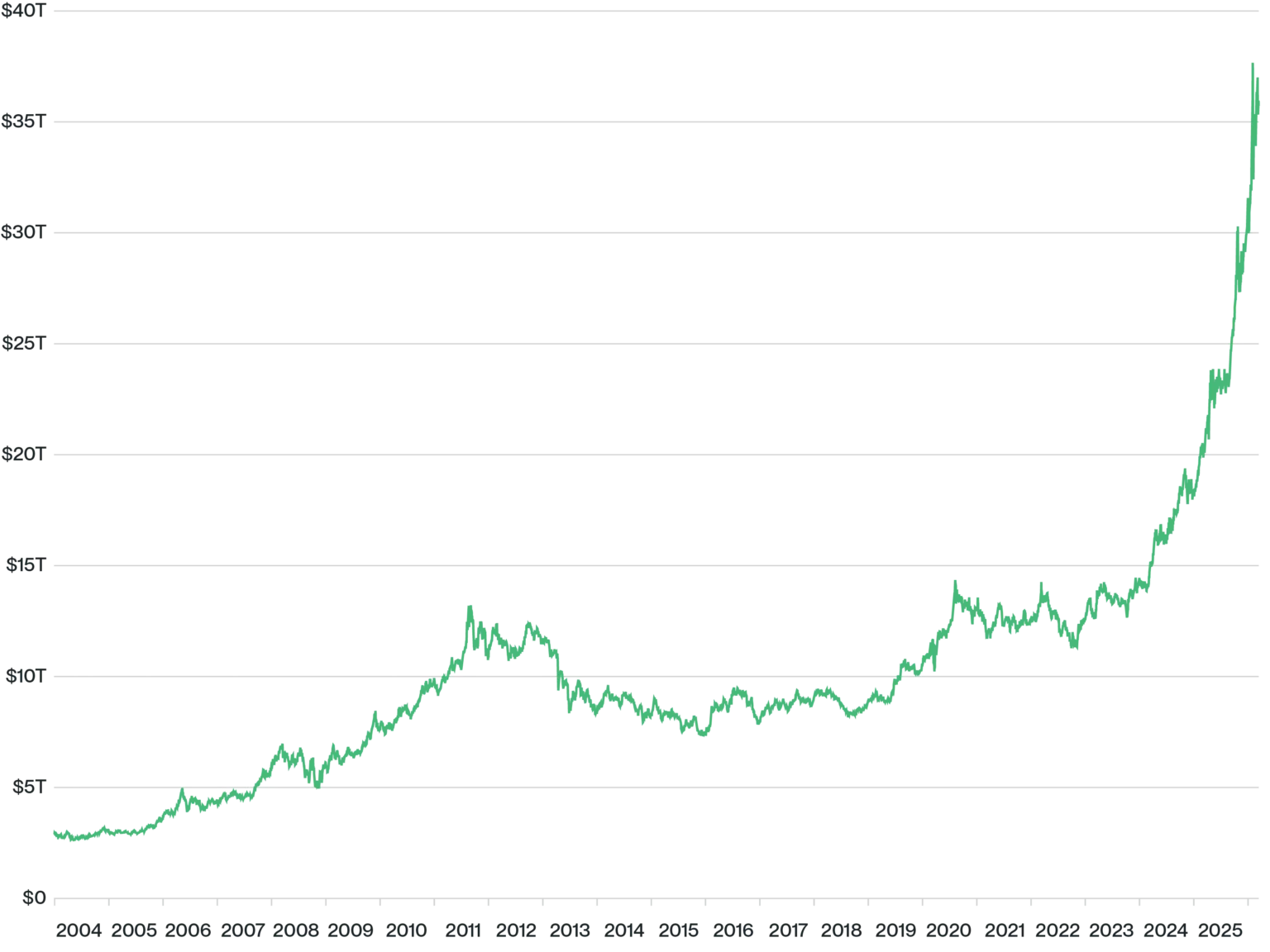
The CIO’s framework, outlined in March, compared Bitcoin to gold within a global store-of-value market currently estimated at roughly $38 trillion.
Rather than assuming Bitcoin must displace gold entirely, Hougan’s model factors in growth of the overall market itself.
He noted that gold’s market capitalization has expanded significantly over the past two decades and could continue to do so.
Gold market cap | Source: Bitwise Asset Management with data from World Gold Council and Bloomberg.
If the total store-of-value market were to grow substantially over the next decade, Bitcoin would only need to capture a modest share—around one-sixth—to reach the $1 million price level.
The thesis is supported by increasing institutional adoption, including the rise of Bitcoin exchange-traded funds and broader portfolio allocations from large investors.
Hougan said improving liquidity and declining volatility have also made Bitcoin more viable for professional portfolios.
Iran’s Strait of Hormuz Bitcoin Proposal
Developments around the Strait of Hormuz could provide a tangible test of Bitcoin’s emerging “currency” use case.
Iran has indicated it may impose a fee of about $1 per barrel on oil shipments passing through the strait, one of the world’s most critical energy chokepoints, handling roughly 20% of global oil flows.
Based on pre-conflict volumes, such a toll could generate around $20 million per day.
Hormuz just made Bitcoin easier to understand.
A $1 per barrel toll on pre-war Hormuz flows would generate about $20 million a day.
At current prices, that would translate to roughly 280 Bitcoin daily—compared with about 450 BTC newly issued each day by the network.
That implies a single geopolitical bottleneck could theoretically absorb a significant share of Bitcoin’s new supply.
However, significant hurdles remain, including transaction speed worries and Bitcoin’s price volatility.
Bitcoin’s Iran Watershed Moment?
Some crypto analysts have echoed Iran’s reported proposal as a broader shift in how Bitcoin is being viewed and adopted.
Crypto author Jesse Tevelow said the significance of even being considered in the first place is enough, regardless of whether it ever gets implemented.
“Whether this proposal ultimately materializes or not is secondary. The signal itself is what matters,” Tevelow wrote on X.
Iran demanding payment in BTC is a watershed moment for Bitcoin as a global reserve asset. https://t.co/Agbo311fAd
Tevelow described Bitcoin as a “neutral, permissionless settlement layer” operating outside traditional geopolitical structures.
That positioning, he said, could make it more attractive than both fiat-based systems and centrally issued digital currencies in regions facing political pressure.
“If even a fraction of this proposal were to be implemented, it would mark the first time Bitcoin is explicitly positioned as a tool for resolving — or at least navigating — a global conflict,” he said.
Kurt Robson is a London-based reporter at CCN, specialising in the fast-moving worlds of crypto and emerging technology. He began his career covering local news in Cornwall after graduating from Falmouth University with First Class Honours in Journalism. There, he cut his teeth on everything from council meetings to missing swans.
He quickly rose through the ranks to become a frontline journalist at several of the UK’s leading national newspapers. Over the years, he has interviewed musicians and celebrities, reported from courtrooms and crime scenes, and secured multiple front-page exclusives.
Following the upheaval of the COVID-19 pandemic, Kurt shifted his focus to technology journalism—just ahead of the AI boom. With a natural curiosity and a trained eye for emerging trends, he has found a new rhythm in reporting on innovation.
At CCN, Kurt's work focuses on the cutting edge of crypto, blockchain, AI, and the evolving digital world. Drawing on his background in people-first reporting and his deep interest in disruptive tech, Kurt delivers stories that are insightful, entertaining, and human-centric.