Bitcoin Price to $250k in 18 Months? Tim Draper Makes a Bold Call Again But Has He Been Right Before?
Share
Key Takeaways
Tim Draper predicts Bitcoin could reach $250,000 within 18 months, continuing a long standing bullish thesis.
His most notable success was accurately predicting Bitcoin’s rise to $10,000 by 2017, which boosted his credibility early on.
However, his $250,000 target has been repeatedly delayed, raising questions about the reliability of his timelines.
On-chain data from firms like Glassnode and Santiment shows mixed signals, including weaker demand and cautious whale activity.
Tim Draper has once again projected that Bitcoin could reach $250,000 within the next 18 months, reviving one of the most persistent bullish forecasts in the cryptocurrency market.
Draper has repeated variations of this prediction for several years, adjusting timelines but maintaining the same core thesis that Bitcoin’s long term trajectory remains upward.
I bought Bitcoin at $4. Or so I thought.
Peter Viscenne had offered to mine it for me. He bought some fast mining chips from Butterfly Labs, but rather than delivering them to him, they used them to mine their own bitcoin. Then when Peter finally got the chips, Bitcoin was over…
His argument is rooted in macroeconomic trends and adoption dynamics. Draper frequently points to inflation, currency debasement, and the expansion of decentralized financial systems as drivers that could push Bitcoin to significantly higher valuations.
In his view, Bitcoin is transitioning from a speculative asset into a widely accepted store of value and medium of exchange.
While such optimism resonates with parts of the market, it also raises a recurring question. How reliable have Draper’s predictions been over time, and how do they compare with data driven analysis and other expert forecasts?
Draper’s Early Success and Lasting Credibility
Draper’s reputation as a Bitcoin forecaster largely stems from a widely cited prediction made in 2014. At the time, he stated that Bitcoin would reach $10,000 within three years. The asset was trading below $200, making the forecast appear highly ambitious.
Bitcoin ultimately crossed the $10,000 mark in late 2017, aligning closely with Draper’s timeline. This call remains one of the most notable successful long term predictions in the cryptocurrency space and continues to underpin his credibility among supporters.
His early conviction was reinforced by direct investment. Draper acquired approximately 30,000 Bitcoins through a US government auction in 2014, signaling a level of commitment that extended beyond public commentary.
Draper’s Missed Deadlines and Shifting Timelines
The $250,000 forecast was first introduced by Draper in 2018, with an initial target date of 2022. Bitcoin did not reach that level. Instead, it peaked around $69,000 in 2021 before entering a prolonged downturn.
Since then, Draper has repeatedly extended the timeline. The prediction shifted to 2023, then later to 2025, and now to an 18 month horizon. This pattern has drawn criticism from analysts who argue that continuously revising deadlines weakens the predictive value of such forecasts.
Draper has attributed these delays to external factors, particularly regulatory uncertainty and slower than expected adoption. He maintains that the underlying thesis remains intact and that the timeline has been affected by macroeconomic and policy developments rather than fundamental flaws in the model.
Glassnode and Santiment Data Reveal Mixed Bitcoin Signals
While Draper’s outlook is strongly bullish, on-chain data from firms such as Glassnode and Santiment presents a more nuanced picture of Bitcoin’s current market structure.
Recent analysis from Glassnode suggests that Bitcoin’s market is stabilizing but lacks the strong demand typically required for a sustained rally. On chain indicators point to declining profit taking and subdued activity, which can indicate both reduced selling pressure and weak new demand.
Further data highlights a shift in investor behavior. Glassnode metrics show that accumulation has slowed and, in some cases, transitioned toward distribution, meaning that holders are either selling or remaining inactive rather than aggressively buying. This contrasts with earlier phases where widespread accumulation preceded major price increases.
Santiment data adds another layer of context. Whale activity, often considered a proxy for institutional or large scale investor behavior, has been relatively muted. Large transactions have declined, suggesting that major players are waiting for clearer macroeconomic or regulatory signals before committing capital.
Bitcoin whale activity. | Source: Santiment
At the same time, Santiment’s broader analysis of 2025 indicates a divergence between price performance and network growth. While Bitcoin experienced volatile and sometimes declining prices, the number of active wallets and overall adoption continued to rise. This suggests that underlying fundamentals may be strengthening even when market sentiment appears weak.
Institutional Trends and Market Structure
Glassnode’s institutional research points to another important dynamic. Bitcoin’s market structure has evolved significantly, with increasing participation from institutions, exchange traded funds, and sovereign entities.
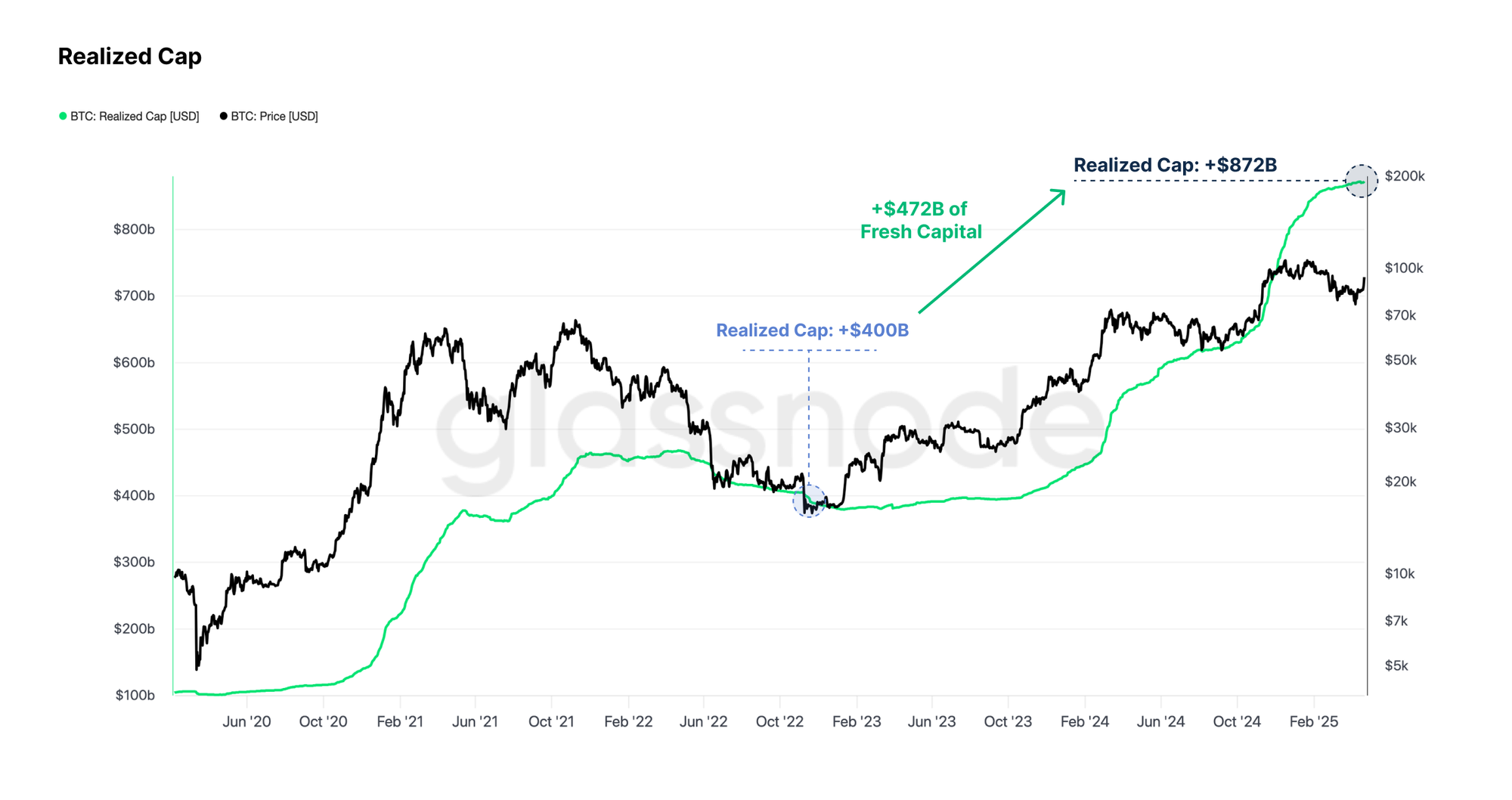
Realized cap hit record $872 billion in 2025. | Source: Glassnode
This shift has both positive and limiting effects. On one hand, institutional inflows have supported price growth and added legitimacy to the asset class. On the other hand, they have introduced new constraints. Markets have become more sensitive to macroeconomic conditions such as interest rates and liquidity cycles.
Recent market behavior reflects this change. Bitcoin’s performance has shown increasing correlation with traditional financial markets, particularly equities, indicating that it is no longer entirely insulated from broader economic trends.
Views from industry leaders reinforce this evolving structure. Michael Saylor, executive chairman of Strategy, has argued that Bitcoin is transitioning into a long term institutional asset driven by sustained capital allocation rather than short term speculation. He has pointed to growing participation from corporations, banks, and even nation states as a key driver of demand heading into 2026.
Bitcoin has won. Global consensus is that $BTC is digital capital. The four-year cycle is dead. Price is now driven by capital flows. Bank and digital credit will determine Bitcoin’s growth trajectory. The biggest risk is bad ideas driving iatrogenic protocol changes.
At the same time, Saylor has emphasized that Bitcoin’s volatility is gradually decreasing as the market matures, with price movements increasingly influenced by macroeconomic liquidity conditions rather than purely crypto native factors. His broader outlook reflects strong conviction, including scenarios where Bitcoin could reach significantly higher valuations over time, but also acknowledges that near term performance remains tied to global economic cycles.
However, this institutional shift also introduces new risks. Bitcoin’s growing correlation with risk assets means that tighter financial conditions or reduced liquidity could limit upside in the short term. Analysts note that even strong conviction from large holders like Strategy does not eliminate downside risk, particularly in periods of macroeconomic stress.
These developments complicate the type of exponential growth implied by Draper’s forecast. While structural adoption continues, the market now operates within a more complex and interconnected financial environment.
Draper’s $250,000 prediction sits at the upper end of current market expectations. Other analysts present a more moderate outlook.
Some forecasts suggest that Bitcoin could reach between $120,000 and $200,000 in the near term, depending on macroeconomic conditions and institutional inflows. Wall Street projections vary, with some analysts targeting levels around $143,000 to $189,000 in the coming years, while others anticipate more conservative ranges.
Even among bullish institutions, expectations have been revised downward in some cases. Analysts at Standard Chartered, for example, have reduced earlier projections, citing weaker liquidity, macroeconomic uncertainty, and changing demand dynamics.
Other research firms highlight the possibility of extended market cycles while cautioning that traditional patterns may no longer apply. Analysts at Bernstein argue that Bitcoin may be entering an “elongated” cycle driven more by institutional capital than retail speculation, marking a departure from the historical four year boom and bust rhythm.
The firm has outlined a more gradual trajectory, maintaining a price target of around $150,000 in the near term and suggesting a potential cycle peak closer to $200,000 in the following years rather than a rapid surge. Bernstein attributes this outlook to sustained inflows from exchange traded funds, long term holders, and broader integration of Bitcoin into institutional portfolios.
At the same time, analysts emphasize that such projections remain conditional. Interest rates, global liquidity conditions, and macroeconomic stability continue to play a critical role in shaping demand for risk assets such as Bitcoin. Higher rates or tighter liquidity could delay or limit upside, while easing financial conditions may support a longer but more measured growth cycle.
This more tempered view contrasts with more aggressive forecasts, suggesting that while Bitcoin’s long term trajectory may remain upward, the pace of growth is likely to be less exponential and more dependent on structural adoption and macroeconomic trends.
Why Predicting Bitcoin Remains Uncertain
Forecasting Bitcoin’s price remains inherently uncertain, even with sophisticated tools and data. Analytical platforms such as Glassnode and Santiment provide valuable insights into market behavior, but their predictive accuracy is limited. Studies suggest that even advanced models achieve directional accuracy of around 55 to 65% at best.
This highlights a broader point. Bitcoin’s price is influenced by a wide range of variables, including macroeconomic conditions, regulatory developments, technological changes, and investor sentiment. These factors interact in complex ways that make precise predictions difficult.
Draper’s forecasts, like many in the cryptocurrency space, should therefore be viewed as expressions of conviction rather than precise timelines.
Yes. He correctly predicted that Bitcoin would reach $10,000 within three years in 2014. However, his later predictions, especially the $250,000 target, have missed original deadlines and been pushed back multiple times.
Why does Tim Draper believe Bitcoin can reach $250,000?
He points to inflation, weakening fiat currencies, increasing adoption, and Bitcoin’s fixed supply as key drivers that could push the price significantly higher.
What do data firms like Glassnode and Santiment say?
Their data suggests a more cautious outlook. Metrics show slower accumulation, weaker demand signals, and reduced large investor activity, although long term adoption trends remain positive.
Do other analysts agree with the $250,000 prediction?
Not entirely. While some analysts are bullish on Bitcoin’s long term growth, many forecasts are more conservative, often ranging between $120,000 and $200,000 depending on market conditions.
Disclaimer:
The information provided in this article is for informational purposes only. It is not intended to be, nor should it be construed as, financial advice. We do not make any warranties regarding the completeness, reliability, or accuracy of this information. All investments involve risk, and past performance does not guarantee future results. We recommend consulting a financial advisor before making any investment decisions.
Onkar Singh has three years of experience as a digital finance content creator. Throughout his career, he has collaborated with various DeFi projects and crypto media outlets. In his leisure time, he enjoys fitness activities at the gym and watching movies across different genres. Balancing his professional and personal interests, Onkar continues to contribute to the digital finance landscape while pursuing his hobbies.


 Easy
Easy