The current Bitcoin selloff didn’t start with charts, macro data, or even market rumors; it began, strangely enough, with a resurfaced email from 2010. | Credit: CCN.com
Share
Key Takeaways
Bitcoin has fallen 40% from its 2025 peak, now trading around $75,000-$77,000, signaling a broader cooling period in the crypto market.
Over $2.5 billion in long positions were liquidated in 24 hours, triggering a self-reinforcing cascade of selling pressure.
High interest rates, a strong U.S. dollar, geopolitical tensions, and a precious metals meltdown have pressured risk assets, including Bitcoin.
The market may be transitioning from speculative euphoria to risk-aware maturation, where returns require careful strategy, not blind optimism.
The current Bitcoin selloff didn’t start with charts, macro data, or even market rumors; it began, strangely enough, with a resurfaced email from 2010.
In the U.S. Department of Justice document dump tied to the Epstein Files Transparency Act, publicist Peggy Siegal described a young Michael Saylor as socially awkward and “a zombie on a drug,” struggling to engage even with experienced board members. At the time, Saylor was an obscure tech executive. Today, he’s the most visible corporate Bitcoin advocate on the planet, leading Strategy’s massive BTC holdings.
The internet’s reaction was immediate: Bitcoin fans celebrated Saylor as an outsider immune to elite social norms. Critics pointed out the irony of Epstein-linked figures calling anyone else creepy. Saylor himself remained silent, letting the market focus on price, not gossip.
Consequently, the rapid evaporation of over $1 trillion in market value in just three weeks serves as a violent reminder that bear markets are often born in the cradle of peak complacency.
BREAKING: More than $1,000,000,000,000.00 has been erased from crypto market cap since January 14th.
Since the crypto market topped out at roughly $4.38 trillion on October 6, 2025, the transition from record-breaking highs to a $2.3 trillion valuation has been fueled by a “vicious cycle” of massive institutional ETF outflows and the forced liquidation of overleveraged retail positions.
This nearly 46% drawdown highlights a fundamental shift in 2026: as the “digital gold” narrative falters against a backdrop of rising tech-sector jitters and a global “risk-off” rotation, the market’s previous resilience has been replaced by an “extreme fear” that caught many investors still waiting for a “moon” that never arrived.
While amusing, the resurfaced email coincided with Bitcoin’s sharpest decline in months to $63k, forcing investors to confront a bigger question: Is the Bitcoin bubble finally deflating?
Bitcoin Price Crash Explained: Why BTC Fell 40% From Its 2025 Peak
Bitcoin’s price has dropped by 40% from its 2025 peak of $126,000, landing in the $75,000-$77,000 range. This isn’t just a correction: it’s a multi-factor market event.
Key drivers are:
$2.5 billion in leveraged liquidations: Over $2.5 billion in long positions were forcibly closed in just 24 hours. This cascade of selling pushed prices lower and triggered more liquidations, creating a feedback loop of fear and forced selling.
ETF outflows and institutional retreat: Many investors who bought Bitcoin ETFs near the 2025 highs are underwater. As they sell to minimize losses, the selling pressure grows, creating a self-reinforcing downward spiral.
Death cross: Bitcoin’s 50-day EMA dropped below its 200-day EMA, a classic bearish signal that confirms momentum has slowed. Institutional traders often use this as a psychological trigger to reduce exposure.
Precious metals meltdown: Gold dropped by 11% and silver fell by 31%, forcing institutions to deleverage by selling assets, including Bitcoin, to meet margin requirements.
Macro pressures: The Fed’s “higher for longer” interest rate stance, government liquidity constraints, and geopolitical tensions further discourage risk-taking, reducing demand for volatile assets like Bitcoin.
Narratively, it feels like a perfect storm. In just a few days, the market shifted from bullish excitement to fear-driven selling. Crypto, once a stand-alone asset class, is now tightly intertwined with global finance, macro policy, and institutional behavior.
Bitcoin Options Market Signals Shift From Speculation to Defensive Positioning
Markets often speak louder than narratives. Bitcoin’s options market is now signaling defensive positioning, a clear departure from the speculative euphoria of prior months.
The $75,000 put option is now as popular as the $100,000 call option, highlighting the shift from bullish speculation to hedging against losses.
Significant activity is also seen in puts at $70,000-$85,000, while call demand beyond $100,000 has dwindled.
Traders are no longer asking “How high can this go?” They’re asking “How low might it fall?”
In effect, Bitcoin’s options market has gone from “moonshot” optimism to pragmatic risk management, signaling that large investors are bracing for continued downside.
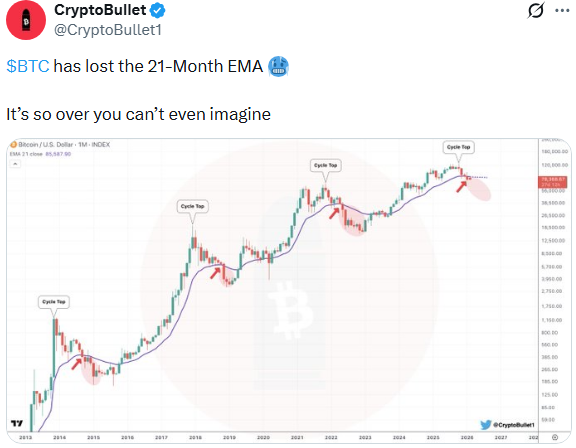
21-week EMA broken: Historically, this level separates bull markets from bear markets. Falling below it has preceded prolonged declines in previous cycles.
True market mean lost: This weakens mid-term support and signals that prior bullish momentum has faded.
Death cross confirmed: Short-term momentum is now below long-term trend, a warning sign for both retail and institutional traders.
Bitcoin has lost the 21-month EMA. | Credit: CryptoBullet
Historically, these conditions coincide with extended bearish phases, rather than quick, short-term pullbacks.
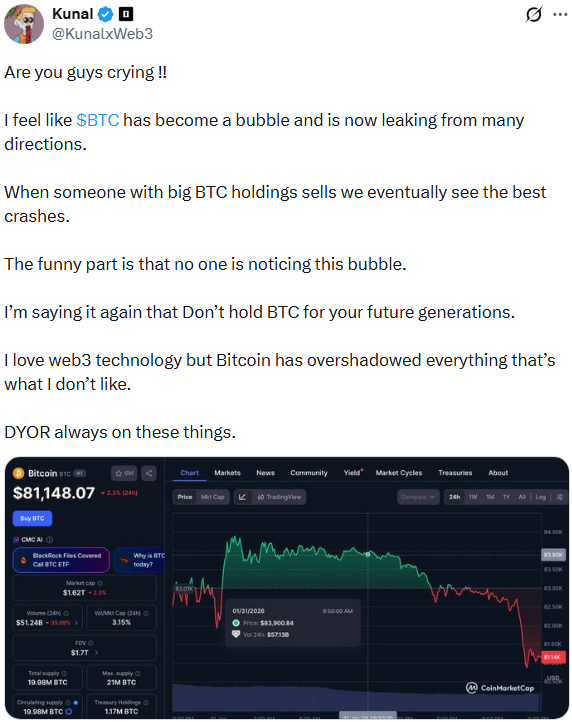
Is Bitcoin a bubble? | Credit: Kunal X profile
Narratively, this means Bitcoin isn’t just volatile; it’s in a position where past holders may sell into strength to cut losses, further pressuring the market.
Michael Saylor and Corporate Concentration Add a New Layer of Bitcoin Risk
Michael Saylor has become a symbol of both conviction and concentration risk.
Strategy is now a de facto Bitcoin whale, and market participants treat its holdings as potential sources of volatility.
While Saylor hasn’t sold, his presence amplifies psychological risk in the market.
ETFs and corporate treasuries are also major players; their selling or retention decisions now have outsized influence on price.
In a 2010 email, Jeffrey Epstein’s publicist Peggy Siegel claimed that they had no interest in taking MicroStrategy CEO Michael Saylor’s money.
“He’s so creepy I don’t even know if I can take his money I don’t even know how to blackmail him he has no personality and doesn’t… pic.twitter.com/ZYe86xarwO
Integration with macro markets: Bitcoin reacts to interest rates, liquidity constraints, and institutional behavior, making it more tied to traditional finance than ever.
This “leak phase” of the bubble is where speculative excess is filtered out and only the most committed holders remain.
Bitcoin Selloff Deepens as Macro Forces Tighten Financial Conditions
Bitcoin is no longer isolated; it’s part of the global financial ecosystem. Several macro trends are amplifying the selloff:
Federal Reserve policy: “Higher for longer” interest rates make bonds more attractive and reduce risk appetite for volatile assets.
Dollar strength: For overseas buyers, a stronger USD makes Bitcoin more expensive, lowering demand.
Geopolitical risks: Tensions between the U.S. and Iran and other conflicts trigger risk-off behavior.
Liquidity constraints: Partial government shutdowns tied up $200 billion, forcing institutions to deleverage assets like Bitcoin.
Together, these macro factors create a self-reinforcing cycle: fear drives selling, which triggers forced liquidations, which in turn fuel more fear.
What New Bitcoin Investors Need to Know in a Macro-Driven Market
Bitcoin no longer trades in isolation or purely on hype-driven narratives; it now responds directly to macroeconomic forces, on-chain metrics, and institutional behavior. Interest rates, dollar strength, liquidity conditions, and geopolitical risk can all influence price action, often overpowering short-term bullish stories.
New investors should avoid FOMO-driven entries, consider dollar-cost averaging or smaller position sizes, and understand that sharp volatility is a structural feature of crypto markets — not a flaw. Success in this environment depends less on timing the perfect entry and more on disciplined risk management, patience, and realistic expectations.
Liquidity can evaporate quickly; margin calls are common in cascading selloffs.
Watch CME futures gaps; they often act as short-term price magnets.
New investors:
Understand Bitcoin now reacts to macro events and on-chain metrics, not just narratives.
Avoid buying out of FOMO; consider dollar-cost averaging or smaller positions.
Recognize that volatility is not a bug; it’s a feature of crypto markets.
Bitcoin isn’t dead, but the easy-money era is likely over. Today’s selloff is painful, but it’s also a real-world lesson in risk management, market psychology, and macro interdependence-essential knowledge for anyone serious about crypto.
Bitcoin’s decline from $126,000 to around $75,000–$77,000 was caused by a combination of factors. Over $2.5 billion in leveraged long positions were liquidated, forcing exchanges to sell Bitcoin into a falling market, which triggered further sell-offs. Institutional investors also pulled out of spot Bitcoin ETFs, adding downward pressure.
What are leveraged liquidations, and why do they matter?
A leveraged liquidation occurs when a trader borrows money to increase exposure to Bitcoin and the market moves against them. The exchange closes the position to recover the loan, selling the underlying Bitcoin. This process pushes prices lower and can trigger more liquidations, creating a cascading effect that amplifies market declines. In the recent selloff, the speed and scale of liquidations significantly intensified downward pressure.
What is a “death cross” and why is it important?
A death cross forms when a short-term moving average, usually the 50-day EMA, crosses below a long-term moving average, typically the 200-day EMA. This technical pattern indicates that short-term momentum is weaker than the long-term trend and is often viewed as a bearish signal. While it is a lagging indicator, it can influence investor behavior, particularly for institutional traders who use it as a psychological cue to reduce exposure, reinforcing a downward trend.
How do ETFs influence Bitcoin prices?
Spot Bitcoin ETFs allow institutional investors to gain exposure to Bitcoin through regulated funds. During the 2024–2025 bull run, ETFs helped drive prices higher by increasing demand. However, in the recent selloff, net withdrawals from ETFs have added selling pressure. Many ETF holders bought near the 2025 highs and are now experiencing losses, prompting them to sell. Because ETFs concentrate large-scale institutional holdings, their actions can have a significant impact on market direction.
Disclaimer:
The information provided in this article is for informational purposes only. It is not intended to be, nor should it be construed as, financial advice. We do not make any warranties regarding the completeness, reliability, or accuracy of this information. All investments involve risk, and past performance does not guarantee future results. We recommend consulting a financial advisor before making any investment decisions.
Giuseppe Ciccomascolo began his career as an investigative journalist in Italy, where he contributed to both local and national newspapers, focusing on various financial sectors.
Upon relocating to London, he worked as an analyst for Fitch's CapitalStructure and later as a Senior Reporter for Alliance News. In 2017, Giuseppe transitioned to covering cryptocurrency-related news, producing documentaries and articles on Bitcoin and other emerging digital currencies. He also played a pivotal role in establishing the academy for a cryptocurrency exchange website. Crypto remained his primary area of interest throughout his tenure as a writer for ThirdFloor.


 Easy
Easy