Johns Hopkins economist Steve Hanke calls Bitcoin ‘zero fundamental value,’ sparking debate on BTC price. | Credit: CCN.com
Share
Key Takeaways
KindlyMD ($NAKA), formerly Nakamoto, sold 367 BTC, worth over $35 million, sending shockwaves across an already fragile crypto market.
Many public companies that bought BTC near cycle highs now face unrealized losses, shrinking liquidity, and shareholder pressure.
Unlike previous bull cycles, today’s market has lower exchange liquidity and weaker retail participation, allowing large sales.
The NAKA dump alone is not catastrophic, but it may be the first signal of a broader, more painful downturn.
When markets turn fearful, a single significant sell-off can act like a match in a room full of gasoline. That’s precisely what happened when KindlyMD ($NAKA), formerly Nakamoto, reportedly dumped 367 BTC, worth over $35 million, onto the market in a single stroke.
For an ecosystem still recovering from months of declining liquidity and dwindling retail participation, the move hit like a shockwave.
JUST IN: Nakamoto $NAKA has just dumped 367 #Bitcoin worth over $35,000,000.
We’re in the phase where all of the treasury companies who bought BTC are now facing major loses and will be forced to dump.
Analysts and traders immediately voiced concerns. One comment spread rapidly across X:
“We’re in the phase where all of the treasury companies that bought BTC are now facing major losses and will be forced to dump. This bear market is going to be worse than any before it.”
Is this panic justified? And is the NAKA liquidation really the spark that ignites a broader meltdown across Bitcoin-exposed public companies?
To understand the scale of the situation, we need to look not only at the size of the sell-off but also at the broader landscape of BTC-linked stocks, corporate treasuries, and the fragile sentiment underlying this entire market cycle.
In bull markets, Bitcoin on the balance sheet serves as a badge of innovation, enabling companies to attract attention, push narrative momentum, and align with digital-asset-native investors.
In bear markets, those same holdings become ticking time bombs.
The NAKA dump came at a time when BTC is already struggling to hold key support levels. For companies that bought aggressively at higher prices, declining portfolio value directly affects:
Treasury health
Shareholder pressure
Financing options
Liquidity runway
Once a firm starts incurring losses, others often follow suit. This is the classic reflexivity loop that drives deep bear markets: from treasuries dumping to price falls to more treasuries being forced to mark down assets, ultimately leading to additional dumping.
KindlyMD sold 367 Bitcoin during the recent market downturn. | Credit: Flying Raven X profile
This is why the $35M NAKA sell-off is sparking such widespread anxiety: it’s the pattern people fear, not the single event.
Bitcoin-Proxy Stocks Show Sharp Declines: What Market Data Reveals
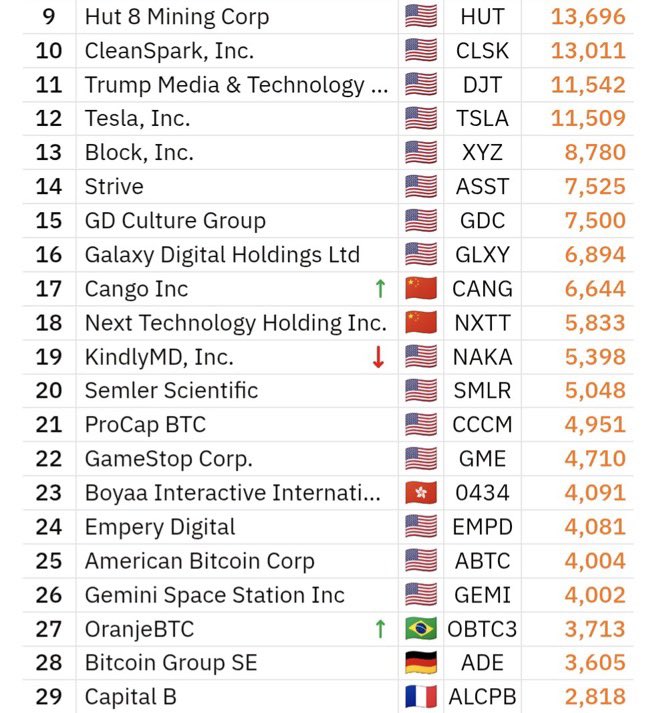
The chart below displays volume and ranking data for multiple BTC-adjacent equities, mining companies, digital asset holding firms, crypto-themed tech platforms, and financial groups that benefited from the last bull run.
High-volume leaders include heavily BTC-exposed firms:
All of the treasury companies who bought BTC are now facing major loses and will be forced to dump. | Credit: Jacob King X profile
Mining stocks and digital asset companies tend to move more violently than BTC itself, meaning a 10% BTC drop often becomes a 20-40% equity sell-off.
NAKA Shows Sharp Downward Stress
KindlyMD appears at rank 19 with a red downward arrow, sitting at 5,398, indicating heavy trading volume and a downward movement consistent with the Bitcoin liquidation event.
This is critical: when a treasury sells BTC, it exerts pressure on both the cryptocurrency market and the equity price of the company selling the BTC.
If multiple Bitcoin-holding corporations are underwater on their positions, NAKA’s move may be the first domino, not the last.
Why NAKA Sold 367 BTC: Liquidity, Margin Pressure, and Signals of Corporate Distress
There are several possible explanations, and none is comforting:
1. Liquidity Crunch
Companies with heavy BTC exposure often rely on it as a strategic reserve. Selling usually means:
They need cash immediately.
Financing options have dried up.
Their equity is too low to be used for capital raises.
Debt obligations or operational costs are due.
A large BTC sale is a distress signal.
2. Anticipation of Deeper Market Declines
Corporate treasuries don’t operate emotionally; they use risk models. If internal metrics indicate further downside for BTC, selling earlier protects capital.
3. Forced Liquidation or Margin Pressure
Some companies use BTC as collateral. Declining prices can trigger:
Margin calls
Risk thresholds
Mandated de-risking from lenders or board directives
Regardless of the reason, dumping 367 BTC is a choice few companies make lightly.
How One Treasury Dump Can Trigger a Bitcoin Liquidation Cascade Across Public Companies
Bitcoin treasuries are not evenly distributed. The market is dominated by:
Public miners
Digital asset holding companies
Web3 and fintech firms
SPAC-era high-volatility tech stocks
Many of them hold BTC bought near the top of previous cycles. This creates a critical vulnerability: if one treasury panics and sells, investors begin questioning every other balance sheet.
A $35M BTC sell-off in 2021 would have barely registered. In 2025 conditions, it creates structural slippage and volatility. This increases the likelihood that similar treasury sell-offs will have a more pronounced market impact.
Cartels have liquidate almost every Bitcoin long. | Credit: Ash Crypto X profile
A market in fear is susceptible to cascading liquidation events, both on-chain and in equities.
4. Macro Risk: Elevated
With interest rates still higher than ideal for risk-on assets and regulatory pressure remaining heavy, companies rely more on their own internal treasury strength.
If BTC holdings are converted from assets into liabilities, corporate survival math changes rapidly.
Historical Parallels: What the 2018 Miner Capitulation and 2022 Corporate Crises Tell Us Now
In every case, corporate distress preceded market bottoms, not the other way around.
Treasury sell-offs almost always signaled deeper problems to come.
Is the Market Overreacting—or Is the NAKA Sell-Off a Real Warning Signal for Bitcoin’s Next Move?
The reality sits somewhere between calm reassurance and full-blown panic. The NAKA sell-off alone doesn’t guarantee a market collapse, but it does send a clear signal that stress is building in dangerous places.
Bitcoin’s supposed price floor is far more fragile than believed.
Liquidity is too shallow to absorb large, sudden sales.
Mining firms and digital-asset companies remain deeply exposed.
Overall market sentiment is fragile and prone to rapid fracture.
If even one or two additional treasuries follow NAKA’s lead, the market could be dragged into a complete capitulation phase, potentially sharper and more chaotic than what we’ve seen in previous cycles.
As one viral warning put it: “This bear market is going to be worse than any before it.”
An exaggeration? Maybe. Impossible? Not even close.
Is Bitcoin at Risk of Falling Below $65K?
Bitcoin continues to trade below $95,000, reflecting broader market volatility rather than any single catalyst. Recent selling pressure has raised questions about whether BTC could revisit lower support levels, including the $65,000 zone, which previously acted as a key liquidity region during the last major correction.
While social-media claims of a “$35 million NAKA dump” circulated, for now, analysts highlight macro conditions, ETF flows, and overall risk sentiment as the primary drivers determining whether Bitcoin stabilizes or retests deeper support.
Bitcoin’s Next Phase Depends on Whether More Corporate Treasuries Start Selling
The $35M NAKA Bitcoin dump was more than a single transaction; it was a stress test for an already fragile market.
If Bitcoin stabilizes and no other corporate treasuries sell, the event may fade into history as an overreaction.
However, if even a handful of BTC-holding companies, especially those appearing in the high-volume rankings, begin liquidating their treasuries. This could mark the beginning of a brutal new phase in the bear market, defined by forced selling, collapsing equity prices, and treasury-driven panic.
Bitcoin has survived worse. But the next moves from corporate holders will determine whether this downturn becomes a crash or a final shakeout before recovery.
KindlyMD ($NAKA), formerly known as Nakamoto, reportedly sold 367 Bitcoin, worth over $35 million, in a single transaction. This raised market-wide fears because treasury-driven sell-offs tend to occur when companies are under significant financial stress.
Why is this BTC dump such a big deal?
The significance lies in what the sale suggests rather than its size alone. Corporate treasuries are generally long-term holders. When they start liquidating during a downturn, it signals distress, lack of liquidity, or risk expectations of deeper drops. These sales can initiate broader market panic and create a domino effect.
Are other BTC-holding companies at risk of selling too?
Possibly. Many publicly traded crypto companies, miners, and digital asset firms bought BTC at higher prices. If their balance sheets are stressed, they may be forced to liquidate just like NAKA. The image data shows several Bitcoin-exposed stocks with vulnerabilities experiencing high volume and downward pressure.
How could a wave of treasury sell-offs affect Bitcoin?
If multiple corporate holders begin liquidating simultaneously, it can create a reflexive downward loop. Bitcoin’s price drops, which worsens corporate losses, forcing further selling. This cycle accelerates market stress and can lead to liquidity shortages and cascading liquidations across exchanges and equities.
Disclaimer:
The information provided in this article is for informational purposes only. It is not intended to be, nor should it be construed as, financial advice. We do not make any warranties regarding the completeness, reliability, or accuracy of this information. All investments involve risk, and past performance does not guarantee future results. We recommend consulting a financial advisor before making any investment decisions.
Giuseppe Ciccomascolo began his career as an investigative journalist in Italy, where he contributed to both local and national newspapers, focusing on various financial sectors.
Upon relocating to London, he worked as an analyst for Fitch's CapitalStructure and later as a Senior Reporter for Alliance News. In 2017, Giuseppe transitioned to covering cryptocurrency-related news, producing documentaries and articles on Bitcoin and other emerging digital currencies. He also played a pivotal role in establishing the academy for a cryptocurrency exchange website. Crypto remained his primary area of interest throughout his tenure as a writer for ThirdFloor.


 Easy
Easy