MSTR eyes $221 after MSCI retains Digital Asset Treasuries | Credit: Veronica Cestari
Share
Key Takeaways
Bitcoin’s recent pullback to the $91,000–$93,000 range has renewed scrutiny of Michael Saylor’s high-conviction Bitcoin strategy.
Saylor insists Strategy can withstand even an 80–90% BTC drawdown due to its long-term debt structure and holding approach.
Analysts are re-examining Strategy’s large BTC exposure, drawing parallels to the company’s steep stock collapse during the dot-com crash.
Whether Saylor is repeating past patterns or navigating a fundamentally different environment remains a sharply debated question among economists and analysts.
Michael Saylor’s Bitcoin strategy is once again under scrutiny as the crypto market pulls back sharply, with Bitcoin trading in the $91,000-$93,000 range (as of Nov. 19, 2025), a noticeable decline from its recent highs.
In multiple public statements, Saylor has maintained that Strategy is structured to withstand even an 80% to 90% drop in Bitcoin’s price, citing the company’s long-dated debt and long-term holding strategy.
As Bitcoin volatility returns, analysts are revisiting Strategy’s large BTC exposure and drawing comparisons to the dot-com era, when the company’s stock experienced one of the steepest single-day declines of that period.
The central question now is whether the current Bitcoin-driven approach repeats elements of that earlier playbook or reflects an entirely different business environment.
That question has been underscored by multiple warnings:
Bloomberg Intelligence senior commodity strategist Mike McGlone cautions that Bitcoin may be entering a phase where it could “go back to $10,000” or fall to $50,000, as speculative assets face mounting pressure.
Henrik Zeberg warns Bitcoin could plunge below $10,000, putting Strategy’s strategy at risk.
Jacob King references Saylor’s dot-com history, arguing today’s leveraged, high-conviction BTC approach shares structural similarities with earlier risks.
Understanding that requires looking back at what happened during the dot-com crash, how Strategy has evolved since then, and why opinions about Saylor’s strategy remain so sharply divided today.
Saylor and the Dot-Com Era: What Actually Happened
Michael Saylor co-founded MicroStrategy in 1989, building it into a major provider of business intelligence software. During the late 1990s, the company’s revenue surged, and by 2000 its stock became one of the standout performers of the tech boom.
The Accounting Restatement and Market Fallout
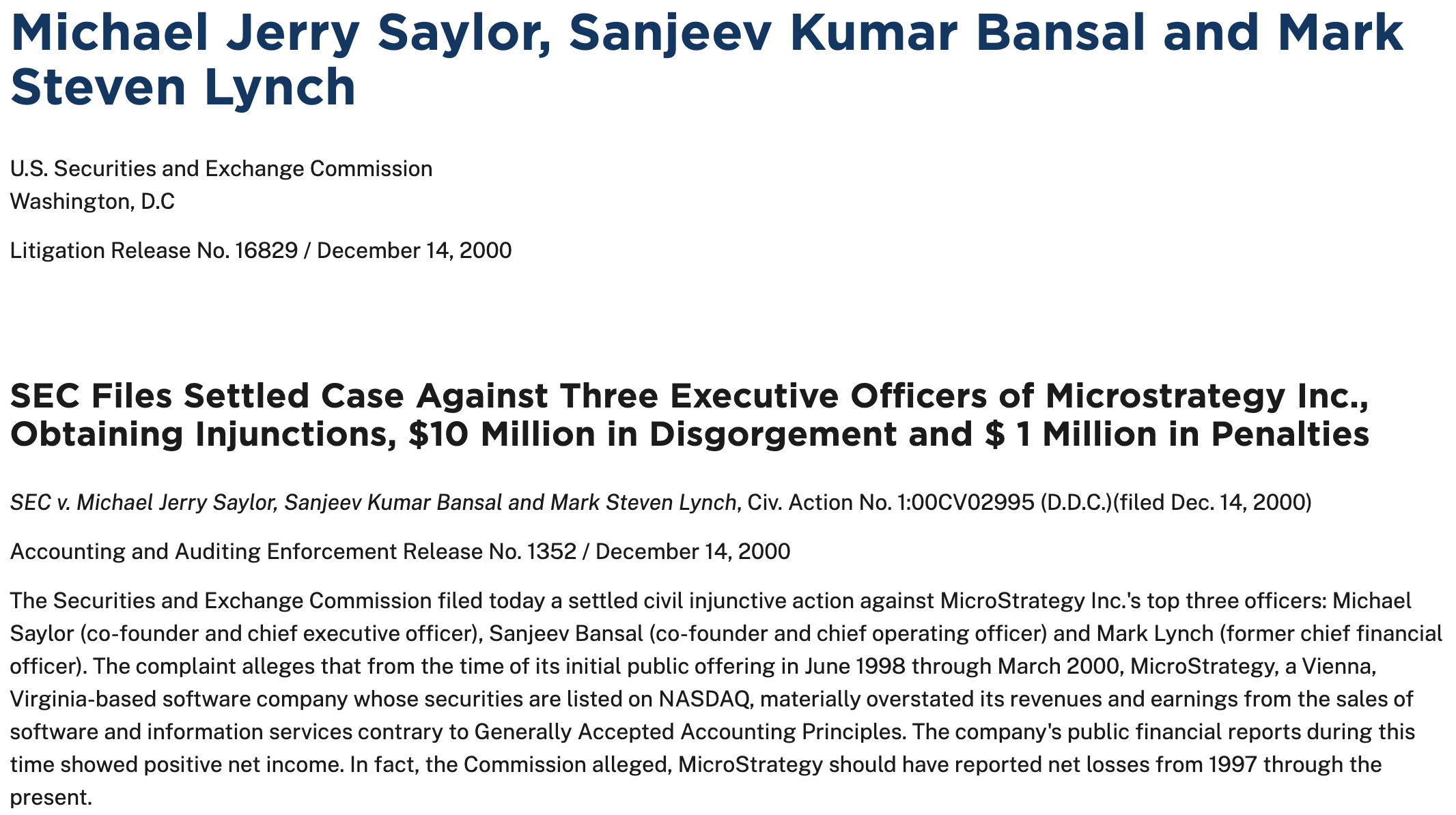
In March 2000, Strategy (previous MicroStrategy) announced it would restate several years of financial results due to how the company recognized revenue. The restatement followed discussions with the U.S. Securities and Exchange Commission about accounting rules involving software contracts.
The impact was immediate: MicroStrategy’s stock, which had traded as high as $333 per share, collapsed after the company announced on March 20, 2000 that it would restate its financial results for 1998 and 1999. Shares plunged from roughly $260 to $86 in a single day, a drop of more than 60%, and the decline became one of the most visible examples of the broader dot-com crash.
Michael Jerry Saylor, Sanjeev Kumar Bansal and Mark Steven Lynch filing. | Credit: SEC
A Key Lesson From the Dot-Com Era
The episode demonstrated how high-growth, high-conviction strategies can suffer massive drawdowns when market cycles reverse.
It also showed that Saylor has historically been willing to take bold positions in emerging technological trends, sometimes with painful short-term consequences.
Strategy’s Bitcoin Strategy: High Conviction, High Visibility
In 2020, Saylor redirected Strategy’s treasury strategy toward Bitcoin, arguing that the asset serves as a long-term store of value in an inflationary world. Over several years, the company purchased large amounts of BTC using:
existing corporate cash
convertible notes
equity offerings
long-term debt instruments
Saylor has consistently stated that the company has no intention of selling its Bitcoin and that its balance sheet can absorb even severe price declines. In multiple interviews and shareholder communications, he has emphasized that Strategy could withstand a deep crash, even one approaching 90%, because:
its debt maturities are long-dated
interest obligations are comparatively low
Bitcoin assets are not marked to market for liquidity purposes
the company’s software business continues generating revenue
This structure is fundamentally different from the speculative tech equity valuations of the late 1990s, but it still involves extreme concentration in a single volatile asset.
Are the Two Eras Comparable? Key Similarities and Differences
Similarities Between the Dot-Com Era and Saylor’s Bitcoin Strategy
Bold, high-conviction strategy: Saylor has a long history of making aggressive, transformative bets – first in enterprise software during the 1990s, and now with Bitcoin as Strategy’s primary treasury asset.
Exposure to market volatility: In both eras, Strategy’s valuation became heavily linked to a single, fast-moving technology sector with significant price swings.
Strong public narrative: Just as Saylor was a high-profile voice in the dot-com boom, he is now one of the most visible advocates for corporate Bitcoin adoption.
Key Differences Between Then and Now
Bitcoin is not tied to revenue recognition: The dot-com restatement involved accounting rules for software revenue. Bitcoin today is simply a treasury asset recorded on the balance sheet, not part of operating revenue.
Strategy’s core business still operates The company’s enterprise analytics software business continues to run, providing ongoing revenue and operational stability independent of Bitcoin.
Debt and liquidity structure is transparent: Strategy’s financing approach, including debt issuance and timelines, is fully disclosed in SEC filings, offering clearer visibility than the rapid-growth environment of the late 1990s.
The market environment is fundamentally different: The dot-com bubble was driven by speculative equity enthusiasm. Bitcoin trades as a global digital asset with separate macro, liquidity, and adoption dynamics.
Market Analysts Clash Over Michael Saylor’s Bitcoin Strategy
Two prominent market commentators recently sparked a heated debate about Michael Saylor and Strategy’s aggressive Bitcoin strategy, while another industry figure pushed back, calling the criticism inaccurate.
Henrik Zeberg’s Warning
Henrik Zeberg, Head Macro Economist at Swissblock, made one of the strongest bearish predictions, arguing that Bitcoin could fall below $10,000. In his view, such a drop would severely pressure Strategy and could turn Saylor into what he called “the villain of the Everything Bubble.”
Henrik Zeberg’s Bitcoin price decline warning. | Credit: Henrik Zeberg X profile
Zeberg’s comments represent a highly bearish macro perspective, not a verified forecast.
I will save this tweet – and show it to my grandchildren when I try to explain "The Everything Bubble" and the mania at its peak!
This is EXACTLY the same sentiment as when the price of ONE Tulip bulb reached the level of the price of a house in 1640s.
Financial analyst Jacob King offered a far more detailed criticism, arguing that Saylor’s investing track record, including his experience during the dot-com era, raises concerns about Strategy’s current approach. King framed Saylor’s strategy as highly concentrated, leveraged, and vulnerable if Bitcoin were to decline sharply.
His comments reflect a personal analysis and opinion, not established historical or financial fact.
Mike McGlone (Bloomberg Intelligence Senior Commodity Strategist)
He cited speculative excess in crypto markets, Bitcoin’s failure as a “digital gold” safe haven (with gold up 16% while BTC dropped 20%. But also overvalued stocks, potential tariff impacts that reduce global liquidity. And persistent inflation limiting Fed stimulus as key drivers for this mean-reversion crash.
Fred Krueger’s Rebuttal
Investor Fred Krueger responded sharply, saying that “everything in this post is factually incorrect.” His comment underscores how polarizing and contested the debate around Saylor has become.
Peter Schiff (Gold Advocate)
Schiff, a longtime Bitcoin critic, forecasted in March 2025 that BTC could plummet to $10,000, a 95% decline from its 2021 peak when priced against gold, by the time gold reaches $5,000 per ounce. He attributes this to Bitcoin’s decoupling from rising safe-haven assets like gold, ongoing pressures on fiat currencies. And the asset’s inherent volatility, which he views as a speculative bubble rather than a store of value.
Is Saylor Repeating His Dot-Com Playbook? A Measured Assessment
The comparison is not perfect, but some patterns recur:
At the same time, Strategy today operates under a different framework:
its debt is structured over multiple years
it has a functioning software business
Bitcoin is a liquid, globally traded asset
its financial disclosures are highly transparent
The dot-com crash was driven by accounting issues and inflated technology valuations. Bitcoin is an entirely different asset class with different risk vectors.
A Strategy of Conviction, Not a Repeat of the Past
Michael Saylor’s corporate history shows a leader who takes large, directional bets on the future. The dot-com era demonstrated both the risks and resilience of such an approach. Today’s Bitcoin strategy is bold, highly visible, and heavily concentrated, but it is not identical to the playbook of 2000.
Whether the strategy proves visionary or excessively risky will depend not on historical analogies, but on Bitcoin’s long-term performance and Strategy’s ability to manage its balance sheet over time.
How much of Strategy’s value now comes from Bitcoin holdings?
Strategy’s market valuation has become heavily influenced by the size and market price of its Bitcoin holdings. While the company still generates revenue from its analytics software business, a substantial portion of its market cap now tracks BTC price movements directly.
Does Strategy’s Bitcoin strategy affect its status in major indices like the S&P 500?
Strategy is not currently part of the S&P 500, and its high concentration in Bitcoin would make inclusion difficult under existing index diversification rules. Index committees typically avoid companies whose valuations depend heavily on a single volatile asset.
How have Strategy’s earnings been impacted by holding Bitcoin?
Strategy does not recognize gains on Bitcoin unless it sells, but it must record impairment losses when BTC’s price drops below the company’s purchase cost. This can cause significant volatility in quarterly earnings, even when the firm has no operational issues.
Could a major Bitcoin drawdown threaten Strategy’s financial stability?
According to Saylor, the company can handle even deep BTC declines because its debt maturities are long-dated and its interest payments are relatively low. However, critics argue that a severe crash could pressure the company’s leverage ratios, earnings optics, and investor confidence.
Disclaimer:
The information provided in this article is for informational purposes only. It is not intended to be, nor should it be construed as, financial advice. We do not make any warranties regarding the completeness, reliability, or accuracy of this information. All investments involve risk, and past performance does not guarantee future results. We recommend consulting a financial advisor before making any investment decisions.
Dr. Guneet Kaur is a senior editor at CCN.com and a Science Fellow at Exponential Science. She is a fintech and blockchain expert with extensive experience in digital finance education, blockchain ecosystems, and cryptocurrency markets. She has worked with global media such as Cointelegraph, as well as education and blockchain platforms, to design and lead strategic content and learning initiatives. As an educator and assessor for top-tier executive programs, she bridges real-world fintech trends with academic insight.
Dr. Kaur is also a published researcher and peer reviewer across fintech and data science journals, including Financial Innovation Journal and International Journal of Big Data Intelligence and Applications. Her work spans data-driven analysis, Web3 innovation, and technical content development. With a strong foundation in both industry and academia, she translates complex financial technologies into practical applications, empowering learners, professionals, and institutions across the rapidly evolving digital finance landscape.
Giuseppe Ciccomascolo began his career as an investigative journalist in Italy, where he contributed to both local and national newspapers, focusing on various financial sectors.
Upon relocating to London, he worked as an analyst for Fitch's CapitalStructure and later as a Senior Reporter for Alliance News. In 2017, Giuseppe transitioned to covering cryptocurrency-related news, producing documentaries and articles on Bitcoin and other emerging digital currencies. He also played a pivotal role in establishing the academy for a cryptocurrency exchange website. Crypto remained his primary area of interest throughout his tenure as a writer for ThirdFloor.


 Easy
Easy