Bitcoin Bleeds, Strategy's Phong Le Sells $11M in Stock — What the Filing Reveals
Share
Key Takeaways
Strategy’s brief discount reflects markets’ pricing in debt, dilution, and operational risks, not irrational panic.
Spot Bitcoin ETFs have eroded Strategy’s advantage as a Bitcoin proxy, redirecting investor capital.
Strategy’s debt-fueled Bitcoin accumulation amplifies both potential gains and losses.
Investors now apply traditional finance discipline to crypto equities, rewarding efficiency, not excess.
Strategy Inc., formerly known as MicroStrategy, made headlines on November 13 after its market capitalization briefly fell below the value of its Bitcoin holdings. The event marks a rare moment in financial markets, where investors valued the company’s equity at less than the worth of its digital assets.
This inversion, often called a negative premium, highlights growing investor caution around corporate structures that hold Bitcoin, especially those financed through debt and equity dilution. While Strategy remains the largest corporate holder of Bitcoin, the incident reflects a meaningful shift in market psychology.
MSTR’s market cap has fallen BELOW the value of the Bitcoin it holds. | Source: @GracyBitget on X.
Strategy Stock (MSTR) Falls Below Its Bitcoin Holdings: The Numbers Behind the Shock
As of the week in question:
Total Bitcoin holdings: approximately 641,692 BTC.
Average acquisition price: around $74,000 per Bitcoin, implying billions in unrealized gains.
Bitcoin market price: fluctuating between $100,000 and $105,000.
Total Bitcoin value: about $66.6 billion.
Strategy’s market capitalization: briefly dropped to around $65.3 billion intraday.
This created a temporary negative premium, meaning the stock market valued Strategy’s equity below the company’s Bitcoin portfolio. For context, Strategy’s stock historically traded above its net Bitcoin value; investors typically paid a premium for the firm’s leverage and additional growth potential.
Why Investors Are Repricing Strategy Stock: Dilution, Leverage Risks and the End of Its Bitcoin Premium
1. Rising Concerns Over Dilution
Strategy has financed its massive Bitcoin purchases through convertible debt, equity issuances, and preferred shares. While this aggressive strategy amplified exposure during Bitcoin rallies, it also introduced dilution risks for existing shareholders.
As the company continues to issue shares to buy more Bitcoin, investors increasingly fear that future ownership stakes will be watered down, reducing per-share value even as total Bitcoin holdings rise.
2. Corporate and Leverage Risks
Owning Strategy’s stock is not the same as owning Bitcoin directly. Investors in Strategy face both asset price risk and corporate risk, including operational costs, debt servicing, and governance issues.
Because Strategy’s capital structure includes billions in convertible bonds and preferred equity, leverage magnifies both gains and losses. This makes Strategy’s stock a leveraged proxy for Bitcoin, but also a riskier one, particularly when market sentiment turns cautious.
3. Changing Market Sentiment
The crypto market has entered a period of fragile sentiment. Despite Bitcoin holding relatively steady above $100,000, the broader Fear and Greed Index sits in “extreme fear” territory.
Investors have grown more conservative, preferring direct Bitcoin exposure via ETFs or custody solutions rather than complex corporate structures. In this environment, the market is demanding a discount for companies like Strategy that introduce additional financial and operational variables.
4. The End of the “Strategy Premium”
For years, Strategy’s stock traded at a premium to the value of its Bitcoin holdings. Investors saw the company as an effective way to get leveraged Bitcoin exposure, especially before spot Bitcoin ETFs were widely available.
Now, with multiple Bitcoin ETFs providing pure exposure, that premium is no longer justified. Strategy’s role as the “corporate Bitcoin ETF” is fading, and the stock’s valuation is starting to reflect actual balance sheet risks, not speculative upside.
The brief fall in Strategy’s market cap below its Bitcoin value highlights two classic finance principles, leverage risk and market efficiency.
In theory, leverage amplifies both returns and losses; in practice, it raises the equity risk premium investors demand. As Strategy financed its Bitcoin purchases through debt and equity issuance, markets began pricing in that higher financial risk. This explains why the stock traded at a discount to its NAV despite strong underlying assets.
The event also reaffirms market efficiency, where prices quickly reflect new information and perceived risk. Investors now distinguish between Bitcoin as a direct asset and Strategy as a leveraged corporate structure, assigning value accordingly. The result: a more efficient, risk-adjusted market where corporate Bitcoin exposure is no longer rewarded simply for scale but judged by balance-sheet strength and financial discipline.
What Strategy’s Valuation Discount Reveals About Market Risk and Investor Behavior
The brief moment when Strategy’s market cap dipped below its Bitcoin value underscores a core financial principle: markets eventually price in risk.
Even though the company’s Bitcoin reserves remain profitable on paper, equity investors have begun distinguishing between:
Strategy as a leveraged business that owns Bitcoin.
From a valuation standpoint, the stock now trades closer to its NAV, with adjustments for debt, dilution, and corporate risk. This behavior mirrors traditional finance logic: when asset-backed companies take on leverage, markets often apply a discount to reflect potential downside.
A Sign of Market Maturity? Investors Now Differentiate Bitcoin Exposure From Corporate Risk
This development is more than a price anomaly, it’s a signal of market maturity.
For the first time in years, investors are treating Strategy’s Bitcoin exposure not as a bonus, but as a risk-adjusted asset within a corporate wrapper. The stock’s temporary discount shows that the market is rewarding transparency and direct exposure over leveraged bets.
It also suggests that institutional investors now differentiate between holding Bitcoin itself and holding shares in a company that owns Bitcoin but carries additional liabilities.
Market Voices: Analysts and Investors Decode Strategy’s Valuation Shift
The sharp move in Strategy’s stock has sparked wide discussion across financial circles and crypto analysts, each interpreting what the brief discount to Bitcoin value really means.
ByteTree captured the changing dynamic bluntly: “Is this the end of @MicroStrategy ($MSTR)? MSTR was 3x ahead of BTC; now it’s just 50%.” The firm noted that retail investors once bought MSTR as a Bitcoin proxy when ETFs were restricted, but with spot Bitcoin ETFs now accessible worldwide, money is flowing to simpler, low-fee vehicles instead of leveraged corporate structures.
Is this the end of Strategy ($MSTR)? | Source: @ByteTree on X.
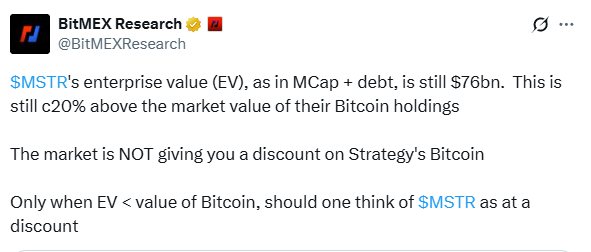
Adding another layer, @BitMEXResearch clarified that Strategy’s enterprise value (EV), including both market cap and debt, remains about $76 billion, roughly 20% above the market value of its Bitcoin holdings. As they explained: “The market is NOT giving you a discount on Strategy’s Bitcoin. Only when EV < value of Bitcoin should one think of $MSTR as at a discount.”
The market is NOT giving you a discount on Strategy’s Bitcoin. | Source: @BitMEXResearch on X.
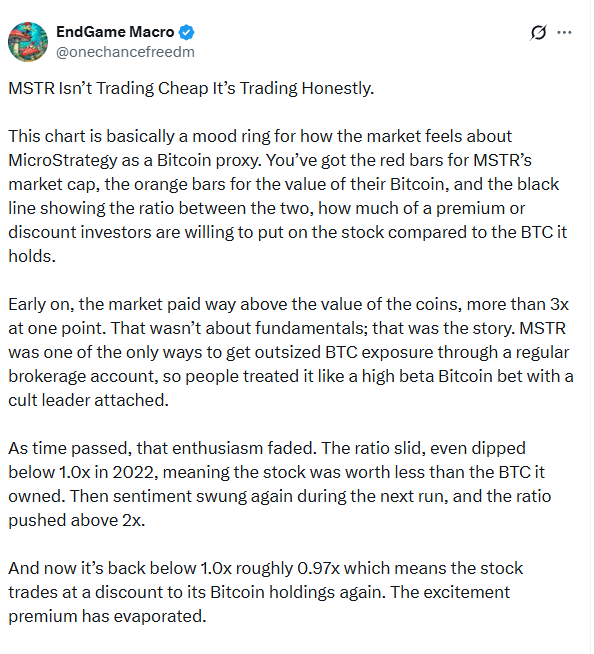
Meanwhile, @onechancefreedm offered perhaps the most grounded take: “MSTR isn’t trading cheap, it’s trading honestly.” He described the ratio between Strategy’s market cap and Bitcoin holdings as a “mood ring” for investor sentiment. Early on, the stock traded more than 3× above its Bitcoin value, driven by hype and limited access to Bitcoin through brokerages. Now, with ETFs available, that premium has collapsed to around 0.97×, implying a mild discount.
His conclusion captured the shift in psychology: “You’re not buying cheap BTC. You’re buying BTC plus leverage, plus liabilities, plus a corporate wrapper.”
The market is telling you something simple…You’re not buying cheap BTC. | Source: @onechancefreedm on X.
Together, these perspectives highlight a clear consensus that the market isn’t irrational or broken. It’s repricing Strategy with realism, distinguishing between Bitcoin as an asset and Strategy as a leveraged business, as investors favor transparency, liquidity, and direct exposure over narrative-driven corporate bets.
What Investors Should Watch Next
Understanding what drives Strategy’s stock valuation requires looking beyond its Bitcoin holdings. The company’s market performance is now influenced by a mix of asset value ratios, balance sheet health, and competitive dynamics in the Bitcoin investment landscape.
Several financial indicators can help investors gauge whether Strategy’s stock is trading at a sustainable level or signaling deeper market caution. These include:
Market cap-to-Bitcoin value ratio (mNAV): When this ratio falls below 1, it indicates a discount. Sustained movement below that threshold could signal deeper investor concern.
Bitcoin price stability: Strategy’s valuation depends almost entirely on Bitcoin’s price. A 10% BTC move can materially shift its market cap.
Equity and debt issuances: Any new fundraising may dilute shareholders further and increase the corporate discount.
Balance sheet leverage: The company’s total debt and interest obligations will determine how much flexibility it has during future Bitcoin downturns.
ETF competition: As spot Bitcoin ETFs gain popularity, fewer investors may view Strategy’s stock as the easiest way to gain Bitcoin exposure.
A Turning Point in the Crypto-Equity Market
Strategy’s $65 billion valuation shock marks a pivotal moment for both the company and the crypto-equity narrative. The episode revealed that markets are no longer blindly rewarding leverage or corporate wrappers.
Though the discount was short-lived, it sent a clear message: the era of guaranteed premiums for Bitcoin-holding corporations is over. Strategy’s stock will likely continue to trade as a leveraged proxy for Bitcoin, but one now priced with greater caution, reflecting both the potential upside and the growing financial risks behind its bold strategy.
Why did Strategy’s stock fall below the value of its Bitcoin holdings?
Strategy’s market cap briefly dipped below its Bitcoin holdings because investors began pricing in corporate and dilution risks tied to its leveraged balance sheet. The event signaled a shift toward more cautious, risk-adjusted valuation of Bitcoin-holding companies.
Does this mean Strategy’s stock is undervalued?
Not necessarily. While the stock traded below its Bitcoin value, the enterprise value (EV), which includes debt, still sits above its Bitcoin holdings. This means the market is not offering a true discount but rather accounting for leverage, liabilities, and operational risk.
How do Bitcoin ETFs affect Strategy’s valuation?
The launch of spot Bitcoin ETFs provides investors with simpler, lower-cost exposure to Bitcoin. As a result, fewer investors see Strategy’s stock as a necessary proxy, leading to reduced demand and the loss of the long-standing “MicroStrategy premium.”
What does the market’s reaction tell us about investor sentiment?
The reaction shows market maturity. Investors now distinguish between Bitcoin as an asset and Strategy as a leveraged business that holds Bitcoin. The focus has shifted from hype-driven premiums to balance-sheet strength, transparency, and direct exposure.
Disclaimer:
The information provided in this article is for informational purposes only. It is not intended to be, nor should it be construed as, financial advice. We do not make any warranties regarding the completeness, reliability, or accuracy of this information. All investments involve risk, and past performance does not guarantee future results. We recommend consulting a financial advisor before making any investment decisions.
Onkar Singh has three years of experience as a digital finance content creator. Throughout his career, he has collaborated with various DeFi projects and crypto media outlets. In his leisure time, he enjoys fitness activities at the gym and watching movies across different genres. Balancing his professional and personal interests, Onkar continues to contribute to the digital finance landscape while pursuing his hobbies.


 Easy
Easy