Could crypto’s $19 billion Oct. 10 crash repeat? Rising leverage raises concerns, but funding rates and ETF demand paint a different picture. | Credit: CCN.com
Share
Key Takeaways
The $19 billion wiped out in one day marked a record-breaking collapse, surpassing even the 2020 and 2022 crises.
A single policy threat from a political leader can instantly reshape global sentiment, underscoring crypto’s sensitivity to macro shocks.
Excessive borrowing amplified the crash’s scale, a reminder that leverage can magnify both gains and losses.
Despite the turmoil, Bitcoin and Ethereum held key levels, and institutional investors see the dip as a buying opportunity, suggesting the long-term bull run may still be alive.
The crypto market just experienced its largest single-day meltdown on record, triggered by an unexpected trade-war escalation. On October 10, 2025, former U.S. President Donald Trump’s announcement of a 100% tariff on all Chinese imports sent shockwaves through global markets and wiped out over $19 billion in leveraged crypto positions.
Oct. 10, 2025 crypto bloodbath event. | Source: @jbondwagon on X
Bitcoin, Ethereum, and a host of altcoins plummeted within hours, leading to unprecedented liquidations and raising fears of broader market contagion. Traders are now grappling with the aftermath of what is being called the biggest crash in crypto history.
Try Our Recommended Crypto Exchanges
Sponsored
Disclosure
We sometimes use affiliate links in our content, when clicking on those we might receive a commission at no extra cost to you. By using this website you agree to our terms and conditions and privacy policy.
Trump’s surprise tariff threat on China ignited panic selling across markets, with crypto hit especially hard.
Record liquidations: Over $19 billion in crypto bets were liquidated in 24 hours, the largest wipeout ever, as roughly 1.6 million traders saw their positions evaporate. More than $7 billion of that was wiped out in just one hour.
Bitcoin’s plunge: Bitcoin (BTC) plunged from above $125,000 to briefly below $102,000 during the frenzy. It later stabilized around $113k, still down 8% on the day.
Ethereum and other Altcoins: Ethereum (ETH) fell over 12%, and major altcoins were slammed, Solana (SOL) saw about $2 billion in liquidations (dropping to $144 at its low), XRP plunged 22%, and Dogecoin (DOGE) slid roughly 21% to about $0.19. Even newly listed tokens like Aster (ASTER), which had surged 2450% since September, lost momentum as risk appetite evaporated.
Market cap collapse: Roughly $560 billion in value was erased from the total crypto market cap in one day, as it shrank from about $4.30 trillion to $3.74 trillion. Trading volumes surged to nearly $500 billion amid the chaos.
Whale profit amid chaos: At least one savvy trader profited massively. A whale on the Hyperliquid exchange shorted large amounts of BTC and ETH just before the crash, netting an estimated $190 million in profit when prices tanked. This raised speculation about insider knowledge as most others were caught off guard.
Trump’s Tariff Shock Sparks Crypto Chaos
Late Thursday and into Friday (Oct. 10), Trump stunned markets by threatening a 100% tariff on all Chinese goods effective Nov. 1, alongside new U.S. export controls on critical software.
He framed it as retaliation for Beijing’s “aggressive” trade moves, China had just imposed export restrictions on rare earth minerals vital for tech manufacturing. The announcement, posted on Trump’s Truth Social account, immediately reignited fears of a full-blown U.S.–China trade war, catching many investors off guard.
Global markets quickly flipped into risk-off mode.
Stocks and commodities wobbled, and crypto, often seen as a barometer of risk sentiment, tanked within minutes of the news.
“The crypto market is reacting strongly to Trump’s announcement… with a total market cap now at $3.74 trillion,” noted Edul Patel, CEO of Mudrex. The shock of potential trade hostilities between the world’s two largest economies led to instant panic-selling in the crypto space, as traders feared a repeat of past market meltdowns triggered by geopolitical strife.
“Traders are retreating to safety… With global supply chains and trade policies in flux, crypto is being treated more like a speculative liability than a hedge,” one analyst observed of the knee-jerk reaction.
Within hours, Bitcoin and other cryptocurrencies went from record highs to free-fall. The tariff bombshell acted as the match that ignited a highly leveraged market tinderbox, unleashing cascading sell-offs and margin calls across exchanges worldwide.
$19 Billion Liquidated – Largest Crypto Wipeout Ever
According to data from CoinGlass, the events of October 10–11 resulted in the largest liquidation event in crypto market history. Over $19.1 billion in leveraged positions was erased in 24 hours, far surpassing any previous single-day crypto drawdown.
The largest liquidation event in crypto history. | Source: @coinglass_com on X
For perspective, even infamous past crashes pale in comparison:
March 2020 (COVID crash): Approximately $1.2 billion liquidated amid the global market panic.
November 2022 (FTX collapse): Around $1.6 billion in positions liquidated when the major exchange imploded.
By contrast, the October 2025 tariff-driven crash saw nearly 20 times the liquidations of the COVID panic, underscoring how extraordinary this event was. “This is the largest liquidation event in crypto history in dollar terms,” CoinGlass noted, calling it an unprecedented wash-out of leverage. Roughly 16.7 of the $19.1 billion were longs (bullish bets) being force-closed, indicating most traders were caught overly optimistic and unhedged.
In total, about 1.6 million trading accounts got liquidated as exchanges automatically sold off their collateral. In the first hour of the cascade alone (midday Friday in New York), more than $7 billion worth of longs were blown out as stop-losses and margin calls kicked in.
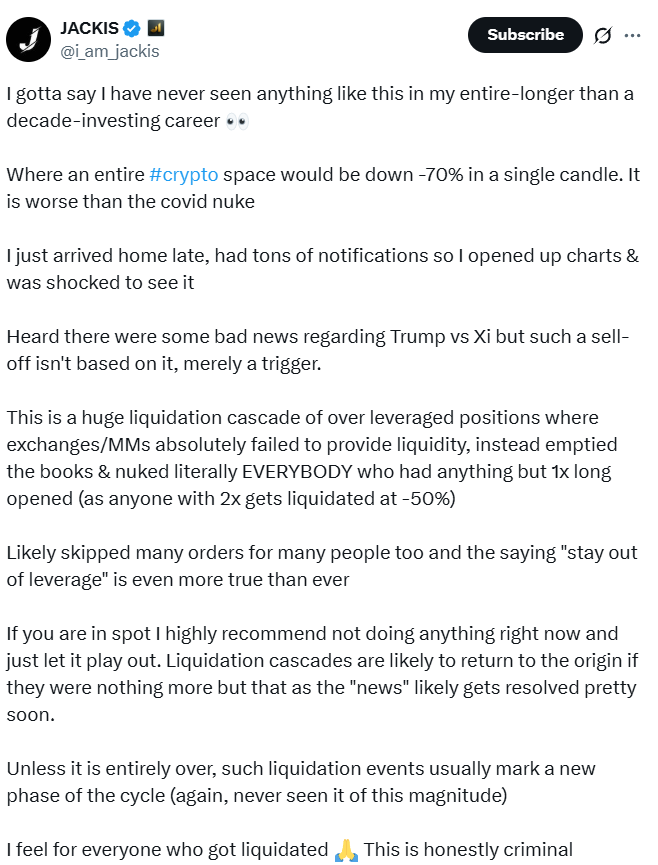
“I gotta say I have never seen anything like this in my entire-longer than a decade-investing career,” said one investment expert, describing how order books thinned out dramatically during the free-fall.
@i_am_jackis noted his perspective regarding liquidation event. Source: @i_am_jackis on X.
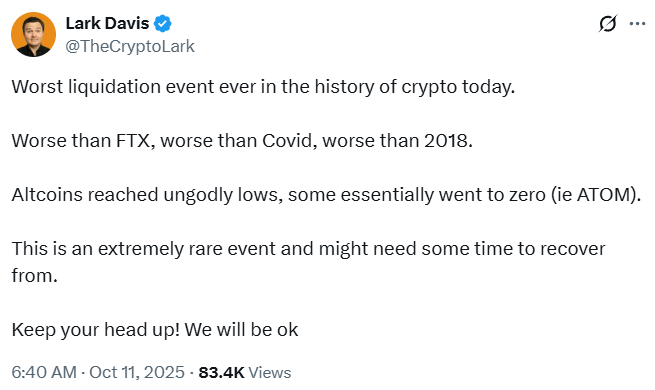
Bitcoin Investor and founder of Wealth Mastery, Lark Davis, wrote on X:
“Worst liquidation event ever in the history of crypto today. Worse than FTX, worse than Covid, worse than 2018.”
Worst liquidation event ever in the history of crypto today. | Source: @TheCryptoLark on X
Notably, exchange infrastructure strained under the volatility. CoinGlass pointed out that the true liquidation total could be even higher, since some exchanges report liquidations with delays or limits (for example, Binance logs only one liquidation order per second). In other words, the $19B figure is likely a conservative estimate of the carnage.
Market veterans drew parallels to past “black swan” events but acknowledged the sheer scale was new.
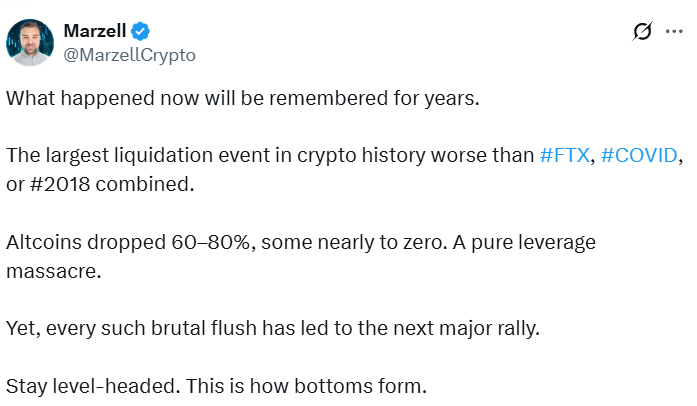
“What happened now will be remembered for years. The largest liquidation event in crypto history worse than #FTX, #COVID, or #2018 combined,” one X user remarked in astonishment.
The largest liquidation event in crypto history worse than #FTX, #COVID, or #2018 combined. | Source: @MarzellCrypto on X.
What might have been a moderate pullback turned into a vicious leverage purge, as highly leveraged bets that Bitcoin and others would keep rising were violently unwound.
Bitcoin and Ethereum Plunge from All-Time Highs
Ironically, this crash came just days after the crypto market was celebrating new all-time highs. Bitcoin had surged above $125,000 earlier in the week, a fresh peak, amid optimism about ETFs and macro trends. Ethereum too was trading near multi-year highs around the mid-$4,000s. The sudden reversal shocked many:
Bitcoin (BTC): After Trump’s tariff remarks, BTC nosedived over 12% intraday, falling from roughly $122K down to about $113,600 by Friday evening. In the depths of the panic, Bitcoin even briefly dipped under $102,000 on some exchanges before quickly bouncing back above $110K. By midday Oct. 11, Bitcoin steadied around $111,500, still down about 8% from 24 hours prior. This collapse wiped out over $5.3 billion in Bitcoin long positions alone. Essentially, BTC gave up all its gains since August in a matter of hours.
Ethereum (ETH): The second-largest crypto saw an even sharper percentage drop at one point. ETH plunged from above $4,300 to roughly $3,373 at its lowest point during the sell-off, a nearly 18% intraday crash. It later recovered to about $3,780 (down 12–13% on the day) once volatility subsided. Ethereum’s market cap slid under $460B. CoinGlass data shows about $4.4 billion in ETH longs were liquidated in the rout, almost as much pain as Bitcoin traders saw.
For both top coins, these were their steepest one-day drops in years. The speed of the decline was exacerbated by high leverage: many traders had piled into long positions expecting prices to keep climbing.
When the market turned, it triggered a chain reaction of auto-deleveraging. Trading algorithms and bots amplified the momentum, as prices fell, more long positions got liquidated, which in turn pushed prices down further in a vicious feedback loop.
It’s worth noting that even after the plunge, Bitcoin remains in a longer-term uptrend, it is still up significantly year-to-date, and as analysts pointed out, “BTC remains above its 200-day moving average, so the bull market structure is intact”. Still, seeing over $1 trillion in Bitcoin’s market value evaporate overnight (before partially recovering) was a jarring reminder of crypto volatility.
Altcoin Bloodbath: SOL, XRP, DOGE Among Biggest Losers
If Bitcoin and Ether’s drops were painful, many altcoins fared even worse. Second-tier cryptocurrencies, which often have smaller liquidity and more speculative interest, saw double-digit percentage losses across the board as panic spread. Some of the notable moves:
Solana (SOL): Solana, a top smart contract platform, was hit hard. Its price crashed from around the $180 level to roughly $144 at the trough. CoinGlass reported SOL accounted for about $2 billion of the liquidations, among the largest for any single altcoin. Solana’s high flying run in recent weeks came to an abrupt end, with the coin down 20% in the blink of an eye.
XRP: XRP plunged as much as 30% at one point before paring losses. It fell from about $2.83 to $1.89 during the crash, a −33% swing, before recovering above $2. XRP ended roughly 22% down on the day. This erased weeks of gains for the token, which had been rallying on speculation of new use-cases.
Dogecoin (DOGE): The meme-inspired Dogecoin, which often surges and falls with crowd sentiment, tanked 21% in the sell-off. DOGE dropped from the mid-$0.25 range to about $0.19. Its market cap slipped out of the top 10 as many short-term traders capitulated. Despite upcoming events (like a possible Doge ETF in the works), panic selling gripped DOGE until it found support around 19 cents.
BNB: BNB, the native coin of the Binance ecosystem, showed relative resilience but still fell over 6%. It dipped from $300 to around $280, reflecting both the broad sell-off and perhaps some flight to safety within Binance’s platform.
Other Altcoins: Virtually every other cryptocurrency was deep in the red.
Many smaller-cap coins experienced flash crashes well beyond 50–60%, especially in decentralized finance (DeFi) and newer sectors. Some thinly traded tokens plunged 80–90% within minutes as liquidity vanished.
Stablecoins like Tether (USDT) briefly saw a premium, USDT held at about $1.00 as investors sold volatile assets for stable value. Another stablecoin, Ethena’s USDE, momentarily broke below its peg amid the turbulence.
Even newly listed high-flyers weren’t spared.
For example, Aster (ASTER), a decentralized exchange token that had just debuted on Binance on Oct. 6, saw its momentum fizzle.
Aster had rallied an eye-popping 2,450% since its launch in September, reaching a $3.5B valuation.
It peaked around $2.42 and was one of the hottest topics on crypto Twitter. But as the market cratered, ASTER’s price recoiled from the highs.
It staged an “unexpected 5% rebound” on its Binance listing news, but that was quickly overshadowed by the tariff-driven sell-off.
Whales and Insider Bets: Profiting Amid the Carnage
While millions of traders suffered, at least one whale trader benefitted from the crash.
Crypto analysts have been abuzz about an entity who seemingly anticipated the plunge and positioned accordingly on Hyperliquid, a rising decentralized derivatives exchange. This anonymous whale opened massive short positions (betting on price drops) on BTC and ETH just 20–30 minutes before Trump’s tariff post went public.
When the market tanked, those shorts paid off immensely. The whale’s timely shorts yielded roughly $190–$200 million in profit in a single day. “The BTC whale closed 90% of his BTC short and fully closed his ETH short, making around $190M–$200M profit… The crazy part is he shorted another 9-figures worth right before the cascade,” one analyst noted.
BTC whale nets $200M in a day after closing major shorts on Hyperliquid. | Source: @mlmabc on X
Such uncanny timing has led to rampant speculation of insider knowledge. Traders are debating whether this was simply a savvy player reading macro signals or someone who got an early whisper of Trump’s tariff move. It wouldn’t be the first time large crypto moves coincided with insider trading allegations.
Blockchain forensics also revealed this whale had shorted over 3,600 BTC and 76,000 ETH with high leverage, amassing a short position over $1.1 billion notional days ahead of the crash. This lends credence to the idea that some big players were positioning defensively (or opportunistically) for a potential downturn.
Regardless of motive, the whale’s windfall underscores a key point: in every crash, while the majority panic, a prepared few can reap enormous gains.
Aftermath: Is the Crypto Bull Run Over or Just a Blip?
In the wake of the crash, the critical question for investors is whether this event signals the end of the crypto bull market or a temporary shock that will pass. Market analysts are divided, but a number of experienced voices see this as more of a healthy shakeout than a long-term trend reversal.
“We could still see another month of bleeding and sideways action as the markets find their footing, with a real recovery likely not until December. But if history is any guide, after the crash and retest comes the rebound, and eventually, new all-time highs.”
In contrast, a futures trader emphasized that “It definitely will take some time for market to recover. A lot of people got wiped out, will probably see some MMs and funds closing out soon. And confidence in to investing crypto has eroded. Not many people are lining up to buy stuff that can go down 70% in a single candle.”
It definitely will take some time for market to recover. | Source: @coinmamba on X.
Some reasons for optimism:
Key supports held: Bitcoin, despite the chaos, held the critical $100,000 support zone (it briefly dipped just below $102K, but bounced back). Ethereum likewise stayed above $3,300 support.
Leverage flushed out: A massive amount of excess leverage has now been purged from the system. Such flush-outs can reset the market for a more sustainable climb.
Institutional interest: Large funds may be quietly accumulating Bitcoin around the $105k–$110k levels, seeing it as a bargain in a longer-term uptrend.
Macro factors: The U.S. Federal Reserve is widely expected to ease monetary policy in coming months. Easier liquidity and the approval of Bitcoin and Ethereum spot ETFs could bring a wave of new capital into the market.
That said, volatility remains high. Much will depend on how the geopolitical situation unfolds. If Trump’s tariff threat escalates into a prolonged trade war with China, risk assets could face continued pressure. Conversely, if tensions ease, a relief rally could follow.
For now, the crypto community is licking its wounds and reassessing risk management. The crash was a stark reminder that even in a bull market, rapid corrections can strike without warning.
Trump’s tariff bombshell triggered a historic crypto crash, but it does not necessarily spell doom for digital assets. The fundamentals haven’t changed, only sentiment and leverage have. The event has reset the market, clearing the path for a healthier long-term climb once stability returns.
The biggest crash in history will be remembered as a trial by fire, one that tested the market’s resilience and left lasting lessons for traders and hodlers alike.
Why did Trump’s tariff announcement cause such a massive crypto crash?
Trump’s surprise declaration of a 100% tariff on all Chinese imports reignited global trade war fears. Investors panicked and fled risky assets like cryptocurrencies, leading to a chain reaction of liquidations across exchanges already overloaded with leverage.
How much was lost during the October 2025 crypto crash?
Over $19 billion in leveraged positions were liquidated within 24 hours, the largest single-day liquidation in crypto history. The total crypto market cap shrank by about $560 billion in a single day.
Did anyone profit from the crash?
Yes. One major trader, dubbed the “Hyperliquid Whale” shorted Bitcoin and Ethereum minutes before the crash and reportedly made nearly $200 million in profit. The timing led to speculation of insider knowledge, though it remains unproven.
Is the crypto bull market over after this crash?
Not necessarily. Analysts believe the crash may be a temporary correction rather than a trend reversal. Key supports for Bitcoin and Ethereum held, leverage has been flushed out, and long-term fundamentals remain strong.
Disclaimer:
The information provided in this article is for informational purposes only. It is not intended to be, nor should it be construed as, financial advice. We do not make any warranties regarding the completeness, reliability, or accuracy of this information. All investments involve risk, and past performance does not guarantee future results. We recommend consulting a financial advisor before making any investment decisions.
Onkar Singh has three years of experience as a digital finance content creator. Throughout his career, he has collaborated with various DeFi projects and crypto media outlets. In his leisure time, he enjoys fitness activities at the gym and watching movies across different genres. Balancing his professional and personal interests, Onkar continues to contribute to the digital finance landscape while pursuing his hobbies.


 Easy
Easy