Dogecoin ETF (DOJE) Launch Guide: Key Dates, How to Buy and Key Risks.
Share
Key Takeaways
DOJE debuted on Sept. 18, 2025, as the first U.S. ETF built around a memecoin.
Structured under the 1940 Act with a Cayman subsidiary, the fund overcame earlier delays to secure approval.
While the ETF offers simplified, regulated access to Dogecoin, it introduces additional costs and removes some of the utility associated with holding DOGE directly.
DOJE carries the same speculative, volatile traits as Dogecoin itself, making it suitable only for investors prepared to handle sharp price swings.
The REX-Osprey Dogecoin ETF (DOJE), launched on Sept.18, 2025, is the first U.S. exchange-traded fund designed to track the price of Dogecoin, a popular “memecoin” cryptocurrency originally created as a joke.
DOJE ETF is now Trading. | Source: @REXShares on X
REX-Osprey is a partnership between two companies. REX Shares is skilled at creating ETFs and getting them listed on stock exchanges, while Osprey Funds specializes in managing crypto investments.
Before today, $DOJE’s path to market wasn’t easy, delays held back its debut.
Bloomberg ETF analyst Eric Balchunas noted on Sept. 9, 2025 that DOJE was set to debut that same week, calling it “the first-ever US ETF to hold something that has no utility or purpose.”
$DOJE slated for a Thursday launch. | Source: @EricBalchunas on X
The U.S. Securities and Exchange Commission (SEC) effectively allowed the fund’s registration to become effective under existing rules (rather than issuing a formal approval order as with traditional ETFs).
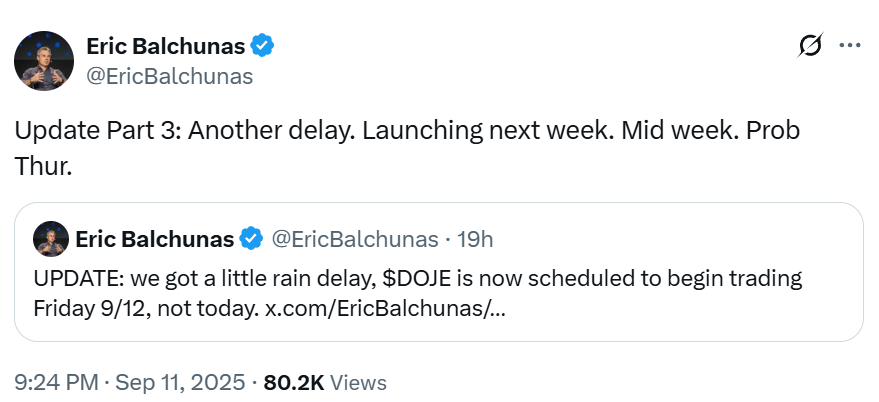
However, on Sept. 11 Balchunas informed via X that there’s been a slight rain delay, $DOJE is now scheduled to begin trading on Friday, Sept. 12. The debut has now been postponed again, with trading expected to begin on Thursday, Sept. 18, 2025.
New launch date for DOJE ETF. | Source: @EricBalchunas on X
The SEC’s tacit approval of the DOGE ETF marked the start of a U.S. “memecoin” ETF era. In other words, by not objecting to the fund’s unique structure, regulators cleared the way for the first Dogecoin-focused ETF in U.S. history.
Why Was DOJE Approved? (The 1940 Act “Back Door” Explained)
How did a Dogecoin ETF get approved while so many crypto funds awaited decisions?
The answer lies in its legal structure. The REX-Osprey DOGE ETF was filed under the Investment Company Act of 1940 (“’40 Act”), rather than the Securities Act of 1933 that spot crypto ETFs normally use.
Try Our Recommended Crypto Exchanges
Sponsored
Disclosure
We sometimes use affiliate links in our content, when clicking on those we might receive a commission at no extra cost to you. By using this website you agree to our terms and conditions and privacy policy.
This 1940 Act approach allowed the issuer to bypass the lengthy SEC review and exchange rule-change process (known as a 19b-4 filing) that spot crypto ETFs usually face. In practical terms:
40 Act structure: DOJE was set up under the Investment Company Act of 1940, which treats it like a traditional mutual fund/ETF. Investor money is pooled, and the fund follows a defined strategy. To meet legal requirements, these types of funds are often structured as C-corporations with a Cayman Islands subsidiary that actually holds the crypto. This design avoids the usual hurdles that block spot crypto ETFs.
Investor protections: The 1940 Act comes with stricter rules on diversification, custody, and governance. The DOGE ETF is required to hold a chunk of its assets in other regulated securities (like ETFs), so it isn’t 100% exposed to Dogecoin. This gave regulators more comfort that it’s not simply a speculative meme coin free-for-all.
Bypassing delays: Other Dogecoin ETF filings under the traditional process have been stuck waiting on explicit SEC approvals. By using the 1940 Act framework and an existing ETF trust, REX and Osprey didn’t need that same rule-change sign-off. This shortcut gave them a clear first-mover advantage.
Here are key differences between a spot Bitcoin/Ether ETF (traditional model) and a 40-Act ETF like the new Dogecoin fund:
Features
Spot BTC/ETH ETF
40-Act Crypto ETF (e.g., DOJE)
Legal basis
Securities Act of 1933 + exchange rule change (19b-4)
Investment Company Act of 1940
SEC process
Requires explicit SEC approval of exchange rule & prospectus
Registration becomes effective unless SEC objects
Underlying asset
Directly holds Bitcoin or Ether
Holds crypto via Cayman subsidiary; rest in securities/ETPs to meet rules
Investor protections
Custody, disclosure rules, but fewer diversification mandates
Stricter on diversification, governance, custody, leverage
Tax structure
Pass-through; taxed like most ETFs (no entity-level tax)
Often structured as a C-corp → potential tax drag on returns
Trading hours
Stock exchange hours only
Same (stock exchange hours only)
Speed to market
Slower, subject to political/regulatory delays
Faster; uses existing ETF trust and framework
Tracking accuracy
Closer to underlying asset price
May lag due to corporate taxes and asset mix requirements
When Will the DOGE ETF (DOJE) Launch (Expected Trading Date)?
$DOJE, the inaugural Dogecoin ETF, officially began trading on a U.S. exchange on Sept. 18, 2025.
Multiple reports and analyst posts in early September 2025 confirmed this timing. For example, Bloomberg’s Eric Balchunas highlighted that “$DOJE is slated for a Thursday launch,” kicking off the memecoin ETF era.
Important notes about the launch:
Exchange ticker: The fund’s ticker symbol will be DOJE. Keep an eye out for this symbol on brokerage platforms. (It’s a play on “DOGE” with a J, likely due to ticker availability.)
Official launch date: Sept. 11 was the target, now scheduled to begin trading on Thursday, Sept. 18. As of that morning, the ETF should be live for trading during normal market hours. If you’re reading this after that date, it may already be trading.
Who’s behind it: The ETF is sponsored by REX Shares in partnership with Osprey Funds, and distributed by Foreside Fund Services. This is the same team that earlier launched a Solana Staking ETF (ticker SSK) in 2025 using a similar structure. Their experience with SSK likely smoothed the path for DOJE’s debut.
After Balchunas update on the delays, Sept. 18, 2025 is when you can expect to buy or sell shares of the Dogecoin ETF on the open market. The launch is being closely watched, as Dogecoin’s price jumped 13–17% in the week leading up to the launch news, indicating high anticipation from traders.
How to Buy the Dogecoin ETF (DOJE) – U.S. and International Investors
One big advantage of an ETF like DOJE is that it’s bought and sold just like a stock. If you’re familiar with buying shares of a company or another ETF, purchasing DOJE will feel the same. Here’s a step-by-step outlook for different investors:
For U.S. Investors:
Brokerage account: You’ll need a standard brokerage account (for example: Fidelity, Charles Schwab, E*Trade, Robinhood, TD Ameritrade, etc.). Any platform that lets you trade U.S.-listed stocks or ETFs should work.
Search the ticker: Once the fund launches, search for the ticker “DOJE” on your broker’s trading app or website. The official fund name might appear as “REX-Osprey Doge ETF” or similar.
Place an order: You can buy shares during normal market hours (generally 9:30am to 4pm Eastern Time, Monday–Friday). Simply enter the number of shares or the amount you want to invest, and execute a buy order. You’ll pay the market price per share at that time (plus any small brokerage commission if your broker charges one, though many are commission-free nowadays).
Fractional shares: If the price of one share is high and your broker allows fractional shares, you could invest, say, $50 or $100 and get a portion of a share. This depends on your brokerage’s policies.
For International Investors:
Buying U.S.-listed ETFs from outside the U.S. can be a bit trickier due to local regulations, but it’s often possible:
Using an international broker: If you have access to international trading platforms like Interactive Brokers, eToro, or a local broker that offers U.S. market access, you may be able to purchase DOJE through them. You’d follow the same steps, lookup the ticker and place an order, during U.S. trading hours.
Local restrictions: Be aware of your country’s rules. For example, European Union/UK retail investors face restrictions (PRIIPs regulations) that prevent buying U.S. ETFs that don’t provide certain disclosures. DOJE, being a U.S. product, likely doesn’t have a EU Key Information Document, so EU retail investors might be blocked from buying it on European brokerages. In practice, some EU investors use brokers like Interactive Brokers or TradeStation Global to access U.S. ETFs, but do your research and comply with local laws.
Alternate routes: If you cannot buy U.S. ETFs directly, you might consider whether any local exchange plans to list a similar product, or use a CFD/derivative platform (though those come with different risks and often aren’t recommended for beginners). As of launch, DOJE is only U.S.-listed, so international investors need a platform that can trade on the U.S. exchange where DOJE is listed (likely NYSE Arca or Nasdaq).
Currency considerations: Buying a U.S. ETF means you’ll be dealing in USD. Your broker will handle the currency conversion if your account is in another currency, but note the forex fee/spread.
Buying Dogecoin (the Token) vs. Buying the Dogecoin ETF
Should you buy Dogecoin (DOGE) directly on a crypto exchange, or invest in the DOGE ETF (DOJE) instead?
Each approach has its own pros and cons. Let’s break it down:
Buying Dogecoin Directly (Holding the Actual Crypto):
Pros:
24/7 trading: Crypto markets never sleep. You can buy or sell DOGE any time, any day, even on weekends, unlike the ETF which only trades during stock market hours.
Direct ownership: You actually own Dogecoin tokens. You can transfer them to a personal wallet, use them for payments or tipping online, or participate in the crypto ecosystem (e.g. use them in DeFi apps or on platforms that accept Dogecoin).
No management fee: Holding DOGE directly doesn’t require paying an expense ratio to a fund manager. If Dogecoin’s price doubles, your holdings reflect that full increase (aside from any trading fees when you bought). There’s no annual fee eating into your coins.
Potential tax benefits for long-term holders: In some countries, holding cryptocurrency for a certain period (e.g., >1 year) can qualify you for reduced capital gains tax or even tax-free gains. (This varies by jurisdiction.) Direct ownership gives you flexibility in tax planning that an ETF might not in certain cases.
Cons:
Custody & security risks: You are responsible for keeping your Dogecoin safe. Storing crypto requires using a secure wallet. If you leave it on an exchange, the exchange could be hacked or go bust. If you hold it yourself, you must manage private keys or recovery phrases. Losing access means losing your coins permanently. There’s no FDIC insurance or recourse if something goes wrong.
Technical complexity: For newcomers, setting up a crypto wallet or navigating exchanges can be intimidating. Mistakes (like sending coins to the wrong address) can be irreversible.
Regulatory/legal hurdles: Buying crypto directly may be restricted in certain jurisdictions. You might have to go through a crypto exchange signup, possibly involving KYC verification, and deal with platforms that might not be as regulated as traditional brokers. Funding an account can also take time.
No traditional investment account use: You generally cannot hold actual Dogecoin in tax-advantaged accounts like a 401(k) or IRA. Many people prefer to keep investments in retirement accounts, which isn’t possible with the raw token.
Buying the Dogecoin ETF (DOJE):
Pros:
Ease of access: If you already invest in stocks or ETFs, buying DOJE is as easy as buying any stock. Use your existing brokerage, no new accounts or crypto exchanges needed. It fits right into your normal portfolio interface. Investors often prefer ETFs for easier access and not having to deal with crypto wallets or unfamiliar platforms.
No wallets or keys: The ETF handles the custody of Dogecoin behind the scenes (via its institutional custodians). You don’t need to worry about digital wallets, safeguarding private keys, or the risk of losing coins. This greatly simplifies security for the user. Your investment is in shares held at your brokerage, just like a stock.
Regulated and familiar: DOJE is regulated by the SEC and operates under established fund rules. The fund’s assets are held by qualified custodians with insurance, audits, etc. This structure may give peace of mind compared to the “wild west” vibe of some crypto exchanges. It’s a familiar investment product – you get brokerage statements, you can set limit orders, etc., like any other ETF.
Use in traditional accounts: Perhaps one of the biggest advantages – you can hold the Dogecoin ETF in tax-advantaged accounts (like an IRA or Roth IRA in the U.S.). This means any growth could be tax-deferred or tax-free (depending on the account type), which isn’t an option if you hold the token directly. Also, financial advisors or institutions that can’t handle actual crypto can hold an ETF for you.
No direct crypto exchange exposure: You avoid having to keep money on a crypto exchange. Your counterparty is the ETF and the regulated exchange it trades on, not an offshore crypto exchange. This shields you from risks like crypto exchange insolvencies (e.g., FTX collapse scenarios), at least for the portion invested via the ETF.
Cons:
Expense ratio and tax drag: The ETF charges a yearly fee and may owe corporate taxes. These costs slightly reduce returns compared to holding Dogecoin directly. You’re paying for convenience and regulated access.
Market hours only: DOJE trades only when U.S. stock markets are open. Unlike DOGE’s 24/7 trading, you can’t react on weekends or overnight. Big news outside market hours can cause sharp price gaps.
Liquidity and spreads: As a new ETF, early trading volume may be thin. This can lead to wider buy-sell spreads and temporary price mismatches. Liquidity should improve as the fund gains popularity.
No real-world use: ETF shares can’t be withdrawn or used for payments. You don’t own Dogecoin itself, only exposure to its price. It’s purely an investment vehicle.
Concentration & limits: DOJE only tracks Dogecoin’s moves, minus fees. You can’t outperform the coin; returns will be slightly lower than DOGE’s. There’s no diversification to cushion losses.
So choosing between DOGE and the DOJE ETF comes down to your priorities: If you value simplicity, security, and the ability to use traditional investment accounts, the ETF is very appealing. It turns a highly speculative asset into a familiar form.
On the other hand, if you want around-the-clock trading, zero management fees, and the ability to actually use Dogecoin in the crypto ecosystem, holding the coin directly is the way to go.
There’s no one-size-fits-all answer – some enthusiasts might even do both (e.g., hold some DOGE in a wallet and some ETF shares in a retirement account).
Ultimately, it’s all about what fits your needs and risk tolerance.
Key Risks of Investing in the Dogecoin ETF (DOJE)
Extreme volatility: Dogecoin’s price can move by double digits in short periods; the ETF mirrors these swings. Significant, rapid losses are possible.
Meme-coin/speculative nature: Dogecoin has no cash flows or fundamental utility. Price is driven largely by sentiment, community, and pop-culture signals; hype reversals can cause sharp declines.
Concentration risk: DOJE is a single-asset fund (economic exposure to Dogecoin). There’s no diversification to offset DOGE drawdowns.
Regulatory/legal risk: Crypto rules are evolving. Changes to exchange oversight, classification of assets, or fund structures (e.g., use of an offshore subsidiary) could affect liquidity, operations, or even lead to trading halts/liquidation.
Tax/structure drag: The fund’s C-corp plus Cayman-subsidiary setup can introduce tax liabilities and tracking error versus spot DOGE. Subsidiary size limits (e.g., 25%) and tax treatment uncertainties can affect performance.
Liquidity/trading frictions: As a new ETF, initial trading spreads could be wider and volumes uncertain. Stress in underlying crypto markets can widen ETF discounts/premiums and complicate creations/redemptions.
Behavioral risk: Ease of buying an ETF can mask the asset’s speculative nature, increasing the chance of chasing hype or panic-selling.
Other Dogecoin and Memecoin ETF Applications in the Pipeline
Grayscale Dogecoin Trust (ETF conversion): Filed to convert its DOGE trust into a U.S. ETF; an SEC decision window was indicated for mid-October 2025. Not approved as of the timeframe described.
Bitwise & 21Shares spot DOGE ETFs: Filed in 2024 under the traditional route. Initial SEC decision dates cited were October 18, 2025 (Bitwise) and January 9, 2026 (21Shares); timelines can be extended.
Additional REX-Osprey products: Filings/signals for other memecoin or crypto ETFs (e.g., TRUMP, XRP, BONK). Some were delayed during review; SOL + Staking (SSK) launched earlier in 2025; an ETH + Staking product was in registration.
Canary Capital TRUMP memecoin ETF: A “Trump Coin” ETF proposal tied to a Solana-based token was filed; proposal stage only, no approval.
Possible SHIB ETF: No major U.S. SHIB ETF filing noted as of the timeframe; SHIB exposure more likely via non-U.S. ETPs or future index products.
Crypto index/themed ETFs: Broader crypto baskets (potentially including DOGE) have been proposed; would provide diversified exposure rather than single-asset focus.
Regulatory backlog: Dozens of crypto ETF proposals were reportedly under consideration; outcomes may cluster around key decision windows, but approvals can vary by asset and structure.
Conclusion
The REX-Osprey Dogecoin ETF (DOJE) is a milestone in crypto investing, marking the first time a U.S. exchange-traded fund is dedicated to a memecoin.
Approved under the Investment Company Act of 1940, it avoided the longer approval route that stalled other crypto ETFs. Now launching on September 18, 2025, DOJE offers investors a way to access Dogecoin exposure through regulated brokerage accounts instead of crypto exchanges.
However, this convenience comes with significant risks: Dogecoin’s speculative nature, extreme volatility, and the ETF’s unique tax and structural setup all mean investors should approach it as a high-risk, speculative allocation.
Whether DOJE is a novelty or the start of a broader memecoin ETF trend, it signals how traditional finance is increasingly embracing crypto culture.
What makes the Dogecoin ETF different from buying DOGE directly?
The ETF trades like a stock, requires no crypto wallets, and can be held in retirement accounts. But unlike holding DOGE itself, ETF investors can’t use tokens for payments or transfers.
Why was this ETF approved so quickly?
It used the 1940 Act structure, which regulates mutual funds and ETFs. This allowed REX and Osprey to bypass the slower spot ETF approval process, while giving regulators comfort through stricter investor protections.
Can international investors buy DOJE?
Yes, if their broker provides access to U.S. markets. Some regions (like the EU/UK) restrict direct purchases of U.S. ETFs due to disclosure rules, so investors may need specialized brokers like Interactive Brokers.
Is this ETF safer than buying DOGE on a crypto exchange?
It reduces custody risks (no wallets/keys) and offers a regulated framework. But price risk, volatility, and speculation remain the same, both are high-risk.
Disclaimer:
The information provided in this article is for informational purposes only. It is not intended to be, nor should it be construed as, financial advice. We do not make any warranties regarding the completeness, reliability, or accuracy of this information. All investments involve risk, and past performance does not guarantee future results. We recommend consulting a financial advisor before making any investment decisions.
Onkar Singh has three years of experience as a digital finance content creator. Throughout his career, he has collaborated with various DeFi projects and crypto media outlets. In his leisure time, he enjoys fitness activities at the gym and watching movies across different genres. Balancing his professional and personal interests, Onkar continues to contribute to the digital finance landscape while pursuing his hobbies.


 Easy
Easy