Bots on X are driving crypto scams, draining wallets and eroding trust. Experts warn fixes are urgent to protect users and rebuild credibility. | Credit: CCN.com
Share
Key Takeaways
Despite Elon Musk’s efforts to clean up X, coordinated bot networks flood the platform with crypto scams, phishing links, and fake token promotions.
Daniel Brundson explains that artificial intelligence has made it “easier for bots to appear more human.”
Tactics like “reply-and-block” and mass automation can suppress legitimate voices, distorting public discourse.
Experts recommend human-centric verification, better transparency, and behavioral throttling for spam bursts.
In recent years, X, formerly Twitter, has become the main stage for crypto discourse and, increasingly, for crypto scams.
Botnets, impersonators, and spammy “arbitrage bot” schemes flood feeds with misleading links and fake token promos. Add AI-generated content and tactics designed to game the algorithm, and you have a hostile environment for ordinary users and legitimate builders alike.
This article explains how scams work, why they persist, what X says they are doing, and how users can protect themselves. It is augmented by expert commentary from security practitioner Daniel Brundson, Growth + Local Lead at human.tech by Holonym.
Try Our Recommended Crypto Exchanges
Sponsored
Disclosure
We sometimes use affiliate links in our content, when clicking on those we might receive a commission at no extra cost to you. By using this website you agree to our terms and conditions and privacy policy.
Not All Bots Are Equal: How Semi-Automation and AI Are Powering Crypto Scams on X
Not all bad actors on X are fully automated. Many accounts are semi-automated or operate in coordinated clusters, blending human operators with scripted posting to amplify reach.
Impersonation bots pose as influencers or project founders to lend credibility to phishing links. Meanwhile, AI/LLMs help botnets produce more natural-sounding replies, masking repetition and obvious tells that automated detection tools used to catch.
Brundson told CCN: “X has been flooded with bots promoting crypto scams. From your perspective, why has the platform failed to control this problem?”
“X does have tools to address spam, but the individuals responsible for the spam are smart. They understand the X tools, and are able to quickly make adjustments to work around the tools, creating a game of whack-a-mole that has been lucrative enough for the spam creators that they continue to invest time, money, and effort into the strategy.”
How the Crypto Scams Evolve (and Why AI Matters)
AI lowers the cost of producing convincing content and increases the variability of posts across a botnet, making pattern-based takedowns harder.
Brundson states, “How are these bot-driven scams evolving: are they just spam, or are they now using AI to appear more human?”
“AI has definitely made it easier for bots to appear more human and work around X’s defenses. Spam-prevention tools that are looking for specific patterns to take down bot networks are going to have a more difficult time identifying and applying rules that can target large spam networks due to the variation that they can add to their posts using AI,” Brundson added.
Common patterns include fake giveaways, “airdrop” announcements that link to wallet drainers, and arbitrage bot contracts that claim to run profitable strategies but actually siphon funds once you approve permissions.
Manipulating Visibility: The “Reply-and-Block” Tactic
One tactic researchers and journalists have flagged is reply-and-block: bot accounts reply to your post to register engagement and then immediately block you, possibly signaling to ranking systems that your content should be de-boosted.
For Brundson, who spent several years at Twitter (now X), “Some reports suggest bots reply-and-block to “deboost” real accounts. How dangerous is this kind of algorithm manipulation for public trust and what role human.tech plays to protect users from this kind of scam?”
Tweet 1/5 Ever wonder how #CryptoScams REALLY work? It's a "Funnel of Deception" designed to lure, build trust, trap, & disappear. Knowing the stages is your best defense! See the diagram below & let's break it down.#ScamAlert#CoreRecoverpic.twitter.com/hHZMzwx6Nd
“I’m unfortunately not familiar with this strategy. However, if X were to enable users to link their blockchain wallets to their accounts, we’d be able to apply a human verification mechanism, similar to the previous verification system that Twitter used for both reputable accounts and bots, but at scale.”
Brundson also said that any malicious strategy to reduce the visibility of reputable human accounts reduces the quality of the platform, as key voices in important areas might have a difficult time communicating perspectives that add value to, or are critical to shape, the public conversation.
The broader harm goes beyond individual creators — it undermines the integrity of discourse itself: throttling authentic voices and amplifying fake ones erodes trust.
X’s Countermeasures and Why Critics Say They Fall Short
X has rolled out measures to deter spam, including a “Not A Bot” program that charges a small fee for new accounts to interact, and periodic sweeps that suspend networks violating manipulation rules. The company also touts legal action against groups attempting to bribe their way back onto the platform.
But critics argue these steps don’t materially raise the cost for determined operators; fees are trivial at scale, and enforcement can be inconsistent and opaque. Meanwhile, reduced data/API access has made independent measurement harder.
Human.tech’s Brundson emphasizes that “Do you think Elon Musk’s paywall experiments and the “Not A Bot” program are real solutions, or just PR?”
“Elon enabling anyone to verify their account with a paid subscription removed any value the verification program previously had. Making it pay-to-play may have increased their revenue, but made it much more difficult to understand who is behind accounts, especially high-profile figures.”
For the expert, they have made progress in reinstating a version of verification that does help to identify different types of accounts, but bad actors can still appear to be credible with a simple subscription.”
Beyond the Crypto Scam: Financial Losses and Reputational Damage
The immediate harm is financial—people lose funds to wallet drainers, fake token promos, or “arbitrage bot” contracts. But the second-order effect is reputational: when scams trend louder than innovation, the entire field suffers.
Brundson said: “Bad news will always find good publicity coverage. The more scammers see success, the more they will be featured in the news and further drive a negative perception of the space, while positive developments are buried.”
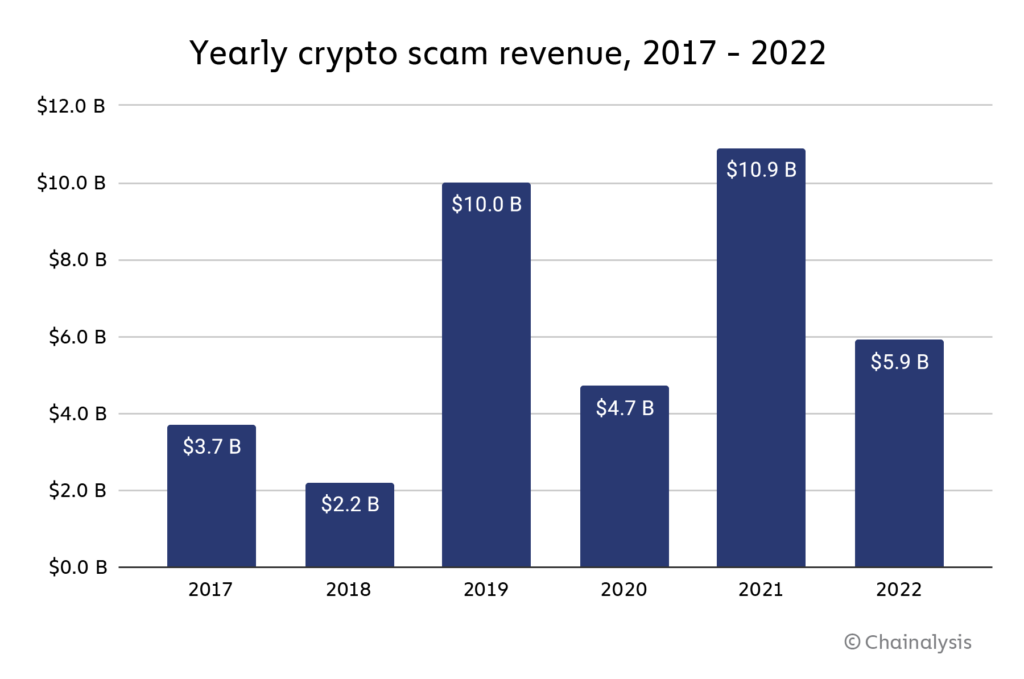
Crypto scam revenue between 2017 and 2022. | Credit: Chainalysis
According to him, this damages the entire industry, preventing new users from onboarding, and money from coming in to help develop positive use cases.
For projects trying to build, bot-amplified noise crowds out genuine updates. For the public, nonstop exposure to scams fosters the belief that Web3 is a grift, even as credible teams continue to ship.
What Can Be Done: Rebuilding Trust and Raising the Cost of Crypto Fraud
Experts point to two broad fixes: rebuild trust and safety capacity and raise the cost of inauthentic behavior, not just with fees but with better verification and more transparent enforcement.
About what would be the most urgent step to cut down bot-driven crypto fraud today, Brundson said: “Invest in your trust and safety team. They were well funded and doing great work before the acquisition, but the majority of the team was let go as part of the acquisition.”
“I’m not sure how well that team is funded now, but they can use funding to help research and implement new tooling to address the problem.”
“Also, consider new human verification methods. There are many out there, and they could help users better understand the context of the account they are engaging with,” he added.
Concrete avenues often cited by researchers and practitioners include:
Tiered human verification: Optional wallet-linking (with privacy protections), enterprise attestations, or government-grade eID where available, so that users can choose stronger identity assurance for sensitive interactions.
Behavior-based throttles: Dynamic limits that clamp down on mass-reply, mass-mention, or link-heavy activity spikes typical of spam waves.
Open telemetry for researchers: Privacy-safe aggregates, or limited API endpoints, so third parties can benchmark bot prevalence and hold platforms accountable.
Shared blocklists & intel: Collaboration among exchanges, auditors, and social platforms to kill off known drainer contracts, phishing domains, and scam wallets before metastasizing.
Transparent enforcement reports: Regular, verifiable disclosures on takedowns, including method and reason codes, to restore public trust.
Until Fixes Arrive: Practicing Personal Crypto Security Hygiene on X
Until systemic fixes land, personal security hygiene is your best defense:
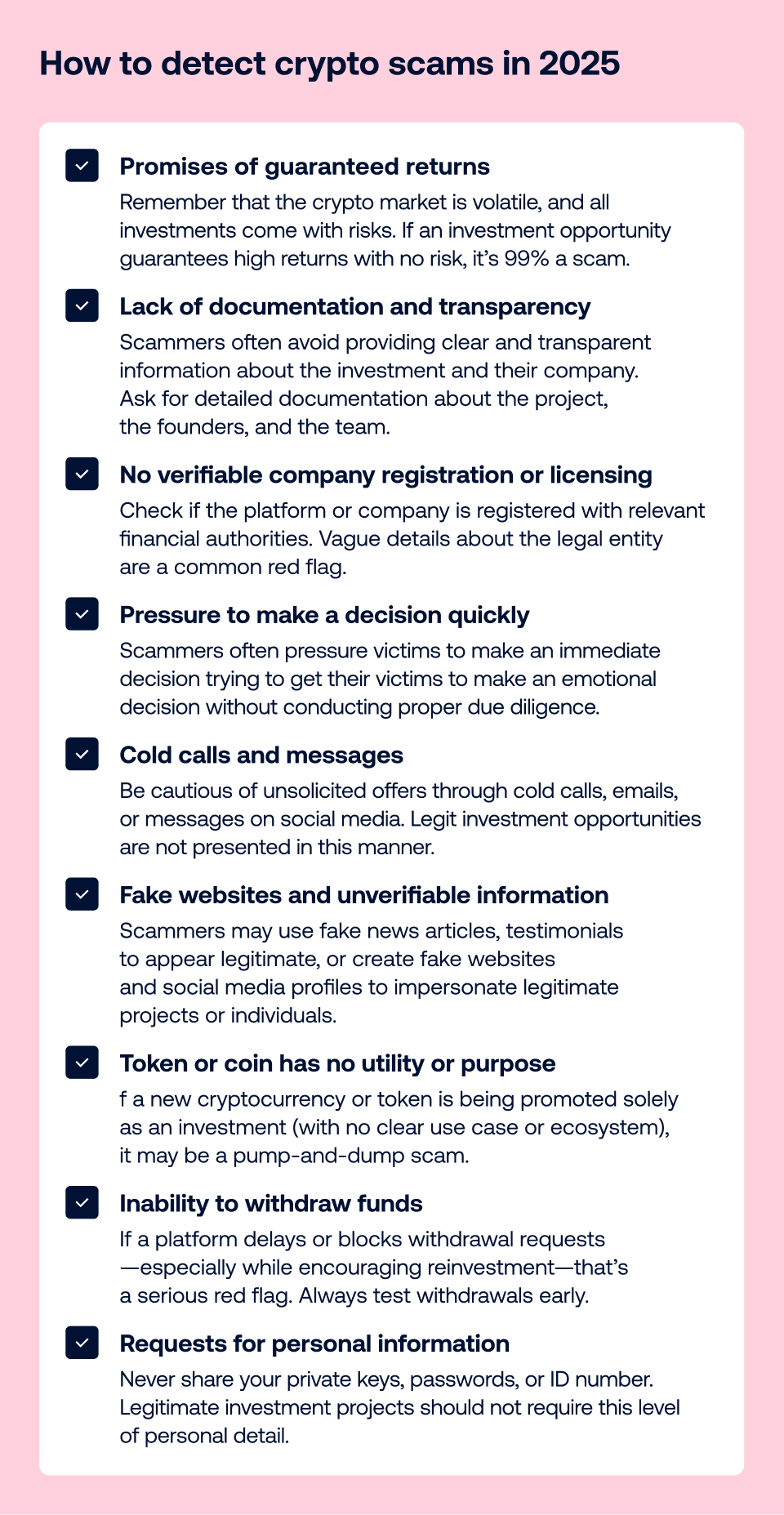
Treat every link as hostile unless you verify the source through multiple channels (official site, docs, GitHub, legit community channels).
Never sign or approve a contract prompted by a social post. Use a burner wallet with minimal funds and strict permissions if you must.
Ignore “too good to be true” ROI claims, giveaways, or airdrops that require urgent wallet interactions.
Verify identities off-platform: Cross-check ENS, verified websites, or notarized profiles.
Use allowlist-first settings in wallet extensions, revoke lingering approvals, and set spending caps.
Report and blocksuspicious accounts; aggregate reporting data helps platforms spot botnets.
Diversify information sources: trusted researchers, audits, and technical communities will consistently outperform viral threads.
Conclusion
X’s crypto conversation is robust and precarious. Botnets and scammers have seized algorithmic quirks and verification gaps to scale their operations, while AI helps them blend in. Platform moves like small paywalls or sporadic purges haven’t changed the economics of abuse enough to stem the tide.
Daniel Brundson’s perspective underscores the core truth: this is whack-a-mole because it’s profitable and defenses haven’t evolved as quickly as offenses.
Reinvesting in trust and safety, augmenting with human-centric verification, and restoring measurement transparency are the practical steps that can shift incentives.
Until then, user vigilance is the firewall. Stay skeptical of viral claims, slow down before you click or sign, and lean on verified sources. In a market where attention is currency, your caution is capital.
After Elon Musk’s acquisition, X loosened some moderation and verification controls while becoming the primary hub for crypto discussion. That combination of high visibility, low friction, and reduced safety oversight created fertile ground for scammers.
Are bots really using AI now?
Yes. AI and large language models make bots more adaptable and human-like.
What is the “reply-and-block” trick?
This tactic involves bots replying to a user’s post to register engagement, then immediately blocking them, potentially signaling the algorithm to suppress that user’s content (“deboosting”). It’s a manipulation strategy that harms visibility and trust on the platform.
How do these scams affect investors and the crypto industry?
Financial losses are the most direct consequence; users lose funds to drainer contracts or fake tokens. But the broader damage is reputational.
Disclaimer:
The information provided in this article is for informational purposes only. It is not intended to be, nor should it be construed as, financial advice. We do not make any warranties regarding the completeness, reliability, or accuracy of this information. All investments involve risk, and past performance does not guarantee future results. We recommend consulting a financial advisor before making any investment decisions.
Giuseppe Ciccomascolo began his career as an investigative journalist in Italy, where he contributed to both local and national newspapers, focusing on various financial sectors.
Upon relocating to London, he worked as an analyst for Fitch's CapitalStructure and later as a Senior Reporter for Alliance News. In 2017, Giuseppe transitioned to covering cryptocurrency-related news, producing documentaries and articles on Bitcoin and other emerging digital currencies. He also played a pivotal role in establishing the academy for a cryptocurrency exchange website. Crypto remained his primary area of interest throughout his tenure as a writer for ThirdFloor.


 Easy
Easy