Ripple moves 250M XRP from Escrow: what the transfer could mean for XRP supply and market balance | Credit: Hameem Sarwar/CCN.com
Share
Key Takeaways
Ripple transferred 250 million XRP ($520 million) from escrow to an unknown wallet on Dec 7, 2025.
The move does not currently increase market supply.
Ripple’s escrow model ensures predictable, controlled token releases.
Market watchers remain alert to any subsequent movements indicating distribution or sale.
On Dec. 7, 2025, blockchain monitoring services such as Whale Alert reported that Ripple Labs moved 250 million XRP from one of its escrow wallets to an unknown address. The transaction, valued at over $520 million at the time, immediately drew attention across the crypto community.
Data from XRPScan confirmed that the transaction originated from a Ripple-controlled wallet. The destination address, however, is not linked to any known cryptocurrency exchange or institutional custodian, leaving the purpose of the transfer unclear.
This move is part of Ripple’s ongoing monthly escrow release cycle, where up to 1 billion XRP are unlocked and either redistributed, re-locked, or held for future use.
Background: Ripple’s Escrow System and Supply Control
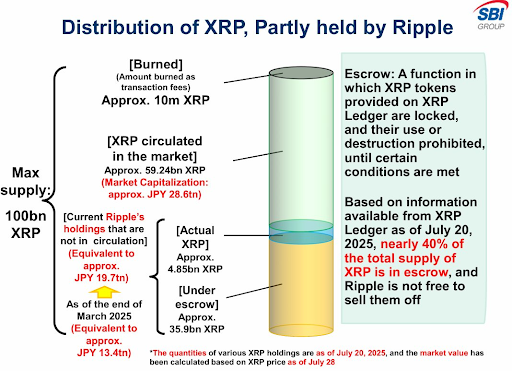
Since 2017, Ripple has managed its massive XRP holdings through a time-locked escrow system designed to prevent oversupply in the market.
Distribution of XRP, party held by Ripple. | Credit: Bitcoinist
Historically, Ripple re-locks or returns around 700-800 million XRP, circulating only 200-300 million XRP monthly.
As of late 2025, an estimated 35-38 billion XRP remain in escrow. This predictable release schedule helps stabilize XRP’s circulating supply and avoid sudden market shocks.
Why Ripple Might Move 250M XRP
While Ripple has not issued an official statement regarding this transfer, several industry experts propose plausible explanations:
Operational funding: Ripple could be preparing funds for business expansion, institutional settlements, or ecosystem partnerships.
Custodial allocation: The XRP might have been moved to a cold or institutional custody wallet, meaning no immediate sale pressure.
Future market distribution: It’s possible this tranche will later be used for liquidity provisioning or strategic sales.
Because the receiving wallet isn’t tied to an exchange, the XRP is not immediately entering market circulation, reducing fears of an imminent sell-off.
Economic Perspective: Supply, Demand and XRP’s Market Dynamics
From an economic perspective, XRP’s recent price behavior around the $2 psychological level reflects a balance between supply-side pressure and holder demand.
Despite Ripple’s disciplined supply management through its escrow system, short-term market forces, like whale activity, have created friction. Large XRP holders (whales) have reportedly sold over 390 million XRP in the past week, adding selling pressure that mirrors a textbook supply increase effect, where greater availability of tokens in circulation can weigh on prices.
🚨 XRP Whale Alert 🚨 Over the last 7 days, wallets holding 1M–10M XRP have offloaded 390+ MILLION XRP worth $783M+ at current prices. pic.twitter.com/s80ELE6Awj
At the same time, long-term XRP investors are demonstrating growing conviction, with the share of XRP held for 1–2 years increasing notably. This trend aligns with the demand stability principle, where committed holders absorb market shocks by holding through volatility, helping maintain price equilibrium.
The result is a temporary market standoff: Ripple’s supply discipline and holder confidence are counterbalancing whale-driven selling. Unless either side gains dominance,XRP is likely to remain rangebound near $2 until new macro or adoption catalysts shift market demand.
Market Impact: What the Transfer Means for XRP Supply and Liquidity
Ripple’s recent transfer of 250 million XRP from escrow to an unknown wallet has drawn attention due to its potential influence on market liquidity and token supply. Since the funds have not been moved to any known exchange, the immediate circulating supply of XRP remains largely unchanged, reducing short-term selling pressure. This effectively tightens available liquidity, which can help support price stability if demand holds steady.
Ripple just moved 250M $XRP, and the entire liquidity structure shifted within minutes.
• Exchange reserves down 2.51% • Taker Buy CVD climbing aggressively • Double-bottom forming at $1.99 • Neckline sitting at $2.2443, the level everyone’s watching
However, the long-term impact will depend on whether Ripple re-locks, holds, or gradually releases the tokens into circulation. If the coins are eventually used for partnerships, liquidity provisioning, or institutional sales, it could incrementally increase supply, influencing market balance and investor sentiment over time.
1. Short-Term Supply Tightening
The transfer effectively removes 250 million XRP from liquid circulation, potentially reducing short-term sell pressure. Traders often view this as a bullish indicator, especially if the tokens remain idle.
2. Stable Price Sentiment
At the time of the move, XRP traded near $2.09, with minor volatility. Analysts suggest the transaction aligns with Ripple’s long-standing supply discipline rather than a dumping event.
3. Future Liquidity Uncertainty
If the XRP is later transferred to exchanges, the added liquidity could create short-term downward pressure. Monitoring on-chain movements of the receiving wallet remains essential for traders and investors.
Could Ripple’s 250M Token Move Affect XRP’s Price?
According to analysts, the 250 million XRP move could support XRP’s medium-term price if demand continues to grow, particularly as institutional adoption and regulatory clarity improve.
XRP price performance. | Credit: CoinMarketCap
If Ripple continues its trend of strategic re-locking and gradual distribution, market confidence may strengthen. Conversely, large sales or redistributions could temporarily weigh on price momentum.
Ripple’s 250M XRP Move: ChatGPT’s Price Outlook
According to ChatGPT, Ripple’s transfer of 250 million XRP is unlikely to cause an immediate major price movement, since the tokens have not been sent to exchanges where they could directly impact liquidity or trigger selling pressure.
As long as the XRP remains in a private or institutional custody wallet, the transfer effectively tightens the circulating supply, which may help support short-term price stability or even modest gains if demand continues to grow.
However, the longer-term price impact depends on Ripple’s next actions. If the company re-locks or holds these tokens for strategic use, such as partnerships or liquidity management, it would signal disciplined supply control, a factor that could strengthen market confidence.
Conversely, if Ripple decides to sell or distribute the tokens later, the added liquidity could create temporary downward pressure on the market.
XRP price outlook after Ripple’s 250M token move. | Source: ChatGPT
What XRP Investors Should Watch Next
Destination wallet activity: Any movement from the unknown address to exchange wallets could signal incoming sales.
Ripple’s escrow reports: Ripple’s quarterly updates often confirm how unlocked XRP is used — for liquidity, partnerships, or re-locking.
Exchange balances: XRP reserves on major exchanges like Binance and Bitstamp provide insight into real-time supply changes.
Market demand drivers: Factors such as cross-border payment adoption, ETF speculation, and macro crypto sentiment will continue to shape XRP’s trajectory.
Ripple’s 250M XRP Transfer Signals Strategic Supply Management, Not a Bearish Move
Ripple’s transfer of 250 million XRP is a significant supply event, but not necessarily a bearish one. With no evidence of an exchange deposit, the move appears consistent with Ripple’s careful supply management strategy.
Unless future on-chain data shows selling activity, this transaction could support XRP’s market balance and maintain stability in its circulating supply, positioning the token for steady performance heading into 2026.
Ripple regularly releases XRP from escrow as part of its monthly token unlock schedule. The 250 million XRP transfer on December 7, 2025, is believed to be part of its treasury or liquidity management process, not necessarily a direct sale. The company often reallocates or re-locks portions of unlocked tokens to maintain stable supply.
Will Ripple’s 250M XRP transfer affect XRP’s price?
In the short term, the move is unlikely to cause major price swings because the tokens haven’t been sent to an exchange. If the XRP remains in private custody, supply in circulation stays tight, which can help support price stability. However, if Ripple sells or distributes these tokens later, it could create mild downward pressure.
What is Ripple’s escrow system and how does it control XRP supply?
Ripple’s escrow system was introduced in 2017 to lock billions of XRP in time-based smart contracts. Each month, 1 billion XRP are released, but Ripple typically re-locks or redistributes most of it. This controlled release ensures predictable supply and helps prevent large, sudden inflows of XRP into the market.
How can investors track Ripple’s XRP movements?
Investors can monitor XRP transactions through on-chain trackers like XRPScan or Whale Alert. These tools show when Ripple or large wallets move tokens. Watching whether transferred XRP goes to exchange addresses or remains idle is key to predicting future market impact.
Disclaimer:
The information provided in this article is for informational purposes only. It is not intended to be, nor should it be construed as, financial advice. We do not make any warranties regarding the completeness, reliability, or accuracy of this information. All investments involve risk, and past performance does not guarantee future results. We recommend consulting a financial advisor before making any investment decisions.
Giuseppe Ciccomascolo began his career as an investigative journalist in Italy, where he contributed to both local and national newspapers, focusing on various financial sectors.
Upon relocating to London, he worked as an analyst for Fitch's CapitalStructure and later as a Senior Reporter for Alliance News. In 2017, Giuseppe transitioned to covering cryptocurrency-related news, producing documentaries and articles on Bitcoin and other emerging digital currencies. He also played a pivotal role in establishing the academy for a cryptocurrency exchange website. Crypto remained his primary area of interest throughout his tenure as a writer for ThirdFloor.


 Easy
Easy