US Treasury yields are rising as bonds sell off. Could this trigger a sharp drop in Bitcoin, Ethereum and XRP prices? | Credit: CCN.com
Share
Key Takeaways
The Treasury General Account (TGA) is the U.S. government’s principal cash balance at the Federal Reserve.
When it rises, liquidity is effectively withdrawn from private markets; when it falls, liquidity is released back.
Analysts and crypto commentators cite $850 billion as a “liquidity ceiling.”
TGA dynamics have become a key macro variable in crypto, less a precise timing tool and more a barometer of systemic liquidity and risk sentiment.
When you read “$850B TGA” in crypto commentary, it refers to the Treasury General Account (TGA), the U.S. government’s “checking account” at the Federal Reserve, which is filled with about $850 billion in cash.
That number has recently drawn attention from analysts arguing that a high TGA balance has significant implications for liquidity, treasury issuance, and risk assets like Bitcoin and cryptocurrency.
Let’s unpack the TGA, explain why its size matters, and explain how a $850 billion balance might ripple through crypto markets, influencing Bitcoin price, stablecoin flows, interest rates, and market sentiment
Try Our Recommended Crypto Exchanges
Sponsored
Disclosure
We sometimes use affiliate links in our content, when clicking on those we might receive a commission at no extra cost to you. By using this website you agree to our terms and conditions and privacy policy.
Behind every headline about U.S. government spending or debt issuance lies a less-discussed but crucial mechanism: the Treasury General Account (TGA).
Think of it as the federal government’s checking account at the Federal Reserve. Every tax payment, bond sale, and outflow for salaries, benefits, or debt service passes through this account.
Because the TGA sits at the center of fiscal operations, changes in its balance don’t just affect Washington; they ripple through the entire financial system, influencing liquidity, interest rates, and, increasingly, the behavior of risk assets like stocks, Bitcoin, and crypto.
The Treasury General Account (TGA) is the U.S. Department of the Treasury’s primary operating cash account, held at the Federal Reserve.
It receives tax revenue, proceeds from Treasury auctions, and funds from other sources; it also disburses funds for government spending (e.g., social benefits, salaries, debt service).
When the Treasury needs cash for spending beyond current receipts, it issues debt (Treasury bills, notes, bonds) to raise funds, some of which may go into replenishing or growing the TGA.
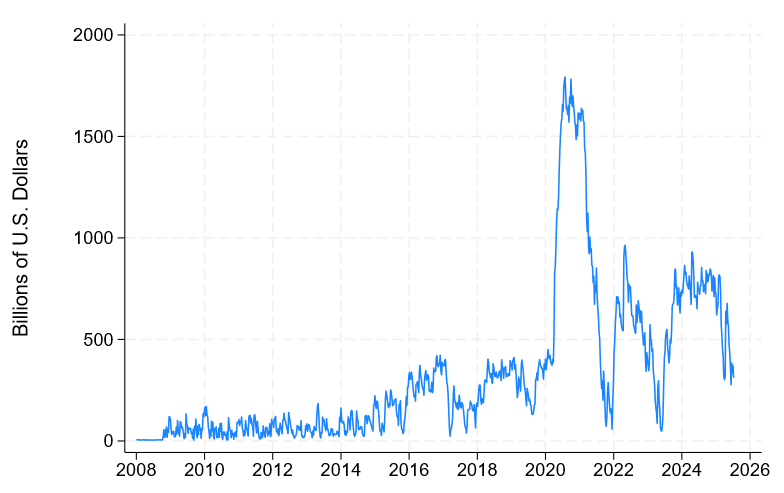
Fluctuations in TGA. | Credit: Federal Reserve
Because the TGA is tightly tied to debt issuance and funding operations, shifts in its balance can influence broader liquidity in financial markets.
Why Does a Large TGA Matter for Markets?
A very high TGA implies that a large portion of newly issued debt is being held as cash rather than flowing into private sector circulation. That can lead to liquidity contraction in financial markets, especially for risk assets like equities and crypto.
Here are key channels by which the TGA balance can affect markets:
Liquidity drain and cash squeeze: When the Treasury deposits newly issued debt (or revenues) into the TGA, that cash is pulled out of the banking and money markets. This reduces the free cash available to fund speculative or risky assets. Some crypto analysts argue that as Treasury issuance rises and TGA inflows accumulate, there is less “oxygen” for Bitcoin and altcoins to breathe.
Interest rate pressure and yield effects: More debt issuance to fund TGA inflows may push yields higher (especially on short- and mid-duration Treasuries) to attract buyers. Higher yields increase the opportunity cost of holding non-yielding assets like Bitcoin and many cryptocurrencies.
Stablecoin and institutional demand for treasuries: Stablecoin issuers like Tether and Circle and crypto firms often hold Treasuries as part of their reserve portfolios. When issuance is heavy, these entities may absorb Treasury supply or face tighter capital constraints, which tightens liquidity in crypto markets.
Market psychology and sentiment: Some crypto market participants see reaching an $850B TGA threshold as a symbolic liquidity “turning point.” The theory is: once the Treasury stops absorbing as much, capital will flow back into risk assets, triggering a rally. The notion has become popular in crypto commentary.
Treasury funding risks and policy flexibility: A huge TGA frees the Treasury against political gridlock, like during a debt ceiling standoff. But past a point, markets worry that maintaining such a large cash buffer drags issuance efficiency and capital flows.
The $850B TGA Narrative and Crypto
One often sees a narrative in crypto circles: once the U.S. Treasury’s TGA hits $850 billion, the “liquidity drain” from private markets is saturated, and risk assets are set to resume strength, perhaps entering a sustained rally mode. The media has repeated this idea, referencing “once TGA flips, crypto is ‘up only’.”
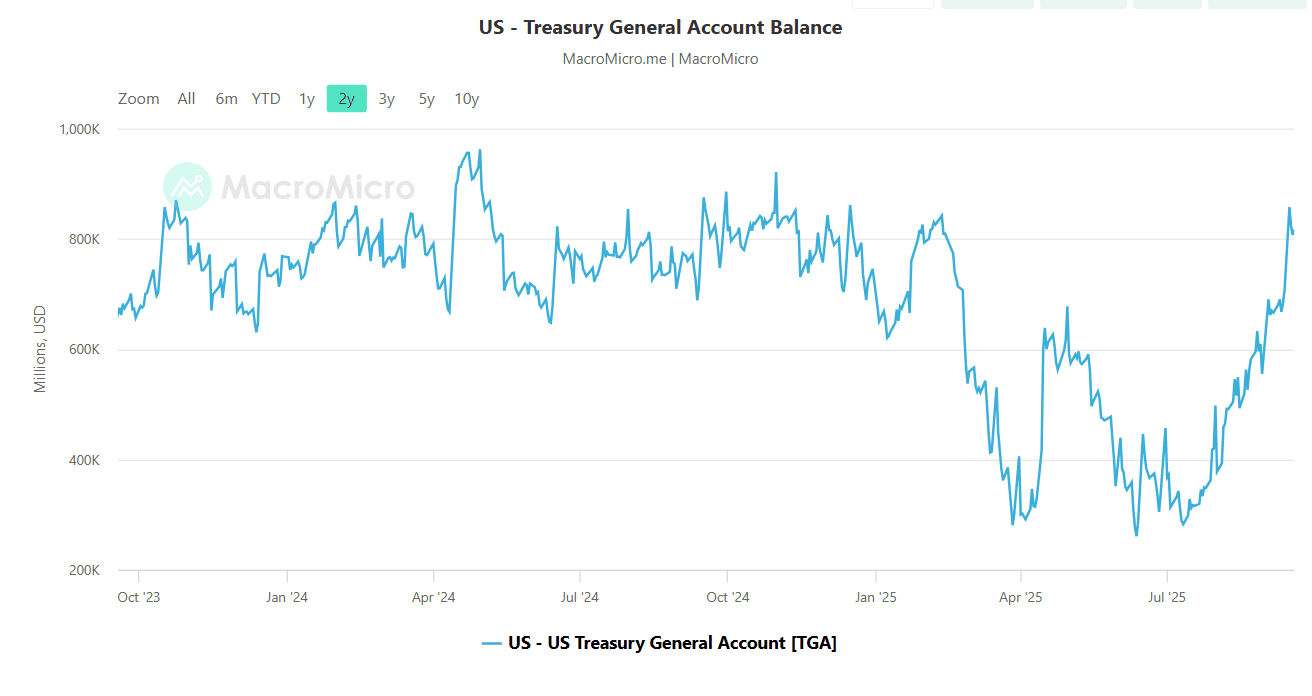
Analyst Arthur Hayes (co-founder of BitMEX) has been vocal in pushing this idea: he argues that $850 billion marks a threshold beyond which the liquidity constraint eases and crypto enters a new bull phase.
Arthur Hayes anticipates crypto surge after $850 billion TGA balance. | Credit: MacroMicro
However, many analysts caution that this is too simplistic. Liquidity flows are influenced by many other factors (Fed rates, foreign demand for U.S. debt, credit markets, macro growth), and there is limited empirical precedent for such a clean trigger. Some consider it more of a myth than a reliable indicator.
Still, whether myth or forewarning, the $850 billion TGA has become a focal point in crypto macro narratives, making it worth understanding.
How an $850B TGA Could Affect Bitcoin and Crypto
Shifts in liquidity and market psychology could drive both upside and downside outcomes for crypto. On one hand, easing Treasury cash balances, stabilizing yields, and renewed stablecoin activity may support capital flows. On the other hand, persistent high rates, policy shocks, and structural frictions could weigh heavily on the space.
Potential Upside Scenarios
Liquidity reversal and capital return: As the TGA reaches its target, the logic goes, the Treasury will slow its accumulation, freeing up cash for deployment into risk assets, fueling a cycle of capital inflow into Bitcoin and crypto.
Improved risk appetite: If yields stabilize or reverse lower, the yield advantage of bonds shrinks, making non-yielding assets like crypto more appealing again.
Stablecoin and DeFi resurgence: With better liquidity, stablecoin issuers may expand operations, DeFi lending and leveraging could revive, and margin dynamics may become more favorable.
Key Risks & Counterpoints
Over-reliance on a symbolic number: The $850 billion mark is not grounded in fundamental macro thresholds; it’s more narrative than model. Markets don’t always behave in textbook fashion.
Yields might stay high: Even if TGA inflows slow, if Treasury yields remain elevated due to inflation, Fed tightening, or weak foreign demand, the opportunity cost for crypto may remain unattractive.
Macro and policy shocks: Geopolitical stress, credit squeezes, or central bank surprises may dominate liquidity dynamics, overshadowing TGA mechanics.
Liquidity mismatch and lag effects: Capital doesn’t flow immediately from Treasuries into crypto. Delays, frictions, and intermediaries can distort the bleeding and return of liquidity.
Stablecoin and reputational stress: If stablecoin reserves become strained due to demand for Treasuries, some issuers may throttle issuance, which could further constrict crypto liquidity.
Timing, Debt Ceiling, & Extraordinary Measures
The interplay with other U.S. fiscal dynamics is critical:
Debt ceiling standoffs often force the Treasury to draw on TGA balances or suspend ordinary issuance. Historically, drawing down TGA temporarily has been seen as supportive of risky assets.
When the U.S. hits its debt limit, the Treasury may use “extraordinary measures” — borrowing accounting tactics to maintain operations without issuing new debt. Those moves can temporarily drain or shift TGA balances, affecting liquidity.
The Quarterly Refunding Announcement (QRA) is a mechanism through which the Treasury communicates upcoming borrowing plans, influencing market expectations. Announcements that lower projected issuance or TGA targets tend to be bullish for risk assets.
Thus, the trajectory toward (or away from) $850 billion is not just a mechanical deposit, but a signal about fiscal and monetary policy direction.
As liquidity dynamics shift across U.S. fiscal and monetary channels, crypto markets are increasingly sensitive to macro and Treasury-related signals.
Several indicators will shape near-term capital flows and risk appetite across digital assets, from the Treasury General Account balance to stablecoin reserves and rate expectations.
TGA balance updates and trajectory: Watch Federal Reserve and Treasury disclosures to see how fast the TGA is rising and whether it’s approaching $850 billion.
Treasury issuance schedules and yields: The shape and amount of new Treasury auctions and the resulting yields will directly compete with crypto for capital flows.
Stablecoin reserve behavior: Monitor leading stablecoin issuers’ holdings of Treasuries and how they respond to rising issuance (are they buying, pausing, or reducing exposure?).
Macro and rate signals: Inflation data, Fed guidance, and foreign demand for U.S. debt will affect whether yield stays attractive or capitulates back to equities/crypto.
Fiscal and political standoffs: Debt ceiling fights or changes in budgetary rules may force TGA drawdowns, which historically provide some relief to risk markets.
Crypto order flow and capital rotation: Watch where capital is going: equities, ETFs, institutional capital flows into Bitcoin/ETH, derivatives flows, etc.
Conclusion
The trajectory toward an $850 billion TGA is one of the more talked-about narratives in crypto macro circles.
The core idea is that when the U.S. Treasury’s cash balance grows large enough, it slows capital backflow into private markets, squeezing liquidity for risk assets like Bitcoin and crypto. Once that accumulation plateaus, liquidity may reenter the system, triggering a new push in crypto.
However, reality is more complex. The TGA is just one factor in a broader macro and financial ecosystem. Yields, monetary policy, political frictions, stablecoin reserve behavior, and global capital flows interact in noisy, sometimes unpredictable ways.
For crypto investors and builders, watching TGA dynamics provides a lens into macro liquidity stress and potential inflection points. Whether $850 billion becomes a literal “trigger” or simply a mythological milestone, it will continue to hold psychological power in narrative markets—and that itself makes it worth paying attention to.
It refers to the U.S. Treasury General Account (TGA), the government’s main cash account at the Federal Reserve, which holds around $850 billion. This balance represents the Treasury’s available cash for spending and debt management.
Why are crypto analysts talking about the TGA?
Because changes in the TGA balance influence liquidity in the financial system, when the Treasury parks more cash in the TGA, that money is effectively removed from circulation, tightening liquidity, which can weigh on risk assets like Bitcoin and crypto.
How does a rising TGA drain liquidity?
When the Treasury issues new debt and deposits the proceeds into the TGA, those funds move out of private banks and money markets and into the Fed’s system. This reduces the pool of cash available for investors, hedge funds, and institutions, indirectly pressuring markets that depend on abundant liquidity, such as crypto.
How could a large TGA affect Bitcoin and crypto prices?
A high TGA can correlate with tighter liquidity and weaker crypto prices. At the same time, a slowdown in TGA accumulation (or drawdown) can coincide with renewed risk appetite and inflows into Bitcoin, Ethereum, and other assets. However, the relationship is indirect and influenced by many other factors, including rates, inflation, and investor sentiment.
Disclaimer:
The information provided in this article is for informational purposes only. It is not intended to be, nor should it be construed as, financial advice. We do not make any warranties regarding the completeness, reliability, or accuracy of this information. All investments involve risk, and past performance does not guarantee future results. We recommend consulting a financial advisor before making any investment decisions.
Giuseppe Ciccomascolo began his career as an investigative journalist in Italy, where he contributed to both local and national newspapers, focusing on various financial sectors.
Upon relocating to London, he worked as an analyst for Fitch's CapitalStructure and later as a Senior Reporter for Alliance News. In 2017, Giuseppe transitioned to covering cryptocurrency-related news, producing documentaries and articles on Bitcoin and other emerging digital currencies. He also played a pivotal role in establishing the academy for a cryptocurrency exchange website. Crypto remained his primary area of interest throughout his tenure as a writer for ThirdFloor.


 Easy
Easy