What SWIFT’s Shared Ledger Means for 24/7 Global Payments, XRP and HBAR. | Credit: Getty Images
Share
Key Takeaways
SWIFT has historically been a messaging utility, not a settlement system.
With blockchain, SWIFT aims to evolve into a real-time settlement platform, tokenizing balances and enabling 24/7 transfers.
SWIFT’s rails could accelerate the adoption of regulated stablecoins and tokenized deposits.
However, navigating global compliance standards remains complex.
For over 50 years, SWIFT, the Society for Worldwide Interbank Financial Telecommunication, has been the backbone of global finance. Its messaging rails connect over 11,000 institutions in more than 200 countries, enabling trillions of dollars to move across borders daily.
Yet, despite its global reach, the SWIFT system has long faced criticism for being slow, expensive, and limited to the operating hours of participating banks.
That status quo is starting to change. In contrast to speculation that SWIFT might adopt the XRP Ledger or Hedera Hashgraph for its blockchain transition, the organization has refuted that narrative by selecting Linea, an Ethereum layer-2, for its first major pilot.
In September 2025, SWIFT confirmed it is progressing with blockchain integration, testing shared ledger technology to enable real-time, 24/7 cross-border settlement. This development has the potential to reshape international payments by addressing long-standing inefficiencies and positioning SWIFT as a bridge between traditional finance and the blockchain-powered future.
This article explores SWIFT’s embrace of blockchain, how a shared ledger model would work, the implications for banks and corporations, and what it could mean for the crypto and digital asset ecosystems.
Try Our Recommended Crypto Exchanges
Sponsored
Disclosure
We sometimes use affiliate links in our content, when clicking on those we might receive a commission at no extra cost to you. By using this website you agree to our terms and conditions and privacy policy.
Understanding what SWIFT actually does is essential to appreciating the significance of this pivot. Contrary to popular belief, SWIFT does not move money itself. Instead, it provides the secure messaging infrastructure that banks use to send instructions to one another.
For example, if a business in Germany wants to pay a supplier in Brazil, its bank will use SWIFT to send payment instructions to the supplier’s bank. Funds move through corresponding accounts, often via intermediary banks, before landing in the final destination.
This reliance on messaging rather than direct settlement has historically made SWIFT reliable but slow:
Payments often take two to three business days to settle.
Transfers are restricted to the working hours of banks in different time zones.
Fees add up due to intermediary banks and FX spreads.
What has kept SWIFT indispensable is its role as a neutral, global infrastructure. Unlike proprietary payment networks, SWIFT doesn’t privilege one currency, bank, or jurisdiction over another. It operates as common rails that all institutions can trust, precisely because it is not owned by any single central bank or private entity.
However, the above inefficiencies contrast with the rise of blockchain-based payment systems (via stablecoins, for example), where transfers can settle in minutes, or even seconds, and operate 24/7.
Why SWIFT Is Turning to Blockchain
The global payments landscape has changed dramatically in the past decade. Several forces have pushed SWIFT toward modernization:
Competition from blockchain and fintech: Stablecoins like USDC and USDT, as well as blockchain rails like Ripple’s On-Demand Liquidity or Stellar’s global settlement tools, have proven that near-instant global transfers are possible outside of traditional banking.
Regulatory and central bank pressure: Governments and central banks are actively exploring central bank digital currencies (CBDCs), with many pilot programs already live. SWIFT risks becoming obsolete if it cannot integrate with digital money standards.
Client demand for efficiency: Corporations, asset managers, and banks want cheaper, faster, always-on payments. SWIFT cannot ignore the competitive pressures.
Maintaining relevance: By adopting blockchain, SWIFT positions itself not as a relic of the old financial system but as a bridge between TradFi and DeFi.
How a Shared Ledger Model Works
At the core of SWIFT’s blockchain initiative is the shared ledger. Instead of merely sending payment instructions, SWIFT would maintain or interoperate with a distributed ledger that records the actual transactions in near real time.
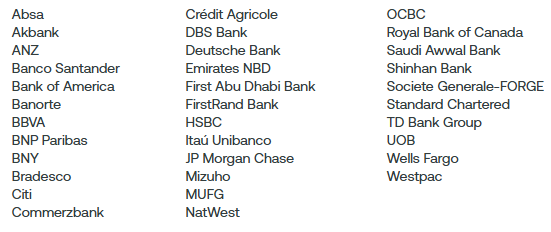
Over 30 global financial institutions (see image below) are collaborating with SWIFT to design a shared digital ledger, with the first use case targeting real-time, 24/7 cross-border payments.
Financial institutions developing a shared digital ledger with SWIFT. | Credit: SWIFT
Here’s how it could work in practice:
Tokenized bank balances: Each participating bank tokenizes its account balances, representing them on the shared ledger. For example, $10 million held at Bank A could be described as a digital token backed 1:1 by reserves.
24/7 transfers: When Bank A sends $1 million to Bank B, the shared ledger instantly updates, transferring the tokenized balance from one to the other. Settlement happens on-chain, not via delayed reconciliations.
Programmable compliance: Smart contract logic can be embedded to automatically handle AML/KYC checks, sanctions screening, and regulatory reporting at the transaction layer.
Interoperability with CBDCs: The ledger can connect with central bank platforms, ensuring that when CBDCs become mainstream, SWIFT can route transactions seamlessly.
Auditability and transparency: Every transaction is time-stamped and recorded immutably, reducing disputes and enhancing oversight.
This would transform SWIFT from a messaging-only system into a real-time settlement platform.
SWIFT Chooses Linea for Pilot, Not Ripple’s XRP Ledger or Hedera Hashgraph
While many in the crypto community speculated that SWIFT’s blockchain rails might run directly on XRP or other payment-native tokens, the organization’s first major pilot is instead being conducted on Linea, an Ethereum layer-2 network developed by ConsenSys.
Why Linea?
Zero-knowledge privacy:Linea leverages zk-proofs, giving SWIFT the ability to process transactions while keeping sensitive bank data confidential—a core requirement for interbank communication.
Ethereum alignment: By building on Ethereum infrastructure, SWIFT gains compatibility with the world’s largest smart contract ecosystem and its expanding universe of regulated stablecoins and tokenized deposits.
Institutional consortium: The pilot reportedly involves more than a dozen global banks, including BNP Paribas and BNY Mellon, underscoring the institutional scale of the experiment.
Interbank token exploration: Alongside messaging, SWIFT tests an “interbank token” and stablecoin integrations, suggesting settlement functionality is firmly on the roadmap.
What This Means for XRP and HBAR
The Linea pilot doesn’t eliminate the possibility of XRP or HBAR playing roles in future settlement layers, but it does shift the competitive narrative. Rather than adopting a payments-specific token outright, SWIFT appears to be building a flexible, modular ledger capable of interfacing with multiple assets.
For XRP: Ripple’s liquidity solutions remain proven in real-time cross-border transfers. But instead of being SWIFT’s default bridge, XRP may need to integrate as one of many tokens that Linea-based rails could support.
For HBAR: Hedera’s enterprise governance and high-throughput design could still make it attractive for interoperability or niche use cases. Yet like XRP, it is now competing to be a complementary rail, not the foundation of SWIFT’s ledger.
Strategic Implications
SWIFT’s choice signals a pragmatic strategy: start with a programmable, privacy-preserving Ethereum L2, then extend interoperability outward. This path allows SWIFT to:
Experiment with regulated stablecoins and tokenized deposits in a controlled environment.
Keep the door open to future bridges with assets like XRP, HBAR, or CBDCs.
Retain flexibility in how global settlement evolves, rather than tying its infrastructure to a single crypto network too early.
In short, SWIFT’s move to Linea highlights its intent to remain the neutral backbone of global payments, integrating blockchain while maintaining optionality on which tokens ultimately power liquidity.
What 24/7 Payments Could Mean
The implications of round-the-clock, blockchain-enabled payments are profound.
Corporations would benefit from faster supplier payments, more efficient treasury management, and reduced FX risks.
Banks could eliminate reconciliation delays and reduce operational costs tied to cross-border settlements.
Retail customers may eventually see lower fees and faster international remittances.
Governments and regulators gain a clearer, real-time view of capital flows.
In short, a shared ledger brings global payments into the internet era: instant, programmable, and always available.
Potential Benefits of SWIFT’s Blockchain Transition
SWIFT’s move reflects growing pressure from central banks, fintechs, and corporate clients to deliver faster, cheaper, and more transparent cross-border payments.
By leveraging distributed ledger technology (DLT), SWIFT aims to address many of the long-standing pain points in traditional correspondent banking.
Below are some of the potential benefits such a shift could bring:
Speed and efficiency: Current SWIFT transfers can take days. With blockchain, settlement could happen in minutes or seconds, regardless of weekends or time zones.
Cost reduction: Eliminating multiple intermediaries could significantly lower fees, leveling the playing field for smaller banks and fintechs.
Enhanced security: Blockchain’s cryptographic guarantees and transparent audit trails may reduce fraud, errors, and disputes.
Interoperability: By adopting blockchain standards, SWIFT ensures compatibility with CBDCs, tokenized deposits, and regulated stablecoins.
Liquidity unlock: Faster settlement means capital is not trapped in transit, unlocking liquidity for banks and corporations.
Risks and Challenges
Blockchain adoption is not without hurdles. SWIFT will need to navigate several risks:
Regulatory complexity: Global compliance requirements vary. Aligning AML/KYC standards across jurisdictions is a monumental task.
Technology integration: Banks must integrate legacy systems with blockchain rails, a costly and complex process.
Cybersecurity: While blockchains can be secure, surrounding infrastructure (wallets, APIs, user interfaces) may be vulnerable.
Adoption friction: Smaller banks or those in developing economies may struggle to participate fully without technical support.ì
Capped innovation: SWIFT’s blockchain may remain permissioned and highly controlled, limiting openness compared to public blockchains.
How SWIFT’s Ledger Fits Into the Stablecoin, RWA and DeFi Landscape
SWIFT’s blockchain adoption is not happening in isolation. It intersects with broader trends in digital finance:
Stablecoins vs. tokenized deposits: SWIFT’s ledger could boost regulated stablecoins or bank-issued tokens, potentially competing with decentralized stablecoins like USDT or DAI.
RWA integration: Tokenized real-world assets (RWAs) such as bonds, money-market funds, or trade finance products could be settled via SWIFT’s ledger, unlockingtrillions in institutional-grade liquidity.
Bridging TradFi and DeFi: If SWIFT integrates with permissioned DeFi platforms, banks could safely interact with smart contracts, lending pools, and tokenized collateral.
Competition with blockchain-native payment networks: Networks like RippleNet, Stellar, and Lightning offer fast cross-border payments. SWIFT’s move may validate these innovations while also challenging them.
BlackRock’s BUIDL Shows the RWA Opportunity for SWIFT
BlackRock’s BUIDL fund, a tokenized U.S. Treasury money market fund, has quickly grown into the largest on-chain RWA, surpassing $2.3 billion in assets. It demonstrates institutional appetite for tokenized products.
If SWIFT’s blockchain rails support such tokenized funds, investors could move capital between banks, funds, and DeFi platforms instantly, with compliance built in.
This would blur the line between traditional settlement and on-chain liquidity management.
Global Regulation: The Gatekeeper to SWIFT’s Blockchain Future
Regulation will determine the pace of adoption.
U.S.: The SEC and CFTC will scrutinize tokenized assets under securities and derivatives laws. The Fed will influence CBDC design and banking integrations.
European Union: MiCA (Markets in Crypto-Assets Regulation) sets a framework for stablecoins and tokenized assets, likely impacting SWIFT’s European operations.
Asia: Singapore, Hong Kong, and Japan are actively piloting tokenized bonds and payments, making them early adopters of shared ledger integration.
Middle East: The UAE and Saudi Arabia are pursuing tokenized settlement rails for oil trade and remittances, offering another testing ground.
For SWIFT, alignment with these frameworks is essential. Without compliance, major banks will hesitate to onboard.
What a Shared Ledger Could Look Like by 2030
By 2030, if SWIFT’s blockchain adoption succeeds, you could see:
Global real-time payments: Money moves instantly between banks anywhere in the world.
Unified settlement layer: Tokenized deposits, CBDCs, and stablecoins coexist on SWIFT’s shared ledger.
Integration with RWAs: Tokenized funds, trade finance, and securities flow seamlessly across borders.
SWIFT’s embrace of blockchain marks a turning point in global finance. By moving beyond messaging to shared ledgers, SWIFT acknowledges that the old model of delayed, costly cross-border payments no longer fits the digital age.
This shift promises banks and institutions faster settlement, lower costs, and compatibility with tokenized assets and CBDCs. For the broader crypto ecosystem, it validates the power of blockchain for payments while introducing new competition from a legacy giant.
The road ahead is not without risks, from regulatory hurdles to adoption friction, but the momentum is undeniable.
As SWIFT modernizes its infrastructure, it has the potential to transform itself from a behind-the-scenes messaging utility into the backbone of 24/7 global payments in the blockchain era.
SWIFT (Society for Worldwide Interbank Financial Telecommunication) is the global messaging system banks use to send payment instructions to each other. It connects over 11,000 institutions in over 200 countries and facilitates trillions of dollars in transactions daily. While SWIFT doesn’t move money, it’s the critical “plumbing” for global payments.
What does it mean for SWIFT to use blockchain?
Instead of just sending payment messages, SWIFT plans to use a shared ledger where transactions themselves are recorded and settled in near real time. This would transform SWIFT into a true settlement network, not just a messaging one.
How would a shared ledger model work in practice?
Banks could tokenize balances and settle transfers instantly on-chain. Smart contracts would automate compliance checks, and the ledger could interoperate with central bank digital currencies (CBDCs). Every transaction would be securely time-stamped and auditable.
How does this impact the crypto and digital asset ecosystem?
SWIFT’s blockchain rails could support regulated stablecoins, tokenized deposits, and real-world assets. This validates the blockchain approach while introducing competition for crypto-native payment networks like RippleNet or Stellar.
Disclaimer:
The information provided in this article is for informational purposes only. It is not intended to be, nor should it be construed as, financial advice. We do not make any warranties regarding the completeness, reliability, or accuracy of this information. All investments involve risk, and past performance does not guarantee future results. We recommend consulting a financial advisor before making any investment decisions.
Giuseppe Ciccomascolo began his career as an investigative journalist in Italy, where he contributed to both local and national newspapers, focusing on various financial sectors.
Upon relocating to London, he worked as an analyst for Fitch's CapitalStructure and later as a Senior Reporter for Alliance News. In 2017, Giuseppe transitioned to covering cryptocurrency-related news, producing documentaries and articles on Bitcoin and other emerging digital currencies. He also played a pivotal role in establishing the academy for a cryptocurrency exchange website. Crypto remained his primary area of interest throughout his tenure as a writer for ThirdFloor.


 Easy
Easy