Kraken’s Crypto Neobank Move: No FX Fees, 1% Bitcoin Cashback & Up To 10% DeFi Yields.
Share
Key Takeaways
Kraken’s new multi-currency Mastercard lets users spend 400+ crypto and fiat assets anywhere Mastercard is accepted.
The Krak card offers 1% cash back in fiat or Bitcoin, up to 10% DeFi yields, and zero foreign fees.
With cards, savings, trading, and soon credit and merchant tools, Kraken is evolving into a full-service financial platform.
Kraken holds the first EU MiCA crypto license and a Wyoming digital asset bank charter, giving it a rare regulatory advantage over fintech and crypto rivals.
Kraken, long known as one of the largest and oldest cryptocurrency exchanges, has quietly begun remaking itself into a full-service fintech “neobank.” In late 2025 the company launched Krak, a standalone money app and Mastercard debit card that lets users spend and earn crypto and fiat seamlessly.
The Krak Card pays 1% cashback on every purchase (in Bitcoin or local currency), with no foreign-exchange fees, no monthly fees, and support for hundreds of crypto or fiat balances. At the same time Kraken rolled out Krak Vaults – on-chain “DeFi” savings accounts offering up to 10% APY yields on stablecoin and crypto balances.
A debit card like no other. 💳
Krak Card is powered by @Mastercard, with up to 1% cashback in cash or bitcoin.
Spend in 400+ currencies across cash and crypto — wherever life takes you.
Together these features signal a strategic pivot: Kraken is positioning itself as a one-stop “everything account” that blends crypto investing, payments, and traditional banking services into a single app.
Try Our Recommended Crypto Exchanges
Sponsored
Disclosure
We sometimes use affiliate links in our content, when clicking on those we might receive a commission at no extra cost to you. By using this website you agree to our terms and conditions and privacy policy.
Krak Card and Money App: Crypto Debit Card with 1% Back
Kraken has launched the Krak Card, a new multi-currency Mastercard debit card that allows users to spend both crypto and fiat seamlessly anywhere Mastercard is accepted. The card offers up to 1% cash-back rewards on every purchase, with the option to receive rewards in either local currency or Bitcoin.
Users can fund the Krak Card directly from any of their Kraken wallets, spending from over 400 supported crypto and fiat balances. The system automatically converts assets at the point of sale, enabling smooth real-world spending without manual swaps.
Key Benefits
No foreign-exchange or cross-border fees
No monthly maintenance fee
1% back in fiat or BTC
Instant funding from Kraken wallets
This fee-free structure makes it stand out from other crypto or traditional bank cards that often charge for currency conversion. Essentially, the Krak Card turns crypto balances into a primary spending account.
Our brand new @Krak card is now available in EU/UK.
This is one of those product launches that is somehow both torture and envigorating at the same. Congrats @jaredrblake@Bivu_D and the whole team who made this happen. @Krak is just getting started! https://t.co/5KVZeibo4A
The Krak Card is currently available in the U.K. and E.U., with global expansion planned. It’s offered in both physical and virtual formats and integrates tightly with the Krak mobile app, where users can:
Manage card settings and controls
Set spending priorities across wallets
Track real-time transactions
An upcoming feature will allow direct salary deposits, enabling UK and EU users to have their paychecks sent straight to their Krak account. With this, Kraken effectively transforms the Krak app into a full financial hub – for spending, transfers, and deposits, all connected to the wider Kraken ecosystem.
How To Access And Activate Your Krak Card
Getting started with your Krak Card is simple. Once you have the Krak app and a verified account, you can request, activate, and begin using your card in just a few steps.
Download the Krak app: Install the Krak mobile app from the App Store or Google Play. The app is your central hub for requesting, activating, and managing your Krak Card. Select a card color: Krak Coral or Krak Black.
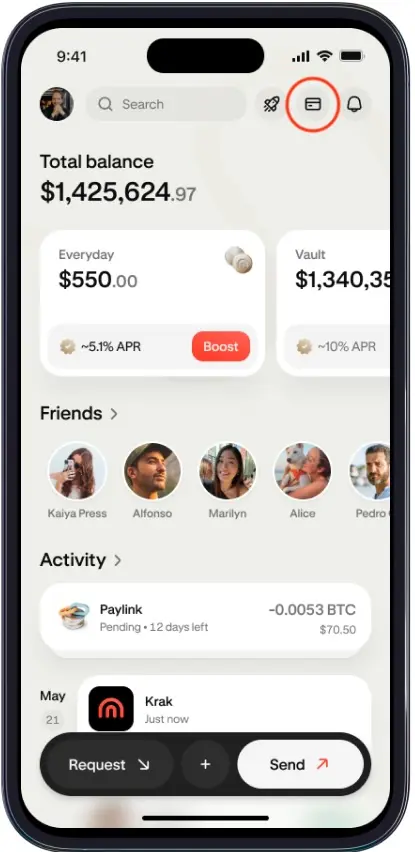
Krak app home screen. Source: Kraken
Create your Krak account and verify your identity: Open the app, sign up, and complete identity verification (KYC). A verified account is required before you can request or use the Krak Card.
Check eligibility by region: At launch, the Krak Card is available to users in the UK and EU. Global rollout is planned, but availability depends on your country of residence.
Request your virtual Krak card: In the Krak app, tap the Card icon to request a virtual card instantly. Choose your preferred design, agree to the terms, and start using it for online or mobile wallet payments.
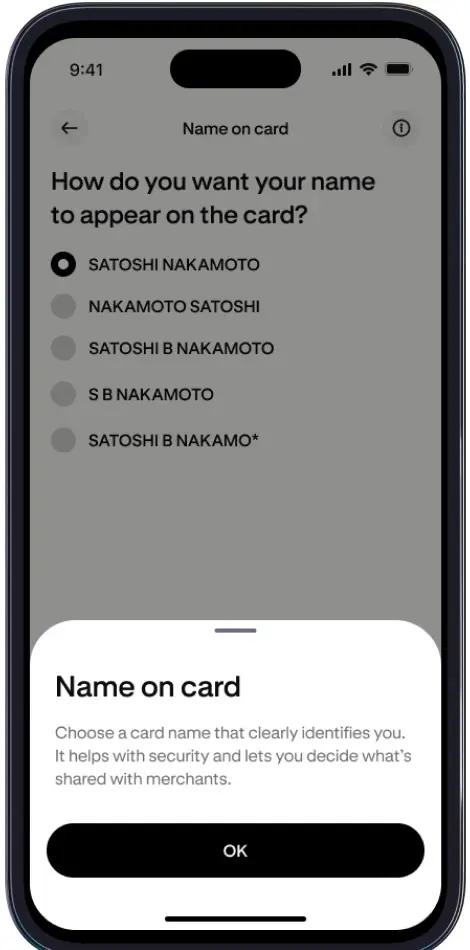
Order a physical Krak card (optional): If you prefer a physical card, order one directly in the app. You can also choose how your name should appear. It will be mailed to your verified address and can be used for ATM withdrawals and in-person transactions.
Choose how your name should appear on Krak app. | Source: Kraken
Activate your physical card: Once your card arrives, open the Krak app → go to Card Settings → select Activate Card. Enter the three-digit code on the back and set your PIN. The card is then ready for use.
Set spend order and controls: In the app, configure your Spend Order to decide which wallet or currency to draw from first. You can also freeze or unfreeze your card, set spending limits, and manage merchant categories.
Add to Apple Pay or Google Pay: Add your virtual Krak Card to Apple Pay or Google Pay for instant contactless payments. You can use it right away without waiting for your physical card.
Fund your card and earn rewards: Load your Krak account from any Kraken wallet. The card supports 400+ crypto and fiat assets, automatically converting at checkout and earning up to 1% cash back in Bitcoin or local currency.
Enable salary deposits (coming soon): Soon, users in the UK and EU will be able to receive direct salary deposits into their Krak account, making Krak a complete, crypto-powered financial solution.
Quick Checklist
Verified Krak account (KYC complete)
Residency in the UK or EU
Krak app installed and updated
Government ID and proof of address ready
Virtual or physical card requested through the app
Troubleshooting Tips
No card option showing: Update the app and ensure your KYC is complete.
Activation error: Double-check the code and PIN, then try again.
Funding issue: Verify your Spend Order setup and wallet balance.
Salary deposits: Feature rolling out soon – check announcements in the app.
Krak Vaults: High-Yield DeFi Savings
Alongside the card, Kraken introduced Krak Vaults, a new feature offering DeFi-powered yield on crypto and stablecoin holdings. Users can earn passive returns without locking up assets, choosing between three risk-reward tiers:
Vault yields depend on underlying audited DeFi protocols such as liquidity pools and yield farming strategies. All Vaults are flexible, with no lock-up periods, no minimums, and no hidden fees. Users can withdraw at any time.
These rates position Kraken competitively in the DeFi savings market, alongside offerings from fintech players like Revolut and Crypto.com. Within the Krak app, Vaults are part of the “Grow” section, a core feature for users who want to earn on their holdings while maintaining instant liquidity.
Early traction is strong: since its June 2025 launch, the Krak app has surpassed 450,000 downloads across 130+ countries, with adoption expected to accelerate as the Card and Vaults roll out globally.
Kraken’s Strategic Shift: From Exchange to Financial Super App
The Krak Card and Vaults are central to Kraken’s broader strategic pivot toward becoming a global financial super app. Moving beyond crypto trading, Kraken now aims to let users send, spend, and grow money in a unified, borderless platform.
In 2025, Kraken raised $800 million at a $20 billion valuation to fund this expansion. The company plans to bring traditional financial products on-chain, combining payments, savings, and advanced trading in one ecosystem.
Kraken’s structure now includes:
Kraken Pro: Core exchange and trading platform
Kraken Institutional: Services for high-volume and corporate clients
Kraken Onchain: DeFi and staking solutions
NinjaTrader: Futures and derivatives
Krak: Consumer banking and payments brand
With Kraken Bank in Wyoming (under the Special Purpose Depository Institution or SPDI Charter) and the Krak app handling retail finance, the company is bridging the gap between crypto and traditional banking. Future plans include credit products, merchant tools, and global card expansion, positioning Kraken as a challenger to fintech giants and neobanks alike.
Kraken’s Competition: Fintech Neobanks vs. Crypto Rivals
Kraken’s entry into banking-style products places it head-to-head with fintech leaders like:
Kraken also faces competition from crypto-native players, such as:
Coinbase
Crypto.com
Revolut offers currency exchange, crypto trading, and staking with yields up to 11.65% APY, while Robinhood launched Robinhood Banking in 2025 with 4% APY savings and FDIC-backed deposits. Stripe has expanded into crypto payments, enabling stablecoin payouts via USDC.
Kraken, however, offers a crypto-first advantage. Its Krak account supports hundreds of cryptocurrencies and dozens of fiat currencies in one place. It delivers 1% rewards, on-chain transfers, and real DeFi yields, often outperforming the modest incentives from neobanks. Transfers between Krak users are instant, wallet-to-wallet, and blockchain-powered.
Analysts describe this as a fundamental differentiator: Kraken is not a “bank with crypto features,” but rather a money movement network built on crypto infrastructure. Experts from Third Bridge note that exchanges must now diversify beyond trading fees, adding payments, savings, and credit to remain competitive.
According to Marcel van Oost, Kraken just took another major step toward becoming a full neobank with the launch of its Krak Mastercard Debit Card in the UK and Europe. Oost says this isn’t just a card launch but Kraken signaling where the next battle for consumer finance is heading, crypto-first firms turning into full financial super apps, betting that if everything is money, users should be able to earn, spend, save, and invest across any asset seamlessly.
🚨 @krakenfx just took another major step toward becoming a full neobank.
Launching a Mastercard Debit Card:
The long story short:
The Debit Card will be launched in the UK and Europe 1% cashback — in fiat or Bitcoin No FX or monthly fees Fully integrated into the Krak app… pic.twitter.com/tbCjgG9GRy
Among crypto rivals, Kraken’s token-agnostic design also stands out. While Crypto.com offers up to 5% back via its CRO token, Kraken’s rewards come in BTC or fiat, with no proprietary tokens or staking lock-ups. This transparency could make it more appealing to mainstream users seeking simplicity and security.
Industry observers agree that Kraken’s evolution mirrors where finance is heading: fintechs are embracing crypto, and crypto firms are becoming banks. If Kraken executes well, it could redefine how people use crypto for daily life, not just investing, but banking, saving, and earning.
Regulatory Landscape: MiCA Compliance and US Strategy
Kraken’s global expansion is shaped by two distinct regulatory environments. In Europe, the Markets in Crypto-Assets (MiCA) framework now governs crypto services under a unified EU license. In June 2025, Kraken became the first exchange to secure a MiCA license from the Central Bank of Ireland. This approval lets Kraken offer regulated services across the entire European Economic Area, including its cards, Vaults, and trading products, under full legal protection.
Kraken also holds longstanding FCA registration in the U.K., strengthening its standing as one of Europe’s most compliant crypto institutions. By contrast, in the U.S., Kraken has faced more scrutiny. After settling SEC charges over its staking program in 2023, the exchange later saw its broader SEC lawsuit dismissed with prejudice in March 2025, a major win that cleared the path for its U.S. growth.
Rather than registering under federal securities laws, Kraken has focused on operating through its Wyoming-based Kraken Bank, a SPDI that holds 100% fiat reserves. This state-level charter allows Kraken to provide banking and custody services legally within the U.S., while sidestepping unclear SEC rules.
In short, Kraken operates as a fully licensed crypto bank in Europe and a regulated digital asset bank in the U.S., giving it an edge over competitors still wrestling with regulatory uncertainty.
Kraken’s long-term vision is supported by deep infrastructure investments. Kraken Bank (Kraken Financial), established in Wyoming in 2020, was the first U.S. digital asset bank under the SPDI charter. It enables Kraken to hold deposits, custody crypto, and process payments while maintaining full 1:1 reserves.
The bank’s goal is to reduce reliance on third-party banks and create a direct bridge between traditional finance and crypto. Currently focused on U.S. customers, Kraken plans to expand banking services globally once regulatory pathways are clear.
On the product roadmap, Kraken is already developing credit and lending options, merchant tools, and multiple card variants. It also plans to extend into tokenized equities, futures, and additional asset classes. Backed by its $800 million funding round, Kraken is expanding into Latin America, Asia-Pacific, and emerging markets, targeting regions with high crypto adoption.
Technologically, Kraken is unifying its platforms under one interface. Users can deposit USD via Kraken Bank, trade on Kraken Pro, and spend with the Krak Card — all from one app. This vertical integration across custody, payments, and trading creates a cohesive ecosystem few competitors can match.
Kraken’s IPO Plans and Market Impact
On November 19, 2025, Kraken confidentially filed for an IPO with the U.S. SEC, aiming for a potential listing in early 2026. The filing follows its $20 billion valuation and signals growing confidence that U.S. regulators are softening their stance on crypto.
Analysts say the IPO could rival or surpass Coinbase’s debut in scale and market visibility. Kraken’s expansion into banking, DeFi, and payments positions it as a diversified fintech contender rather than a pure exchange, a narrative likely to resonate with institutional investors.
Insiders also report ongoing discussions with major equity partners and strategic investors, as Kraken looks to leverage its new funding for global scaling.
The Bigger Picture
Kraken’s transformation captures a major shift in finance: crypto platforms becoming full-service financial ecosystems. After the crypto downturn of 2022–2023, the industry realized trading fees alone couldn’t sustain growth. Kraken’s pivot toward cards, vaults, and banking products reflects this new reality.
Experts emphasize that success will depend on execution and trust. DeFi yields attract risk-tolerant users, but mainstream adoption hinges on reliability and compliance. Kraken’s MiCA approval, Wyoming charter, and transparent, token-free model give it a credible foundation to win over both crypto veterans and traditional finance users.
By merging the best of fintech convenience with the power of crypto, Kraken is positioning itself as a crypto-first challenger bank, one that could pressure not just exchanges, but also traditional banks and neobanks to evolve.
Krak card is a Mastercard debit card that lets users spend crypto or fiat directly from their Kraken wallets, earning up to 1% back in Bitcoin or local currency.
What are Krak Vaults?
A new DeFi-based savings feature offering 5–10%+ APY on crypto or stablecoins with instant withdrawals and no staking lock-ups.
Is Kraken a bank now?
Not a traditional bank, but Kraken operates Kraken Bank in Wyoming and holds an EU MiCA license, making it one of the most regulated crypto-finance platforms.
When will Krak Card be available globally?
It’s currently live in the UK and EU, with global rollout planned as Kraken expands its super app into new markets.
Disclaimer:
The information provided in this article is for informational purposes only. It is not intended to be, nor should it be construed as, financial advice. We do not make any warranties regarding the completeness, reliability, or accuracy of this information. All investments involve risk, and past performance does not guarantee future results. We recommend consulting a financial advisor before making any investment decisions.
Onkar Singh has three years of experience as a digital finance content creator. Throughout his career, he has collaborated with various DeFi projects and crypto media outlets. In his leisure time, he enjoys fitness activities at the gym and watching movies across different genres. Balancing his professional and personal interests, Onkar continues to contribute to the digital finance landscape while pursuing his hobbies.


 Easy
Easy