Bitmine buys 4.97M ETH as Tom Lee targets $60K Ethereum. Can institutional demand drive the next ETH price rally? | Source: CCN
Share
Key Takeaways
Bitmine now holds 4.976 million ETH, controlling over 4% of Ethereum’s total supply, making it the largest ETH treasury globally.
The company has reached 82% of its 5% supply target in just 9 months, highlighting a growth in institutional crypto buying.
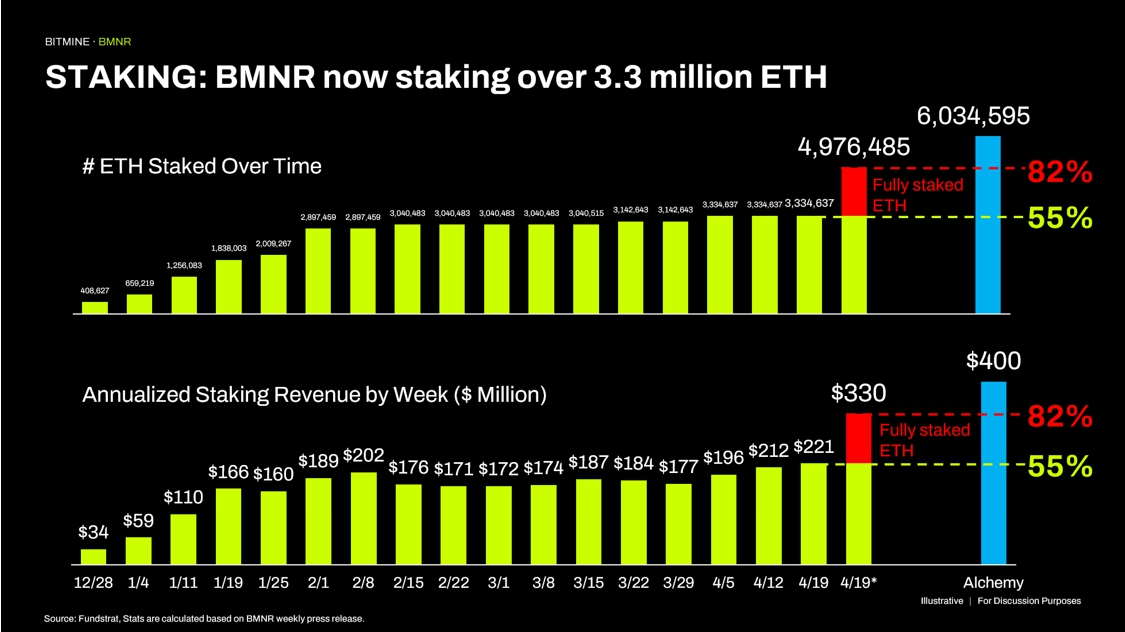
Over 3.3 million ETH is staked, generating $200M+ in annualized yield, signaling a commitment beyond speculation.
Factors like Wall Street adoption, AI integration, and easing geopolitical risks are strengthening Ethereum’s outlook.
Ethereum is once again at the center of crypto market news, but this time the spotlight isn’t just on price charts, it’s on institutional crypto buying at an unprecedented scale.
Bitmine Immersion Technologies has accumulated nearly 5 million ETH, representing over 4% of the total Ethereum supply, while prominent investor Tom Lee is making a bold Ethereum price prediction of $60,000.
This combination of aggressive accumulation and high-profile forecasts has reignited debate: will Ethereum price rise after institutional buying, or is this another short-lived narrative?
Understanding the mechanics behind this move is key to evaluating Ethereum’s outlook in 2026 and beyond.
Bitmine’s $4.97M Ethereum Purchase Explained
The headline figure, 4.976 million ETH, makes Bitmine’s Ethereum purchase one of the largest single treasury accumulations in crypto history. At a valuation of roughly $2,301 per ETH at the time of reporting, this equates to more than $11 billion in Ethereum exposure alone within Bitmine’s broader $12.9 billion crypto and cash holdings.
What makes this acquisition particularly notable is its scale relative to Ethereum’s total supply of approximately 120.7 million ETH. Bitmine now controls about 4.12% of all circulating ETH, putting it within striking distance of its stated goal: the “Alchemy of 5%.”
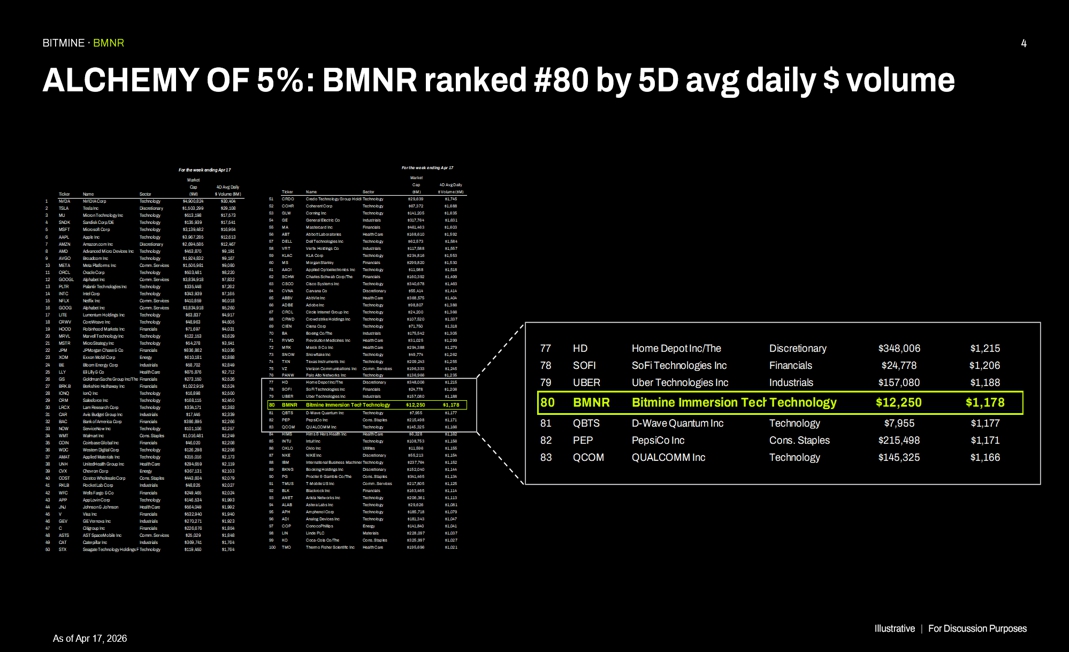
BMNR ranked 80th by five-day daily volume. | Credit: Bitmine
The pace of buying is equally important. In just nine months, the company reached 82% of that target, with over 100,000 ETH purchased in a single week at one point. This reflects not just accumulation, but acceleration.
Additionally, Bitmine has staked over 3.3 million ETH, roughly 67% of its holdings, generating annualized staking revenues exceeding $200 million. This signals a long-term strategy focused on yield generation, not just speculative holding.
Who Is Tom Lee and Why His $60K ETH Prediction Matters
Tom Lee, Chairman of Bitmine and a well-known figure in traditional finance and crypto markets, is not new to bold forecasts. As co-founder of Fundstrat Global Advisors, Lee has built a reputation for macro-driven market insights that often bridge Wall Street and emerging asset classes.
BMNR now staking over 3.3 million ETH. | Credit: Bitmine
His Ethereum price prediction of $60,000 is significant not just because of its magnitude, but because of the reasoning behind it. Lee points to two major structural tailwinds:
Wall Street tokenization: Increasing adoption of blockchain for financial instruments, from bonds to equities.
AI-driven demand: The rise of agentic AI systems requiring decentralized, neutral infrastructure, something Ethereum is well-positioned to provide.
Lee also frames Ethereum as a “war-time store of value,” noting its strong performance during geopolitical instability. According to his analysis, ETH has outperformed traditional assets, including the S&P 500, during recent global tensions.
Investors pay attention because Lee’s forecasts are rooted in macro trends rather than short-term speculation, making his outlook more influential in shaping institutional sentiment.
Why Institutional Buying Could Impact Ethereum (ETH) Price
From a supply perspective, when a single entity accumulates millions of ETH, it effectively removes liquidity from the market. With fewer tokens available for trading, upward price pressure can build, especially if demand remains constant or increases.
From a sentiment perspective, institutional accumulation acts as a signal of confidence. When major players commit billions to ETH, it often attracts:
Additional institutional inflows
Increased retail investor interest
Greater media attention
This creates a feedback loop where rising demand meets constrained supply.
Moreover, Bitmine’s staking strategy further reduces circulating supply. Staked ETH is locked up, making it less accessible for trading and amplifying scarcity dynamics.
Ethereum (ETH) Price Outlook After the Bitmine News
In the short term, news of Bitmine’s purchase could drive a surge in Ethereum price due to increased attention and speculative trading. Historically, large institutional buys often trigger immediate upward movements as traders anticipate further demand.
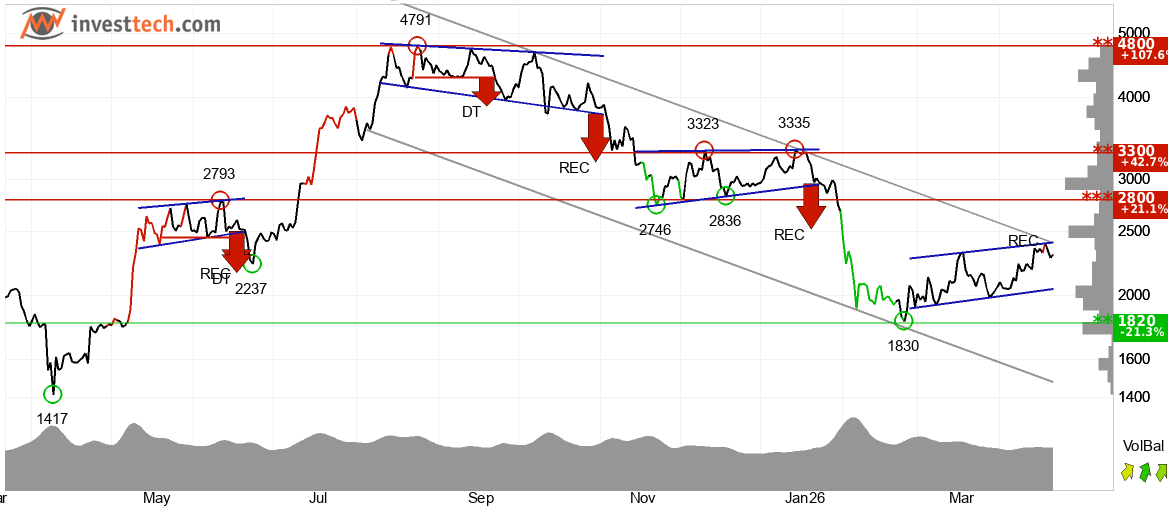
Ethereum is currently trading within a medium- to long-term downtrend, suggesting sustained bearish pressure and weakening investor demand. This trend reflects a broader decline in buying interest, with price action consistently forming lower highs and lower lows.
Ethereum technical analysis. | Credit: InvestTech
At present, ETH is consolidating within a horizontal range, with key support around $2,049 and resistance near $2,413. This rectangle pattern indicates a period of indecision in the market. A clear breakout above resistance or breakdown below support will likely determine the next directional move.
Beyond this range, stronger structural support is seen near $1,820, while a move higher could face significant resistance around $2,800.
Key Drivers That Could Push ETH Toward $60,000
Reaching a $60,000 Ethereum price would require multiple reinforcing factors. Some of the most important include:
Institutional inflows and ETFs: Spot Ethereum ETFs and similar investment vehicles could open the door for trillions in traditional capital.
Staking growth: As more ETH is staked, circulating supply decreases, increasing scarcity and potential price pressure.
Network upgrades: Scalability improvements and lower transaction costs can boost adoption and usage.
These catalysts, combined, could create the kind of sustained demand necessary for extreme price appreciation.
Risks That Could Limit Ethereum’s Upside
Despite the bullish narrative, several risks could prevent Ethereum from reaching such ambitious price targets.
Regulatory uncertainty remains one of the biggest threats. Changes in policy or unfavorable rulings could restrict institutional participation.
Macroeconomic conditions also matter. High interest rates or economic downturns can reduce appetite for risk assets, including crypto.
Competition from other blockchains is another factor. Networks offering faster speeds or lower fees could capture market share.
Finally, market cycles cannot be ignored. Crypto markets are historically volatile, and even strong fundamentals do not prevent corrections.
Balancing optimism with these constraints is essential for realistic expectations.
Market Reaction: How Traders and Investors Are Responding
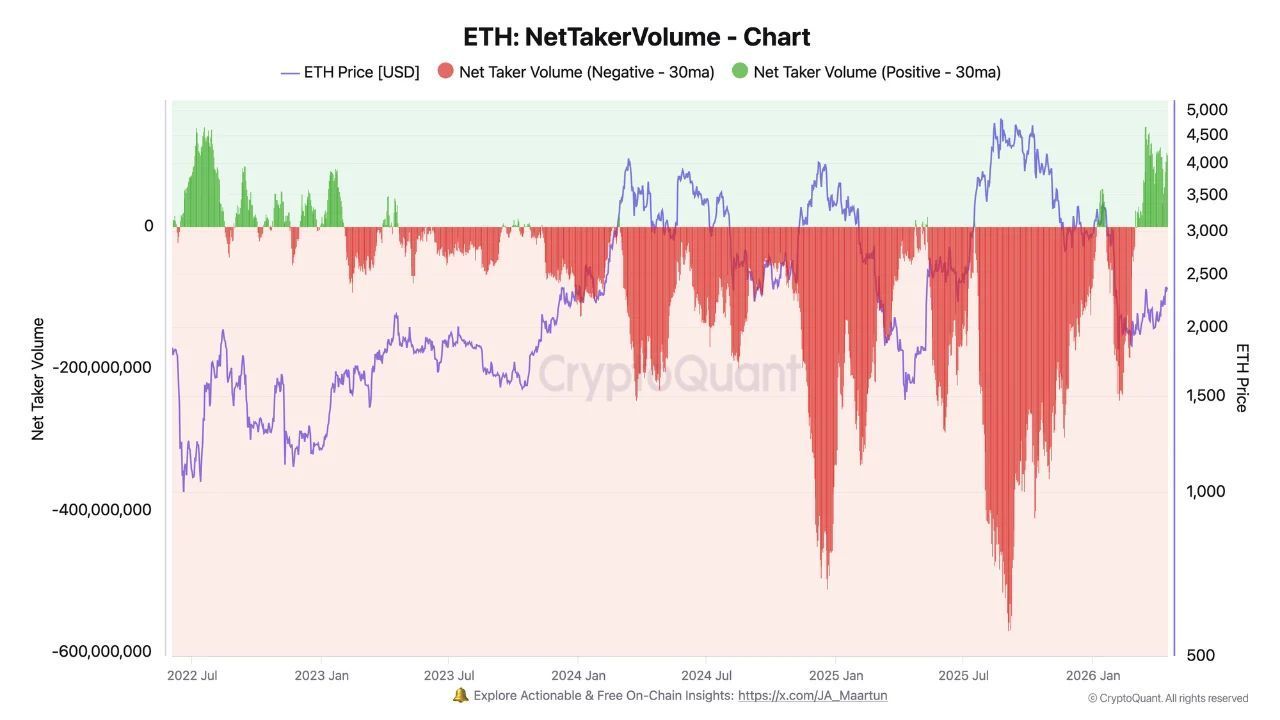
Following the announcement, Ethereum price saw increased trading activity, reflecting heightened interest.
Bitmine itself is one of the most actively traded stocks in the US, with daily volumes around $1.2 billion, indicating strong investor engagement.
ETH net taker volume. | Credit: CryptoQuant
Market sentiment appears cautiously optimistic. Traders are interpreting the purchase as a sign that the “mini-crypto winter” may be nearing its end, a view echoed by Tom Lee.
Comparisons can be drawn to past institutional buying events, such as Tesla’s Bitcoin purchase in 2021, which triggered significant price rallies. However, Ethereum’s more complex ecosystem makes its response less predictable.
How Bitmine Fits Into the Broader Crypto Accumulation Trend
Bitmine’s move is not happening in isolation. It reflects a broader Ethereum accumulation trend in 2026, where companies and funds are increasingly adding ETH to their balance sheets.
Unlike earlier cycles dominated by Bitcoin treasury strategies, this phase highlights Ethereum’s growing importance as a programmable financial layer.
Other institutions are also exploring staking, decentralized finance, and tokenization opportunities, signaling a shift from passive holding to active participation in blockchain ecosystems.
However, one company, even one as large as Bitmine, cannot drive a sustained rally alone. A true bull market would require widespread participation across institutions, developers, and users.
Still, Bitmine’s actions could act as a leading indicator of what’s to come.
What It Means for Retail Investors
For retail investors, this development offers both opportunity and caution.
On one hand, institutional buying can validate Ethereum’s long-term potential and reduce perceived risk. It may also lead to higher prices over time.
On the other hand, entering the market after large purchases can be risky, especially if short-term hype drives prices beyond fundamental value.
Rather than chasing price movements, it’s more important to assess whether Ethereum aligns with one’s investment strategy and risk tolerance.
Bitmine’s Purchase and Tom Lee’s Forecast: Hype or Real Momentum for ETH?
Bitmine’s acquisition of 4.97 million ETH and Tom Lee’s $60,000 forecast together represent one of the strongest bullish signals in recent Ethereum news. The scale of accumulation, combined with macro-driven optimism, suggests that institutional confidence in Ethereum is growing.
However, whether this translates into a sustained Ethereum price rise depends on broader market dynamics. Institutional buying can spark momentum, but long-term growth requires continued adoption, innovation, and favorable economic conditions.
In short, this may be more than hype, but it’s not a guarantee.
For Ethereum to approach $60,000, the current wave of institutional crypto buying must evolve into a structural shift in how global finance interacts with blockchain technology.
What is the significance of Bitmine buying 4.97 million ETH?
Bitmine’s purchase represents over 4% of Ethereum’s total supply, making it one of the largest institutional accumulations in crypto history. This reduces available supply in the market and signals strong institutional confidence in Ethereum’s long-term value.
Why is Tom Lee predicting a $60,000 Ethereum price?
Tom Lee’s Ethereum price prediction is based on macro trends such as increasing Wall Street adoption of blockchain technology and growing demand from AI systems that rely on decentralized infrastructure. He believes these factors could drive long-term demand for ETH.
Will Ethereum price rise after institutional buying?
Institutional buying can push prices higher by reducing supply and increasing demand. However, while it often boosts market sentiment, price movements also depend on broader factors like macroeconomics, regulation, and overall crypto market conditions.
How does staking affect Ethereum price?
Staking locks up ETH, reducing the circulating supply available for trading. This can create upward price pressure over time, especially if demand continues to grow while more ETH is staked.
Disclaimer:
The information provided in this article is for informational purposes only. It is not intended to be, nor should it be construed as, financial advice. We do not make any warranties regarding the completeness, reliability, or accuracy of this information. All investments involve risk, and past performance does not guarantee future results. We recommend consulting a financial advisor before making any investment decisions.
Giuseppe Ciccomascolo began his career as an investigative journalist in Italy, where he contributed to both local and national newspapers, focusing on various financial sectors.
Upon relocating to London, he worked as an analyst for Fitch's CapitalStructure and later as a Senior Reporter for Alliance News. In 2017, Giuseppe transitioned to covering cryptocurrency-related news, producing documentaries and articles on Bitcoin and other emerging digital currencies. He also played a pivotal role in establishing the academy for a cryptocurrency exchange website. Crypto remained his primary area of interest throughout his tenure as a writer for ThirdFloor.


 Easy
Easy