Home / Education / Crypto / Investing / Tom Lee’s BitMine (BMNR) Now Controls 3.37% of ETH Supply in Its Treasury — Does That Ethereum Threaten Decentralization?
BitMine now holds more than 4 million ETH in its digital asset treasury. Does ownership concentration threaten Ethereum’s decentralization or network security? | Credit: CCN.com
Share
Key Takeaways
BitMine now controls 3.37% of Ethereum’s total supply, holding more than 4 million ETH worth over $12 billion.
The company’s stated goal is to reach 5% of all ETH, or nearly 6 million tokens.
BitMine’s rapid accumulation has structural market implications, removing millions of ETH from circulation and increasing scarcity.
Ethereum’s proof-of-stake model magnifies concentration risk, as large ETH holders can compound influence through staking rewards and validator operations.
BitMine Immersion Technologies (NYSE American: BMNR) quietly crossed a threshold that few Ethereum observers ever expected a single corporate entity to approach.
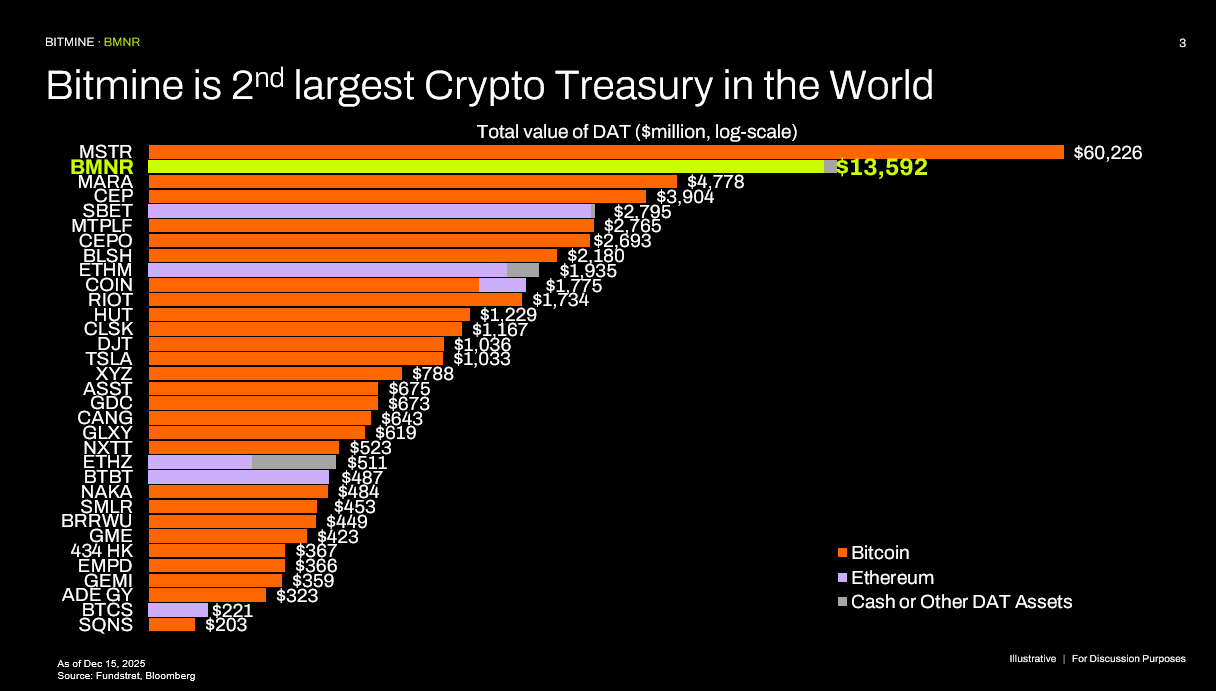
According to its Dec. 22 holdings update, BitMine now controls around 4.1 million ETH, representing 3.37% of Ethereum’s total supply of roughly 120.7 million ETH. At current prices, that stake alone is worth over $12 billion, making BitMine the most extensive Ethereum treasury in the world and the second-largest crypto treasury globally, behind Strategy Inc.’s Bitcoin holdings.
Led by Fundstrat’s Tom Lee, BitMine has openly stated its goal: reach 5% of all ETH in existence, a milestone Lee has dubbed the “alchemy of 5%.” If achieved, BitMine would hold nearly 6 million ETH, a level of concentration that would rival or exceed most decentralized staking pools and reshape Ethereum’s economic and governance environment.
The development raises an unavoidable question: Does one company holding more than 3%, and potentially 5%, of ETH threaten Ethereum’s decentralization?
BitMine’s Ethereum Treasury Explained: How BMNR Accumulated 3.37% of ETH Supply
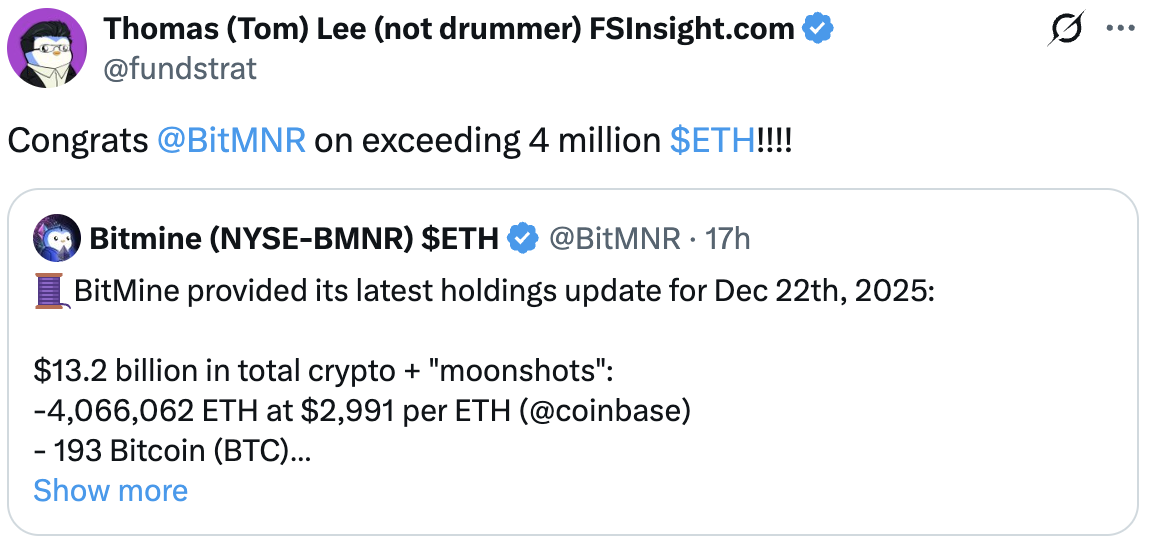
BitMine’s accumulation has been both rapid and unprecedented. In just 5.5 months, the company surpassed 4 million ETH, adding nearly 100,000 ETH in a single week leading up to its December disclosure. Its treasury now consists of:
4,066,062 ETH (3.37% of supply).
193 BTC.
$1.0 billion in cash.
$32 million stake in Eightco Holdings (NASDAQ: ORBS), labeled as “moonshots”.
In total, BitMine’s crypto, cash, and equity holdings stand at $13.2 billion.
Tom Lee shares Bitmine’s milestone of topping 4 million ETH holding. | Credit: Tom Lee X profile
What makes this accumulation especially notable is not just its size, but also its liquidity and accessibility. BMNR is now one of the most actively traded stocks in the U.S., averaging $1.7 billion in daily trading volume, ranking 66th nationwide, ahead of Chevron and just behind Wells Fargo. That liquidity allows BitMine to continuously raise capital and expand its ETH position with minimal friction.
Why BitMine’s ETH Accumulation Could Trigger an Ether Supply Shock
Ethereum’s supply dynamics already lean toward scarcity. Since the merge to proof-of-stake and the implementation of fee burning, ETH issuance has slowed significantly, resulting in periods of net deflation.
BitMine’s accumulation compounds this effect.
Removing over 4 million ETH from liquid circulation tightens exchange supply, reduces order book depth, and increases sensitivity to marginal demand. If BitMine reaches its 5% target, the removal of nearly 6 million ETH could materially alter Ethereum’s market structure.
Bitmine is second largest crypto treasury in the World. | Credit: Bitmine
Historically, cryptocurrency markets have responded predictably to supply constraints. Bitcoin’s institutional accumulation between 2020 and 2021, driven by corporate treasuries and ETFs, helped fuel one of the largest bull markets in its history. Ethereum could experience a similar dynamic.
However, scarcity cuts both ways. While reduced supply can accelerate price appreciation, it also amplifies volatility. With fewer coins available, price moves become sharper, and market reactions to unexpected selling or macro shocks can be more violent.
Does Owning 3.37% of ETH Mean BitMine “Controls Ethereum”?
No. Token ownership alone is not the same as consensus control on Ethereum.
Ethereum operates under a proof-of-stake model. Network security and transaction finality depend on validators that actively stake ETH and participate in consensus by voting on checkpoints. Finality requires broad participation across the validator set, not merely large token balances held in reserve.
First, holding ETH does not automatically grant influence over the network. Consensus power only arises if ETH is actively staked, either by running validators directly or by delegating stake through staking providers. Passive ownership, regardless of size, does not affect block production or finality.
Second, Ethereum does not grant special permissions or privileges to large holders. The system is designed to be open and permissionless, allowing anyone who meets the technical and economic requirements to participate without approval from a central authority.
As a result, BitMine’s reported holdings represent a concentration of ownership, not proof of centralized control over Ethereum’s consensus.
Ethereum Staking Centralization Risks: What BitMine’s Validator Power Means for ETH
Ethereum’s proof-of-stake model turns ETH into more than a speculative asset; it is also productive capital. Large holders can stake ETH to earn a yield while participating in the network’s consensus.
BitMine has already announced plans for its own staking infrastructure, the Made in America Validator Network (MAVAN), expected to launch in early 2026. If BitMine stakes a substantial portion of its ETH, it would instantly become one of the largest validator operators on the Ethereum network.
At 5% of the total supply, BitMine could earn an estimated 150,000-200,000 ETH annually in staking rewards, further compounding its influence.
This raises legitimate decentralization concerns:
Validator concentration could increase.
Governance influence may skew toward institutional priorities.
Client diversity and censorship resistance could be weakened if too much stake is consolidated under a single entity.
Ethereum does not rely on token voting in the same way as some blockchains, but economic weight still matters. Large validators shape defaults, client adoption, upgrade coordination, and social consensus during contentious forks.
Institutional-grade staking infrastructure offers reliability and security, albeit at the expense of concentration.
How BitMine’s ETH Holdings Could Impact Ethereum Liquidity and DeFi Markets
Ethereum is not just a network; it is the base asset of DeFi. ETH underpins lending protocols, AMMs, derivatives platforms, and liquid staking systems.
When millions of ETH are removed from circulation, downstream effects ripple across the ecosystem:
Borrowing rates may rise as collateral becomes scarcer.
AMM depth declines, making large swaps more expensive.
Liquidation cascades become more likely during periods of high volatility.
At the same time, a large, long-term holder like BitMine could act as a stabilizing force, deploying capital during drawdowns or providing structured liquidity in select venues.
This duality defines the current moment: Ethereum becomes both scarcer and more fragile.
Is Ethereum Becoming Less Decentralized as Institutions Accumulate ETH?
Ethereum’s decentralization has never meant perfectly equal ownership. Even today, large staking pools, exchanges, and foundations collectively control a significant share of staked ETH.
What makes BitMine different is corporate coherence. It is a single, publicly traded entity with a defined strategy, governance structure, and stated accumulation target.
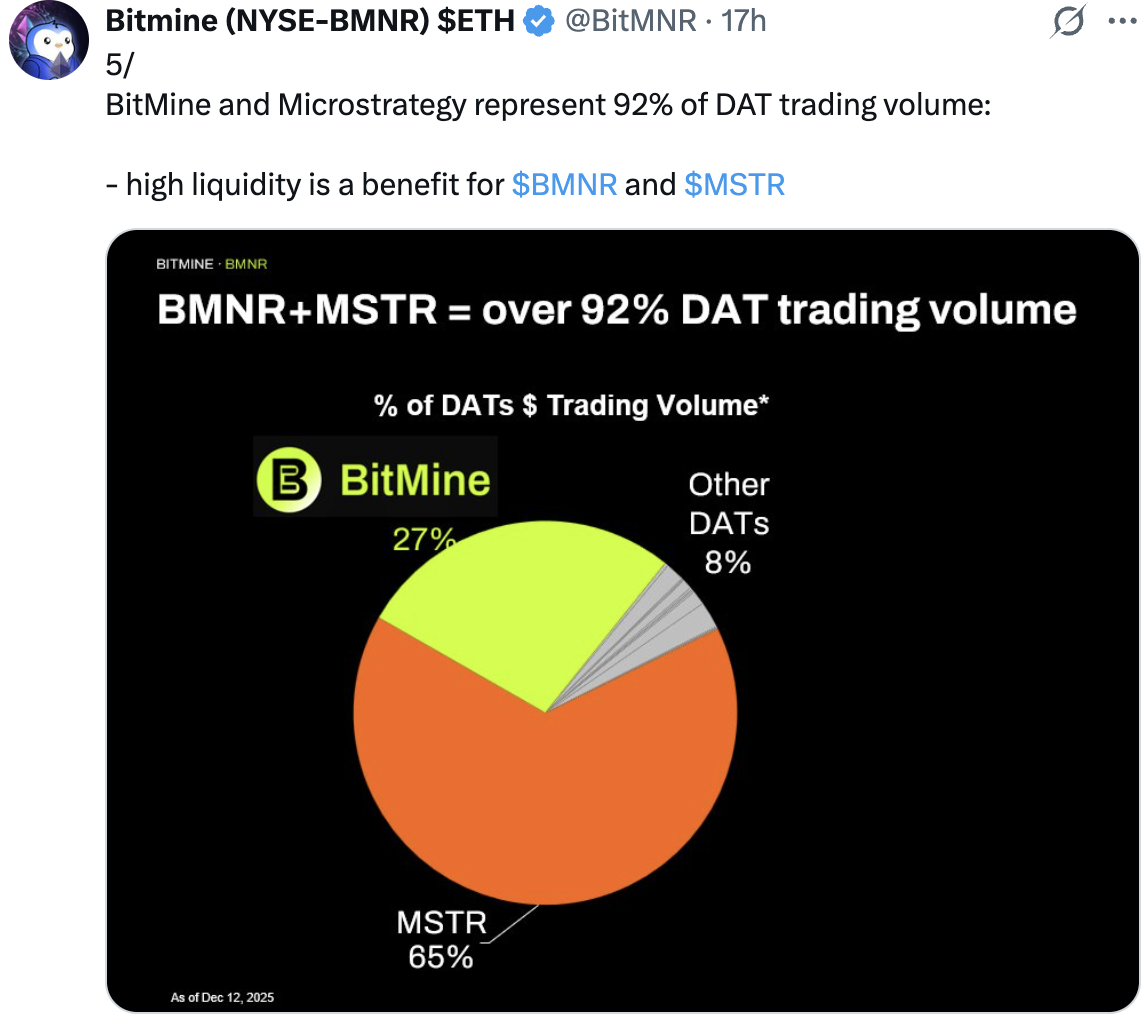
Bimine and Strategy represent 92% of DAT trading volume. | Credit: Bitmine
Critics argue that such concentration undermines Ethereum’s ethos. Supporters counter that Ethereum’s future necessarily involves institutions, compliance, and scale, and that professional validators and treasury managers are inevitable.
Tom Lee himself frames BitMine’s strategy as an infrastructure bet, likening Ethereum’s current phase to Bitcoin’s position in 2017: controversial, underestimated, but on the brink of mainstream integration.
Both views can be true.
The More Relevant Question: Where Is Ethereum’s Staking Power Concentrated?
On proof-of-stake Ethereum, decentralization concerns focus less on who owns ETH and more on how staking power is distributed. The critical issue is how much of the actively staked ETH and validator operations are concentrated among a small number of operators, clients, or custodians.
This is where Ethereum’s decentralization debates typically concentrate.
1. Supermajorities Matter
Ethereum’s consensus model relies on defined thresholds. Finality requires a two-thirds supermajority of staked ETH voting on checkpoints. Conversely, an entity controlling roughly one-third of the stake can disrupt finality, although protocol mechanisms exist to penalize and counter prolonged inactivity or malicious behavior.
Operational risks arise if too much of the network depends on a single validator operator or software client. If a dominant client approaches supermajority usage, software bugs or coordination failures can create network-wide issues.
In practice, decentralization is therefore less about “who owns the coins” and more about how validator influence and operational dependencies are distributed.
2. Client Diversity Is a Core Decentralization Factor
Ethereum’s resilience depends on diversity across both execution and consensus clients. A healthy distribution reduces the risk that a single software failure or exploit could impact a large portion of the network simultaneously.
Monitoring client diversity has become a standard part of assessing Ethereum’s decentralization because it directly relates to the same supermajority thresholds that govern finality and security.
3. Large Staking Pools Exist and Are Measurable
Significant portions of staked ETH are controlled by large staking providers and pools. These entities can command meaningful shares of validator participation and therefore have real influence over consensus outcomes.
This concentration is distinct from BitMine’s corporate treasury holdings, but it is more directly relevant to the decentralization debate because it reflects active validator power rather than passive ownership.
Where BitMine’s Holdings Do Matter
Even without implying control over consensus, a single public company holding approximately 3.37% of ETH supply is still meaningful in several concrete ways.
Market structure: BitMine’s disclosures establish it as a visible, publicly accountable ETH whale. The presence of a large corporate holder can affect market structure, liquidity considerations, and how institutional participants view Ethereum as a balance-sheet asset. This influence is economic rather than protocol-level.
Governance vs. consensus: Ethereum does not operate through tokenholder voting in the manner of shareholder governance. Protocol changes are coordinated through an open, multi-team process involving improvement proposals, client implementation, and community consensus. Holding ETH does not grant formal voting rights over protocol changes. This structural feature distinguishes Ethereum from chains where governance power is directly proportional to token ownership.
Staking at scale would be consensus-relevant: If a large holder chooses to stake a significant portion of its ETH, that decision becomes relevant to decentralization analysis. Network security and finality are directly tied to staked ETH and validator participation. Whether BitMine stakes its holdings, and through which operators or infrastructures, is therefore the relevant variable. Decentralization conclusions cannot be drawn from holdings alone.
Regulatory Tailwinds and Policy Changes Accelerating Institutional ETH Adoption
BitMine’s rise coincides with a dramatic shift in U.S. crypto policy. Lee has compared the impact of the GENIUS Act and the SEC’s Project Crypto to the 1971 end of the Bretton Woods system, a regulatory reset that modernized financial markets.
If Ethereum becomes deeply embedded in tokenized finance, payments, and institutional settlement, large, regulated holders like BitMine may be seen less as threats and more as anchors.
But that legitimacy comes with trade-offs. Concentrated ownership invites regulatory scrutiny and could make Ethereum more sensitive to policy risk than ever before.
So Does BitMine Owning 5% of ETH Actually Threaten Ethereum’s Decentralization?
Currently, BitMine’s 3.37% stake does not grant it unilateral control over Ethereum. The network remains globally distributed, with thousands of validators, developers, and users.
But trajectory matters.
At 5%, BitMine would not “own” Ethereum, but it would become too large to ignore. Its decisions around staking, custody, liquidity, and governance would ripple across the ecosystem.
Ethereum’s decentralization was never binary. It exists on a spectrum, shaped by economics as much as ideology.
BitMine’s rise pushes Ethereum toward a new equilibrium: one where institutional concentration and decentralized coordination must coexist.
Whether that balance strengthens Ethereum or exposes new vulnerabilities will define the next phase of its evolution.
One thing is clear: this is no longer just a treasury strategy. It is a structural experiment, and the entire Ethereum ecosystem is now part of it.
As of Dec. 22, BitMine Immersion Technologies controls approximately 4.07 million ETH, representing about 3.37% of Ethereum’s total supply of roughly 120.7 million ETH. This makes BitMine the most extensive Ethereum treasury in the world.
What is BitMine’s “alchemy of 5%” Ethereum strategy?
The “alchemy of 5%” refers to BitMine’s stated goal of accumulating 5% of all ETH in existence, or nearly 6 million ETH. According to chairman Tom Lee, reaching this threshold would create strategic advantages across staking, liquidity, and institutional integration with Ethereum.
Does BitMine owning 3.37% of ETH threaten Ethereum’s decentralization?
Owning 3.37% of ETH does not give BitMine direct control over Ethereum, but it does raise concerns about decentralization. Large, concentrated ownership can increase influence over staking, liquidity, and governance coordination, even if no formal voting power exists.
How could BitMine’s ETH accumulation impact Ethereum price?
Large-scale ETH accumulation reduces liquid supply on exchanges, which can create supply shock dynamics. Historically, similar scarcity conditions in crypto markets have contributed to price appreciation, though they can also increase volatility if market sentiment shifts.
Disclaimer:
The information provided in this article is for informational purposes only. It is not intended to be, nor should it be construed as, financial advice. We do not make any warranties regarding the completeness, reliability, or accuracy of this information. All investments involve risk, and past performance does not guarantee future results. We recommend consulting a financial advisor before making any investment decisions.
Giuseppe Ciccomascolo began his career as an investigative journalist in Italy, where he contributed to both local and national newspapers, focusing on various financial sectors.
Upon relocating to London, he worked as an analyst for Fitch's CapitalStructure and later as a Senior Reporter for Alliance News. In 2017, Giuseppe transitioned to covering cryptocurrency-related news, producing documentaries and articles on Bitcoin and other emerging digital currencies. He also played a pivotal role in establishing the academy for a cryptocurrency exchange website. Crypto remained his primary area of interest throughout his tenure as a writer for ThirdFloor.


 Easy
Easy