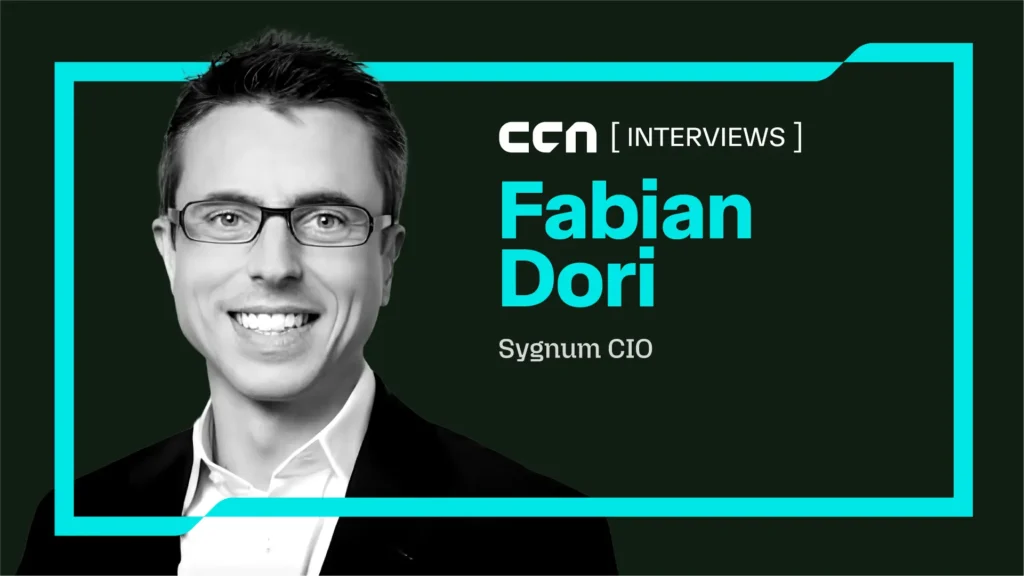
"Traditional banks are concerned that stablecoins may become the default balance." | Image credit: CCN
Share
Macroeconomic pressure, geopolitical tensions, and regulatory delays continue to shape digital asset markets.
Yet, according to Sygnum Bank Chief Investment Officer Fabian Dori, the current environment does not signal the start of a prolonged downturn.
In an interview with CCN, Dori explained that recent volatility reflects liquidity constraints and investor sentiment rather than weakening fundamentals.
“Our hypothesis is that the current market volatility is more caused by liquidity and by sentiment than by fundamentals that would be deteriorating,” Dori said.
He pointed to several short-term factors behind the recent instability. These include reduced market liquidity following large liquidation events, uncertainty about the traditional four-year crypto cycle, and concerns about regulatory delays and emerging risks such as quantum computing.
At the same time, underlying indicators continue to improve.
“If you however, look at the fundamental data… then we see that the fundamentals are not only still strong, but rather still improving,” he added.
Watch the full interview here:
Geopolitical Risks Add Short-Term Pressure but Support Long-Term Narrative
Global tensions, particularly those affecting energy markets, have introduced new uncertainty. Rising oil prices often increase inflation pressure and influence interest rate decisions, which tend to weigh on risk assets.
Dori acknowledged this short-term impact but highlighted a more complex dynamic.
“In the short term, obviously, an increase in oil prices has a negative impact… on liquidity conditions… and then ultimately on interest rate decisions,” he said.
Despite this, crypto markets have shown resilience during recent geopolitical escalations. Bitcoin and other digital assets have reacted positively in some cases, reinforcing their long-term narrative as alternative stores of value.
“That storyline around Bitcoin being a long-term store of value… there still seems to be substance to that,” Dori said.
Institutional behavior also reflects this shift. Instead of focusing only on price exposure, large players now prioritize infrastructure development.
“Institutional adoption is much less about price exposure and much more about institutional integration,” he said.
This includes building systems for tokenization, stablecoins, and on-chain financial products.
Dubai’s Ambitions Face Volatility but Not Structural Risk
Dubai has positioned itself as a global hub for tokenized real-world assets (RWAs). The strategy relies on investor confidence, cross-border capital flows, and political stability.
While geopolitical tensions may introduce temporary disruptions, Dori does not expect long-term damage.
“There is probably a bit of a short-term volatility to that adoption journey,” he said.
He stressed that structural drivers such as regulation, talent, and capital remain intact.
“The longer-term factors… I have no signs of fundamental disruptions on that side yet,” he added.
Bitcoin Shows Dual Identity as Risk Asset and Store of Value
Bitcoin continues to present a mixed profile. In the short term, it behaves like a risk asset due to liquidity conditions, speculative exposure, and constant trading activity.
“In the shorter term, Bitcoin acts as a risk asset,” Dori said.
However, the long-term trend points in a different direction. Growing integration with traditional finance strengthens its role as a store of value.
“We clearly see that this store of value characteristic… gains further traction,” he explained.
Institutional investors, asset managers, and sovereign funds continue to increase exposure, reinforcing Bitcoin’s position within global financial systems.
Tokenized Bonds Need Regulation, Infrastructure, and Liquidity
Sygnum Bank’s research suggests that 1 in 10 bonds could eventually be tokenized at issuance. For that to happen, several conditions must align.
Dori outlined three key requirements:
Regulatory clarity: clear definitions, oversight, and tax treatment.
Infrastructure development: systems that allow issuance, trading, and custody.
Market liquidity: active participation from issuers, investors, and intermediaries.
“Regulation is there and if the technology is there, that is not a guarantee yet… that tokenized real assets are really taking off,” he said.
Switzerland provides an early example. Strong regulation and technology already exist, but demand has only recently started to grow as the ecosystem expands.
Custody Will Remain Dominated by Institutions
Self-custody remains a core feature of crypto, but Dori expects institutional custody to dominate in the long run.
He compared the structure to traditional finance, where individuals hold some assets directly while most remain within regulated institutions.
“The major part will be with regulated compliant institutions,” he said.
Institutional custody offers additional services such as tax reporting, lending, and risk management, which many users and organizations require.
"Structured, regulated yield solutions and basis trading are opening new avenues to capture risk-adjusted yield in USD, CHF, EUR or Bitcoin."
Tokenization and AI Will Reshape Financial Infrastructure
Looking ahead, Dori expects tokenization to transform the financial system over the next decade.
“We have the hypothesis that in the long term, all assets will be on-chain and tokenized,” he said.
Key advantages include:
24/7 tradability: continuous market access.
Cost efficiency: lower transaction costs, especially cross-border.
Near real-time settlement: faster execution and reduced friction.
Programmable value chains: automation through smart contracts.
Stablecoins and tokenized funds represent the first wave of adoption. At the same time, regulatory debates continue, particularly around their impact on traditional banking systems.
“Traditional banks are concerned that stablecoins… may become the default balance,” Dori said.
Artificial intelligence will also play an increasingly important role. Blockchain systems provide structured data and programmable environments that AI agents can interact with directly.
“AI agents have the ability to… initiate transactions, monitor flows, and automate value chains,” he explained.
Regulation Race Accelerates Global Competition
Switzerland remains a leader in crypto regulation, but other jurisdictions are moving quickly.
Dori pointed to developments across multiple regions:
European Union: Markets in Crypto-Assets Regulation (MiCA).
Hong Kong: expanding digital asset frameworks.
United States: recent policy shifts that triggered broader regulatory momentum.
“I think that… started off a bit of a regulatory race,” he said.
The crypto market continues to face volatility driven by liquidity constraints, sentiment shifts, and geopolitical uncertainty. However, fundamentals remain strong, supported by improving macro conditions, institutional adoption, and expanding infrastructure.
Tokenization, stablecoins, and AI integration signal a structural transformation that extends beyond price cycles. While short-term risks persist, long-term trends point toward deeper integration of digital assets into global finance.
As Dori summarized, the transition is already underway, with infrastructure and regulation gradually aligning to support the next phase of growth.
Disclaimer:
The information provided in this article is for informational purposes only. It is not intended to be, nor should it be construed as, financial advice. We do not make any warranties regarding the completeness, reliability, or accuracy of this information. All investments involve risk, and past performance does not guarantee future results. We recommend consulting a financial advisor before making any investment decisions.
Dr. Lorena Nessi is an award-winning journalist and media technology expert with 15 years of experience in digital culture and communication. Based in Oxfordshire, UK, she combines academic insight with hands-on media practice.
She holds a PhD in Communication, Sociology, and Digital Cultures, and an MA in Globalization, Identity, and Technology.
Lorena has taught at Fairleigh Dickinson University, Nottingham Trent University, and the University of Oxford. She is a former producer for the BBC in London, with additional experience creating television content in Mexico and Japan.
Her research focuses on digital cultures, social media, technology, capitalism, and the societal impact of blockchain innovation.
She has written extensively on digital media and emerging technologies, with her work featured in both academic and media platforms. Her Web3 expertise explores how blockchain technologies shape culture, economics, and decentralized systems.
Outside of work, Lorena enjoys reading science fiction, playing strategic board games, traveling, and chasing adventures that get her heart racing. A perfect day ends with a relaxing spa and a good family meal.


 Easy
Easy