Who Really Owns the Most Ethereum in 2026? One Address Controls More ETH Than Binance, BlackRock — and Bitmine
Share
Key Takeaways
Ethereum Beacon Deposit Contract holds over 80M ETH, worth approximately $160B, making it the largest single address by far.
This contract aggregates staked ETH from validators worldwide, securing the network rather than representing a single entity’s control.
Binance, the top exchange holder, controls about 4.1M ETH, while BlackRock’s ETF holds around 3.2M ETH.
BitMine, a prominent corporate treasury, owns up to 4.2M ETH but ranks below the Beacon Contract and major exchanges in verified on-chain holdings.
Who do you think holds the keys to the world’s largest Ethereum (ETH) vault? If you guessed a billionaire founder, a Wall Street bank, or a global exchange, you’re missing the biggest player on the board. The Ethereum Beacon Deposit Contract controls over 77M ETH, valued at roughly $241B as of early 2026, eclipsing giants like Binance, BlackRock, and even corporate heavyweight BitMine.
This isn’t the wallet of a secretive whale or an aggressive trader; it’s the backbone of Ethereum’s security system, pooling staked funds from thousands of participants to keep the network running smoothly. According to Arkham’s data, this single address acts as the structural “gravity” for the entire ecosystem, ensuring that the network remains decentralized and resistant to attack.
This article dives into the top ETH holders, examines the Beacon Contract’s intents, and analyses what this distribution means for Ethereum’s future.
Which Ethereum Wallet Holds More ETH Than Anyone Else
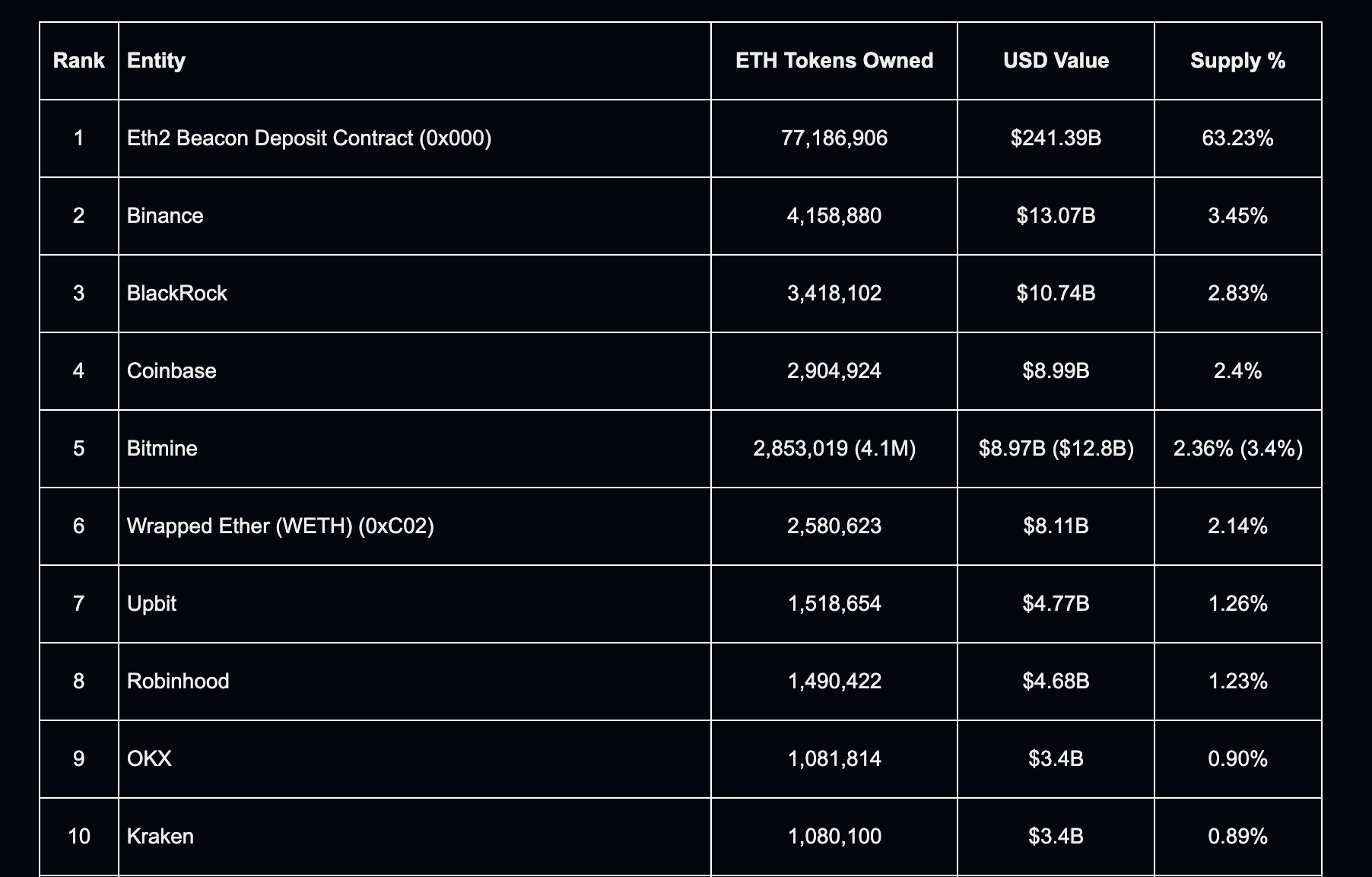
The address belonging to the Ethereum Beacon Deposit Contract tops every list of ETH holders in 2026. It holds 77,186,906 ETH, equal to $241.39B at current price. That’s more than the combined holdings of the next several major players.
To put this number into perspective, it represents over 63% of the total circulating supply of Ether. If this address were a private individual, they would be the wealthiest person in history.
But what are the risks of holding so much ETH? If one address holds so much, does that centralize power? Not quite. The ETH here belongs to decentralized validators, not a single controller.
Top 10 ETH token owners of 2026 | Credit: Arkham.com
What the Beacon Deposit Contract Actually Is — and Why It’s So Massive
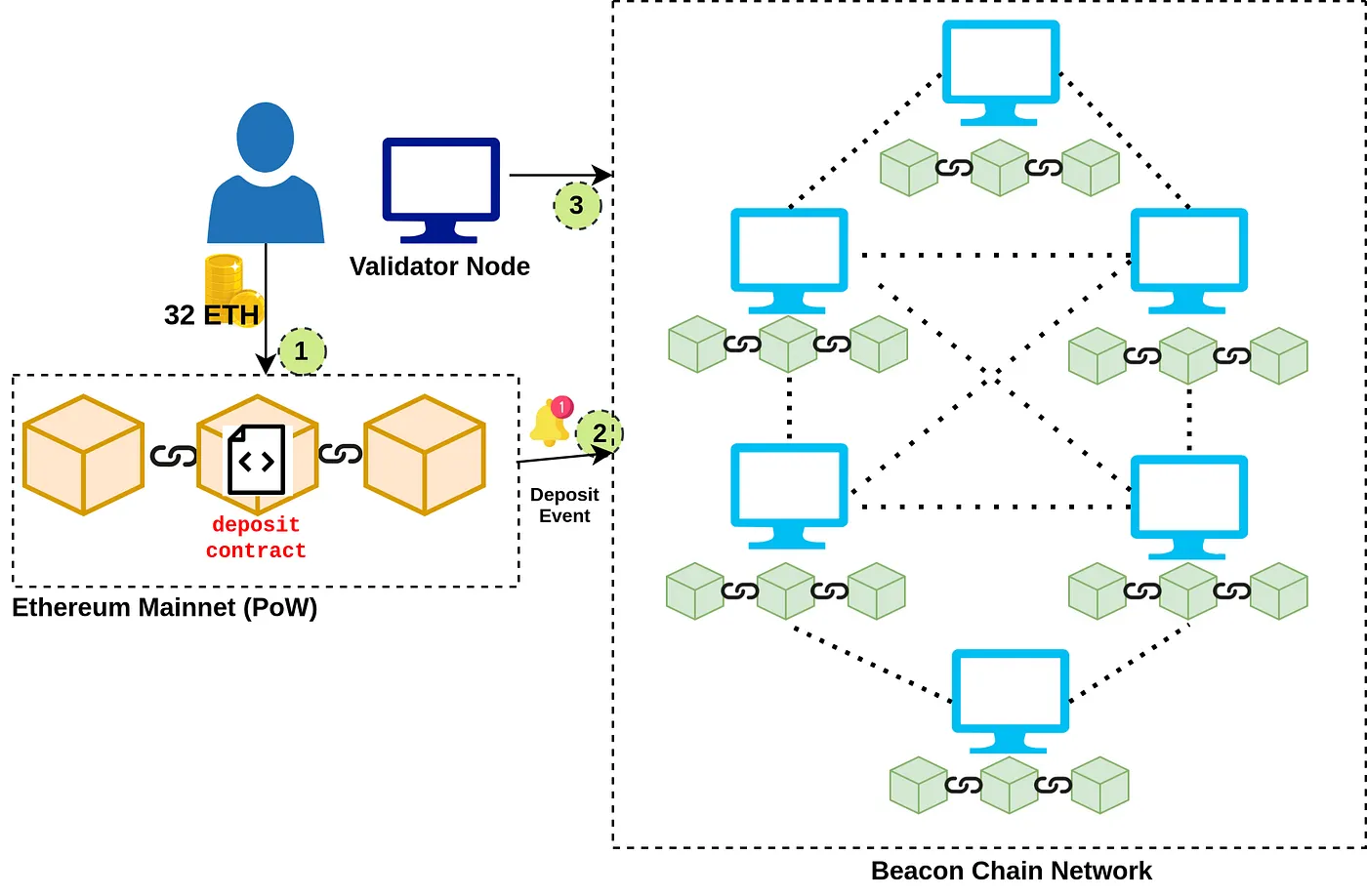
The Beacon Deposit Contract is the technical “bridge” that allows Ethereum to function under its proof-of-stake (PoS) system. Since the network moved away from traditional mining, it has relied on validators to process transactions. It’s an Ethereum mainnet smart contract that accepts ETH deposits for staking.
Why has it gotten so big? Staking provides annual yields of 3% to 5%, attracting people, institutions, as well as decentralized finance (DeFi) protocols. Staking became even easier with upgrades like Dencun in 2024, which lowered fees. Historical background: Pre-merge Ethereum was dependent on miners. Post-merge, staking reduced the amount of ETH in circulation and might have helped maintain price stability by locking up more than 60% of the supply.
Does anyone “control” this address? No. The contract is governed by the decentralized Ethereum protocol. There is no private key that can withdraw the $241B at once, making it the most secure and transparent vault in financial history.
Ethereum 2.0: The Beacon Chain | Credit: Kerala Blockchain Academy
How the Beacon Contract Dwarfs Binance and BlackRock’s ETH Holdings
For years, Binance was the undisputed heavyweight of the Ethereum ecosystem. As a centralized exchange (CEX), it holds ETH on behalf of millions of global users. However, in 2026, Binance’s total reserves sit at roughly 4.1M ETH. While substantial, this is less than 6% of what is held in the protocol’s deposit contract.
BlackRock, through its iShares Ethereum Trust ETF, controls 3,418,102 ETH ($10.74B), representing 2.83% of supply. Launched in 2024, the ETF has seen massive inflows as institutions seek regulated exposure. Still, it pales next to the contract’s holdings, which secure the entire network.
Why the gap? Most of the ETH “held” by Binance and BlackRock is actually physically sitting inside the Beacon contract through their staking services, making them major contributors to the #1 ranking.
While the Beacon Contract blocks ETH for long-term staking, exchanges and exchange-traded funds (ETFs) manage active funds for trading and investment. Historical parallels: ETH was more liquid on exchanges in 2023, and by 2026, staking dominance demonstrates Ethereum’s maturity.
What does this mean for traders? If you’re holding ETH on an exchange, consider the risks of centralized custody versus self-staking.
Why BitMine Isn’t Even in the Top 3 Ethereum Holders
In early 2026, BitMine Immersion Technologies (BMNR) made waves by announcing its ETH holdings had reached 4.326M tokens. However, on-chain verification shows it below the Beacon Contract, Binance, and BlackRock.
Why? Despite being the world’s largest corporate treasury for Ethereum (effectively doing for ETH what MicroStrategy did for Bitcoin), BitMine remains in the #5 spot behind the protocol itself. Arkham verifies 2,85M ETH under BitMine-labeled addresses, though the company reports total holdings exceeding 4.1M ETH.
BitMine’s strategy emphasizes staking and holding, but its total lags behind staking aggregates and institutional ETFs. Similar cases: Companies like Strategy holding Bitcoin in their treasuries can influence markets, but Ethereum’s PoS favors network-level concentration.
What Ethereum’s Ownership Distribution Reveals About the Network
Ethereum’s holder landscape depicts a fortified but focused setup. Besides the Beacon Contract, Wrapped ETH (WETH) manages 2.5M for DeFi, while Coinbase handles 2.9M and Upbit controls 1.5M. Notable personalities like Vitalik Buterin (240,000 ETH) and hidden wallets add to the complexity, yet institutions win out.
This breakdown highlights advantages: Elevated staking fortifies against assaults via over 1M validators. Drawbacks include potential volatility from mass unstaking, echoing 2023’s Shanghai events.
Why is this relevant to everyday traders and investors? It highlights Ethereum’s durability in a fractured crypto space, where staking not only protects but defines global finance.
What is the Ethereum Beacon Deposit Contract, and why does it hold so much ETH?
The Beacon Deposit Contract is the smart contract used for staking on the Ethereum network. All ETH staked by validators to secure the network is deposited into this contract, which is why it has accumulated over 76M ETH, making it the largest ETH-holding address in existence.
Does the Beacon Deposit Contract control or own the staked ETH?
No. The contract does not “own” the ETH in a traditional sense. It acts as a protocol-level escrow, locking ETH while validators participate in securing the network. The funds cannot be moved freely like exchange or corporate holdings.
Why does BitMine not rank among the top three Ethereum holders?
While BitMine has reported large ETH reserves, blockchain analytics platforms only rank holdings that can be verified on-chain. Based on verifiable data, BitMine’s confirmed ETH balance is lower than those held by the Beacon Deposit Contract, Binance, and BlackRock.
How does Arkham determine who owns the most Ethereum?
Arkham tracks wallet balances using on-chain data, labeling addresses that have been publicly identified or cryptographically verified. Rankings are based strictly on confirmed holdings, not estimates or self-reported claims.
Disclaimer:
The information provided in this article is for informational purposes only. It is not intended to be, nor should it be construed as, financial advice. We do not make any warranties regarding the completeness, reliability, or accuracy of this information. All investments involve risk, and past performance does not guarantee future results. We recommend consulting a financial advisor before making any investment decisions.
Curious about how technology and crypto reshape global finance, Elizaveta Savenko explores blockchain, AI, decentralized systems, their applications, and regulatory requirements. She contributes to research, educational initiatives, and industry collaborations, examining trends in digital assets and fintech innovation, increasing awareness of the crypto space and its impact on financial systems.


 Easy
Easy