Veteran Wall Street strategist and Fundstrat cofounder Tom Lee is one of Bitcoin’s loudest institutional bulls.
He was among the first mainstream equity strategists to publish a formal valuation framework for Bitcoin as “digital gold.”
Lee’s Bitcoin targets often land in the six figures, and he’s been directionally right, if not early, on several major BTC cycles.
His models focus on halvings, fixed supply, adoption curves, a macro look, and more.
From bold Bitcoin predictions to an enthusiastic endorsement of Ethereum, Thomas Jong Lee, better known as Tom Lee, has become a familiar name in both Wall Street and cryptocurrency circles. With a career spanning traditional finance and digital assets, Lee has built a reputation as a data-driven contrarian, unafraid to challenge mainstream narratives about markets, money, and technology.
Over the years, he has been featured on major financial networks, invited to global investment conferences, and cited by institutions and retail investors alike for his macroeconomic insights and quantitative approach. While many traditional analysts dismissed Bitcoin in its early years, Lee stood out as one of the first to apply Wall Street-style valuation models to crypto, effectively framing Bitcoin as “digital gold” long before that comparison became conventional wisdom.
Let’s take a closer look at who Tom Lee is, what shaped his perspective, and why his views carry such weight in the digital asset space.
Lee’s Background
Tom Lee grew up in Westland, Michigan, the son of Korean immigrants. He studied economics in the Wharton School at the University of Pennsylvania, concentrating in finance and accounting. He earned a Bachelor of Economics degree and is now a part of finance shows like CNBC’s Fast Money. As of June 2025, Lee is also chairman of the board of directors at BitMine.
Now, Lee’s education initially brought him into traditional finance. In 2014, he left a role at JPMorgan to found an advisory firm, Fundstrat Global Advisors, where he remains a head of research. It was at Fundstrat where he became known for Bitcoin predictions, making calls on all sorts of macro assets, including the world’s first cryptocurrency.
While Lee is known for his “contrarian” claims driven by data, perhaps most relevant to the crypto space is his status as the first Wall Street strategist to take Bitcoin seriously.
Earn Crypto with These Top Mining Apps
Sponsored
Disclosure
We sometimes use affiliate links in our content, when clicking on those we might receive a commission at no extra cost to you. By using this website you agree to our terms and conditions and privacy policy.
Lee’s Bitcoin Price Predictions: Here’s What You Should Know
Lee isn’t a “crypto native” in the traditional sense, considering he was in traditional finance long before the publishing of Bitcoin’s white paper on October 31st, 2008. But he was the first documented analyst to promote Bitcoin as a real alternative investment.
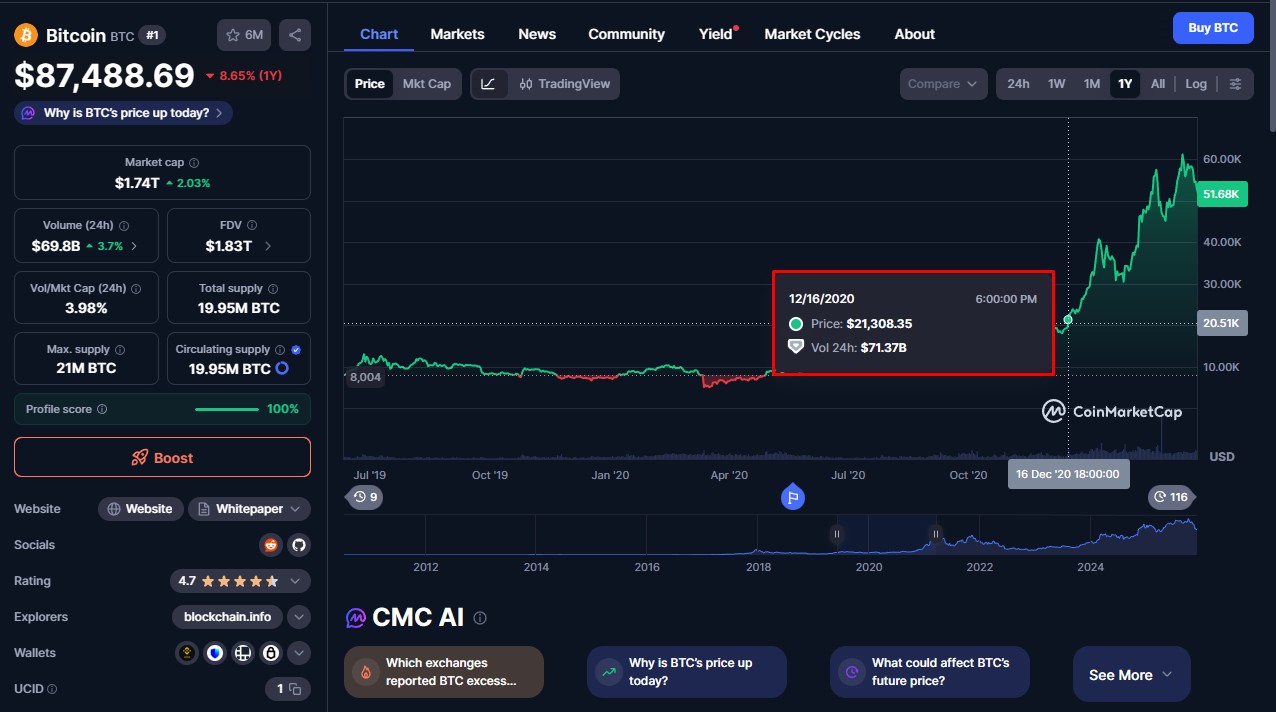
On July 7th, 2017, just three years after founding his own firm, Lee published a report titled “A framework for valuing bitcoin as a substitution for gold.” In it, he predicted that Bitcoin could range anywhere from $20,000 to $55,000 by 2022. Keep in mind that Bitcoin was trading around $2,500 at the time, with a market cap of approximately $41 billion. This was also during Bitcoin’s first mainstream breakout.
Source: CoinMarketCap
Lee’s reasoning was simple: the supply and demand for “digital gold,” paired with its accessibility and general improvements (store of value, impossible to “print” more), should mirror the value and movements of its physical counterpart.
Believe it or not, Lee was right. Bitcoin broke $20,000 far before Lee’s claim of 2022, hitting over $21,000 in mid-December 2020. The asset went as high as $67,500 in November 2021 before plummeting to the $15,000s less than a year later. It wouldn’t hit the $60k mark for another 16 months.
Source: CoinMarketCap
Lee’s Most Notable Bitcoin Price Predictions and What Happened Next
But there’s more to the story.
Lee was right about his 2017 prediction that Bitcoin would break $20,000 by 2022. Thing is, he made a new claim in January 2018, stating Bitcoin would hit $125,000 by 2022. The digital asset barely broke that in October 2025, many years later.
TOM LEE EXPLAINS THAT THE HIGHER GOLD CLIMBS, THE HIGHER #BITCOIN'S FUTURE PRICE WILL BE
That’s the interesting thing about Lee: his predictions aren’t wrong, per se, but his timelines are.
A few of his most notable calls:
2018 – $25,000 by year’s end: When Bitcoin crashed from its 2017 highs through to the next year, Lee repeatedly pushed for a rally, claiming a $25,000 mark by 2018’s end. That didn’t happen. Bitcoin spent the vast majority of 2018 under $10,000.
2021 – $100,000 to $125,000: During the post-pandemic bull cycle, Lee again argued that Bitcoin would climb into the six figures. It wouldn’t hit $100,000 until December 2024.
2025 – $150,000 to $200,000: In 2025, Lee made his boldest claim. That Bitcoin would reach $150,000-$200,000 by year’s end, with a possibility of $250,000, due in large part to 2024’s Halving cycle. However, Lee cut that prediction as late as November of 2025, shifting it to a year-end goal of above $100,000. GPT agrees.
Surely, you see Lee’s claims are considered too optimistic or too early, but they’re also a part of what made him a recognizable name in crypto. Better to have a Wall Street convert excited about digital assets than the alternative.
How Does Tom Lee Come Up With These Numbers?
Of course, Lee doesn’t pull these price targets out of thin air. His Bitcoin research tends to lean on a few recurring ideas:
Halving cycles and scarcity: Lee studies Bitcoin’s four-year Halving cycle, the cycle that halves miner rewards and slows BTC issuance. Like many on-chain analysts, he argues that these Halvings create demand that leads to bull runs later on.
Adoption curves: Lee compares Bitcoin’s adoption to that of the typical technology curves, such as the internet or mobile phones. As more people and institutions hold BTC, its value should eventually curve higher, especially with its limited supply of 21 million.
Macro flows and ETF demand: Coming from equities, Lee thinks in terms of global liquidity and risk appetite. He ties his price targets to factors like Federal Reserve rate cuts, Bitcoin ETF inflows, and the “debasement trade” where investors hedge government debt with assets like BTC and gold.
Public sentiment: Lee also refers to the Bitcoin Misery Index (BMI), which he created in 2023. The Index attempts to quantify how traders feel about the digital asset at any given time.
You can disagree with Lee all you want, but he at least follows some semblance of a framework, and some of that approach comes from his time in equities and other macro assets.
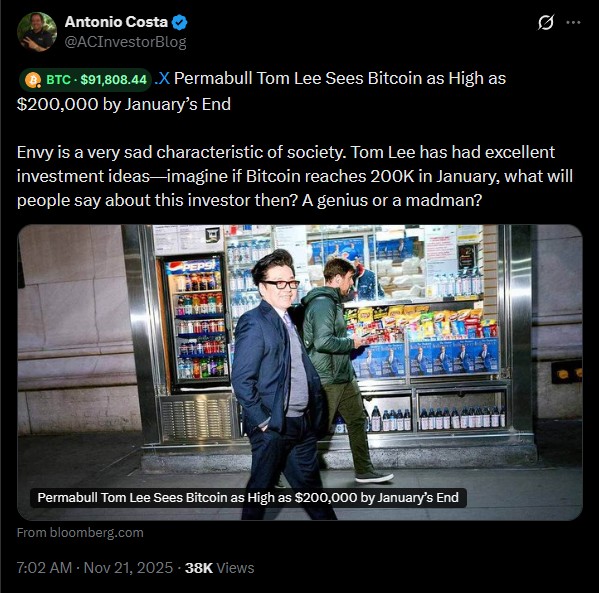
If Lee is right about a $200k Bitcoin in January, is he a genius or a madman? | Source: @ACInvestorBlog on X
Beyond Bitcoin: Ethereum, BitMine and the Next Phase
Lee doesn’t stop at Bitcoin predictions, however. Over the last two years, he has emphasized Ethereum’s importance through his role at BitMine Immersion Technologies.
BitMine started as a small company, but Lee turned it into a full-blown Ethereum-focused digital asset treasury (DAT). By late 2025, BitMine disclosed earnings of roughly 3% of all ETH, intending to hit 5% of its circulating supply over time.
Lee considers BitMine’s ETH position as a “supercycle” bet, claiming that its current correction is a precursor to a stronger, more sustainable uptrend. BitMine will roll out its own staking solution as well, and, according to Lee, Ethereum founders are working to “ensure Wall Street can build” on it.
Lee’s Ethereum Predictions and Outlook
According to Lee, ETH could reach $9,000–$12,000 by late 2025 if adoption, staking growth, and ETF demand accelerate. He believes Ethereum will remain the primary settlement layer for DeFi and tokenized assets, even as competitors emerge.
Long-term price target: In Lee’s “supercycle” scenario, Ethereum could eventually trade above $60,000, assuming broad institutional use and the tokenization of real-world assets.
High-beta correlation to Bitcoin: Lee describes Ethereum as a “high-beta version of BTC,” typically following Bitcoin’s halving-driven uptrends but with amplified gains.
Institutional accumulation: Lee cites growing interest from funds, corporate treasuries, and ETF issuers, noting that institutional staking could become a key driver of demand.
Ethereum as “crypto’s treasury bond”: With staking rewards offering predictable yields, Lee argues ETH may evolve into a yield-bearing, low-volatility asset in mature portfolios.
Taken together, Lee’s pivot shots how Lee considers crypto: Bitcoin as a macro “digital gold” with Ethereum as a core programmable layer for the global tokenized financial system.
If you’re an investor, you don’t need to agree with Lee to benefit. The smarter move is to treat his predictions as one input among many. Instead, as always, you should focus on doing your own research (DYOR) instead of outsourcing to someone else’s model.
Why do people care about Lee’s Bitcoin predictions?
Investors follow his calls because he blends traditional macro analysis with on-chain and ETF data. He isn’t afraid to publish bold targets.
Has Tom Lee been right about Bitcoin in the past?
He is often right about a target, just not the timeframe. Lee is often too optimistic.
Is Tom Lee only bullish on Bitcoin?
No. In recent years, he has become increasingly bullish on Ethereum as well, especially through BitMine’s large ETH treasury strategy.
Should I base my crypto strategy on Tom Lee’s targets?
No. His forecasts can be a useful input, but you should treat them as scenarios to analyze, not guarantees, and make decisions based on your own risk tolerance.
Disclaimer:
The information provided in this article is for informational purposes only. It is not intended to be, nor should it be construed as, financial advice. We do not make any warranties regarding the completeness, reliability, or accuracy of this information. All investments involve risk, and past performance does not guarantee future results. We recommend consulting a financial advisor before making any investment decisions.
Max Moeller is a Chicago‑based writer and video editor passionate about games, tech, and crypto. Whether it’s crafting clear, insightful articles or piecing together engaging video retrospectives, he’s driven by curiosity and takes pride in keeping things human. Since 2017, Max has been published in a variety of notable crypto magazines.


 Easy
Easy