BitMine aims to own 5% of Ethereum, potentially reshaping ETH’s supply and DeFi markets. | Credit: CCN.com
Share
Key Takeaways
BitMine aims to hold 5% of Ethereum’s total supply, equal to 6 million ETH.
This level of accumulation dwarfs nearly all corporate crypto treasuries and most decentralized staking pools.
BitMine’s MAVAN validator network would give outsized influence over consensus and protocol governance.
Tom Lee expects Ethereum is ready for a major bull run, similar to Bitcoin in 2017.
Ethereum, the world’s second-largest cryptocurrency, has long been celebrated for its decentralization, innovation, and role as the backbone of decentralized finance. But what happens when a single entity quietly accumulates enough ETH to control 5% of its entire supply, potentially? Enter BitMine Immersion Technologies.
Led by crypto strategist Tom Lee, BitMine has embarked on a sweeping acquisition campaign. By December 2025, the company held roughly 3-3.2% of ETH’s circulating supply, about 3.6-3.9 million coins, and publicly set a target of 5%, or nearly 6 million ETH. For perspective, that’s a sum larger than many decentralized staking pools, dwarfing almost all corporate treasuries in the cryptocurrency space.
The implications of such concentrated ownership are profound. From price surges and staking dominance to liquidity crunches and governance influence, BitMine’s ETH strategy could reshape the ecosystem, for better or worse.
Ethereum Supply Shock: How BitMine’s 5% ETH Bet Could Move the Market
The first, most obvious effect of BitMine cornering 5% of ETH is a supply shock. Ethereum’s circulating supply is already thin on exchanges, hovering near all-time lows. Large holders have been quietly withdrawing coins from exchanges, thereby reducing available liquidity.
BitMine’s accumulation amplifies this trend, meaning that even modest buying or selling can significantly swing prices.
Historically, crypto markets respond to scarcity predictably: less supply meets steady demand, prices climb. Bitcoin provides a perfect parallel. In 2021, institutional accumulation and dwindling exchange reserves helped fuel massive rallies. Ethereum could follow a similar path if scarcity intensifies.
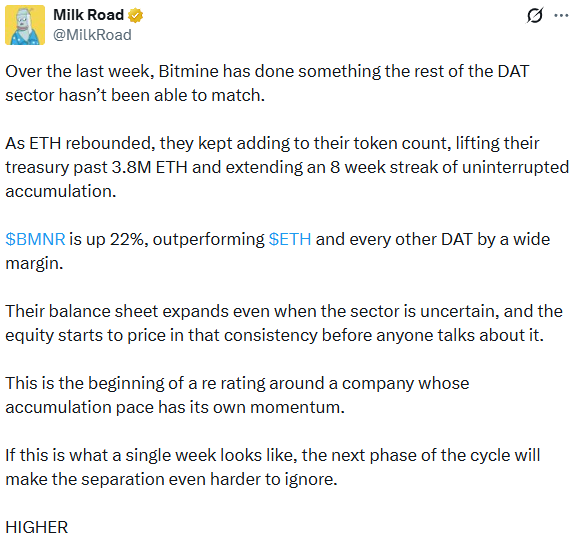
As ETH rebounded, BitMine kept adding to its token count, lifting its treasury past 3.8M ETH. | Credit: Milk Road X profile
If ETH prices double, from around $3,000 to $6,000, the market cap would effectively double. Tom Lee has suggested that under favorable conditions, ETH could reach $9,000-$12,000 by late 2025, with a “supercycle” scenario potentially pushing prices above $60,000 over the longer term.
However, concentrated ownership also amplifies volatility. Fewer coins circulating means smaller trades can cause outsized price moves. A single large sale, a pause in buying, or a forced liquidation could ripple across the market, causing dramatic swings.
Market cap expands in tandem with higher ETH prices.
Volatility increases as fewer coins buffer trades.
What BitMine’s 5% ETH Stake Means for Validators and Governance
Ethereum’s Proof-of-stake (PoS) network transforms ETH into a yield-bearing asset. With 5% of the supply, BitMine would likely stake most of its holdings, becoming one of the largest validators globally.
Currently, the top 10 staking entities control nearly half of all staked ETH, and adding BitMine’s potential 6 million ETH would reshape the validator environment.
🚨 TOM LEE JUST HINTED AT SOMETHING HUGE
Bitmine’s ETH accumulation is NOT normal… It’s historic.
🔹 Accumulating close to 4% of all ETH 🔹 Did that in five months, insane speed 🔹 MAVAN staking coming online soon 🔹 Projected to produce $1M+ per day 🔹 Still holding a $1B… pic.twitter.com/V6IWKfPNpb
Staking rewards, currently 3-5% annually, could net BitMine 150,000-200,000 ETH per year, compounding their holdings. The firm’s MAVAN validator network could rival or surpass major existing pools, giving BitMine a voice in consensus decisions, client diversity, and governance upgrades.
While institutional staking brings stability and professional infrastructure, it also raises centralization concerns. Ethereum’s decentralized design assumes distributed control; a single corporate entity holding 5% of total supply and a significant portion of staked ETH challenges that ethos:
BitMine would capture a massive share of staking rewards.
Validator influence could tilt governance decisions.
Network centralization concerns would grow, even as institutional professionalism stabilizes operations.
How BitMine’s ETH Accumulation Could Reshape Ethereum Liquidity and DeFi
Removing millions of ETH from circulation affects more than just price; it reshapes the liquidity environment. Exchanges will hold thinner order books, meaning larger trades face higher slippage. Wider spreads make trading more expensive, and the market becomes sensitive to even moderate buying or selling pressure.
Decentralized finance (DeFi) would feel the pressure acutely. ETH serves as collateral, liquidity for automated market makers (AMMs), and the base for lending and borrowing.
— Thomas (Tom) Lee (not drummer) FSInsight.com (@fundstrat) December 12, 2025
Scarcity could push borrowing rates higher, increase liquidation risk, and reduce AMM depth, making swaps more costly. Even seemingly small adjustments by large holders could create cascading effects, highlighting the fragility of a market increasingly dominated by a few whales.
At the same time, BitMine could act as a stabilizer. Large purchases during market dips could accelerate rebounds, while concentrated staking and treasury management could provide predictable long-term liquidity in certain areas. The market becomes a delicate balance between scarcity-driven rallies and fragility-induced volatility.
BitMine’s ETH Play Follows a Familiar Pattern of Institutional Accumulation
BitMine’s aggressive accumulation echoes patterns seen throughout crypto history. When institutional investors like MicroStrategy or Fidelity cornered significant portions of Bitcoin, exchange supplies dwindled, creating scarcity and bullish momentum.
Institutional investors like Strategy and Fidelity have previously cornered large portions of Bitcoin.
Resulted in dwindling exchange supplies, creating scarcity.
Contributed to bullish momentum in the market.
Ethereum has experienced whale-driven cycles.
Accumulation during 2018-2019 lows set the stage for major bull runs in 2020–2021.
Currently, BitMine’s ETH holdings exceed all other corporate treasuries combined, creating a winner-takes-most dynamic.
Historical pattern shows that high concentration.
Can drive markets higher.
Also increases dependency on the actions of a single entity.
Tom Lee and Other Analysts Weigh In on BitMine’s Ethereum Play
Tom Lee frames BitMine’s ETH accumulation as a long-term infrastructure bet, likening it to Bitcoin’s institutional positioning before the 2017 bull run. He cites Ethereum upgrades, staking demand, and macroeconomic trends as catalysts for higher prices.
Other analysts sound a note of caution. No single buyer can indefinitely prop up the market, and excessive concentration could draw regulatory scrutiny. On-chain data, however, show persistent accumulation and falling exchange reserves, conditions that could fuel a supply-driven rally.
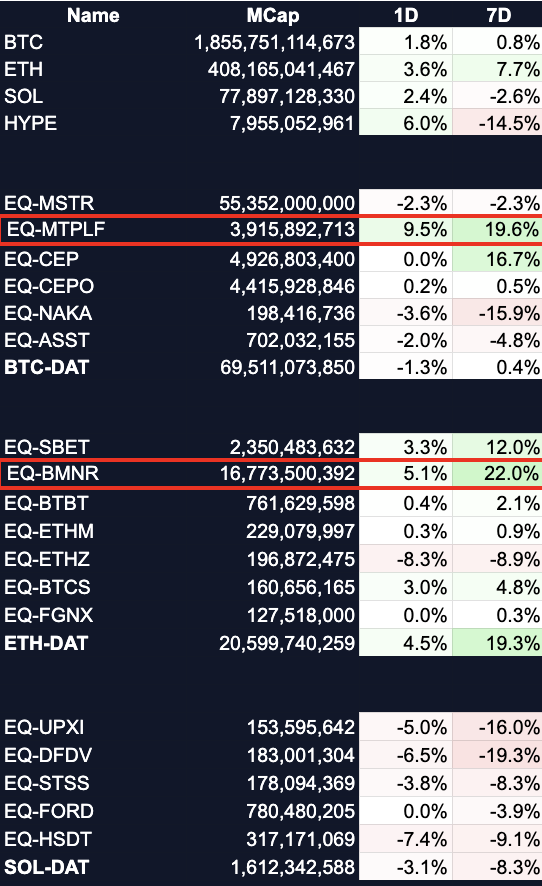
Ethereum main holders. | Credit: Milk Road X profile
Max Shannon, Bitwise: “The biggest treasuries, like BitMine, are best positioned to raise funds, buy more ETH, and attract capital.”
CryptoSlate: “Supply + Demand = Price Explosion. With fewer coins available for sale, the risk of large-scale sell-offs diminishes, helping stabilize or even drive up prices.”
BitMine’s 5% ETH Bet — What Happens If It Becomes Reality
If BitMine reaches its 5% target, Ethereum could enter an unprecedented structural phase. On one hand, supply scarcity and concentrated staking could catalyze a massive price rally, pushing valuations into uncharted territory. On the other, liquidity pressures, DeFi stress, and centralization concerns could amplify volatility and risk.
Historical parallels suggest bullish potential, especially when institutional accumulation coincides with supply constraints, but success is not guaranteed.
The ultimate outcome will depend on broader macroeconomic conditions, ETF flows, network upgrades, and market psychology.
BitMine’s move is more than just a corporate treasury strategy; it is reshaping the very ecosystem of Ethereum, making one giant holder a central figure in the world’s second-largest cryptocurrency.
How the market reacts, and whether this becomes a legendary rally or a cautionary tale, will be watched closely by every trader, investor, and ETH whale.
Who is BitMine, and what are they doing with Ethereum?
BitMine Immersion Technologies, led by crypto strategist Tom Lee, is quietly accumulating Ethereum. By late 2025, they held about 3-3.2% of circulating ETH (3.6-3.9 million coins) and aim to reach 5%, equal to 6 million ETH. Their strategy involves both holding and staking ETH, potentially influencing price, liquidity, and governance.
How could BitMine’s holdings impact ETH price and market cap?
With fewer coins available for trading, demand could push prices up. Historical parallels, like Bitcoin’s institutional accumulation in 2021, suggest scarcity can lead to rapid price increases. Tom Lee predicts ETH could reach $9,000–$12,000 by late 2025, with a long-term “supercycle” scenario possibly exceeding $60,000.
How does staking play into BitMine’s strategy?
Ethereum’s Proof-of-Stake network allows ETH holders to earn rewards by validating transactions. BitMine’s potential 6 million ETH stake could yield 150,000-200,000 ETH annually. Their MAVAN validator network could rival the largest existing pools, giving BitMine outsized influence over protocol decisions and governance votes.
Are there historical parallels for this kind of accumulation?
Yes. Institutional buyers like Strategy and Fidelity cornered large portions of Bitcoin, reducing exchange supply and creating bullish momentum. Ethereum has also seen whale-driven cycles, where accumulation during low periods preceded major bull runs.
Disclaimer:
The information provided in this article is for informational purposes only. It is not intended to be, nor should it be construed as, financial advice. We do not make any warranties regarding the completeness, reliability, or accuracy of this information. All investments involve risk, and past performance does not guarantee future results. We recommend consulting a financial advisor before making any investment decisions.
Giuseppe Ciccomascolo began his career as an investigative journalist in Italy, where he contributed to both local and national newspapers, focusing on various financial sectors.
Upon relocating to London, he worked as an analyst for Fitch's CapitalStructure and later as a Senior Reporter for Alliance News. In 2017, Giuseppe transitioned to covering cryptocurrency-related news, producing documentaries and articles on Bitcoin and other emerging digital currencies. He also played a pivotal role in establishing the academy for a cryptocurrency exchange website. Crypto remained his primary area of interest throughout his tenure as a writer for ThirdFloor.


 Easy
Easy