Tom Lee’s BitMine (BMNR) Falls 81% Despite Holding 3% of ETH Supply — What Went Wrong?
Share
Key Takeaways
Tom Lee says Ethereum may be entering a multi-year supercycle driven by real utility and long-term adoption.
Ethereum’s fundamentals are stronger than ever thanks to proof-of-stake, fee burning, and fast-growing layer-2 networks.
Real-world adoption is surging, with DeFi, tokenization, and institutions increasingly building on Ethereum.
A supercycle still comes with big risks, and Lee cautions that volatility and deep pullbacks are likely, especially for leveraged traders.
Ethereum continues to dominate conversations across the crypto market, but one prediction is drawing more attention than most. Bitmine’s Tom Lee, well-known strategist and co-founder of Fundstrat Global Advisors, has made a bold claim: Ethereum may be entering a “supercycle.”
While the term sounds dramatic, the idea is grounded in long-term market behavior, historical crypto trends, and Ethereum’s evolving role in digital finance.
This article explains what Tom Lee means, why the theory matters, and how it may shape Ethereum’s future.
What Is Tom Lee Predicting for Ethereum (ETH)?
Tom Lee argues that Ether (ETH) is beginning a multi-year growth phase similar to what Bitcoin experienced during its early adoption curve.
Tom Lee Thinks Ethereum (ETH) Is on the Verge of a Bitcoin-Level Supercycle. | Source: @fundstrat on X.
Lee hasn’t detailed every factor driving his outlook, but his comments fit within a broader narrative supported by Ethereum’s ongoing development and adoption trends.
The following points outline the structural backdrop that helps explain why some analysts, including Lee, see the potential for a long-term “supercycle.”
1. Ethereum’s Growing Role as a Base Layer
Ethereum is widely considered the leading smart-contract platform. It underpins major sectors such as:
This combination gives Ethereum stronger economic properties compared to earlier cycles.
3. A History of Crypto Supercycles
Lee often references Bitcoin’s historical behavior: long periods of volatility punctuated by major multi-year uptrends. Ethereum, he suggests, may now be entering a similar pattern, where:
Adoption accelerates
Institutional interest increases
Long-term holders outnumber speculative traders
This is the basis for calling the current phase a potential “supercycle.”
What Exactly Is a Supercycle?
A supercycle is not a short-term rally. It refers to a long-duration, structurally driven trend where an asset grows substantially due to real adoption and improved fundamentals, not hype alone.
Unlike standard boom-and-bust cycles, supercycles are driven more by fundamentals than speculation.
Bitcoin’s Playbook for Success and What It Means for Ethereum
The journey of Bitcoin (BTC) offers a useful “playbook” for how a blockchain-asset can evolve from niche curiosity into mainstream infrastructure. By examining key stages of Bitcoin’s growth, we can better understand how Ethereum (ETH) might follow a similar trajectory – support the thesis of a potential “supercycle,” while also highlighting where real differences exist.
1. Early Adoption and Network Growth
Bitcoin began as a niche digital currency in 2009, gradually attracting early adopters, miners, and developers. Over time it gained recognition as a store of value and hedge.
Key elements of this phase:
Rising number of users and addresses on the network.
Strong developer activity and new layer-2 solutions emerging on top of Ethereum.
Implication: If ETH can maintain and accelerate this network-growth dynamic, the early-adoption phase of Bitcoin’s playbook is already underway.
2. Technological Upgrades and Supply Dynamics
Bitcoin’s success hinged on consistent improvements that boosted usability, scalability, and trust. Its fixed 21 million supply became a cornerstone of its “digital gold” narrative.
Ethereum’s roadmap mirrors this focus on structural improvement. The shift to PoS reduced energy usage and changed its economic incentives. The introduction of fee burning through EIP-1559 made ETH partially deflationary, while layer-2 solutions lowered transaction costs and increased throughput.
These developments strengthen Ethereum’s fundamentals in the same way Bitcoin’s upgrades enhanced its value proposition. A more efficient, deflationary Ethereum supports the idea of a long-term “supercycle.”
3. Institutional and Mainstream Acceptance
Bitcoin’s turning point came when institutions began treating it as an asset class – through ETFs, corporate holdings, and hedge-fund exposure. Mainstream financial acceptance transformed it from a niche technology into a core portfolio asset.
Ethereum is now walking a similar path. Institutions and enterprises are exploring ETH not just as a cryptocurrency, but as infrastructure for tokenized assets, real-world finance, and digital settlement systems. The appeal of staking yields and blockchain integration has expanded ETH’s role far beyond speculation.
As institutional confidence grows, Ethereum could experience the same multiplier effect Bitcoin did during its early adoption by Wall Street and global markets.
4. Multi-Year Cycles and Market Psychology
Bitcoin’s history is defined by multi-year boom-and-bust cycles – major price surges followed by sharp corrections, each leading to higher long-term baselines. This cyclical pattern is the foundation of the “supercycle” idea.
Ethereum seems to be developing in a similar rhythm. It experiences volatility but continues to build adoption and network activity through each downturn. The ecosystem matures with every phase, creating stronger fundamentals and deeper market integration.
If Ethereum continues following this long-term pattern, innovation, correction, consolidation, and expansion, the “supercycle” thesis becomes more credible.
5. Lessons for Ethereum’s Future
Bitcoin’s playbook teaches that sustainable growth depends on three forces: strong technology, consistent community support, and global confidence. Ethereum already demonstrates all three, but with the added advantage of being programmable and adaptable.
Continued deflationary pressure through staking and fee burning
Institutional adoption driven by utility, not speculation
Maturation of its layer-2 and scaling ecosystem
Bottom line?
Bitcoin’s rise from a digital experiment to a global asset offers a strong precedent for how a blockchain can evolve through innovation and adoption. Ethereum appears to be following some of the same steps, expanding its network, refining its technology, and gaining institutional interest.
However, whether these trends can sustain over time remains uncertain. Market volatility, regulatory challenges, and competition could all influence the outcome.
While some analysts, including Tom Lee, suggest Ethereum might experience a similar “supercycle” driven by real-world use and long-term utility, this remains a possibility rather than a guarantee.
Ethereum vs. Bitcoin: Can ETH Repeat BTC’s Supercycle Story?
According to CCN analyst Victor Olanrewaju, one of the key reasons Bitcoin experienced a supercycle was the surge in massive institutional interest, primarily driven by unprecedented inflows into spot ETFs.
This wave of institutional capital helped push BTC to its all-time high of $126,196.
During this cycle, Ethereum was setting up for a similar run. Its price approached the $5,000 region, and early ETF activity briefly supported bullish momentum.
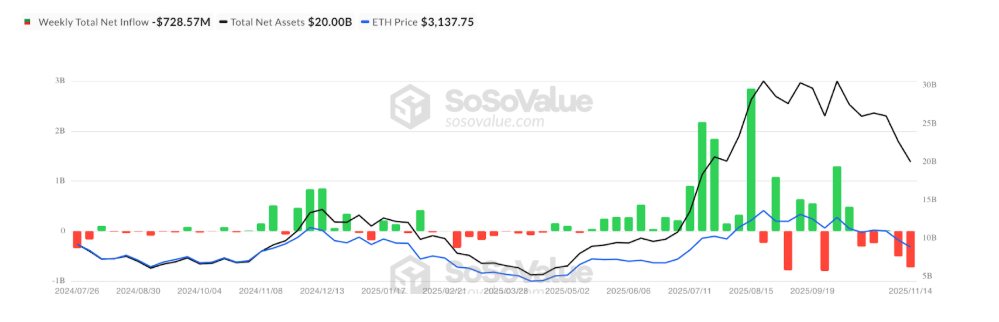
However, Ethereum’s spot ETF inflows have slowed down in recent times. Data from the past two weeks highlights this weakness.
Last week alone, ETH spot ETFs recorded $726.57 million in outflows, following more than $500 million in outflows the previous week. This reversal in demand shows that institutional capital is not flowing into ETH at the scale required to sustain a parabolic cycle.
For Ethereum’s price to replicate anything close to Bitcoin’s supercycle performance, it would need sustained, substantial inflows into its spot ETFs, far greater than the outflows currently being seen.
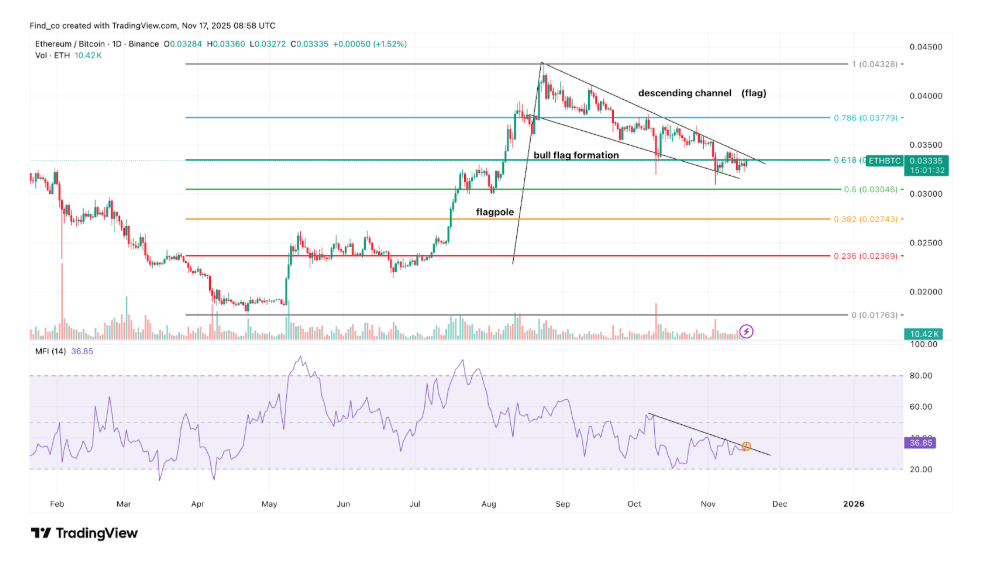
From a technical perspective, the ETH/BTC daily chart indicates that Ethereum’s price has continued to trend downward in relation to Bitcoin.
This sustained decline has carved out a descending channel, which has also taken the shape of a bull flag.
Encouragingly, the Money Flow Index (MFI) is now recovering from oversold territory. This change suggests that buyers are beginning to re-enter the market.
However, to confirm that the bearish trend is truly losing strength, the MFI must push above the neutral line (50). A breakout through this threshold would signal a meaningful shift in capital inflows and strengthen the case for a bullish reversal.
If this confirmation occurs, the ETH/BTC pair could defend the crucial support at 0.030, paving the way for a potential move toward 0.038.
A rebound to that level would likely translate into strength in the ETH/USD pair, creating a path for the price to move toward the $4,000 region.
On the other hand, if ETH fails to maintain its current reversal attempt, either due to weakening momentum or a broader market pullback, the setup could be invalidated.
In that scenario, Ethereum may struggle to hold its recent gains and could drop back below the $3,000 psychological level, resetting its medium-term bullish structure.
Risks and Challenges: A Balanced View
A supercycle is a theory, not a guarantee. Factors that could slow or disrupt it include:
Intense competition from other smart-contract platforms
Regulatory uncertainty in major markets
High volatility typical of crypto markets
Potential delays or setbacks in Ethereum upgrades
Macroeconomic conditions that affect risk assets
Tom Lee frequently emphasizes that volatility is part of the journey, and leveraging in such environments can magnify risks.
What Ethereum’s Supercycle Entry Means for Investors and Analysts
Whether or not Ethereum is entering a true supercycle, several points are clear:
Ethereum remains central to blockchain innovation
Network activity continues to grow across multiple sectors
Institutional and developer demand is increasing
Major upgrades have strengthened ETH’s long-term outlook
For analysts, these signals support the idea of a structural, multi-year trend rather than a short-term rally.
What does Tom Lee mean by an Ethereum “supercycle”?
A supercycle refers to a long, sustained period of upward growth driven by real adoption, improved fundamentals, and network expansion. For Ethereum, it means a multi-year trend where its utility as a global smart-contract network drives increasing value over time.
Why do some analysts think Ethereum could follow Bitcoin’s early growth pattern?
Ethereum now shows characteristics that Bitcoin displayed during its major growth waves: rising long-term holders, reduced sell pressure from staking, strong network activity, and increasing institutional participation.
Does a supercycle guarantee that ETH price will keep rising?
No. A supercycle is a theory, not a certainty. While fundamentals support long-term growth, ETH is still highly volatile and exposed to macro events, regulatory changes, and competition from other blockchains.
What upgrades or developments could strengthen the supercycle thesis further?
Upcoming Ethereum improvements, such as danksharding, more efficient rollup scaling, and growth in real-world asset tokenization, could significantly increase demand for ETH and reinforce the long-term supercycle narrative.
Disclaimer:
The information provided in this article is for informational purposes only. It is not intended to be, nor should it be construed as, financial advice. We do not make any warranties regarding the completeness, reliability, or accuracy of this information. All investments involve risk, and past performance does not guarantee future results. We recommend consulting a financial advisor before making any investment decisions.
Onkar Singh has three years of experience as a digital finance content creator. Throughout his career, he has collaborated with various DeFi projects and crypto media outlets. In his leisure time, he enjoys fitness activities at the gym and watching movies across different genres. Balancing his professional and personal interests, Onkar continues to contribute to the digital finance landscape while pursuing his hobbies.
Victor Olanrewaju is a crypto analyst and reporter at CCN with deep roots in on-chain research and technical analysis. His crypto journey began in 2017, but it was the 2020 Uniswap airdrop that sparked a full-time pivot into the space.
With a foundation in copywriting, Victor honed his craft creating high-converting content for leading crypto brokers — most notably an XRP price prediction that ranked #1 on Google during the 2021 bull run.
He later joined AMBCrypto in 2022, where he combined storytelling with technical and on-chain analysis to cover key market narratives.
In 2024, he expanded his expertise at BeInCrypto, collaborating with analysts and using tools like Glassnode, Santiment, and IntoTheBlock to break down Bitcoin and altcoin trends.
At CCN, Victor covers the top cryptocurrencies, memecoins, macro shifts, blending real-time insights with deep-dive metrics.
He holds a Bachelor’s degree in Physics from the University of Ibadan, equipping him to simplify complex data for a wide audience. Follow his work or connect on LinkedIn or X.


 Easy
Easy