Dollar’s Global Reserve Share Hits 30-Year Low but De-Dollarization Threat Looks Overstated
Share
Key Takeaways
Dollar debasement fears are rising at unprecedented levels.
Crypto leaders predict Bitcoin will break from its historic four-year cycle.
Analysts warn of potential bearish conditions.
What does all of this mean for the future of Bitcoin and its price?
Fears of U.S. dollar debasement are climbing to new highs, coinciding with several leading industry figures predicting an end to Bitcoin’s long-standing four-year cycle.
As searches for “dollar debasement” reach record levels and Bitcoin’s price rebounds slightly, the twin narratives are prompting traders and analysts to reconsider how Bitcoin might behave in a new, shifting environment.
All of which raises the inevitable question — what will it mean for Bitcoin’s price?
Try Our Recommended Crypto Exchanges
Sponsored
Disclosure
We sometimes use affiliate links in our content, when clicking on those we might receive a commission at no extra cost to you. By using this website you agree to our terms and conditions and privacy policy.
Dollar Debasement Concerns Surge to Historic Highs
Public anxiety around the weakening U.S. dollar is rising and reflected in a surge of online search activity.
Google Trends data show that interest in the term “dollar debasement” has jumped to record levels, with “Bitcoin” appearing as the breakout keyword associated with it.
Google Searches for Dollar "Debasement" soared this quarter to the highest level in history 🚨🚨🚨 pic.twitter.com/qJJFqd5b5h
The search “soared this quarter to the highest level in history,” according to BarChart.
Dollar debasement refers to the erosion of a currency’s purchasing power, typically driven by inflation or aggressive monetary policy.
The current wave of concern stems from persistent inflation pressures and the rapid expansion of U.S. federal debt.
As reported previously by CCN, the BRICS alliance’s new gold-anchored digital instrument has further raised concerns, as it aims to reroute trillions in trade away from the U.S. dollar.
“Although the Unit does not compete with domestic currencies, it still challenges the wider dominance of the dollar,” CCN’s education team wrote.
Crypto Leaders Signal a Break From Bitcoin’s Four-Year Cycle
Amid the shifting macro backdrop, several prominent crypto figures are now predicting that Bitcoin’s well-known four-year market cycle, historically driven by its halving schedule, may be fading.
The cycle has long been used to map bull and bear phases.
But industry leaders including Tom Lee, Changpeng Zhao (CZ), and Cathie Wood have publicly argued that Bitcoin may be decoupling from that rhythm as the asset matures and institutional participation deepens.
At Binance Blockchain Week, Fundstrat’s Lee argued that the four-year cycle was no longer a reliable framework for the market.
“We’re going to shatter the Bitcoin four-year cycle,” Lee told the audience.
Meanwhile, Ark Invest CEO Cathie Wood said on Tuesday that “the four-year cycle is going to be disrupted,” noting the impact of large-scale investors entering the industry.
🇺🇸 CATHIE WOOD JUST SAID LIVE ON FOX THAT #BITCOIN 4 YEAR CYCLE IS NOW DEAD AND IT'S ABOUT TO GO PARABOLIC
When asked whether he believed 2026 would be a bull market, he suggested that Bitcoin could be entering a supercycle.
On top of these heavyweights, Bitwise CEO Hunter Horsley also echoed the sentiment.
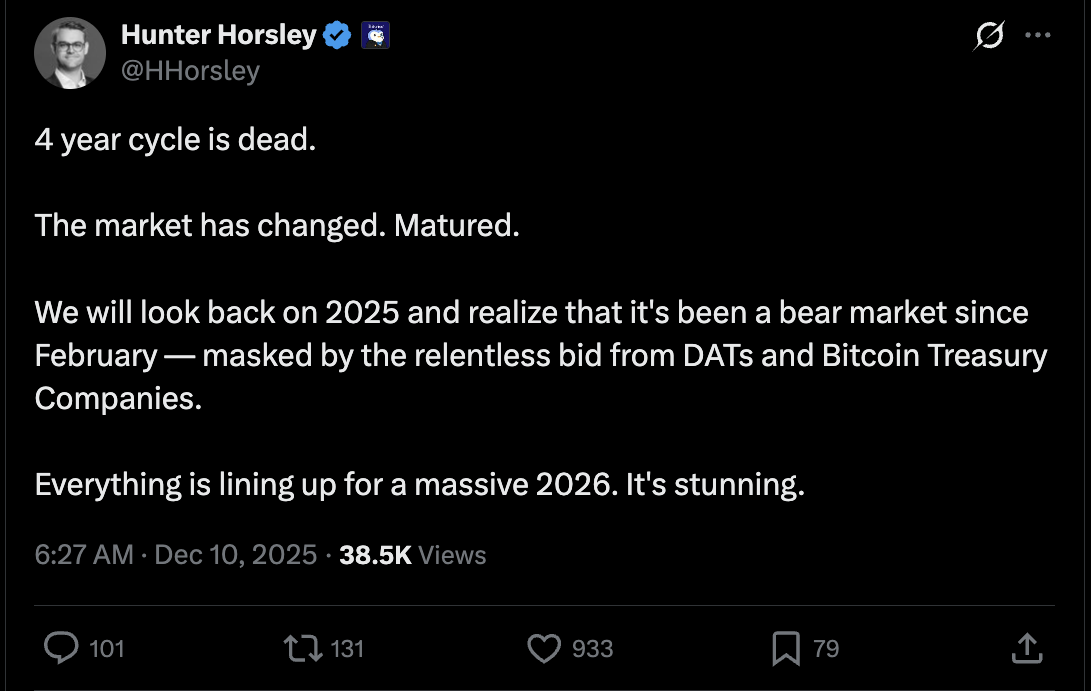
In a post on X on Wednesday, Dec. 10, Horsley starkly claimed the “4 year cycle is dead” and that the “market has changed.”
Hunter Horsley has also remained bullish on Bitcoin.
“We will look back on 2025 and realize that it’s been a bear market since February — masked by the relentless bid from DATs and Bitcoin Treasury Companies,” he wrote.
Adding: “Everything is lining up for a massive 2026. It’s stunning.”
What Does It Mean for Bitcoin’s Future?
The convergence of the two narratives, dollar debasement and the end of the potential four-year cycle, has raised new questions about how Bitcoin could behave in the months ahead.
Although the asset remains volatile, Bitcoin’s properties gain traction when confidence in fiat money weakens and investors look for a potential hedge.
At the same time, a breakdown of Bitcoin’s familiar halving-driven cycle would represent a meaningful shift.
The halving governs supply by reducing the issuance of new coins every four years, while fears of dollar debasement influence demand by encouraging investors to seek inflation-resistant assets.
These forces can align — as they did in 2020–2021 when unprecedented global liquidity overlapped with a supply shock — but they operate independently.
If Bitcoin becomes less dependent on the halving for directional momentum, price action may begin to smooth out.
In this scenario, Bitcoin may start responding more directly to economic policy than to its own protocol mechanics.
Bear Market Concerns
While Bitcoin has rebounded roughly 2% in the past 24 hours to trade near $92,509, several analysts warn that the broader trend may be turning negative.
Some experts argue that Bitcoin has already slipped into a prolonged downtrend, raising the risk that recent gains could prove temporary.
He noted that after months of moving within a major long-term parallel channel, the cryptocurrency has now fallen decisively below that structure — an event he and others view as the possible start of a new bear market.
Tahiri warned that current market conditions closely resemble those that preceded the 2021 crash, with chart formations and technical indicators showing patterns he considers “strikingly similar.”
According to Tahiri, the technical backdrop has turned “overwhelmingly bearish.”
“Unless Bitcoin manages an immediate and powerful reversal to reclaim the broken channel, extreme caution is warranted,” Tahiri said.
Kurt Robson is a London-based reporter at CCN, specialising in the fast-moving worlds of crypto and emerging technology. He began his career covering local news in Cornwall after graduating from Falmouth University with First Class Honours in Journalism. There, he cut his teeth on everything from council meetings to missing swans.
He quickly rose through the ranks to become a frontline journalist at several of the UK’s leading national newspapers. Over the years, he has interviewed musicians and celebrities, reported from courtrooms and crime scenes, and secured multiple front-page exclusives.
Following the upheaval of the COVID-19 pandemic, Kurt shifted his focus to technology journalism—just ahead of the AI boom. With a natural curiosity and a trained eye for emerging trends, he has found a new rhythm in reporting on innovation.
At CCN, Kurt's work focuses on the cutting edge of crypto, blockchain, AI, and the evolving digital world. Drawing on his background in people-first reporting and his deep interest in disruptive tech, Kurt delivers stories that are insightful, entertaining, and human-centric.