


 Easy
Easy 

Bitcoin is once again navigating a period of price weakness. Trading below $70,000 at the time of writing, BTC remains well off its all-time highs and has underperformed assets like gold during recent bouts of macro volatility.
Yet according to research and brokerage firm Bernstein, this downturn may represent the “weakest Bitcoin bear case in its history.” Far from revising its long-term outlook, the firm has reiterated a bold forecast: $150,000 per bitcoin by the end of 2026.
Why does Bernstein believe the bear case is weaker this time? And what would need to happen for BTC to nearly double from current levels?
This article explores the structural, macroeconomic, and technological arguments behind the firm’s thesis.
A Different Kind of Bitcoin Bear Market
Historically, Bitcoin bear markets have been triggered by major systemic failures.
- 2014-2015: The collapse of Mt. Gox exposed exchange fragility.
- 2018: The ICO bubble burst amid regulatory crackdowns and failed projects.
- 2022: Terra-Luna imploded, Three Arrows Capital collapsed, and FTX unraveled in one of the largest financial frauds in crypto history.
Each of these cycles featured hidden leverage, forced liquidations, insolvencies, and cascading trust breakdowns.
Bernstein argues that none of those elements are present today.

- Bernstein predicted that Bitcoin will reach a valuation of $150,000 by the end of 2026. | Credit: BTC Strategist X profile
In a recent note to clients, analysts led by Gautam Chhugani wrote that the current sell-off reflects a crisis of confidence rather than structural damage. There has been no systemic implosion, no widespread exchange failures, and no discovery of massive hidden leverage destabilizing the ecosystem.
Bitcoin’s network continues to operate uninterrupted. Settlement finality, hash rate security, and global node participation remain intact.
That distinction is critical. In prior cycles, price weakness was accompanied by structural breakdown. This time, Bernstein contends, the weakness appears primarily sentiment-driven.
Institutional Involvement Is Reshaping the Bitcoin Cycle
One of the clearest differences between this cycle and previous downturns is the level of institutional involvement.
Bernstein points to several structural tailwinds:
- Spot Bitcoin ETFs in the U.S.
- Growing participation from large asset managers.
- Increasing corporate treasury allocations.
- A more favorable U.S. political environment toward Bitcoin.
Spot ETFs, in particular, represent a significant milestone. They provide regulated, accessible exposure to BTC for institutions and retail investors who may not wish to custody crypto directly.
Importantly, the ETF infrastructure already exists. According to Bernstein, it is not broken, it is simply operating in a tight liquidity environment. Should financial conditions ease, these vehicles could absorb renewed inflows quickly.
This is materially different from prior cycles when institutional on-ramps were limited or nonexistent.
Bitcoin vs. Gold: Why the Underperformance?
Critics point to Bitcoin’s recent underperformance relative to gold as evidence that the digital asset has failed to mature into a true safe haven.
Bernstein disagrees with that interpretation.
The firm argues that BTC continues to trade primarily as a liquidity-sensitive risk asset, not as a defensive store of value like gold. In environments defined by high interest rates and tight financial conditions, capital tends to concentrate in:
- Precious metals
- AI-linked equities
- Select high-conviction sectors
Bitcoin, with its historically high beta to liquidity cycles, is more sensitive to tightening.
This does not invalidate its long-term thesis. Instead, it reinforces that Bitcoin’s price is highly responsive to macro conditions. If rates decline and liquidity expands, BTC could reprice rapidly.
In other words, the underperformance may reflect macro positioning rather than structural weakness.
Bitcoin’s Performance Is Tied to Global Liquidity Conditions
Bernstein’s outlook hinges heavily on liquidity dynamics.
When financial conditions are restrictive, speculative and high-beta assets tend to struggle. Bitcoin, still widely treated as a risk asset, falls into that category.
However, the firm argues that the infrastructure supporting BTC, made of ETFs, corporate treasury vehicles, institutional custody, and capital markets access, remains fully operational.
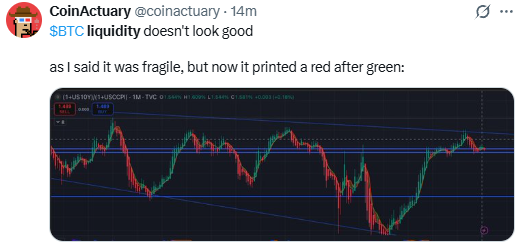
- Traders are concerned about BTC’s liquidity. | Credit: CoinActuary X profile
If central banks shift toward easing, and global liquidity expands, those channels are positioned to absorb capital efficiently.
Bitcoin does not require structural repair. It requires macro tailwinds.
Is Bitcoin Losing Relevance in the Age of Artificial Intelligence?
Another emerging criticism suggests that Bitcoin is losing relevance in an economy increasingly shaped by artificial intelligence.
Bernstein pushes back strongly on this narrative.
The firm argues that blockchains and programmable wallets may actually play a central role in what some call an “agentic” digital environment, a future in which autonomous AI agents transact, allocate capital, and settle value programmatically.
In such a world, global, machine-readable financial rails would be essential.
Traditional banking systems remain constrained by:
- Closed APIs
- Jurisdictional barriers
- Legacy integration challenges
Blockchains, by contrast, offer open, interoperable infrastructure. Bitcoin’s global settlement layer could theoretically serve as foundational monetary infrastructure for autonomous digital actors.
Rather than being displaced by AI, Bernstein suggests Bitcoin could complement it.
Is Quantum Computing a Serious Risk to Bitcoin Security?
Quantum computing fears periodically resurface in crypto discourse, with critics arguing that advanced quantum machines could one day break Bitcoin’s cryptographic security.
Bernstein acknowledges that cryptographic transitions will eventually be necessary across the digital world. However, the firm emphasizes that Bitcoin is not uniquely vulnerable.
Banks, governments, defense systems, and internet infrastructure rely on similar cryptographic foundations.
As quantum-resistant standards develop, the transition would likely occur across industries, not just within Bitcoin.
This view echoes comments from Strategy Executive Chairman, Michael Saylor, who recently announced a Bitcoin Security Program aimed at coordinating with the broader cyber and crypto community. Saylor framed quantum risk not as an imminent existential threat, but as a long-term engineering challenge that the ecosystem has time to address.
Bitcoin’s open-source codebase and global developer community provide mechanisms for consensus-based upgrades if needed.
Are Corporate Bitcoin Holdings a Systemic Risk?
Concerns have also surfaced regarding leveraged corporate Bitcoin accumulation and potential miner capitulation.
Bernstein dismisses both risks as overstated.
According to the firm, major Bitcoin-holding companies have structured liabilities conservatively. Strategy executives have indicated that only an extreme scenario — BTC falling to $8,000 and remaining there for five years, would require balance sheet restructuring.

- The aggregated size of Bitcoin treasuries held by public and private companies has grown. | Credit: Bitlanger X profile
Similarly, miners have diversified operations. Some have reallocated energy resources toward AI data center demand, reducing dependence on mining revenue alone.
Forced selling risk, Bernstein argues, has diminished compared to previous cycles characterized by cascading liquidations.
What Would It Take for Bitcoin to Reach $150,000?
For Bitcoin to reach $150,000 by the end of 2026, several conditions would likely need to align:
- Easing monetary policy or improved liquidity conditions
- Renewed ETF inflows and institutional allocation
- Continued corporate treasury participation
- Absence of systemic crypto failures
- Sustained network security and adoption
Bernstein does not suggest a straight-line path upward. Volatility is intrinsic to Bitcoin’s market structure.
However, the firm believes that with structural adoption intact and systemic risks subdued, the downside case is weaker than in previous cycles.
If liquidity turns supportive, Bitcoin’s historical beta suggests it could amplify that shift dramatically.
Why the Long-Term Bitcoin Thesis Remains Intact
The core of Bernstein’s argument is simple:
This downturn lacks the structural damage seen in past bear markets.
No exchange implosions. No cascading insolvencies. And no hidden leverage unraveling.
Instead, the firm sees a sentiment-driven retracement occurring within a structurally stronger ecosystem, one featuring ETF access, institutional alignment, corporate treasury involvement, and a maturing infrastructure base.
Bitcoin remains volatile. It remains liquidity-sensitive. It has not yet achieved universal safe-haven status.
But according to Bernstein, the broader adoption story is intact.
If that thesis holds, and macro conditions improve, the path to $150,000 by 2026 may not require extraordinary assumptions. It may simply require liquidity to meet infrastructure that is already in place.
As always, investors should conduct independent research and consider their own risk tolerance. Bitcoin’s history shows that both exuberance and pessimism can overshoot.
For Bernstein, however, the conclusion is clear: this is not a structural breakdown.
It may be the weakest bear case Bitcoin has ever seen, and the upside, they argue, remains intact.
FAQs
Why does Bernstein believe this is the “weakest” Bitcoin bear market in history?
Bernstein argues that previous Bitcoin bear markets were triggered by systemic failures such as exchange collapses (Mt. Gox, FTX), hidden leverage (Three Arrows Capital), or ecosystem-wide breakdowns (Terra-Luna). In the current downturn, none of those structural implosions have occurred. The network continues to function normally, and there are no widespread insolvencies. According to the firm, the decline appears driven more by sentiment and macro liquidity conditions than by internal crypto failures.
What is Bernstein’s Bitcoin price target?
Bernstein has reiterated a $150,000 Bitcoin price target by the end of 2026. The firm believes that structural adoption trends, institutional infrastructure, and potential improvements in global liquidity could support a significant upside move over the next two years.
Why has Bitcoin underperformed gold recently?
Bernstein notes that Bitcoin still trades primarily as a liquidity-sensitive risk asset, not a defensive safe haven like gold. During periods of high interest rates and tight monetary conditions, investors tend to favor assets such as precious metals. If financial conditions ease, Bitcoin may benefit disproportionately due to its historically high sensitivity to liquidity cycles.
How do spot Bitcoin ETFs factor into the bullish outlook?
Spot Bitcoin ETFs provide regulated, accessible exposure for institutional and retail investors. Bernstein argues that the ETF infrastructure is already in place and functioning as designed. If liquidity conditions improve, these vehicles could absorb significant capital inflows, potentially accelerating price appreciation.


