BlackRock and ‘Trump Team’ Wallets Buying $USOR? The Truth Behind the Viral Oil Tokenization Narrative
Share
Key Takeaways
USOR is a Solana-based crypto token, not a regulated oil product.
Claims about BlackRock-linked wallets interacting with USOR rely on heuristic wallet labeling, not official disclosures.
Wallets labeled as “Trump Team” are based on historical trading behavior and community tagging, not confirmed political affiliation or insider participation.
Active trading volume and liquidity on Solana DEXs show interest, but do not validate claims about utility, reserves, or legitimacy.
Crypto markets continue to attract attention not just for price movements but for narratives that connect blockchain activity with traditional finance and political figures.
One such narrative gaining traction in early 2026 centers on the U.S. Oil Reserve (USOR) token, a Solana-based digital asset, and potential on-chain activity involving wallets labeled in public analytics tools as linked to BlackRock and to traders associated with past politically branded tokens.
USOR claims to be backed by federal oil reserves, yet the U.S. Department of Energy (which manages the Strategic Petroleum Reserve) has issued no statement authorizing a private Solana token to represent these assets.
As of mid-January 2026, $USOR exhibits typical “narrative-driven” trading patterns:
Liquidity: Most trading occurs on Solana DEXs like Meteora.
Verification gap: The project’s website contains technical inaccuracies, such as implying the Federal Reserve stores oil.
Market sentiment: While retail volume has spiked due to the “BlackRock/Trump” rumors, “smart money” and institutional trackers remain largely on the sidelines.
This article examines what can be verified from on-chain data, public project information, and widely reported market context and separates this from speculation or unverified claims.
What Is the USOR Token?
USOR (U.S. Oil) is a Solana-based token that markets itself around the idea of tokenizing oil reserves on the blockchain. According to the project’s website, it aims to bring transparency and on-chain verification to what it describes as oil-backed assets. The token operates as an SPL (Solana Program Library) token.
Key technical features of USOR include:
Network: Built on Solana, enabling fast transactions and low fees.
Token supply: Near 999 million tokens, suggesting a nearly fixed total supply.
Trading: Traded primarily on Solana-based decentralized exchanges, with liquidity pools where transactions can occur.
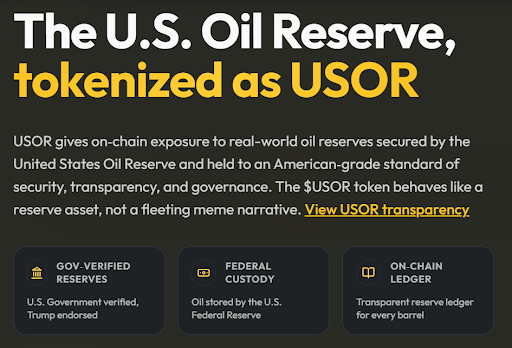
The USOR website claims the token represents the U.S. Oil Reserve and says reserves are government-verified and held in federal custody. There is no public confirmation of these claims from U.S. government agencies. U.S. oil reserves are managed by the Department of Energy, not the Federal Reserve.
Blockchain data can only verify token transactions, not physical oil storage. No verified political endorsement has been publicly documented. These statements should be treated as marketing claims, not confirmed institutional backing.
The U.S. Oil Reserve tokenized as USOR. | Credit: usor.tech
Notably, aspects of the project’s communication include statements or website content that may inaccurately imply links to U.S. institutions, such as federal agencies, a distinction that carries significance for investors and analysts.
Why USOR Is Drawing Attention in 2026
Several overlapping trends are contributing to increased visibility:
Some of the speculation also taps into U.S.-Venezuela energy dynamics, with online commentators suggesting, without verification, that USOR’s branding echoes narratives around strategic oil reserves and Venezuela’s vast petroleum holdings.
While there is no evidence that USOR is linked to Venezuelan reserves or geopolitics, the resurfacing of oil-related sanctions debates and energy security themes has helped fuel discussion around the token.
When these narratives intersect with observable wallet activity, social media attention tends to follow, even when no official partnerships exist.
BlackRock CEO Larry Fink has repeatedly described asset tokenization as the future of financial markets, making the firm a natural reference point whenever tokenized real-world asset (RWA) projects surface.
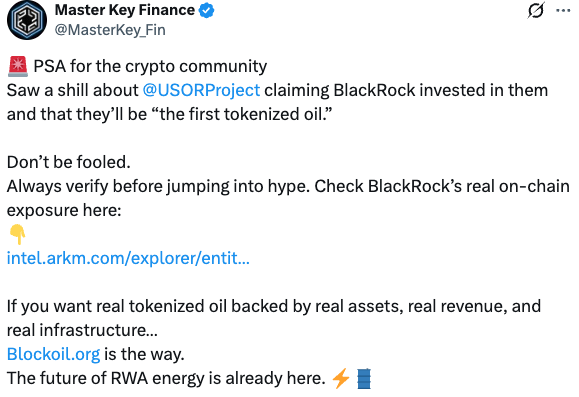
In USOR’s case, attention intensified after claims circulated that BlackRock-linked wallets were accumulating the token.
These assertions rely on wallet labeling heuristics, methods based on transaction patterns and counterparties rather than direct attribution. Such labels can be informative, but they are not definitive evidence of ownership or endorsement.
USOR PSA circulating on X. | Credit: Master Key Finance X profile
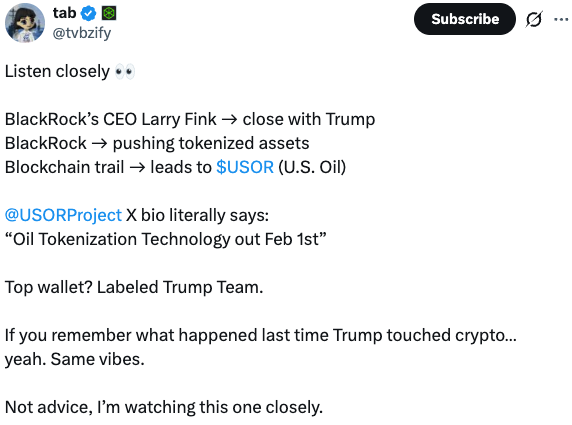
Adding fuel to the narrative, DexScreener labels USOR as “U.S. Oil,” and the project’s X bio states: “Oil Tokenization Technology out Feb 1st.” For traders already primed to see tokenization everywhere, these signals appear meaningful.
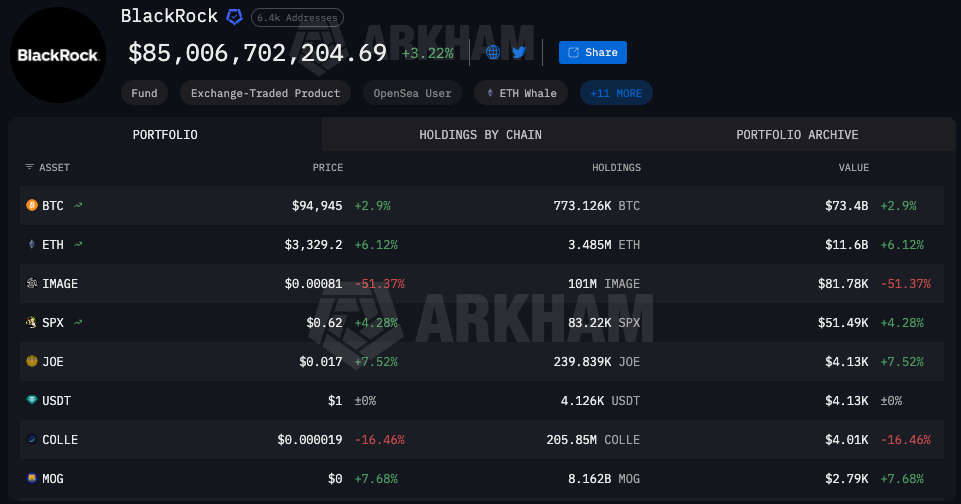
However, Arkham’s dashboard clearly shows Blackrock’s holdings, excluding USOR, which then urges caution. So users must verify BlackRock’s actual on-chain exposure via Arkham Intelligence’s public entity tracker or any other on-chain analytics platform, which aggregates wallets credibly attributed to BlackRock.
BlackRock holdings doesn’t list USOR. | Credit: Arkham
Crucially, there is no public confirmation from BlackRock, no filings, and no technical documentation linking the firm to USOR.
Large asset managers often interact with blockchain infrastructure indirectly through custodians, liquidity providers, or service vendors, which can create misleading proximity signals on-chain.
Are Trump-Tagged Wallets Accumulating $USOR Token?
The second central narrative involves politically tagged wallets, particularly those labeled as connected to Trump-adjacent crypto activity.
On-chain analysts flagged that a top USOR holder wallet is labeled “Trump Team,” with alleged links to accounts that were active during the previous $TRUMP token cycle.
Historically, Trump-associated crypto projects have drawn intense speculative interest. Past tokens tied, directly or indirectly, to Trump’s brand generated extreme volatility, minting short-term millionaires while exposing late participants to sharp reversals. This history has conditioned traders to react quickly whenever similar wallet tags reappear.
X users started spreading news about BlackRock-Trump links with USOR. | Credit: tab X profile
While the Trump family’s World Liberty Financial is active in DeFi, and Trump Media (TMTG) has announced plans to award tokens to shareholders, $USOR is not an official project under these banners.
The circulating PSA reinforces this dynamic, noting the overlap of several attention-grabbing elements:
However, as with institutional wallet tagging, political labels are not proof. Wallet tags are often community-generated and based on historical behavior, not verified identity. A wallet’s participation in a prior Trump-related token does not imply coordination, insider knowledge, or future political involvement.
Importantly, USOR is neither a stock nor a regulated commodity product, and U.S. oil reserves do not back it. Currently, it is a cryptocurrency token marketed around an oil tokenization concept, not a verified RWA instrument.
Claim
Status
Evidence
Backed by U.S. Oil
Unverified
No official government or DOE confirmation.
BlackRock Accumulation
False/Speculative
Based on heuristic wallet tags, not official disclosures.
Trump Team Involvement
Unconfirmed
Likely community-tagged wallets from previous cycles.
Solana-Based SPL Token
TRUE
Verifiable on-chain activity on the Solana network.
Market Data: USOR’s Liquidity and Volume
According to CoinGecko:
Recent data shows USOR trading with significant daily volume and liquidity on Solana DEXs, including tens of thousands of transactions and notable trading pairs like USOR/SOL.
These figures demonstrate that USOR is being actively traded in secondary markets; however, they do not inherently validate claims about token utility, backing, or institutional relationships.
This increases the chance of market reactions driven by perception rather than fundamentals.
Tokenized Oil Narrative, Market Sentiment and the Crypto Hype Cycle
USOR’s surge in visibility reflects how quickly crypto markets can shift when real-world themes, institutional branding, and political narratives overlap.
Oil remains a highly emotional and geopolitically sensitive commodity, and when a token adopts “national reserve” language, it can trigger assumptions of stability or state backing even when no such backing exists.
In practice, this pattern is similar to past hype cycles around politically themed tokens, celebrity-linked NFTs, and memecoins, where branding and narrative drive attention faster than verifiable fundamentals.
On-chain data confirms trading activity and wallet concentration, but sentiment appears largely driven by storylines rather than confirmed partnerships or audited reserves. This does not mean all interest is irrational, but it does suggest that price and volume are currently more sensitive to social momentum than to demonstrable utility.
As with prior narrative-driven crypto trends, visibility can rise quickly, but confidence can also reverse just as fast once claims face closer scrutiny or when new themes capture market attention.
USOR is a Solana-based SPL token centered on the concept of oil tokenization. The project claims to represent oil-related assets on-chain, but there is no public confirmation from U.S. government agencies or regulators that actual U.S. oil reserves back it.
Is USOR backed by the U.S. Strategic Petroleum Reserve?
No. There is no verified evidence that the U.S. Strategic Petroleum Reserve or any government-held oil assets back USOR. The U.S. Department of Energy manages the Strategic Petroleum Reserve, and no official documentation links it to USOR.
Does BlackRock own or sponsor the USOR token?
There is no public confirmation that BlackRock owns, sponsors, or is directly involved with USOR. Claims about “BlackRock-linked wallets” are based on on-chain wallet labeling heuristics, which can suggest patterns but do not prove ownership or endorsement. BlackRock itself has not made any statements about USOR.
Are Trump-tagged wallets actually buying USOR?
Some on-chain trackers report that wallets labeled as connected to past Trump-branded tokens hold USOR. However, this does not prove involvement by Donald Trump or his organization. Political wallet tags often reflect prior trading activity, not official coordination.
Disclaimer:
The information provided in this article is for informational purposes only. It is not intended to be, nor should it be construed as, financial advice. We do not make any warranties regarding the completeness, reliability, or accuracy of this information. All investments involve risk, and past performance does not guarantee future results. We recommend consulting a financial advisor before making any investment decisions.
Giuseppe Ciccomascolo began his career as an investigative journalist in Italy, where he contributed to both local and national newspapers, focusing on various financial sectors.
Upon relocating to London, he worked as an analyst for Fitch's CapitalStructure and later as a Senior Reporter for Alliance News. In 2017, Giuseppe transitioned to covering cryptocurrency-related news, producing documentaries and articles on Bitcoin and other emerging digital currencies. He also played a pivotal role in establishing the academy for a cryptocurrency exchange website. Crypto remained his primary area of interest throughout his tenure as a writer for ThirdFloor.


 Easy
Easy