Discover the 2026 surge of USOR ($USOR) on Solana. Is there actual on-chain evidence of BlackRock and Trump-linked wallets accumulating? | Credit: CCN.com
Share
Key Takeaways
Larry Fink now calls Bitcoin an “asset of fear,” suggesting investors turn to it during periods of economic uncertainty.
Fink’s stance marks a significant shift from his earlier criticism of Bitcoin in 2017.
BlackRock’s iShares Bitcoin Trust (IBIT) has become the world’s largest Bitcoin ETF, surpassing $70 billion AUM in 2025.
Institutional investors, including endowments and pension funds, now hold IBIT, further legitimizing Bitcoin within traditional finance.
Larry Fink, the chairman and CEO of BlackRock, described Bitcoin as an “asset of fear” during his recent appearance at The New York Times DealBook Summit in December 2025.
The comment reflects Fink’s ongoing shift from crypto skepticism to cautious adoption, following the success of BlackRock’s spot Bitcoin ETF, the iShares Bitcoin Trust (IBIT).
In 2017, Fink dismissed Bitcoin as primarily a tool for illicit activity, saying it “shows you how much demand for money laundering there is in the world.”
However, eight years later, his perspective has evolved significantly. Speaking with journalist Andrew Ross Sorkin, Fink admitted that his earlier stance had changed, calling it a “glaring public example of a big shift” in his opinions.
At the DealBook Summit, Fink explained that Bitcoin’s appeal stems from uncertainty and fear in traditional markets. He called Bitcoin an “asset of fear” because investors often turn to it when they lose confidence in fiat currencies or global stability.
Despite his recognition of Bitcoin’s growing role, Fink cautioned that it remains volatile and should be approached with discipline.
“If you bought Bitcoin for a trade, it’s a very volatile asset. You’re going to have to be really good at market timing, which most people aren’t,” Fink said.
What “Asset of Fear” Means
By calling Bitcoin an “asset of fear,” Fink suggested that investors often buy Bitcoin as a hedge against inflation, currency depreciation, and geopolitical risks.
Similar to gold, Bitcoin can act as a digital store of value during uncertain times. However, its price also reflects global sentiment and risk appetite. When fear subsides or markets stabilize, Bitcoin’s demand often declines.
This interpretation aligns with Bitcoin’s recent price movement. As global trade tensions eased and inflation moderated, Bitcoin briefly fell from its highs despite continued ETF inflows.
BlackRock’s iShares Bitcoin Trust (IBIT): The Institutional Gateway
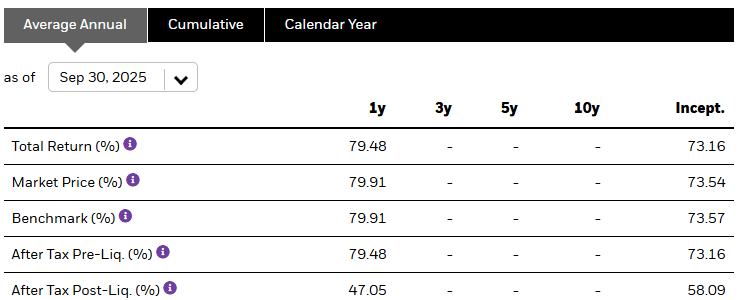
BlackRock’s iShares Bitcoin Trust (IBIT) has become a major milestone in the institutional adoption of cryptocurrencies. Approved by the U.S. Securities and Exchange Commission (SEC) in January 2024, IBIT allows investors to gain direct exposure to Bitcoin through a regulated, exchange-traded vehicle.
BlackRock’s IBIT details. | Credit: BlackRock
Key Facts About IBIT
Launch: January 2024
Ticker: IBIT
Expense Ratio: Approximately 0.25%
Custody Partner: Coinbase Custody
Structure: Spot Bitcoin ETF, holding real BTC
Regulator: U.S. Securities and Exchange Commission (SEC)
IBIT simplifies access to Bitcoin for institutional and retail investors alike. It removes the need for private wallets and direct crypto custody, offering exposure through traditional brokerage accounts.
IBIT’s Record Growth
Since its debut, IBIT has achieved record-breaking growth across multiple metrics:
Assets under management (AUM): Over $70 billion as of Q4 2025, making it the largest Bitcoin ETF globally.
Trading volume: Consistently ranks among the top 20 ETFs in the U.S. by volume.
Institutional holders: Large investors such as Harvard University’s endowment fund and several major pension funds disclosed IBIT holdings in 2025 regulatory filings.
Peak performance: During Bitcoin’s rally in mid-2025, IBIT briefly surpassed $90 billion in assets before stabilizing due to outflows in November.
According to Reuters, IBIT experienced over $2.3 billion in outflows in November 2025, including a single-day withdrawal of $523 million on November 18. Despite this, BlackRock executives described the redemptions as “normal market activity” given ETF liquidity and rotation.
Why IBIT’s Success Matters
The growth of IBIT demonstrates that institutional investors are increasingly comfortable with Bitcoin as part of diversified portfolios. It marks a turning point in how traditional finance interacts with digital assets:
Legitimization of Bitcoin: A BlackRock-managed ETF gives Bitcoin mainstream financial credibility.
Regulated exposure: Investors can hold Bitcoin exposure through a fully regulated, audited product.
Institutional participation: Major funds, endowments, and wealth managers can now participate in the crypto market.
Market maturity: The success of IBIT has paved the way for similar products from other asset managers.
Fink has emphasized that while Bitcoin is gaining institutional traction, it remains speculative and should represent only a small portion of diversified portfolios.
BlackRock’s Role in the Future of Crypto Investing
BlackRock’s involvement has reshaped the landscape of digital assets. With over $13.5 trillion in total assets under management, the firm’s entry into the crypto market signals a long-term institutional commitment.
Fink has also expressed interest in the tokenization of real-world assets, suggesting that blockchain technology could play a broader role in future financial systems.
Fink’s remarks indicate that Bitcoin and blockchain are now integral parts of global finance, even if they remain volatile.
The combination of regulation, institutional participation, and technological progress could continue to drive adoption over the next decade.
Bitcoin’s Dual Identity: Hedge Against Fear and Symbol of Market Evolution
Larry Fink’s statement that Bitcoin is an “asset of fear” captures its dual nature: both a hedge against uncertainty and a volatile, sentiment-driven asset.
His evolution from skepticism to acceptance mirrors the financial industry’s shift toward regulated crypto exposure.
With IBIT emerging as the largest Bitcoin ETF in the world, BlackRock has positioned itself at the center of institutional crypto investing.
While Fink remains cautious about Bitcoin’s volatility, his firm’s actions demonstrate that digital assets are no longer on the financial fringe, they are now part of the mainstream investment conversation.
Why did Larry Fink call Bitcoin an “asset of fear”?
Fink says investors often buy Bitcoin when they fear inflation, geopolitical instability, or weakening fiat currencies. Similar to gold, Bitcoin becomes appealing when confidence in traditional markets drops.
Has Larry Fink always supported Bitcoin?
No. In 2017 he associated Bitcoin with money laundering and expressed strong skepticism. His views have since shifted, especially after the success of BlackRock’s Bitcoin ETF, IBIT.
What changed Larry Fink’s opinion on Bitcoin?
The rise of regulated financial products, such as spot Bitcoin ETFs, and growing institutional demand led Fink to reconsider Bitcoin’s role as a hedge and store of value.
Does Fink believe Bitcoin is the future of finance?
Fink sees Bitcoin as part of a broader shift toward tokenization and blockchain, but still views it as speculative. He believes digital assets are now a legitimate part of global finance, even if risky.
Giuseppe Ciccomascolo began his career as an investigative journalist in Italy, where he contributed to both local and national newspapers, focusing on various financial sectors.
Upon relocating to London, he worked as an analyst for Fitch's CapitalStructure and later as a Senior Reporter for Alliance News. In 2017, Giuseppe transitioned to covering cryptocurrency-related news, producing documentaries and articles on Bitcoin and other emerging digital currencies. He also played a pivotal role in establishing the academy for a cryptocurrency exchange website. Crypto remained his primary area of interest throughout his tenure as a writer for ThirdFloor.


 Easy
Easy