Home / Education / Crypto / Regulation / $600B in Oil, $60B in Bitcoin: How Venezuela Became a ‘Geopolitical Jackpot’ and a Strategic Reserve Asset for the US
From 300B barrels of oil to rumored 600K BTC, Venezuela may be the most valuable strategic reserve the U.S. now influences. | Credit: CCN.com
Share
Key Takeaways
Venezuela is increasingly viewed as a strategic U.S. asset due to its combination of energy resources, minerals, water, and financial leverage.
The country holds the largest proven oil reserves in the world, vast natural gas supplies, major gold and iron ore deposits, and critical untapped minerals.
Reports suggest Venezuela may control over 600,000 BTC, accumulated through gold liquidation, oil-for-crypto deals, and mining seizures.
Venezuela’s significance lies in its role as a convergence point for energy security, resource nationalism, sanctions enforcement, and crypto-financial strategy.
For years, Bitcoin has dominated conversations about strategic assets, reserve diversification, and geopolitical leverage. But as 2026 begins, attention is quietly shifting elsewhere. Not to a protocol, not to a commodity, but to a country: Venezuela.
Following a U.S.-led blitz targeting the Maduro regime, including the capture of Nicolás Maduro, the conversation in Washington is no longer just about sanctions or regime change. It’s about asset control.
Because Venezuela is no longer merely a failed state under sanctions. It is a country sitting on extraordinary physical resources and potentially one of the largest undeclared crypto reserves in the world.
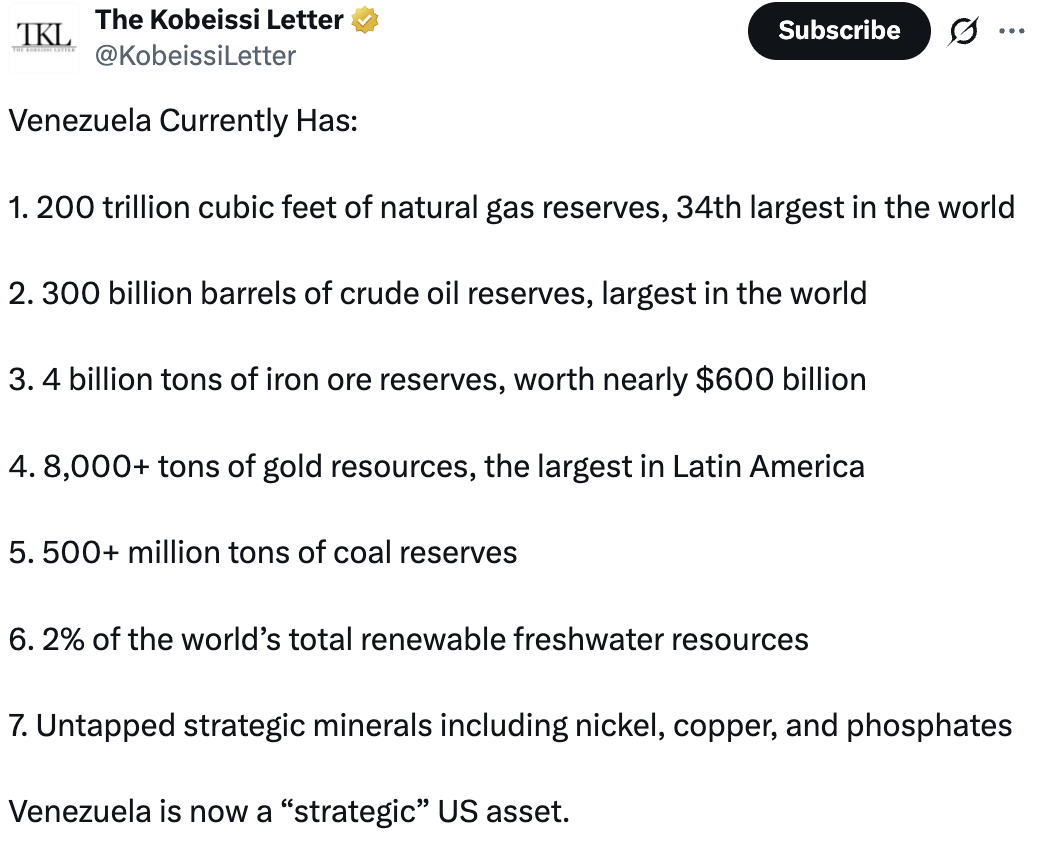
300 billion barrels of proven crude oil reserves, the largest in the world.
200 trillion cubic feet of natural gas, 34th globally.
8,000 tons of gold resources, the largest in Latin America.
4 billion tons of iron ore, worth nearly $600 billion.
500 million tons of coal reserves.
2% of the world’s renewable freshwater resources.
Untapped nickel, copper, and phosphate deposits.
Venezuela main holdings. | Credit: The Kobeissi Letter X profile
This is not a marginal economy. It is a resource superpower rendered dysfunctional by governance collapse, sanctions, and financial isolation.
From a U.S. strategic standpoint, that matters more today than it did a decade ago. Energy security, supply-chain reshoring, and resource nationalism have returned to the center of global policy.
Venezuela represents latent supply, resources that exist, are known, and could be mobilized under a different political structure.
Why Venezuela Has Re-Entered the US Strategic Playbook
Financial warfare, where sanctions, asset freezes, and alternative settlement rails matter as much as military pressure.
This third element is where crypto becomes critical.
How US Sanctions Forced Venezuela to Adopt Crypto for Survival
Unlike El Salvador, Venezuela did not embrace crypto as a philosophical experiment. It adopted crypto out of necessity.
As sanctions tightened after 2017-2018, Venezuela faced a simple problem: How do you sell oil, move value, and store reserves when the traditional financial system is closed?
The answer was improvised but effective.
Analysts estimate that during peak sanctions pressure, Venezuela’s external value flows were roughly:
Venezuela’s Oil-for-Crypto Strategy and Heavy Reliance on USDT
After the failure of the state-backed “Petro” token, Venezuela reportedly began settling oil exports using Tether (USDT), especially through intermediaries operating outside Western banking channels.
USDT offered clear advantages:
Faster settlement than wire transfers.
No immediate exposure to SWIFT.
Dollar-denominated liquidity without direct dollar clearing.
But USDT has a weakness that matters at the sovereign level: centralization.
Tether can freeze addresses. And that vulnerability appears to have driven Venezuela’s next move.
Does Venezuela Hold a “Shadow” Bitcoin Reserve? What Analysts Claim
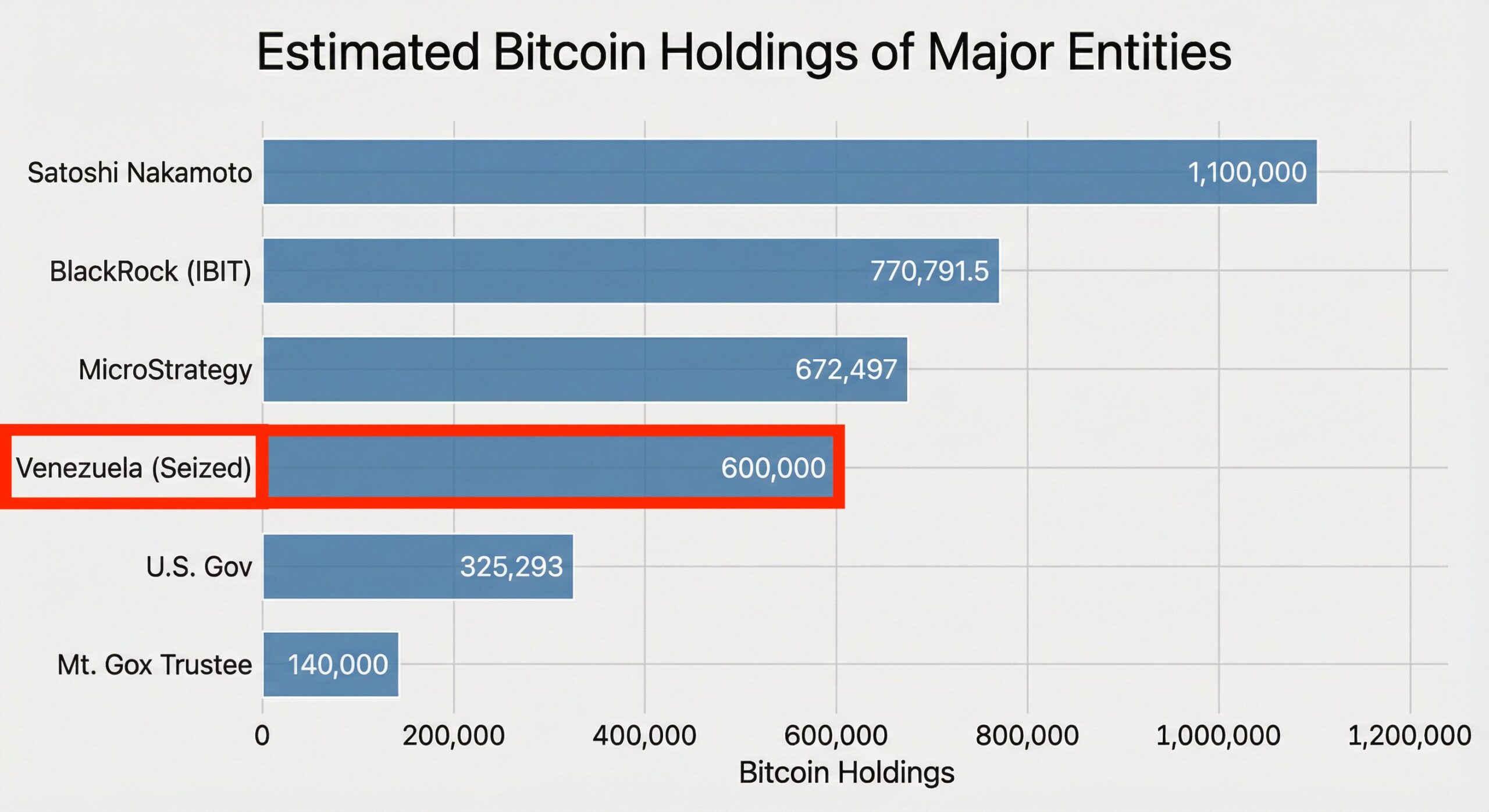
According to Whale Hunting analysts and intelligence-linked reporting, Venezuela may have quietly converted large portions of its crypto flows into Bitcoin, building what some describe as a shadow sovereign reserve.
Estimated Bitcoin holdings of major entities. | Credit: Binance
Estimated value at early-2026 prices: $56-67 billion.
If accurate, Venezuela would rank among the largest Bitcoin holders on Earth, ahead of known U.S. government holdings and rivaling major institutional players.
How Venezuela Allegedly Accumulated Hundreds of Thousands of Bitcoin
Analysts point to three primary accumulation channels.
Subsequent seizures transferred mined BTC to state-controlled wallets.
Individually small, these contributions compound over time.
Why Venezuela’s Bitcoin Holdings Matter to US Strategy and Markets
This is where the U.S. blitz targeting the Maduro regime becomes analytically relevant.
What if Venezuela is the US Strategic Bitcoin Reserve? | Credit: Jeff Park X profile
If Venezuela controls anything close to 600,000 BTC, the implications are enormous:
3% of Bitcoin’s circulating supply.
Twelve times larger than Germany’s 2024 sale of 50,000 BTC, which triggered a 15-20% market correction.
Large enough to materially influence Bitcoin supply dynamics.
This transforms Venezuela from a sanctions problem into a strategic balance-sheet problem.
Venezuela Crisis to Act as Bitcoin Price Catalyst?
The crisis in Venezuela is pushing Bitcoin higher and is likely to serve as a broader price catalyst, affirms the CEO of one of the world’s largest independent financial advisory organisations.
The comments from Nigel Green of deVere Group follow Washington’s actions that have sharply intensified political and financial pressure on Caracas, reigniting concerns over sanctions risk, capital controls, and regional and geopolitical instability.
“Events in Venezuela have once again underscored a fundamental truth about today’s markets: political risk is now priced not just in equities and bonds, but in digital assets as well,” says Nigel Green, chief executive of deVere Group.
“When geopolitical tensions increase, and questions arise about sanctions, capital controls, or currency stability, investors instinctively seek assets that are portable, liquid, and free of any single government’s control. Bitcoin is increasingly fulfilling that role.”
“The speed and scale of the reaction in crypto markets, particularly Bitcoin, highlights how this asset class has matured,” he continues.
“Unlike stocks or bonds, which trade only during set hours, Bitcoin’s 24/7 market structure allows investors to respond in real time to geopolitical shocks. This makes Bitcoin not just a speculative instrument, but a dynamic tool in capital allocation when political uncertainty spikes.”
Looking ahead, deVere expects geopolitical risk to remain a defining feature of markets through the year. With sanctions regimes expanding, trade relationships under strain, and political flashpoints multiplying, demand for assets that operate outside traditional financial structures is unlikely to fade.
“The implications of Venezuela go far beyond one country,” Nigel Green concludes.
“They speak to a world where political risk is becoming more persistent and more unpredictable.
What Happens to Venezuela’s Bitcoin If Political Control Changes?
After capturing Maduro, the Venezuela government is now led by his vice, Delcy Rodriguez. But while the future of the South-American country is still uncertain, analysts tried to outline three potential scenarios for Venezuela:
1. Asset Freeze (Most Likely)
Seized Bitcoin becomes trapped in legal and sanctions limbo, effectively removed from circulation for years.
This quietly tightens Bitcoin supply without market panic.
2. Strategic Reserve Pivot
The U.S. Treasury could hold seized Bitcoin as a long-term sovereign asset, mirroring historical treatment of confiscated gold.
This would further legitimize Bitcoin as a strategic reserve asset—ironically using Venezuela as the precedent.
3. Fire Sale (Least Likely)
A rapid liquidation is considered unlikely. Political sentiment in the U.S. has shifted away from dumping confiscated Bitcoin after backlash from prior sovereign sales.
Why Venezuela, Not Bitcoin, Is the Real Strategic Asset for the US
Bitcoin is one instrument inside that larger strategic puzzle.
Even if the estimates remain unconfirmed, markets price probabilities, not proof.
The possibility that hundreds of thousands of BTC are effectively locked, frozen, or absorbed into sovereign reserves changes long-term supply assumptions.
At the same time, Venezuela’s physical resource base ensures it remains strategically relevant regardless of crypto outcomes.
Why is Venezuela being described as a “strategic” U.S. asset?
Venezuela is considered strategic because it combines massive energy and mineral resources with growing geopolitical importance and potential control over significant financial assets, including crypto. Its position affects energy security, supply chains, and global market stability.
Is the US officially calling Venezuela a strategic asset?
No. The term “strategic asset” is an analytical framing used by commentators and analysts, not an official U.S. government designation. It reflects how Venezuela’s resources and financial exposure could influence U.S. policy decisions.
How does cryptocurrency factor into Venezuela’s strategic importance?
Crypto became critical as Venezuela sought alternatives to the traditional financial system under sanctions. Analysts estimate that a large share of Venezuela’s external value flows relied on crypto, particularly Bitcoin and USDT, making digital assets part of its economic survival strategy.
What happens to Venezuela’s Bitcoin if political control changes?
Analysts outline three likely outcomes: the Bitcoin could be frozen in legal proceedings, held by the U.S. as a long-term strategic reserve, or, less likely, sold on the open market. A rapid sale is generally viewed as improbable.
Disclaimer:
The information provided in this article is for informational purposes only. It is not intended to be, nor should it be construed as, financial advice. We do not make any warranties regarding the completeness, reliability, or accuracy of this information. All investments involve risk, and past performance does not guarantee future results. We recommend consulting a financial advisor before making any investment decisions.
Giuseppe Ciccomascolo began his career as an investigative journalist in Italy, where he contributed to both local and national newspapers, focusing on various financial sectors.
Upon relocating to London, he worked as an analyst for Fitch's CapitalStructure and later as a Senior Reporter for Alliance News. In 2017, Giuseppe transitioned to covering cryptocurrency-related news, producing documentaries and articles on Bitcoin and other emerging digital currencies. He also played a pivotal role in establishing the academy for a cryptocurrency exchange website. Crypto remained his primary area of interest throughout his tenure as a writer for ThirdFloor.


 Easy
Easy