If the crisis leads to looser financial conditions or sustained hard-asset demand, Bitcoin could eventually align with silver’s move.
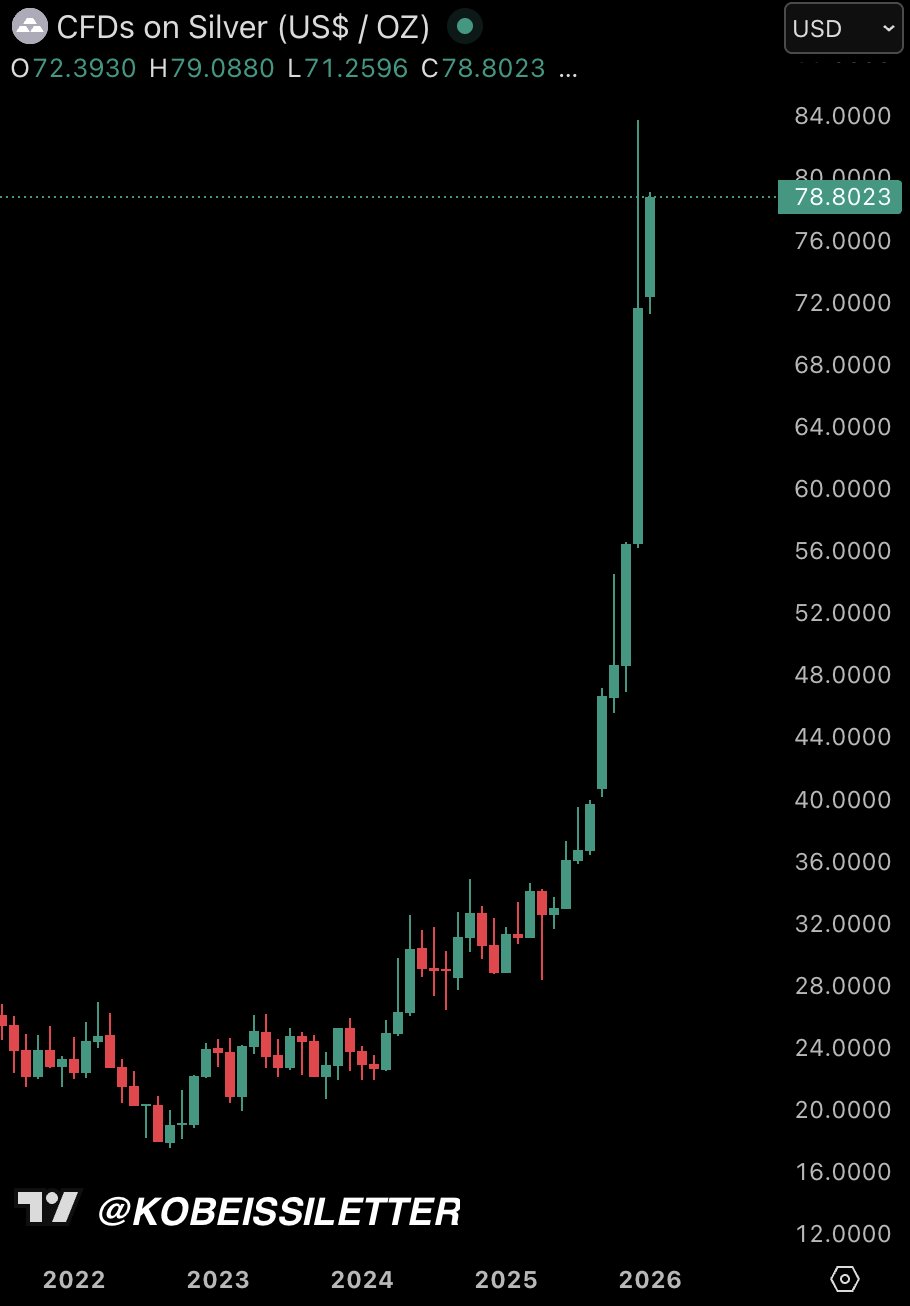
Silver surged above $79 per ounce, placing it less than 6% away from new all-time highs, following the U.S.-led operation that resulted in the capture of Venezuelan President Nicolás Maduro.
In just a few days, silver climbed roughly 9%, reigniting debate across global markets about the role of hard assets during geopolitical shocks and whether Bitcoin tends to follow the same playbook.
Silver is back above $79. It’s only six days into the new year, and silver is already up more than 10%. Gold is up over $20 this morning too, trading above $4,470. Even though 2025 was the best year for precious metals since 1979, 2026 looks like it could be even better.
The move is notable not only because of silver’s speed, but also because it arrived amid heightened geopolitical tension, supply-chain risks, and renewed questions about currency debasement. Historically, moments like these have driven investors toward assets perceived as scarce, hard to obtain, or politically neutral. Gold has long filled that role. Silver often follows, sometimes with greater volatility. Bitcoin, however, occupies a more complex position.
This article examines whether Bitcoin is correlated with silver during crises, drawing on historical evidence, and how the Efficient Market Hypothesis (EMH) complicates the notion that geopolitical shocks automatically translate into predictable crypto rallies.
Why Silver Prices Surged Above $79 After the US–Venezuela Crisis
Silver’s rally fits a familiar pattern. When geopolitical risk rises sharply, markets often rotate toward assets that satisfy three conditions:
Scarcity
Global liquidity
Independence from any single government
Silver checks all three boxes. It is scarce, globally traded, and historically trusted during periods of political or monetary instability. The Venezuelan crisis adds another layer: it directly impacts energy security, sanctions enforcement, and commodity supply chains, all of which influence precious metals.
Industrial metal, critical to solar, electronics, and defense supply chains.
Peter Schiff reports silver’s increase over $80. | Credit: Peter Schiff X profile
That dual role can amplify price moves during geopolitical stress, particularly when markets anticipate both financial hedging and physical demand.
Is Bitcoin Correlated With Silver During Geopolitical Crises?
At first glance, Bitcoin and silver appear philosophically aligned. Both are often framed as alternatives to fiat currency and hedges against systemic risk. But correlation is not constant; it is regime-dependent.
Historically, Bitcoin has exhibited an intermittent correlation with precious metals, rather than a stable one.
During some crises, Bitcoin tends to rise in tandem with gold and silver. At other times, it behaves more like a high-beta risk asset.
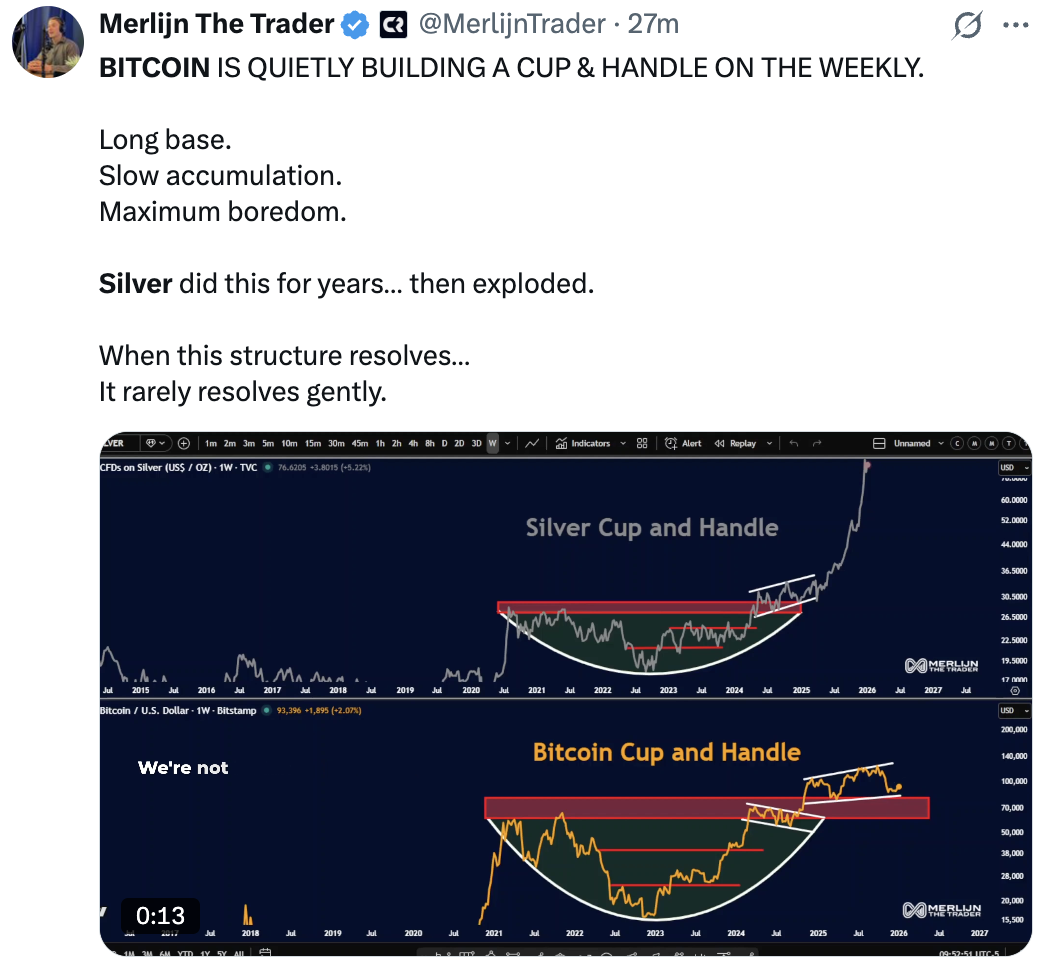
Bitcoin is “building a cup.” | Credit: Merijn The Trader X profile
Unlike conflicts that primarily affect regional stability, this crisis directly intersects with complex assets and crypto.
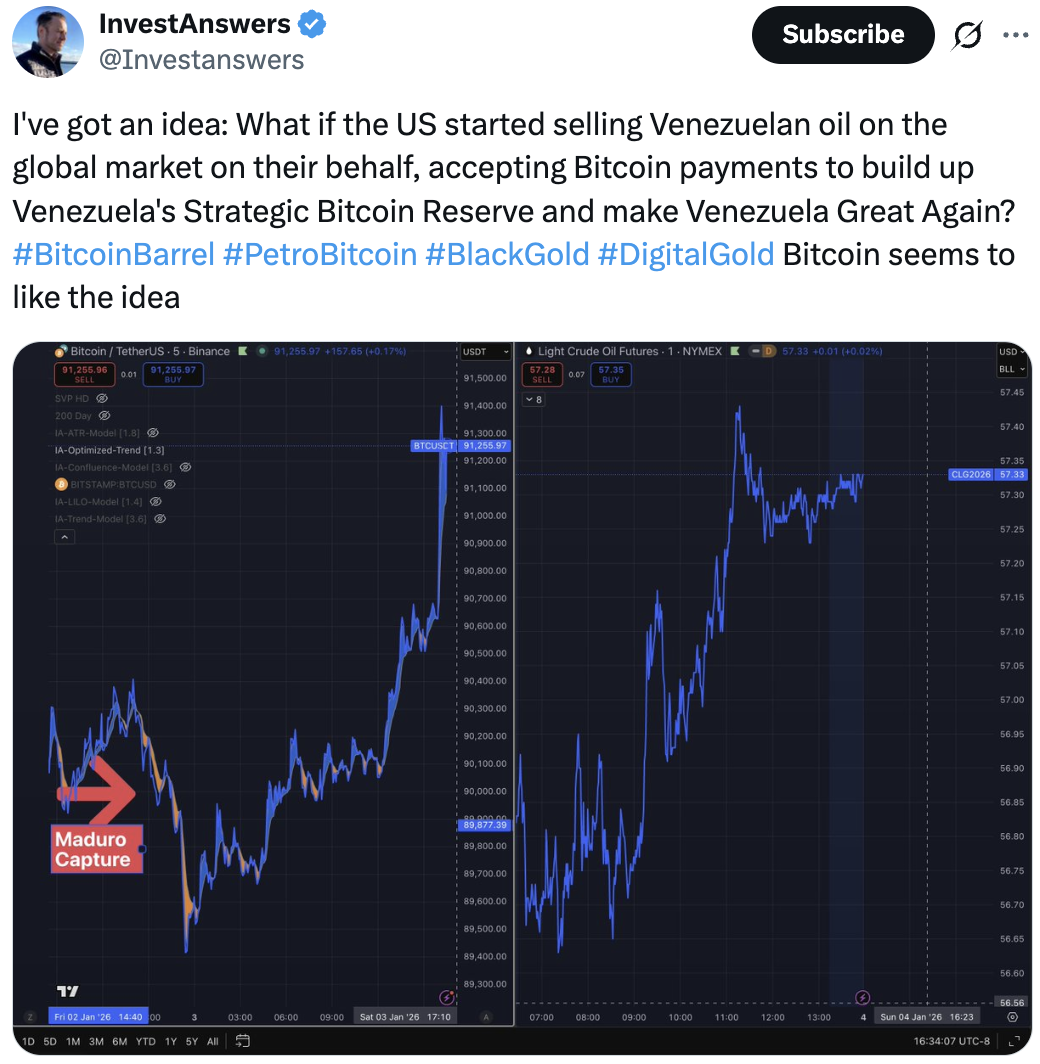
Potential US-Venezuela scenario. | Credit: Invest Answers X profile
Reports suggesting Venezuela may control hundreds of thousands of BTC have reframed Bitcoin not just as a hedge against governments, but as an asset held by governments. That shift matters.
Markets are now considering scenarios where the Bitcoin supply could be:
That narrative aligns Bitcoin more closely with silver and gold in terms of long-term scarcity, even if short-term price action remains volatile.
What the Efficient Market Hypothesis Explains About Bitcoin and Silver Price Reactions
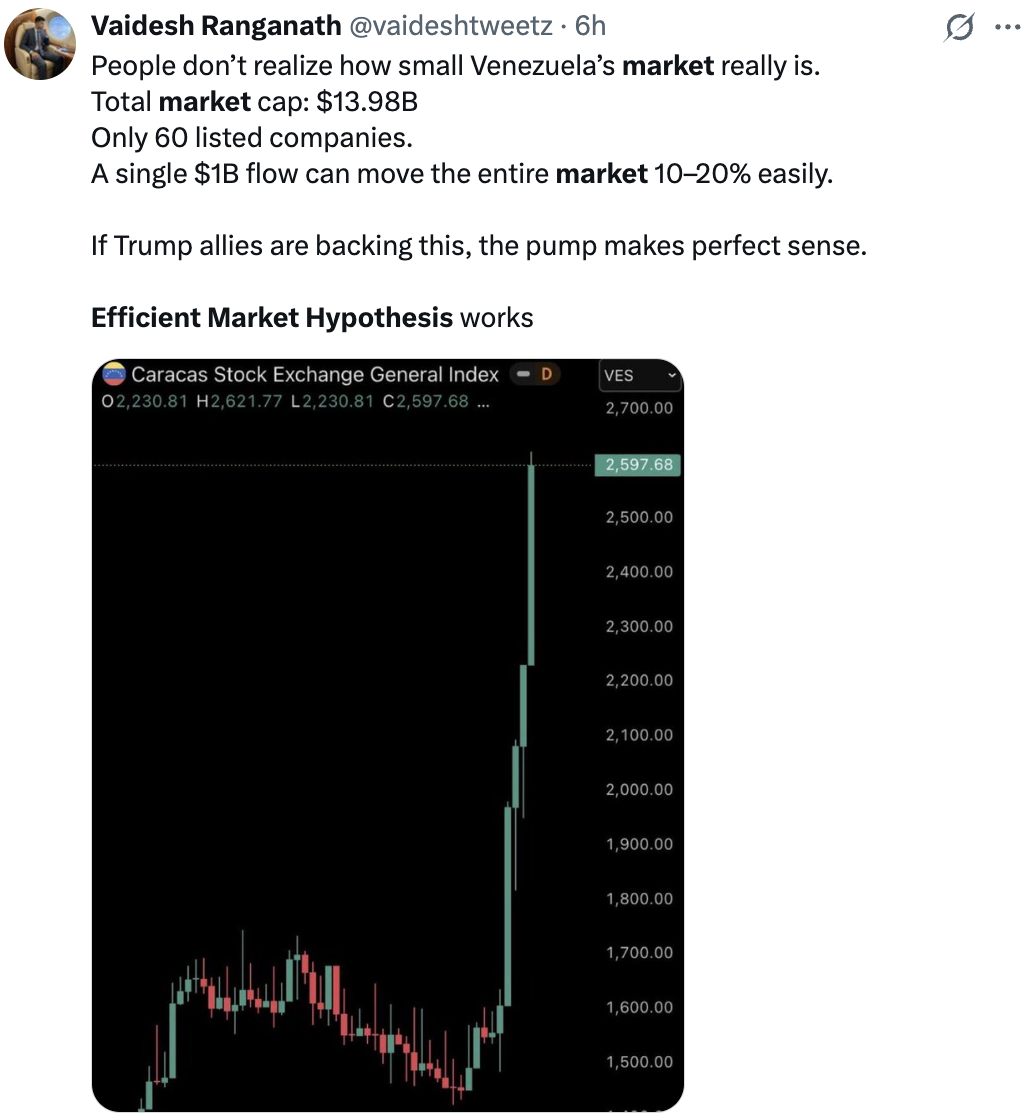
The Efficient Market Hypothesis (EMH) argues that asset prices reflect all available information. If markets are efficient, then known geopolitical events should already be priced in, limiting predictable follow-through.
Efficient Market Hypothesis applied to Venezuela. | Credit: Valdesh Ranganath X profilr
This raises an important question: If silver surged on the news of Venezuela, why hasn’t Bitcoin already followed?
Information diffuses at different speeds across these ecosystems.
2. Different Risk Profiles
Silver is widely perceived as a defensive asset. Bitcoin still carries a risk premium due to its volatility, regulatory uncertainty, and leverage. In the early stages of geopolitical stress, capital often first moves into assets with lower perceived volatility.
3. Liquidity Constraints
Bitcoin’s price is more sensitive to liquidity conditions. Even if the long-term thesis improves, short-term moves can be suppressed if:
Interest rates remain high.
Leverage is unwound.
Risk appetite is constrained.
Under EMH, this isn’t irrational; it reflects current constraints.
Why Bitcoin Often Lags Gold and Silver During Macro Shocks
Evidence of Bitcoin supply being locked or frozen.
If multiple signals align, Bitcoin’s correlation with silver could strengthen rapidly.
Will Bitcoin Catch Up to Silver’s Geopolitical Rally?
Silver breaking above $79 is a clear signal that markets are pricing heightened geopolitical and monetary risk. Bitcoin’s response, however, is not automatic.
History suggests Bitcoin often lags hard assets, responding not to the shock itself, but to the policy and liquidity consequences that follow. The Efficient Market Hypothesis helps explain why reactions differ across assets, not because markets are wrong, but because they process information differently.
Silver has moved first.
Whether Bitcoin follows depends less on silver and more on what happens next in global liquidity, policy response, and risk appetite.
In today’s market, Bitcoin does not move in isolation. It moves when the macro environment allows it to.
Silver surged as investors moved into hard assets following the U.S.–Venezuela crisis. Geopolitical instability, supply-chain risk, and concerns about fiat currency exposure often drive demand for precious metals, with silver benefiting from both its monetary and industrial roles.
Is silver correlated with Bitcoin?
Silver and Bitcoin can be correlated during certain market regimes, particularly when liquidity is abundant and investors seek alternatives to fiat currency. However, the correlation is inconsistent and tends to break down during periods of tight financial conditions or risk-off sentiment.
Why didn’t Bitcoin rise immediately with silver?
Bitcoin is more sensitive to liquidity, interest rates, and leverage than silver. In early stages of geopolitical stress, capital often flows first into lower-volatility defensive assets like silver and gold before rotating into higher-risk assets such as Bitcoin.
What role does the Efficient Market Hypothesis play here?
The Efficient Market Hypothesis suggests that markets quickly price in publicly available information. Different assets react at different speeds because they have different investors, risk profiles, and liquidity constraints, not because one market is inefficient.
Disclaimer:
The information provided in this article is for informational purposes only. It is not intended to be, nor should it be construed as, financial advice. We do not make any warranties regarding the completeness, reliability, or accuracy of this information. All investments involve risk, and past performance does not guarantee future results. We recommend consulting a financial advisor before making any investment decisions.
Giuseppe Ciccomascolo began his career as an investigative journalist in Italy, where he contributed to both local and national newspapers, focusing on various financial sectors.
Upon relocating to London, he worked as an analyst for Fitch's CapitalStructure and later as a Senior Reporter for Alliance News. In 2017, Giuseppe transitioned to covering cryptocurrency-related news, producing documentaries and articles on Bitcoin and other emerging digital currencies. He also played a pivotal role in establishing the academy for a cryptocurrency exchange website. Crypto remained his primary area of interest throughout his tenure as a writer for ThirdFloor.


 Easy
Easy