BlackRock’s proposed iShares Bitcoin Premium Income ETF uses covered calls to turn BTC volatility into yield. | Credit: Getty Images.
Share
Key Takeaways
Tokenized ETFs combine blockchain efficiency with traditional fund exposure, promising faster settlement and global access.
BlackRock’s BUIDL and Franklin Templeton’s FOBXX show that tokenized RWAs can already attract billions in investments.
Investors stand to benefit from fractional ownership, programmability, and reduced fees.
Unclear regulation and tax rules remain the biggest hurdles to mainstream adoption.
A tokenized version of exchange-traded funds (ETFs) has long been a target for many crypto companies. As of June 2025, traditional ETFs had reached a record $16.99 trillion in invested assets, according to ETFGI.
Bitcoin ETFs alone totaled $567.35 million in investments as of August 2025. With that value in mind, it makes complete sense that crypto investment firms developed a tokenized version of ETFs for their customers.
Not only are ETFs more accessible, but they also provide a far easier way to diversify one’s investments. And in the world of cryptocurrency, accessibility and diversity go a long way.
Tokenized funds, such as BlackRock’s BUIDL, have proven that blockchain-based financial products representing real-world assets (RWAs), such as tokenized treasuries, money-market funds, and even equities, can generate billions.
But what are tokenized ETFs in the first place, and what could they mean for investors?
Let’s dive deeper.
Try Our Recommended Crypto Exchanges
Sponsored
Disclosure
We sometimes use affiliate links in our content, when clicking on those we might receive a commission at no extra cost to you. By using this website you agree to our terms and conditions and privacy policy.
Similar to a traditional ETF, a tokenized ETF is a fund represented as a digital token on a blockchain. Also, you’re not holding the underlying assets. Instead, you are holding a fund that represents their value. However, the key difference between traditional and tokenized ETFs lies in their delivery system.
Typical ETFs are held with a brokerage, such as ETRADE or Fidelity. Unfortunately, this means you’re paying them fees for managing your ETFs. Tokenized ETFs are decentralized, meaning there’s no intermediary handling the process. That lack of an intermediary leads to cheaper ETF management and more control over your funds.
With traditional ETFs, you’re walking into a bank branch during business hours, paying the teller for their time. Tokenized ETFs are being your own bank: 24/7, borderless, and completely under your control.
BlackRock’s Push Into Blockchain and Tokenization
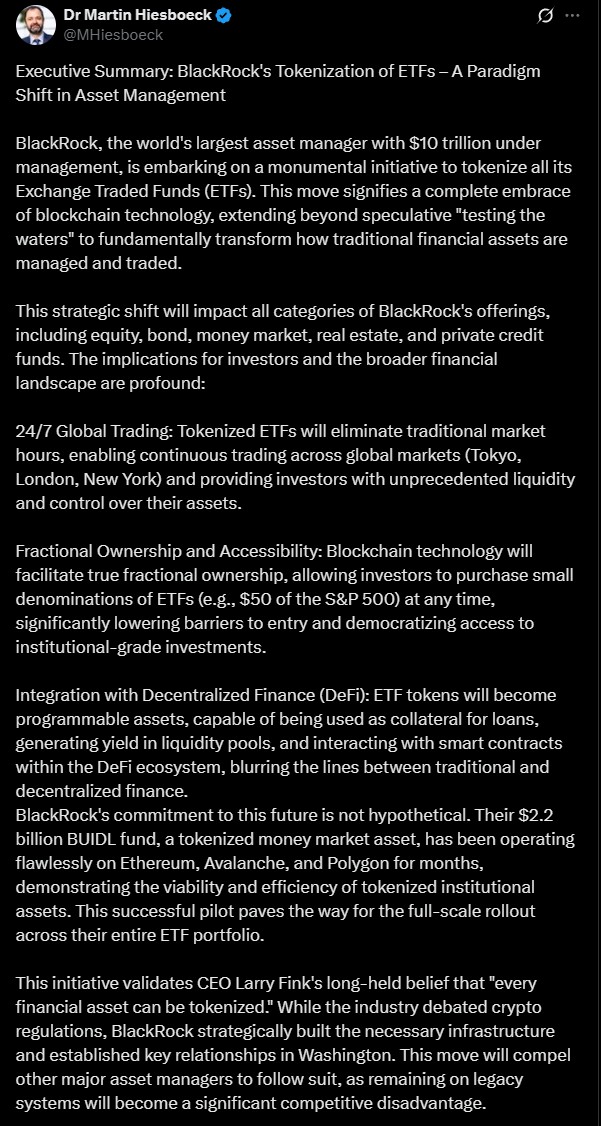
Of course, tokenized ETFs still need creation. They don’t appear out of thin air. As the world’s largest asset manager, BlackRock is converting its top ETFs into tokenized entities, making them ready for decentralized trading.
The entity already manages BlackRock USD Institutional Digital Liquidity Fund (BUIDL), which is the world’s largest tokenized money market fund with over $2.2 billion in managed assets.
BlackRock’s rival, Franklin Templeton, has also gotten involved, operating its FOBXX money market tokenized fund, managing over $400 million on public blockchains.
Uphold’s CEO comments on BlackRock’s potential ETF tokenization. | Source: @MHiesboeck on X
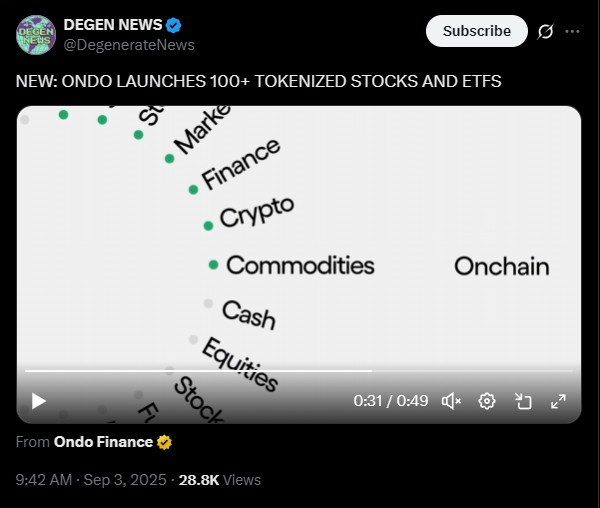
Crypto-native projects like Ondo and even exchanges like Kraken (through its xStocks product) are also building tokenized, ETF-like products. While these smaller firms helped set the trend, BlackRock’s attempted entry is a sign that tokenized ETFs are gaining traction in the mainstream.
Ondo Finance launched tokenized stocks and ETFs earlier this month. | Source: @DegenerateNews on X
How Tokenized ETFs Differ From Traditional ETFs
On the surface, tokenized ETFs provide the same level of market exposure as traditional ones.
The key differences are in how you can trade them and how you can settle them:
Settlement: Traditional ETFs take days to settle, while tokenized ETFs settle instantly.
Accessibility: Tokenized ETFs are available 24/7, globally, with few limitations. Though that accessibility can vary based on the regulations of your country.
Custody: Tokenization means self-custody. When you buy a tokenized ETF, it’s sent to your wallet for management. You can then hold it, trade it peer-to-peer (P2P), or use it as collateral in decentralized finance (DeFi).
Transparency: Blockchain technology provides complete transparency, allowing you to track a tokenized ETF’s entire history.
Put simply: traditional ETFs are locked into regional markets and business hours, while tokenized ETFs are global, programmable, and portable.
Potential Benefits of Tokenized ETFs for Investors
On the investor side of things, enjoy the following benefits:
Fractional investments: Tokenization introduces fractional investments, meaning you can buy part of an ETF. Fractional investments ensure anyone can get involved, rather than just those with a lot to invest.
Increased liquidity: A global market means global liquidity, which can lead to reduced spreads and an overall cheaper investment experience. For example, an investor in Singapore can buy a tokenized S&P 500 ETF in real-time, instead of waiting for US markets to open, and without paying international fees.
Programmability: To many, the best part about decentralized assets is liquidity farming. You can take a tokenized ETF and put it up as collateral in a decentralized application (dApp). In this same vein, tokenized ETFs are locked into smart contracts, which could automate the dividend process and ensure you’re paid out on time, any time.
Lower costs: A lack of an intermediary lowers transaction fees, saving you money over time.
While these benefits could incentivize the mass adoption of tokenized ETFs beyond what we’re already seeing, at least, they’re not without risks.
Risks Associated with Tokenized ETFs
Tokenized ETFs still have some barriers to overcome:
Regulatory uncertainty: The US is the home base of BlackRock’s operations. While US regulators have established policies for stablecoins alongside a basic crypto framework, they’ve yet to establish a unified tokenized ETF framework.
Security: New technology brings new security risks. Smart contracts and crypto wallets can be hacked or suffer from programmability issues.
Liquidity fragmentation: Despite the potential for increased liquidity, tokenized ETFs are distributed across various platforms. Each platform only has a specific amount of liquidity, which can vary.
Adoption hurdles: The goal of tokenized ETFs is, in part, to bring institutional investors into the fold. However, these investors may wait until widespread regulations are in place, which can limit the initial appeal of BlackRock’s approach.
Essentially, the RWA movement has momentum, but institutional caution means mass adoption could take years.
Future tax treatment is one of the largest unknowns when it comes to tokenized ETFs. Traditional ETF holders enjoy tax efficiency through in-kind redemptions to mitigate capital gains tax, while spot Bitcoin ETFs are treated like grantor trusts, meaning that you are taxed a capital gain or a loss on every buy or sell order.
In terms of tokenized ETFs, it’s hard to say. If regulators treat tokenized ETFs like traditional equity ETFs, they may operate the same in terms of taxation.
But it’s possible that regulators will treat them differently. Until tax authorities introduce a clearer regulation, there’s always a risk that tokenized ETFs lose one of the biggest advantages that made ETFs so popular in the first place: accessibility.
Conclusion
Tokenized ETFs merge RWAs, DeFi, and traditional finance. With BlackRock leading the charge toward tokenized ETFs, they could transform how you interact with markets, turning assets once locked behind time-gated brokers into borderless, programmable tokens.
But regulatory clarity and tax rules will decide whether or not these financial instruments reach mass adoption.
Will tokenized ETFs pay dividends directly into my wallet?
Yes, tokenized ETFs could distribute dividends automatically via smart contracts, meaning payouts may go directly to your blockchain wallet without manual intervention.
How do tokenized ETFs differ from synthetic assets like wrapped tokens?
Tokenized ETFs are backed by real-world assets such as stocks, treasuries, or money market funds. Synthetic assets (like wrapped tokens) only mirror an asset’s price without holding the underlying securities.
If a tokenized ETF is hacked or I lose access to my wallet, will issuers like BlackRock reimburse me?
No. With tokenized ETFs, you hold the tokens in self-custody, which also means you’re responsible for wallet security. If tokens are lost or stolen, issuers typically will not replace them.
Can tokenized ETFs be traded on decentralized exchanges (DEXs)?
In theory, yes. Tokenized ETFs can be traded peer-to-peer or on decentralized platforms.
Disclaimer:
The information provided in this article is for informational purposes only. It is not intended to be, nor should it be construed as, financial advice. We do not make any warranties regarding the completeness, reliability, or accuracy of this information. All investments involve risk, and past performance does not guarantee future results. We recommend consulting a financial advisor before making any investment decisions.
Max Moeller is a Chicago‑based writer and video editor passionate about games, tech, and crypto. Whether it’s crafting clear, insightful articles or piecing together engaging video retrospectives, he’s driven by curiosity and takes pride in keeping things human. Since 2017, Max has been published in a variety of notable crypto magazines.


 Easy
Easy