XRPL just crossed $2B in tokenized assets. As real-world finance moves on-chain, could this milestone set up XRP price for a new all-time high? | Credit: CCN.com
Share
Key Takeaways
The 99% XRPL activity drop is misleading without context, as it reflects a sharp weekend slowdown in institutional and large-account usage.
Despite the on-chain crash, XRP continues to trade above $2, indicating the market does not see the drop as a fundamental threat.
XRP price action is influenced more by market sentiment, liquidity, and macro factors than short-term transaction counts.
Upcoming protocol upgrades, including TokenEscrow, AMMClawback, MPTs, and Price Oracles, signal continued long-term investment in the ecosystem.
The XRP Ledger (XRPL) shocked the crypto market over the weekend after on-chain data showed a dramatic 99% collapse in network activity within just 48 hours.
Headlines quickly framed the drop as a potential warning sign for XRP, raising concerns about declining adoption or technical issues.
So what actually happened on Ripple’s blockchain, and what does it mean for XRP’s outlook?
What Caused the 99% XRP Ledger (XRPL) Activity Crash?
At first glance, a 99% drop in on-chain activity sounds catastrophic. However, a closer look at the data suggests the decline is less about structural weakness and more about timing and market behavior.
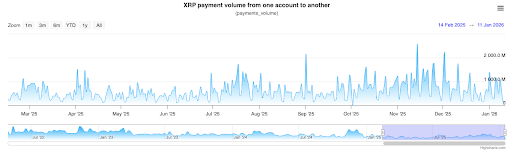
According to XRPScans, payment volume on the XRP Ledger fell from more than 1.09 billion XRP on Thursday, January 8, to roughly 167 million on Saturday, before slipping further to around 137 million by January 11.
XRPL activity crashed by 99%. | Credit: XRPScans
Transaction counts also declined, from over 2 million transactions to about 1.8 million during the same period.
While the percentage drop is eye-catching, it’s essential to note that XRPL usage is heavily influenced by a relatively small number of large participants, particularly institutional users, payment providers, and liquidity hubs. When those actors step back, overall network metrics can fall sharply even if retail usage remains steady.
Why XRPL Activity Falls When Markets Slowdown
One key factor behind the sudden drop is the “weekend effect,” a phenomenon observed across many blockchains, particularly those with strong institutional use cases.
Unlike retail-heavy networks where activity remains more evenly distributed, the XRP Ledger is widely used for payments, liquidity transfers, and enterprise-grade operations.
Many of these participants reduce or halt activity on weekends, leading to thinner liquidity and fewer large-value transactions.
Because payment volume is a core XRPL metric, even a brief pause by major accounts can cause significant fluctuations in reported activity. In that sense, the 99% figure reflects concentration risk in usage patterns rather than a sudden loss of interest in the network itself.
Why XRP Price Stayed Stable Despite the XRPL Activity Collapse
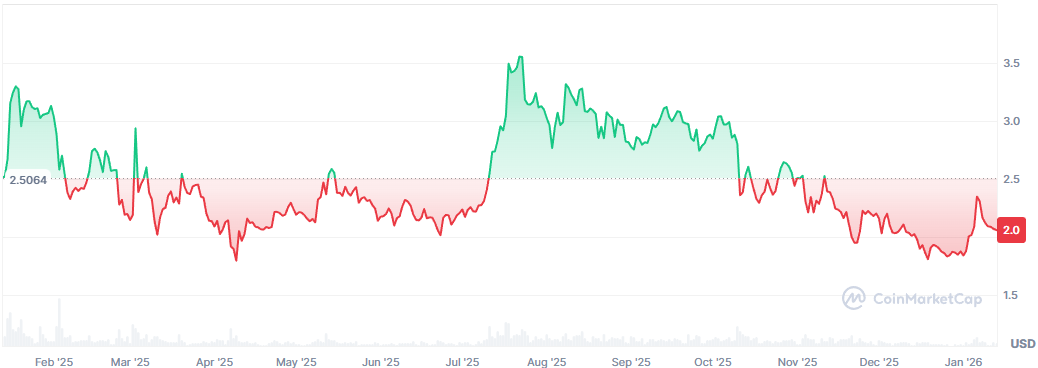
Despite the sharp drop in on-chain metrics, XRP’s price has shown notable resilience. While CoinMarketCap data indicates XRP is down just over 4% on the week, the move does not align cleanly with the timing or magnitude of the activity decline.
XRP price remained stable despite the ledger activity drop. | Credit: CoinMarketCap
There are several reasons for this disconnect:
On-chain activity is not always price-leading: especially for assets with strong speculative and derivatives markets, prices often react more to macroeconomic sentiment, liquidity conditions, and regulatory narratives than to short-term transaction counts.
Large holders remain active: Just days before the activity drop, XRPL recorded a surge in whale transactions exceeding $100,000 per transfer, suggesting continued engagement from major holders and institutions.
Market participants expected a slowdown: Experienced traders understand that weekend slowdowns are common. As a result, the decline may not have triggered panic selling.
In short, the market is interpreting the data as noise rather than a signal of deteriorating fundamentals.
XRP On-Chain Metrics vs. Network Health: What Investors Should Know
It’s also crucial to distinguish between activity levels and network health.
A drop in volume does not automatically imply congestion, outages, or security failures. In this case, there were no reports of XRPL downtime, consensus issues, or transaction finality problems.
This distinction matters because long-term value is driven more by reliability, upgrade cadence, and developer engagement than by short-term transaction spikes.
XRPL Development Update: Upcoming Features and Network Improvements
Reinforcing that point, XRPL developer and dUNL validator Vet recently shared an update indicating that a large batch of fixes and protocol amendments is nearing its activation timer.
Price Oracle features, critical for DeFi and institutional integrations.
These changes are designed to strengthen XRPL’s infrastructure and expand its use cases, regardless of short-term market fluctuations.
Notably, the development roadmap continues independently of XRP’s price performance, a sign of maturity compared to more hype-driven ecosystems.
What the XRPL Activity Crash Means for XRP Price Outlook
From an educational standpoint, the XRPL activity crash highlights several broader lessons for investors and users:
Volatility in on-chain metrics is not always bearish: Especially on networks dominated by large actors, metrics can swing sharply without signaling fundamental damage.
Institutional-heavy blockchains behave differently: XRPL’s usage profile makes it more sensitive to scheduling patterns than retail-driven networks.
Price stability can coexist with activity dips: As seen here, XRP’s market price has not mirrored the magnitude of the on-chain decline.
Development matters more than short-term volume: Ongoing upgrades and feature rollouts often provide a stronger long-term signal than weekend transaction data.
XRP Technical Analysis: Downtrend Holds, Support Being Tested
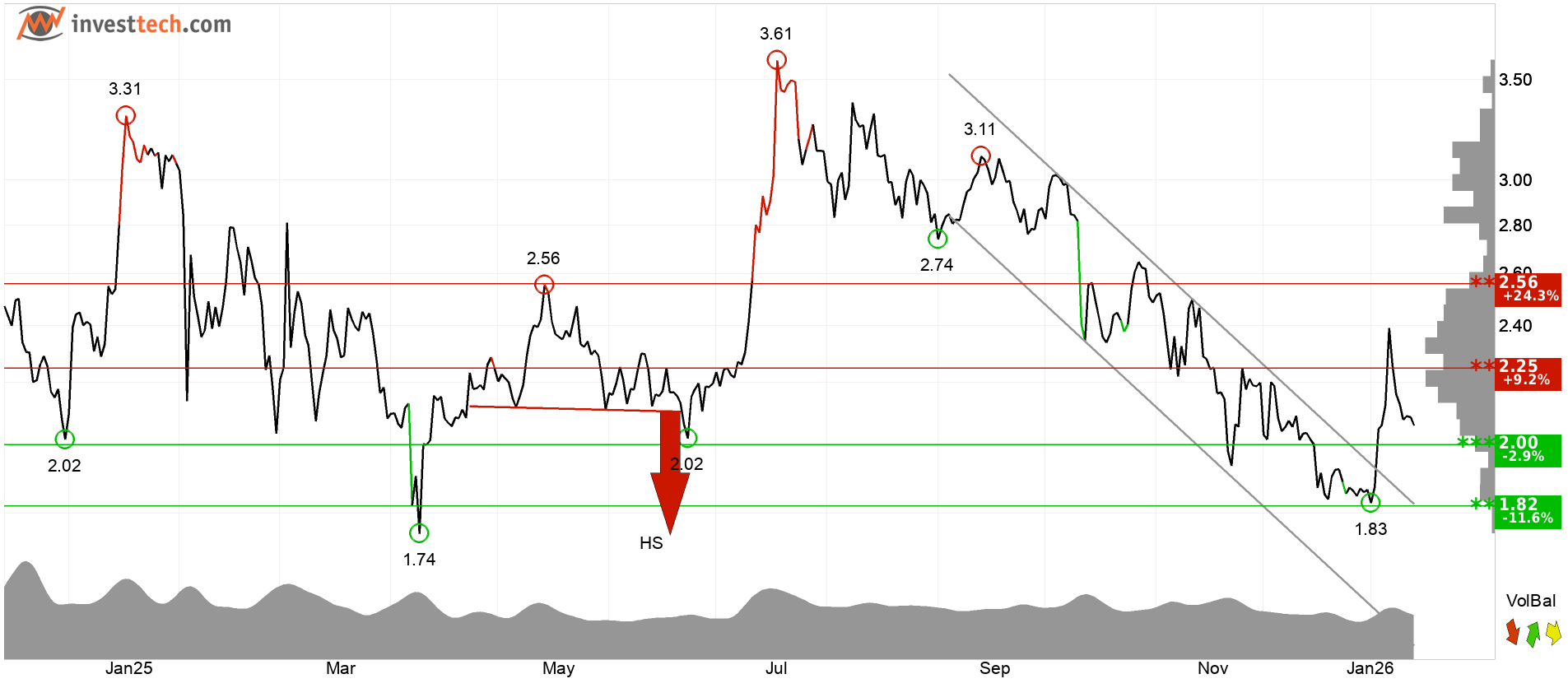
XRP remains in a clear descending channel, confirming a bearish medium-term trend marked by lower highs and lower lows.
The price is currently stabilizing near the lower boundary of this channel, suggesting short-term support, but no confirmed trend reversal has yet occurred.
XRP technical analysis. | Credit: InvestTech
Key supports and resistance show diverse patterns:
$1.82–$1.85: Critical support zone. The recent low near $1.83 has attracted buyers, but a break below this level would likely accelerate downside pressure.
$2.00: Former support, now short-term resistance.
$2.25: First meaningful resistance and pivot level.
$2.56: Major resistance. A break above this level would invalidate the bearish structure and improve the outlook.
Volume remains subdued, pointing to stabilization rather than substantial accumulation. As long as XRP remains below $2.25–$2.56, rallies are likely to be corrective. A decisive move above $2.56 would signal a shift toward a neutral-to-bullish trend, while a drop below $1.82 would reinforce the downtrend.
XRP remains bearish, but is holding key support. The next directional move hinges on a breakout above resistance or a breakdown below $1.82.
How to Interpret Sudden Drops in XRPL Network Activity
The XRP Ledger’s 99% activity drop over 48 hours may seem dramatic, but context is crucial. The decline appears to be primarily driven by weekend slowdowns among large users, rather than by technical issues or collapsing demand.
XRP’s price resilience, combined with recent whale activity and continued protocol upgrades, suggests the market does not view the event as a fundamental threat.
For XRP holders and observers, the episode is a reminder to look beyond headline numbers and understand who is using a network, when they use it, and why activity fluctuates.
In that light, the XRPL crash may be less a warning sign and more a case study in how institutional blockchains behave under the hood.
FAQs
Disclaimer:
The information provided in this article is for informational purposes only. It is not intended to be, nor should it be construed as, financial advice. We do not make any warranties regarding the completeness, reliability, or accuracy of this information. All investments involve risk, and past performance does not guarantee future results. We recommend consulting a financial advisor before making any investment decisions.
Giuseppe Ciccomascolo began his career as an investigative journalist in Italy, where he contributed to both local and national newspapers, focusing on various financial sectors.
Upon relocating to London, he worked as an analyst for Fitch's CapitalStructure and later as a Senior Reporter for Alliance News. In 2017, Giuseppe transitioned to covering cryptocurrency-related news, producing documentaries and articles on Bitcoin and other emerging digital currencies. He also played a pivotal role in establishing the academy for a cryptocurrency exchange website. Crypto remained his primary area of interest throughout his tenure as a writer for ThirdFloor.


 Easy
Easy