The Avalanche Foundation, the Injective Foundation, and TRON DAO are investing hundreds of millions of dollars in crypto treasury companies. | Credit: Kevin Carter/Getty Images
Share
Key Takeaways
Corporate crypto treasuries have passed $100B, led by giants like Strategy and dozens of new entrants piling into Bitcoin (BTC) and Ether (ETH).
The real winners are service providers: custodians (BitGo, Anchorage, Coinbase, Fireblocks) and tokenization platforms (Ondo, Centrifuge) are quietly earning hundreds of millions in fees.
Wall Street and political insiders are riding the boom; banks earn underwriting fees, ETFs collect management fees, and politically connected ventures like WLFI and Trump Media profit from crypto exposure.
Risks are rising with scale: leverage, opaque holdings, and centralization make the system fragile—one shock could ripple across both crypto and tokenized Treasuries.
In the wild world of cryptocurrency, where fortunes are made and lost in the blink of an eye, a massive shift is underway that’s quietly turning everyday corporations into Bitcoin behemoths.
As of August 2025, the total value of crypto held in corporate treasuries has climbed above $100 billion, with public companies holding around 951,000 BTC worth over $105 billion.
But while you’re watching from the sidelines, debating whether to buy the dip or HODL through the storm, who’s really getting rich off this $100 billion crypto treasury explosion?
Spoiler alert: It’s not just the firms holding the coins.
From crypto storage pros to Wall Street banks and even some political insiders, the real winners are cashing in big while you’re still deciding whether to buy the dip.
Why Are Companies Hoarding $100B in Crypto? The Big Picture Explained
A year ago, only a few companies dared to touch crypto. Now, over 150 public firms hold nearly a million Bitcoin worth more than $100 billion, plus billions more in Ethereum and smaller allocations in altcoins. That’s a huge leap from just 416,000 BTC in 2024.
Try Our Recommended Crypto Exchanges
Sponsored
Disclosure
We sometimes use affiliate links in our content, when clicking on those we might receive a commission at no extra cost to you. By using this website you agree to our terms and conditions and privacy policy.
Bitcoin’s fixed supply (21 million coins max) makes it a hedge against inflation, while Ethereum’s staking offers 7-8% yearly returns—way better than traditional savings.
New U.S. laws, like the GENIUS Act for stablecoins and fair-value accounting rules, have made it easier for CFOs to jump in, raising $47 billion this year alone to buy crypto.
The leader? Strategy Inc. (formerly MicroStrategy), holding 629,376 BTC ($69.75 billion as of August 27, 2025).
But as BitcoinTreasuries.NET points out, this “super spreader” trend is spreading fast, with $31 trillion in global corporate cash ready to pour in.
There’s a catch, though: Some firms are borrowing big to buy, which could spell trouble if prices crash.
So, who’s really winning while companies stack coins? The answer’s in the shadows.
1. Crypto Custodians: The Real Winners Behind the Scenes
Think of crypto storage companies (aka custodians) as the banks of the crypto world, they keep corporate coins safe and charge fees.
You know BlackRock? Yes, they are the institution that significantly influences the crypto market. If you look at it, wherever BlackRock goes, liquidity follows.
Three years later, in August 2025, we all know that BlackRock has become the largest Bitcoin custodian, surpassing… pic.twitter.com/l78eTBqmqg
With $100 billion in assets under custody (AUC), they’re earning 0.1-1% yearly fees, racking up $100 million to $1 billion annually.
Here’s who’s cashing in:
BitGo: BitGo, one of the largest custodians, recently filed for a U.S. IPO after its assets under custody (AUC) surpassed $100 billion in early 2025
Anchorage Digital: It also plays a key role: it provides institutional-grade custody and trading for big corporate Bitcoin treasuries. For example, Anchorage (with Crypto.com) was selected to hold Trump Media’s new $2 billion Bitcoin treasury, and it is partnering on the $710M Nakamoto-KindlyMD Bitcoin treasury strategy.
Coinbase Custody: The go-to for 81% of crypto ETFs, Coinbase is banking on storage and yield services, boosting their stock (COIN) for investors.
Fireblocks: It now claims 2,200 organizations and over $10 trillion in transacted volume on its platform.
These firms profit via custody fees, trading and staking services, and by offering on-chain treasury management.
2. Tokenized U.S. Treasuries: The Next Big Yield Play
Even tokenized assets (like digital versions of the U.S. Treasuries) are hot.
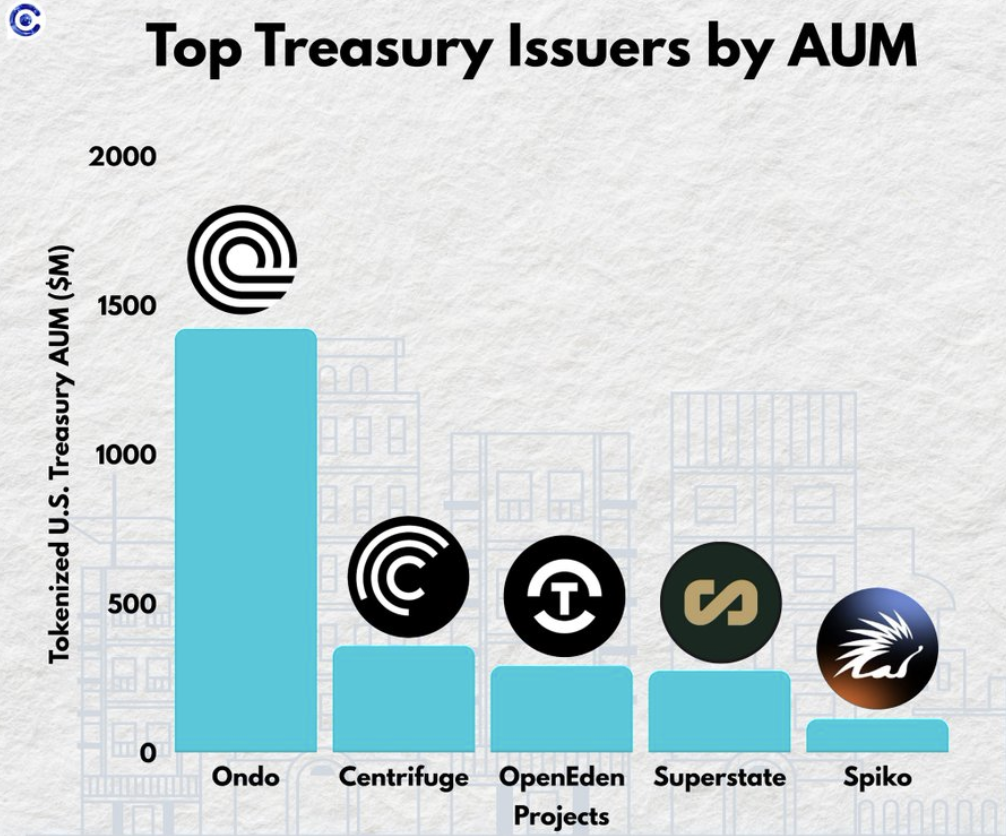
Unlike giants such as BlackRock or Franklin Templeton, the below companies are crypto-native platforms designing systems that turn U.S. Treasuries into programmable, liquid assets that plug directly into DeFi.
Platform
AUM
Focus / Edge
Ondo Finance
$1.42 billion
Leader in OUSG (Treasuries) + USDY (stable); driving “real yield” in DeFi
Centrifuge
$357 million
Backed by Anemoy/Janus Henderson; links DeFi (Maker, Solana) with institutions
OpenEden
$289 million
T-Bill vaults with BNY Mellon custody; Web3-native design
Superstate
$273 million
Ex-Compound founder Robert Leshner; regulated fund + DeFi access
Spiko
$111 million
Niche T-Bill player; community-driven, on-chain first
Centrifuge:As of late August 2025, Centrifuge also reported over 1700 assets tokenized and $1.15 billion in total value across the ecosystem, according to Crowdfund Insider. Their TVL is around $517 million according to DeFiLlama data. Additionally, the JTRSY tokenized fund reached over $500 million AUM in a matter of weeks, while the JAAA fund is reported to have become the fastest tokenized fund to hit $1 billion AUM.
OpenEden: The company manages about $289 million in AUM through its tokenized U.S. Treasury offerings.
Superstate: It manages approximately $273 million in AUM, focused on tokenized U.S. Treasury funds.
Spiko: The company reports about $111 million in AUM through its tokenized real-world asset offerings.
Top treasury issuers by asset under management. | Credit: OCT Gems
These platforms earn management fees and capture yield spreads (around 4–5%) for offering easy access to ultra-safe assets on-chain.
3. Wall Street Banks Profit Without Holding Crypto
Wall Street firms are profiting indirectly from the crypto treasury craze.
BlackRock’s Bitcoin ETF (IBIT) now holds roughly $89.5 billion in BTC, capturing inflows from crypto-rich treasuries as well. BlackRock is also a strategic partner for tokenization: its USD Institutional Digital Liquidity Fund (BUIDL) was tokenized via Securitize into $USD-backed tokens, and Ondo’s token (OUSG) invests in that vehicle.
Otther institutions are moving too: for example, TD Securities and Citi helped issue a €100 million on-chain Eurobond via R3’s Corda with TD managing the issuance.
Banks underwrite and advise these corporate financings, earning standard fees. For example, underwriting a $722M stock sale or $950 million bond issue would typically net 1–2% fees – on the order of $10–20 million each.
Major banks like Morgan Stanley and Goldman Sachs have also begun offering crypto trading and custody products (Morgan Stanley is exploring crypto trading for its clients), and Goldman led a $95M round for Fnality (tokenized cash infrastructure).
Meanwhile, financial titans are plowing money into crypto infrastructure: between 2020–2024 global banks poured >$100 billion into blockchain startups and projects.
Grayscale continues to facilitate institutional flows with its Bitcoin and Ethereum trusts (now restructuring into ETFs), while JPMorgan, ICE and others are working on custody and stablecoin services.
In short, banks aren’t buying the crypto themselves, but they are raking in fees and investing in the underlying ecosystem.
4. Politics and the Crypto Power Game
Crypto treasuries have a distinctly political dimension. U.S. regulators under the Trump administration have taken a more accommodating stance on crypto, which coincides with several high-profile, politically connected crypto projects. For instance,
Similarly, Trump Media & Technology Group publicly announced a $2.5 billion fundraise to buy Bitcoin, with Anchorage and Crypto.com chosen to custody those coins.
The Trump family-backed World Liberty Financial (WLFI) project is also amassing crypto assets: it engineered a $1.5B treasury for its WLFI token by merging into a Nasdaq-listed firm. These moves, often touted as “crypto for all,” have enriched insiders and their service providers.
At the same time, World Liberty Financial (WLF) just made its WLFI tokens tradeable after an investor vote, potentially enriching Trump and his family (they control 75% of revenues).
In this environment, custodians and advisors are benefiting handsomely: Anchorage and others collect huge fees to hold and trade these insider treasuries. At the same time, critics warn of conflicts of interest and political influence in these deals (e.g. prompting SEC scrutiny and Congress questions.
The US Treasury Department is now acknowledging that Tokenization of US treasuries on Ethereum is the most efficient way to trade treasuries 24/7!
In few years, they'll probably launch an Ethereum L2 to mint US treasuries natively onchain.
Regulatory changes under the new U.S. administration have also tilted in crypto’s favor. SEC Chair Paul Atkins (appointed under Trump) has announced a crypto-friendly agenda dubbed “Project Crypto,” directing staff to clarify token classifications and enable tokenized securities.
A recent White House working group urged immediate federal clearance for trading digital assets. In contrast to the prior SEC’s aggressive enforcement (which sued Coinbase, Binance, etc.), Trump’s SEC has dropped those lawsuits.
These moves, along with pro-crypto promises from President Trump, have buoyed market confidence and even spurred a memecoin ETF filing by Canary Capital.
Overall, both crypto-linked political ventures and policy shifts have created new capital flows into crypto treasuries.
5. Institutional Portfolios and Sovereign Funds: How Big Money Is Rebalancing Into Crypto
Beyond companies, large institutional portfolios are repositioning too.
Norway’s sovereign wealth fund (NBIM) quietly boosted its indirect Bitcoin exposure by 83% in Q2 2025 (to 11,400 BTC) via stakes in Strategy and Metaplanet.
Globally, SWFs and pension plans cite crypto’s low correlation with equities and negative correlation with gold as diversification – some targeting 20–25% portfolio allocations to Bitcoin or crypto-based assets. For example, Allianz (a $2.5T asset manager) now recommends a 1–3% Bitcoin allocation in institutional portfolios.
Even Kazakhstan’s sovereign fund is studying a move to convert reserves into crypto.
Central banks and proposals like the U.S. Strategic Bitcoin Reserve (1 million BTC) underline how digital assets are challenging traditional Treasury dominance.
These institutional flows – via ETFs, token funds or equity proxies – strengthen crypto markets by adding deep pockets and legitimacy.
Market Impact: Structure, Liquidity, and Credibility
The massive inflow of treasury capital into crypto is reshaping the market. Liquidity and volatility are affected as well-capitalized players hold large positions.
On one hand, corporate and institutional accumulation provides a stable bid under crypto prices, potentially dampening volatility by smoothing demand (for instance, corporate treasuries tend not to day-trade).
On the other hand, it centralizes risk: a few firms now control 4% of Bitcoin’s supply. If any major holder were forced to liquidate (or take on leverage), it could stoke outsized swings. Overall market structure is hybridizing: crypto assets and tokenized Treasuries now trade across both on-chain DEXs and regulated venues, increasing 24/7 liquidity. This bridges DeFi and TradFi – for example, short-term U.S. Treasuries are now coded as tokens that yield ~4–5% APY but trade like crypto, linking two worlds.
Institutional adoption has also boosted crypto’s credibility. Renowned funds and banks backing these products lend trust, attracting more inflows. The success of tokenized yield (e.g. Ondo’s funds) and stablecoin programs for treasurers bolsters arguments that blockchain can handle real-world assets.
It’s fueling innovation in DeFi – e.g. protocols are now using tokenized Treasuries as stable collateral, reducing reliance on fiat rails. In essence, the crypto market is being rewired into the broader financial system.
But at the same time, some of DeFi’s anarchic volatility has given way to more conservative asset management.
High-Risk Fault Lines: Where the Crypto Treasury Boom Could Crack
While the $100B+ crypto treasury surge looks impressive on the surface, it carries a set of structural risks that investors and policymakers can’t ignore.
Crypto treasury companies will be a disaster for equity investors, just like SPACs
Sponsors come out ahead while retail gets clobbered
If you want exposure to crypto then buy the ETFs or directly on exchanges and chill
Leverage and financing: Many corporate treasuries have been built using debt, convertible notes, or equity raises. This means balance sheets are exposed not just to crypto’s volatility, but also to repayment obligations. If asset values fall, shareholders may face dilution or companies could struggle to service debt.
Opaque holdings: Unlike traditional financial disclosures, corporate crypto positions are not always transparent. While some firms file details in quarterly reports, off-chain agreements, lending activities, or staking collateral can obscure the true size and nature of a company’s holdings.
Centralization risks: A handful of custodians and blockchains now hold enormous sums of corporate crypto. If one custodian were hacked, or if a regulatory crackdown targeted a major blockchain, the ripple effects could destabilize multiple firms at once.
Political entanglement: The entry of politically connected projects into the treasury game adds new risks. Personal stakes held by leaders can raise conflict-of-interest concerns, and a sudden policy reversal could trigger market shocks.
New leverage vectors: Tokenized Treasuries, perpetual futures, and structured DeFi products introduce layers of synthetic exposure. If leveraged traders or lenders were forced to unwind positions during a downturn, the liquidation spiral could spread across both crypto and tokenized traditional assets.
The bottom line?
The treasury boom has given crypto unprecedented legitimacy, but it has also concentrated risks. As with any financial innovation, robust governance, transparency, and risk management will determine whether this $100 billion milestone becomes a foundation for stability or a fault line for the next crisis.
Conclusion
The “$100 billion crypto treasury” boom has been a windfall for infrastructure and insiders. Custodians (BitGo, Coinbase, Anchorage) and tokenization platforms (Ondo, Centrifuge) are reaping steady fees, and political insiders have launched lucrative crypto strategies.
For investors eyeing this space, possible plays include: crypto-friendly stocks (Coinbase COIN, Strategy MSTR or a future BitGo IPO) and tokenized yield products (Ondo’s funds, stablecoin yield platforms).
However, caveats abound.
Crypto prices are volatile, and analysts warn that a market downturn could crush the “NAV premiums” on these treasury stocks. Also, regulation could tighten again if the political winds shift.
Custodians and banks are already getting paid, but retail players should do their own research and risk assessment. The corporate crypto experiment is far from over, it may be only the beginning, but it’s a wild ride with big winners on the sidelines.
A crypto treasury refers to digital assets—like Bitcoin, Ethereum, or tokenized U.S. Treasuries—held on the balance sheets of corporations, funds, or sovereign entities as part of their reserve strategy.
Who benefits most from the $100B+ crypto treasuries?
While companies like Strategy Inc. gain headlines, custodians, tokenization platforms, and Wall Street intermediaries often profit more consistently through management fees, custody charges, and underwriting.
Are tokenized U.S. Treasuries safe?
They are backed by traditional short-term government bonds, which are considered low-risk. However, investors face smart contract, custody, and regulatory risks that don’t exist in conventional bond markets.
Could a downturn in crypto prices hurt crypto treasuries?
Yes. Many companies financed their crypto purchases with debt or equity issuance. If asset prices drop sharply, they may face balance-sheet stress, while ETFs and tokenized funds could see rapid outflows.
Disclaimer:
The information provided in this article is for informational purposes only. It is not intended to be, nor should it be construed as, financial advice. We do not make any warranties regarding the completeness, reliability, or accuracy of this information. All investments involve risk, and past performance does not guarantee future results. We recommend consulting a financial advisor before making any investment decisions.
Giuseppe Ciccomascolo began his career as an investigative journalist in Italy, where he contributed to both local and national newspapers, focusing on various financial sectors.
Upon relocating to London, he worked as an analyst for Fitch's CapitalStructure and later as a Senior Reporter for Alliance News. In 2017, Giuseppe transitioned to covering cryptocurrency-related news, producing documentaries and articles on Bitcoin and other emerging digital currencies. He also played a pivotal role in establishing the academy for a cryptocurrency exchange website. Crypto remained his primary area of interest throughout his tenure as a writer for ThirdFloor.


 Easy
Easy