Retail crypto sentiment hits extreme fear as Bitcoin stalls, altcoins slide, and capital rotates to gold—raising the question: is crypto fading or consolidating? | Credit: CCN.com
Share
Key Takeaways
Retail investors increasingly feel that “crypto is fading,” driven by prolonged drawdowns, sideways price action, and repeated crypto market crashes since 2022
Bitcoin dropping into extended ranges and ongoing altcoin market crashes have weakened hype-driven investing and intensified frustration among retail participants.
The Crypto Fear and Greed Index at 15 signals extreme fear, historically associated with capitulation and late-stage downturn sentiment rather than market peaks.
Capital rotation is evident, with investors moving to gold as gold and silver rally, reinforcing a broader risk-off market environment.
The phrase “crypto is fading” has resurfaced across social media, forums, and investor discussions, reflecting a growing unease among retail participants.
A recent Reddit thread titled “Is crypto starting to fade?” captures this mood perfectly, surfacing fears of a prolonged downturn, frustration with sideways price action, and a sense that attention and capital may be permanently shifting elsewhere.
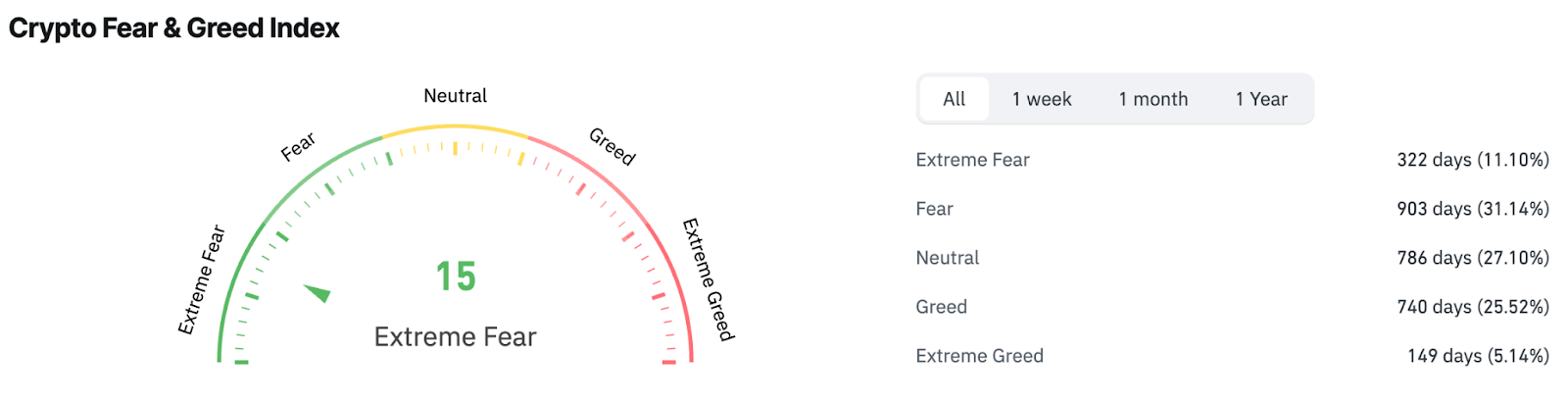
At the same time, objective sentiment indicators paint a striking picture. The Crypto Fear and Greed Index currently sits at 15, firmly in extreme fear territory. Historically, this zone has marked moments of capitulation, not confidence.
MARKET IS BLEEDING AGAIN 🩸$BTC falls to $81k$ETH is down to $2600 Gold and Silver dumping too $800M liquidation in last 30 mins, $1.7B in 24 hours Total crypto mcap is down 6.5% $190B wiped out in 24 hours
So what does this mean for global markets? Is crypto dying or simply consolidating?
Retail Investor Sentiment After the Recent Crypto Market Crash
For many retail investors, the current environment feels fundamentally different from past cycles. Following the 2022 crypto market crash, expectations of quick rebounds have repeatedly been disappointed.
Reddit’s thread “Is crypto starting to fade?” | Credit: Reddit
The Reddit discussion clearly reflects this fatigue. Users note that crypto once thrived on belief-driven speculation: people bought early, held patiently, and relied on hype cycles to lift prices. Today, that dynamic feels weaker. The crypto sell-off has been relentless for smaller tokens, while Bitcoin’s price decline has been slow, grinding, and psychologically draining.
This environment fuels the perception that crypto market sentiment has shifted from optimism to resignation.
Bitcoin Dropping Following Gold and Silver Dips: Crypto vs Gold in a Risk-Off Market
One of the clearest signals in the current cycle is capital rotation. As Bitcoin continues to struggle, gold and silver have initially been rallying, hitting new highs before dropping, reinforcing the view that markets are entering a broader risk-off phase rather than a crypto-specific event.
Instead of chasing speculative upside, investors are prioritizing capital preservation, and that shift is showing up clearly in asset performance.
What the market is signaling right now:
Bitcoin price decline: BTC remains range-bound and under pressure, with repeated sell-offs failing to spark sustained recoveries.
Gold and silver fell: Precious metals have been attracting steady inflows as confidence in fiat policy weakens and macro uncertainty rose but yesterday, Jan. 29, they also pulled back, mainly due to profit taking activity.
Crypto vs gold debate resurfaces: Commentators like Peter Schiff argue that metals, not crypto, are benefiting from today’s fear-driven environment.
Risk-off behavior dominates: Investors are reducing exposure to volatile assets, including altcoins and high-beta crypto trades.
This divergence has reignited a familiar debate: should investors rotate into gold now, or is that move arriving too late?
For many retail investors, the dilemma is uncomfortable. Moving into metals today may mean locking in crypto losses after a prolonged drawdown. Yet staying fully exposed to crypto carries its own risk if the bitcoin price crash extends further or if macro conditions worsen.
What makes this moment particularly telling is how the safe-haven narrative is being assigned. Historically, during periods of financial stress, capital flows toward assets perceived as stable, liquid, and proven. Right now, gold is clearly filling that role. Bitcoin, despite its long-term “digital gold” narrative, is still being treated by most markets as a risk asset, not a defensive one.
This gap matters for sentiment.
Why Bitcoin Is Falling Today
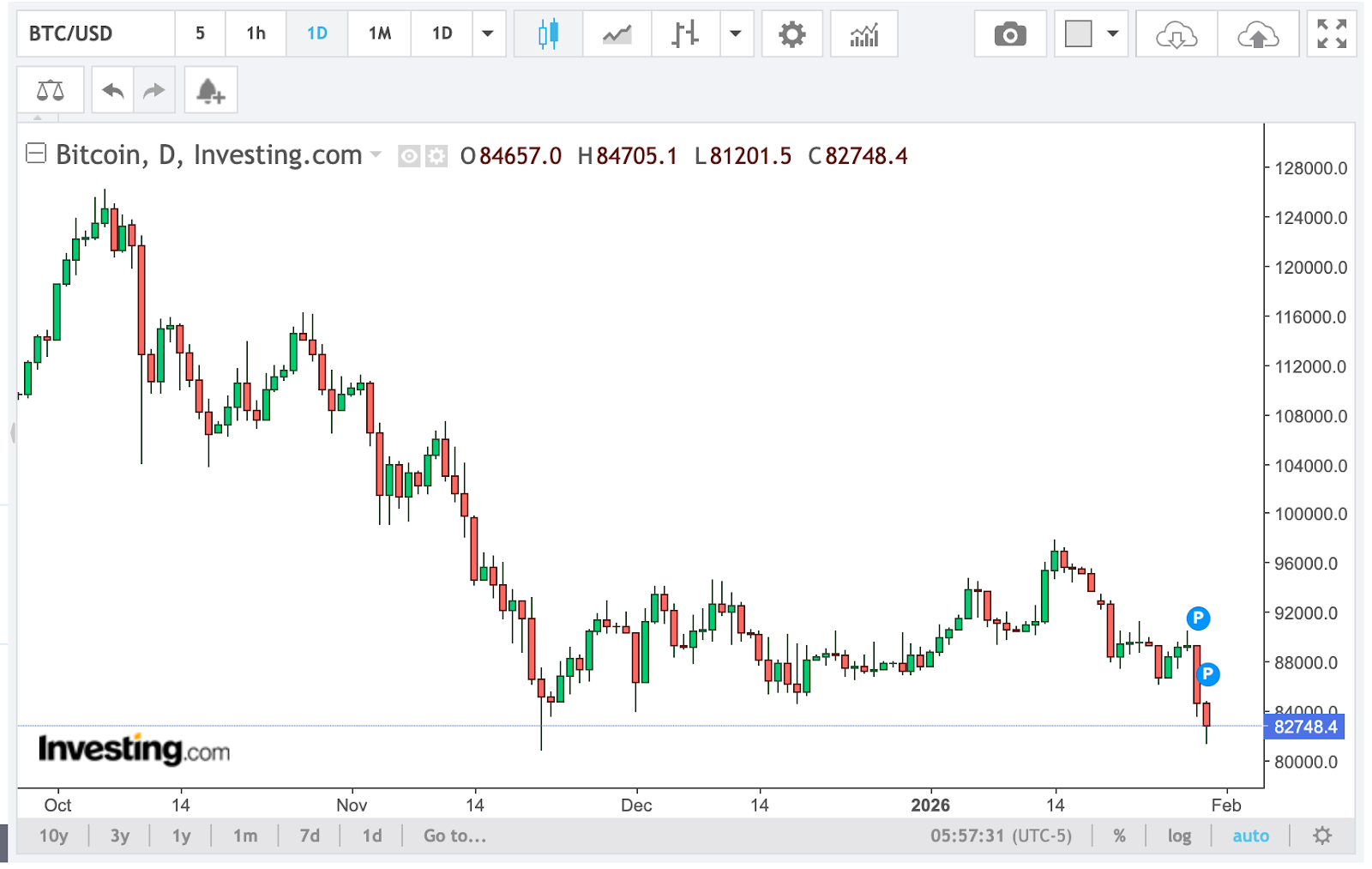
Bitcoin fell sharply, dropping to around $82,000 after failing to hold key technical support. The move triggered heavy liquidations as selling spread across global markets.
More than $3 trillion in value was wiped out in under an hour as stocks, crypto, and even traditional safe havens sold off simultaneously. Gold fell nearly 10% from recent highs, silver dropped about 12%, the S&P 500 lost close to $1 trillion before rebounding, and Bitcoin came under intense liquidation pressure.
Bitcoin daily chart. | Credit: Investing.com
The synchronized decline points to forced selling rather than routine profit-taking, driven by tightening liquidity, elevated leverage, and a sharp shift in risk sentiment.
Bitcoin’s drop was fueled by a broader rotation away from risk assets as investors moved toward cash and yield-bearing instruments following the Federal Reserve’s decision to keep interest rates unchanged. With borrowing costs elevated and liquidity tight, leveraged crypto positions were quickly unwound, accelerating losses.
While some traders argue the speed of the sell-off suggests whale-driven manipulation, the move also highlights how thin liquidity and high leverage can amplify declines during macro-driven shocks.
Crypto Fear & Greed Index Hits Extreme Fear — What It Signals
The crypto fear and greed index at 15 is a critical data point. Extreme fear historically aligns with moments when retail investors disengage emotionally, stop buying dips, and question whether recovery will ever come.
Crypto Fear & Greed index falls into Extrem Fear territory. | Credit: Coinglass
Ironically, these moments often precede stabilization or reversal. Past cycles show that what happens after a crypto crash is rarely an immediate recovery but rather prolonged boredom, low participation, and eventual accumulation by patient capital.
This does not guarantee upside tomorrow. But sentiment at these levels typically reflects exhaustion rather than euphoria.
Is Crypto Dying or Consolidating? Understanding the Current Market Phase
Structurally, crypto adoption continues through ETFs, on-chain finance, and regulatory clarity. Psychologically, however, retail confidence is deeply shaken.
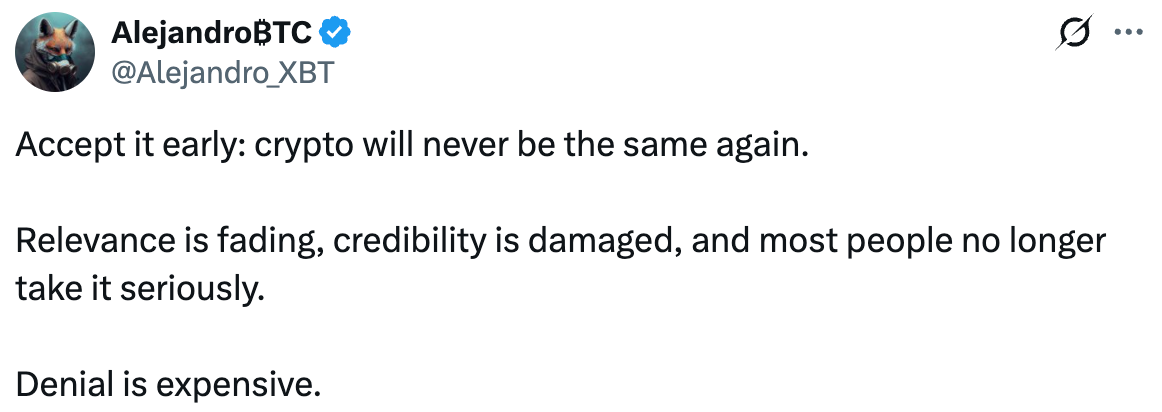
Users react on X. | Credit: Alejandro BTC X profile
Bitcoin dropping within defined ranges is not exciting. It does not reward hype-driven behavior. Instead, it favors discipline, long-term horizons, and selective exposure, traits that retail investors often struggle to maintain during extended drawdowns.
This disconnect explains why crypto market sentiment feels worse than on-chain fundamentals might suggest.
Will Crypto Recover After the Latest Market Crash?
Despite the heavy pessimism, historical context matters. Every major crypto cycle has included moments when the bitcoin price decline felt terminal, sentiment collapsed, and headlines declared the end of the market. In each case, recovery followed, but only after excess leverage was flushed and conviction reset.
That’s why the more accurate question today isn’t “is crypto dying?” but “is crypto between narratives?”
Right now, price action reflects stress, not disappearance.
Where the market stands today:
Bitcoin (BTC):
Down roughly 6% on the week.
Trading near $82,000, approaching the November low around $80,600.
Failure to reclaim $90,000 keeps downside pressure intact.
A break below $80,600 could open a move toward $74,500.
Trading near $1.75, its lowest level since mid-October.
Loss of $1.83 support signals broader altcoin weakness.
Further downside could target the $1.50 area.
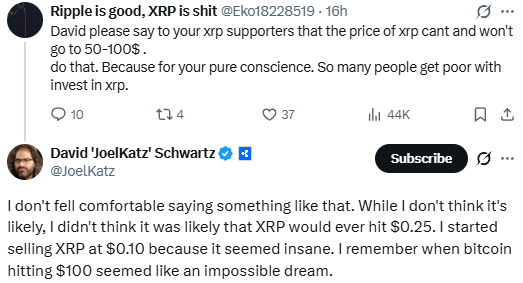
Furthermore, Ripple CTO David Schwartz has cast doubt on long-standing predictions that XRP could one day reach $50-$100.
His comments sparked backlash from long-term holders, who argue they undermine confidence in the token, even as bullish forecasts persist.
Ripple’s CTO rules out a potential jump to $100 for XRP. | Credit: X
Responding to speculation on X, Schwartz said he was uncomfortable making such claims. “While I don’t think it’s likely, I didn’t think it was likely that XRP would ever hit $0.25,” he wrote.
This across-the-board weakness explains why crypto market sentiment feels so fragile. Momentum is negative, rallies are being sold, and confidence remains low, especially among retail investors.
Yet historically, these conditions have often marked late-stage consolidation, not final collapse.
Markets rarely recover when optimism persists. They tend to turn when participation dries up, boredom sets in, and the prevailing narrative shifts from “buy the dip” to “why crypto is falling today.”
So, will Bitcoin recover?
No one can time the bottom with certainty. But past cycles suggest that survival, not speed, has been the advantage. Crypto markets that feel “dead” are often simply waiting for the next catalyst, liquidity wave, or narrative shift.
Predictions for BTC, ETH and XXRP Prices According To Grok
According to Grok, retail sentiment leans bearish short-term, with many viewing the market as “dead” or exhausted after failed rallies and altcoin pain. However, contrarian signals (e.g., capitulation, exhausted sellers) point to potential rebounds, especially if macro improves or catalysts emerge.
Bitcoin (BTC): Retail views it as tied to fading U.S. dominance and macro noise, with prices consolidating/dipping (recently testing ~$82K-$89K zones). Sentiment is negative but not dangerous, discussions spiked bearishly, yet on-chain metrics show accumulation into weakness. Next: Potential rebound if $80K-$86K holds as support; forecasts for 2026 range widely ($65K bear case to $250K bull), but extreme fear often precedes pumps. Retail predicts caution, with some seeing it as a “buy-the-blood” zone.
Ethereum (ETH): Similar to BTC, neutral to negative retail sentiment, with underperformance vs. BTC and ETF outflows. Discussions focus on staking but lack strong directional hype. ETH has shown resilience in demand zones historically. Next: Could catch up aggressively on a breakout, but retail sees it as “boring” and risky until leadership confirms (e.g., ETH/BTC ratio shift).
XRP: Stands out with more mixed/optimistic pockets, some bullish spikes from news (e.g., ETF inflows, escrow events), despite trading 50% below 2025 highs ($1.90 range). Retail polls show divided views (e.g., low odds of overtaking BTC). Next: Analysts target $3-$8 in 2026 on regulatory clarity and inflows, but it lags broader optimism. Ripple leadership remains bullish on market ATHs.
Overall, retail sentiment predicts near-term pain or stagnation (“more pain first,” fading hype, rotation out), but this disconnect from fundamentals (e.g., stablecoin ATHs, on-chain activity) often resolves bullishly.
The debate isn’t settled, fading retail could mark a bottom, with contrarians betting on exhaustion leading to upside in 2026. Crypto cycles reward patience amid despair. Always DYOR; markets remain volatile.
However, please note that AI-based predictions like Grok’s are best understood as conditional scenarios — their outputs reflect underlying assumptions about adoption, regulation, institutional inflows, and macro conditions, not guaranteed price targets.
What Happens After a Crypto Crash: Reading Retail Market Signals
Retail sentiment is not forecasting innovation failure; it is signaling exhaustion. The belief that crypto’s fall today is solely due to fundamentals misses the emotional dimension of markets.
Crypto is not fading because it lacks utility. It feels like it is fading because speculation has been drained, attention has rotated, and fear dominates behavior.
That combination historically marks late-cycle consolidation, not disappearance. Crypto markets do not die loudly. They go quiet.
And when the noise fades, sentiment, not headlines, often tells the most important story.
Is crypto really fading or just going through another cycle?
Crypto is not disappearing, but it is likely in a consolidation phase. Extreme fear, low trading excitement, and sideways price action are common after major market crashes and have historically preceded long periods of accumulation.
Why is crypto falling today despite long-term adoption?
Short-term declines are driven by risk-off market conditions, macro uncertainty, reduced speculation, and capital rotation into safer assets like gold. Sentiment, not technology, is currently dominating price action.
What does the Crypto Fear and Greed Index at 15 mean?
A reading of 15 signals extreme fear, indicating widespread pessimism among retail investors. Historically, this zone reflects capitulation rather than market tops and has often occurred near longer-term bottoms.
Why is Bitcoin dropping while gold and silver are rising?
Gold and silver are benefiting from their traditional safe-haven status, while Bitcoin is still treated as a risk asset in periods of uncertainty. This has fueled the ongoing crypto vs gold debate among investors.
Disclaimer:
The information provided in this article is for informational purposes only. It is not intended to be, nor should it be construed as, financial advice. We do not make any warranties regarding the completeness, reliability, or accuracy of this information. All investments involve risk, and past performance does not guarantee future results. We recommend consulting a financial advisor before making any investment decisions.
Giuseppe Ciccomascolo began his career as an investigative journalist in Italy, where he contributed to both local and national newspapers, focusing on various financial sectors.
Upon relocating to London, he worked as an analyst for Fitch's CapitalStructure and later as a Senior Reporter for Alliance News. In 2017, Giuseppe transitioned to covering cryptocurrency-related news, producing documentaries and articles on Bitcoin and other emerging digital currencies. He also played a pivotal role in establishing the academy for a cryptocurrency exchange website. Crypto remained his primary area of interest throughout his tenure as a writer for ThirdFloor.


 Easy
Easy