Do Epstein Emails Support Claims That Fort Knox Is Empty? What You Need to Know About Missing Gold
Share
Key Takeaways
Bitcoin fell below key support after failing to hold above the $90,000 level, triggering technical selling and liquidations.
Investors rotated into gold and silver as geopolitical and macro risks increased, reducing demand for crypto assets.
The Fed’s decision to keep rates unchanged tightened liquidity expectations, pressuring leveraged crypto positions.
Global markets lose $3 trillion in under an hour as gold, Bitcoin, and stocks trigger mass liquidations.
Global financial markets are experiencing a sharp and synchronized sell-off, with more than $6 trillion in market value erased in under an hour, signaling a powerful liquidation wave across major asset classes.
Markets were hit by insane, cross-asset volatility over the last 24 hours, with a brutal sell-off that spared almost nothing:
Precious metals led the collapse, as gold plunged 10.9%, wiping out $4.1 trillion in market value, while silver crashed 21.5% (−$1.4 trillion).
Industrial metals followed, with copper down 10.3%, palladium off 20%, and platinum sinking 23%.
Equities were more resilient but still negative, as the S&P 500 fell 0.6%, the Nasdaq dropped 1.2%, and small caps weakened.
Crypto didn’t escape the risk-off wave, with Bitcoin sliding 6.6% and Ethereum down 7.5%.
In total, more than $6.5 trillion in value was erased across metals, stocks, and digital assets in a single day, highlighting a rare, synchronized liquidation across global markets.
What makes this move especially notable is that all major asset classes are falling at the same time, including stocks, crypto, and even traditional safe havens like gold and silver. This type of price action is typically associated with forced selling, margin calls, and risk-off positioning, where investors sell whatever they can to reduce exposure and raise cash.
Rather than a routine pullback, current price action reflects a market-wide liquidation event, driven by tightening liquidity, elevated volatility, and rapidly shifting investor sentiment.
Bitcoin Price Crashes Today: What’s Causing the Sudden BTC Sell-Off?
On January 29, 2026, Bitcoin (BTC) experienced a notable price drop from recent highs, with BTC sliding from above $90,000 earlier in the session to near $84,700 (at the time of writing) during the most recent trading period.
The decline reflects broader market rotation away from risk-on assets like cryptocurrencies toward traditional safe havens such as gold and silver. The overall crypto market, including Bitcoin and major altcoins, is in the red today, with total crypto valuations dipping alongside equities and commodities volatility.
In just 45 minutes, over $2.8 trillion in wealth has completely vanished. | Credit: TradingView
Key Price and Market Drivers
BTC price slide:Bitcoin traded lower today after failing to hold the $90,000 level, with price action showing increased selling pressure.
Market sentiment shift: Analysts note capital flows moving toward hard assets amid uncertainty, weakening Bitcoin’s short-term momentum.
Geopolitical and economic risks: Ongoing geopolitical tensions and macroeconomic uncertainty are pushing traders toward traditional hedges, weakening risk assets like Bitcoin.
Investors are watching closely as Bitcoin tries to stabilize around current levels, but the continued rally in gold and silver, both hitting record highs on the same day, is drawing capital away from crypto.
Market Context
Bitcoin’s pullback today isn’t an isolated “crash” in the sense of a historic collapse, but rather a significant correction within an ongoing volatile market environment. The shift toward gold and silver, both rallying strongly, is one of the main narrative drivers as traders rebalance their portfolios amid uncertainty.
Raise your hand if you think today’s Bitcoin crash is a pure market manipulation. pic.twitter.com/Jl2GPnuo16
However, some traders are calling today’s Bitcoin crash a case of market manipulation rather than normal price discovery, pointing to the speed and timing of the sell-off.
Critics argue that large players, often referred to as “whales,” may have used heavy sell orders and derivatives positions to push BTC below key support levels, triggering a wave of forced liquidations that amplified the drop.
Once those liquidation thresholds were hit, automatic sell orders cascaded through the market, accelerating losses and allowing bigger traders to potentially buy back at lower prices.
While there is no public proof of coordinated manipulation, the sharp, synchronized move across spot and futures markets has renewed concerns about how thin liquidity and high leverage can allow large players to move prices quickly during periods of macro uncertainty.
How the Fed Holding Interest Rates Steady Is Hitting Bitcoin Today
The U.S. Federal Reserve did not cut interest rates and signaled that it is not ready to ease monetary policy yet.
Markets had been hoping for clearer signals of future rate cuts or more supportive (“dovish”) guidance. When that didn’t happen, expectations for cheap money and easy liquidity dropped immediately.
Why Liquidity Matters So Much for Bitcoin
Bitcoin performs best when there is lots of money flowing in markets, because:
Result: lower demand for BTC and more selling pressure
Why Risk Assets Fall When Rates Stay High
High or steady rates mean:
Investors can earn guaranteed returns in bonds
They don’t need to chase risky assets like Bitcoin
So capital shifts from:
Crypto & tech stocks → Bonds, commodities, and cash
Bitcoin is treated by big investors more like a high-risk tech asset than a true safe haven.
That’s why BTC fell while gold stayed strong — gold benefits from fear, BTC does not (yet) in institutional portfolios.
Impact on Leverage and Crypto Trading
High interest rates and tighter financial conditions directly affect how much leverage traders can safely use in crypto markets. When the Federal Reserve signals that rates will remain elevated, borrowing costs increase and liquidity becomes more limited, forcing traders and market makers to reduce risk.
As prices begin to fall, exchanges quickly liquidate leveraged long positions, triggering automatic sell orders. This creates a cascade effect where falling prices lead to more liquidations, which then push prices even lower. Because crypto markets rely heavily on derivatives and margin trading, this liquidation cycle can accelerate losses within minutes, turning moderate declines into sharp sell-offs.
In addition, institutional traders and hedge funds tend to scale back exposure when funding conditions tighten. With less cheap capital available, speculative strategies become less attractive, and many large players shift to capital-preservation mode. This reduces buy-side support during market dips, making price recoveries slower and more fragile after sudden drops.
Why Markets React So Strongly to Fed Decisions
Financial markets closely track Federal Reserve policy because interest rates determine how easy or difficult it is to move capital into higher-risk investments. When the Fed keeps rates unchanged or signals fewer future cuts, it suggests that liquidity will remain tight, which immediately lowers risk appetite across global markets.
Traders respond by reallocating funds from volatile assets such as cryptocurrencies into safer alternatives like government bonds, cash, or precious metals. Since Bitcoin is widely treated as a risk-sensitive asset by institutional investors, it often reacts quickly and sharply to changes in rate expectations.
Crypto markets also trade around the clock and are heavily influenced by algorithmic trading systems. These systems are programmed to respond instantly to macroeconomic signals, including Fed statements and press conferences.
As a result, selling can begin within seconds of policy announcements, even before traditional stock markets open. This rapid reaction makes Bitcoin and other cryptocurrencies particularly sensitive to central bank decisions, leading to sudden price swings on days when major economic updates are released.
$4 Trillion Gold and Silver Market Wipeout: Precious Metals Plunge After Record-Breaking Rally
Over $4 trillion has been wiped out of the gold and silver markets in the last 60 minutes, signaling a violent plunge in precious-metals pricing and a rapid evaporation of value across global trading venues.
The sell-off comes after an explosive rally that pushed gold and silver to record and multi-year highs, fueled by geopolitical tensions, dollar weakness, and growing uncertainty around global monetary policy.
Gold’s sharp pullback comes after an extraordinary rally that pushed prices from just above $5,300 to nearly $5,600 an ounce in a matter of days. That move was driven by classic safe-haven forces: geopolitical tensions, a weakening U.S. dollar, and growing concerns about the Federal Reserve’s independence.
However, once prices reached record territory, profit-taking quickly set in. Gold retreated roughly 2%, falling back toward the $5,200 level as traders locked in gains.
Gold/USD daily chart. | Credit: TradingView
Market experts note that such pullbacks are not unusual after parabolic rallies. Rising volatility, reflected in a sharp jump in the India VIX, has encouraged investors to rebalance portfolios rather than chase further upside. When equity markets turn unstable, gold often benefits initially, but sustained equity sell-offs can lead investors to sell gold ETFs and futures to raise cash. This dynamic can temporarily pressure prices even when long-term fundamentals remain supportive.
From a technical perspective, gold’s retreat still looks more like a correction than a trend reversal.
Charts point to support zones around the $5,460-$5,420 range, where buyers have begun stepping in. Momentum indicators have cooled from overbought levels but remain positive, suggesting the broader bullish structure is intact.
In other words, gold’s pullback appears to be a pause driven by positioning and volatility rather than a collapse in safe-haven demand.
Silver Retreats More Sharply After Outsized Rally Raises Bubble Concerns
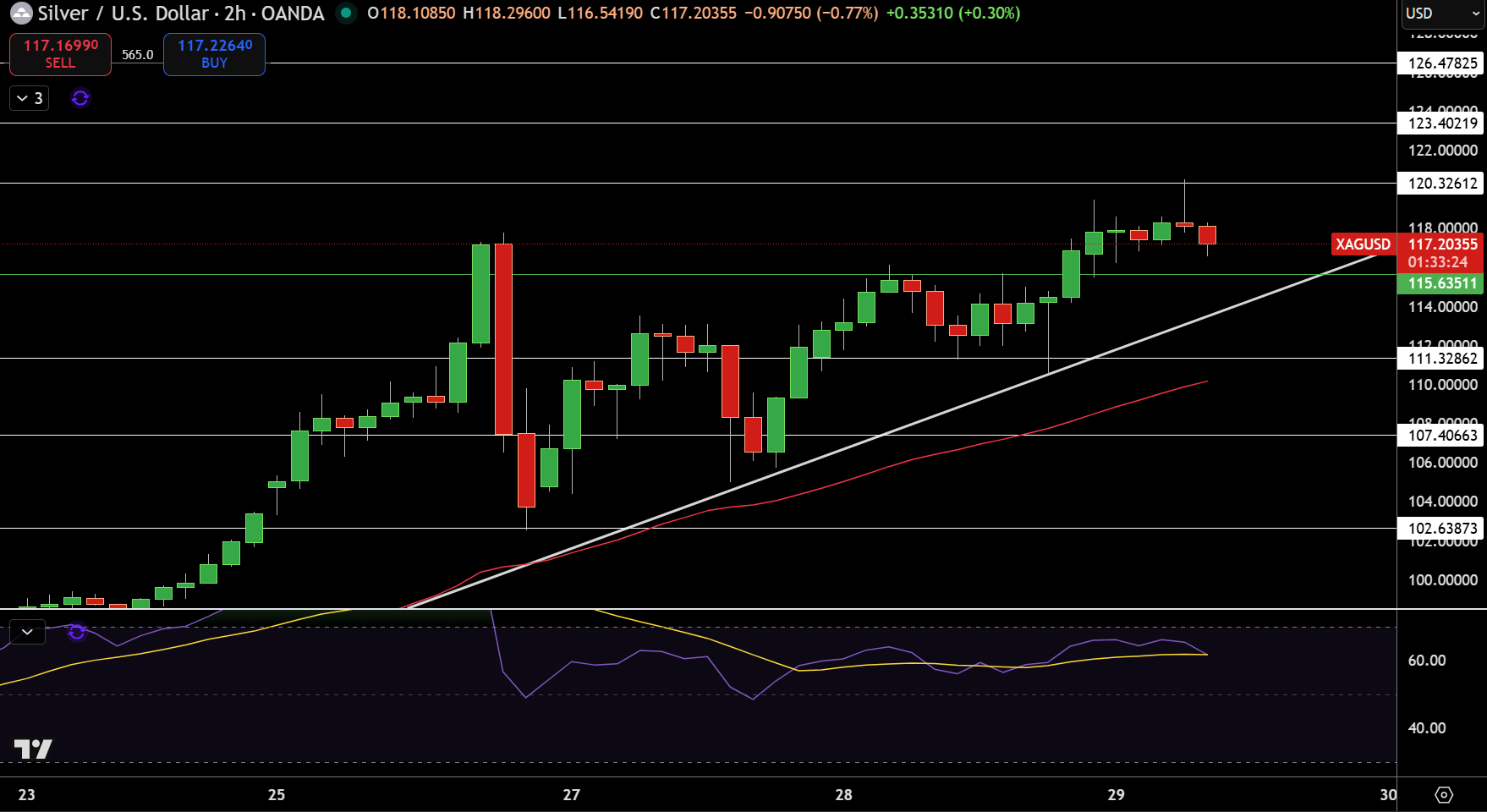
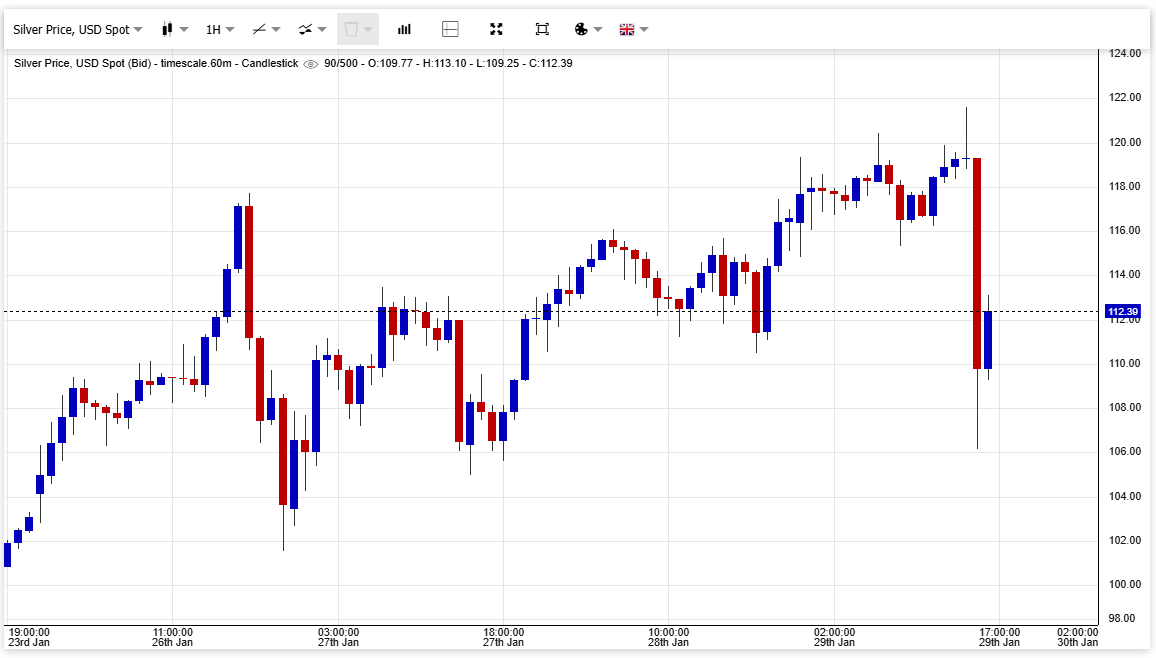
Silver’s pullback has been more pronounced than gold’s, reflecting both its higher volatility and the scale of its prior gains. After climbing above $121.75 an ounce, silver dropped around 4% to near $109. This reversal follows an extraordinary run in which silver prices surged nearly 250% over the past year, far outpacing gold’s already strong performance.
Silver/USD daily chart. | Credit: TradingView
Because silver has both monetary and industrial characteristics, it tends to exaggerate market moves in both directions. Analysts warn that when broader markets come under stress, silver is often sold more aggressively than gold as investors seek liquidity.
Silver’s recent rally may have created bubble-like conditions, making it particularly vulnerable to sharp corrections if sentiment shifts.
Technical indicators suggest silver is consolidating rather than collapsing, but risks remain elevated. Prices are hovering above key trendline support near $115-$116, with further support seen around $112 to $111 if selling intensifies.
Silver pulled back. | Credit: TradingViews
Momentum has cooled, with the RSI easing toward neutral territory, suggesting the market is digesting gains. While long-term demand drivers such as dollar weakness and global uncertainty still support silver, experts caution that short-term corrections of 25% or more are possible during periods of extreme volatility.
Silver’s pullback reflects how quickly speculative excess can unwind when markets turn risk-averse, reinforcing the advice to avoid chasing precious metals solely on past returns.
Protecting Portfolios During Market-Wide Liquidation Events
Periods of synchronized sell-offs, where stocks, crypto, and even traditional safe havens fall together, highlight the importance of portfolio risk management. When liquidity tightens and volatility spikes, protecting capital often matters more than chasing returns.
One of the most critical lessons from events like this is the danger of excessive leverage. In crypto markets especially, leveraged positions can be liquidated within minutes once key support levels break, turning normal pullbacks into steep cascades. Reducing leverage, or avoiding it entirely during uncertain macro conditions, helps limit forced selling risk.
Diversification also plays a key role, but investors should understand that diversification does not always protect during liquidity crises. When markets enter a “sell everything” phase, correlations between assets rise, and even traditionally defensive assets can temporarily fall as investors rush to raise cash. This makes position sizing and cash allocation just as important as asset selection.
Maintaining a portion of capital in liquid, low-risk instruments allows investors to weather sharp drawdowns without being forced to sell at unfavorable prices. It also provides flexibility to re-enter markets once volatility stabilizes and clearer trends emerge.
Ultimately, sharp liquidation events like this reinforce a core principle: markets can move faster and more violently than expected. Portfolios built with risk controls, limited leverage, and realistic volatility assumptions are far better positioned to survive sudden shocks and take advantage of opportunities once the dust settles.
Because selling was amplified by liquidations of leveraged trades after BTC broke below major technical levels.
Did the Federal Reserve directly cause the BTC crash?
Not directly, but the Fed’s steady-rate stance reduced hopes for easier money, which hurt risk assets like crypto.
Why are gold and silver rising while Bitcoin is falling?
Investors see metals as safer during uncertainty, while Bitcoin is still treated as a high-risk asset by institutions.
Is this a long-term trend reversal for Bitcoin?
Current data suggests a short-term correction within a volatile market, not confirmation of a long-term bear cycle.
Disclaimer:
The information provided in this article is for informational purposes only. It is not intended to be, nor should it be construed as, financial advice. We do not make any warranties regarding the completeness, reliability, or accuracy of this information. All investments involve risk, and past performance does not guarantee future results. We recommend consulting a financial advisor before making any investment decisions.
Giuseppe Ciccomascolo began his career as an investigative journalist in Italy, where he contributed to both local and national newspapers, focusing on various financial sectors.
Upon relocating to London, he worked as an analyst for Fitch's CapitalStructure and later as a Senior Reporter for Alliance News. In 2017, Giuseppe transitioned to covering cryptocurrency-related news, producing documentaries and articles on Bitcoin and other emerging digital currencies. He also played a pivotal role in establishing the academy for a cryptocurrency exchange website. Crypto remained his primary area of interest throughout his tenure as a writer for ThirdFloor.


 Easy
Easy