XRP ‘Negative’ Sentiment Secret: Why Record Social Media ‘Hate’ is Actually a Massive Buy Signal
Share
Key Takeaways
XRP social sentiment has fallen into deep fear, which historically has coincided with market stabilization or rebounds in some cycles.
Institutional XRP investment products have recorded sustained inflows, indicating continued interest despite weak retail sentiment.
Strong network fundamentals support the long-term thesis, as the XRP Ledger continues to process millions of transactions daily at low cost and high speed.
A sustained break above $2.28–$2.44 could indicate a shift toward a broader trend, pending confirmation from volume and market conditions.
In the volatile world of digital assets, the crowd is often the loudest right before it’s wrong.
As of December 23, 2025, XRP is caught in a fascinating psychological trap. While social media platforms like X and Reddit are drowning in “record negative sentiment” and bearish commentary, on-chain data and institutional flows are presenting a potential contrarian indicator that traders are monitoring.
😨 XRP is seeing far more negative social media commentary than average. Historically, this setup leads to price rises. When retail has doubts about a coin's ability to rise, the rise becomes significantly more likely.
XRP Social Sentiment Hits Deep Fear — Why Traders See a Contrarian Buy Signal
According to sentiment data aggregated by Santiment, which tracks social media activity as a proxy for retail emotion, XRP social sentiment has plunged into “deep fear” territory, reaching its most negative levels since October 2025. For professional traders, this is music to their ears.
Historically, XRP has a “coiled spring” or compressed volatility relationship with social media negativity:
The November 21 precedent: Just last month, when retail sentiment hit a similar “danger zone,” XRP defied the critics with a 22% rally in under 72 hours.
The capitulation floor: Currently testing the $1.85–$1.90 support level, the token is entering what analysts call a “capitulation pocket.” When retail traders finally give up and sell out of frustration, the market loses its ” short-term holders,” making it significantly easier for the price to move upward.
XRP ETF Inflows Surge as Institutional Buying Defies Bearish Sentiment
The most striking part of this “negative sentiment secret” is the massive divide between what people are saying and what big money is doing.
While social media “FUD” (Fear, Uncertainty, and Doubt) peaks, Spot XRP ETFs have recorded an unprecedented streak of over 20 consecutive days of net inflows. For instance, Grayscale, Bitwise, and 21Shares continue to see steady accumulation. Total assets in these funds have surged past $1.1 billion this month alone.
Geoffrey Kendrick, Global Head of Digital Assets Research at Standard Chartered, doubled down on a highly bullish forecast in April 2026. Kendrick has outlined a speculative long-term scenario in which XRP could reach higher valuations by 2026, subject to regulatory, macroeconomic, and adoption risks.
#XRP Standard Chartered Analyst Predicts XRP Price to Hit $8 by 2026 According to Geoffrey Kendrick, head of digital asset research at Standard Chartered, XRP’s upside potential is far from exhausted.
So while retail is venting on social media, institutions are quietly absorbing the supply at $1.90, treating this “hate-filled” dip as a price consolidation before 2026.
Why Transaction Volume Matters More Than XRP’s Price
Also, the XRP Ledger has powered Ripple’s payment network since 2012 and has now processed more than 4 billion transactions. It averages about 1.5 million transactions per day, with peaks above 5 million.
Ripple CTO David Schwartz says this activity matters more than short-term price moves near $1.90. Transactions on XRPL settle in 3–5 seconds and cost only fractions of a cent.
Low fees, built-in spam protection, and recent upgrades for tokenized assets and automated market makers are driving institutional use in cross-border payments. So far, more than 14 million XRP has been burned in transaction fees.
SWIFT vs. Ripple: The 2026 Infrastructure Shift
Beyond the charts, the fundamental pressure on XRP is reaching a boiling point due to the global banking shift.
November 2025 marked the final mandatory deadline for the ISO 20022 migration, the new global standard for financial messaging. While SWIFT has dominated cross-border payments for decades, its legacy rails are under immense pressure to compete with the speed of the XRP Ledger (XRPL).
In July 2025, Ripple CEO Brad Garlinghouse predicted that XRP could capture up to 14% of SWIFT’s volume (roughly $20+ trillion) within the next five years.
With the legal clarity of the 2025 SEC settlement now in the rearview mirror, the “XRP as a bridge currency” narrative is no longer a theory, it’s an institutional roadmap.
Brad Garlinghouse once said $XRP could take 14% of SWIFT’s volume in 5 years. ⚡️
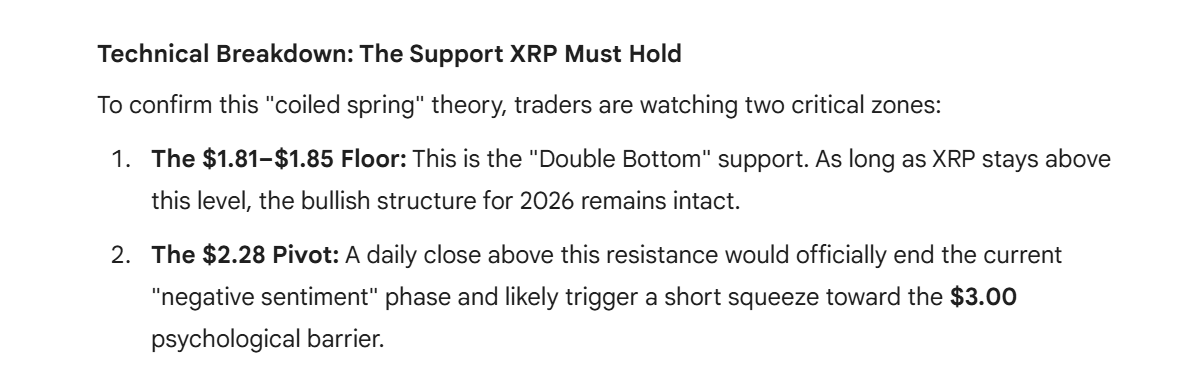
To confirm this “coiled spring” theory, traders must watch below two critical zones, according to Gemini:
The $1.81–$1.85 floor: This is the “Double Bottom” support. As long as XRP stays above this level, the bullish structure for 2026 remains intact.
The $2.28 pivot: A daily close above this resistance would officially end the current “negative sentiment” phase and likely trigger a short squeeze toward the $3.00 psychological barrier.
XRP price prediction by Gemini. | Source: Gemini
Watchlist: Key Levels for XRP’s $8.00 Journey
To confirm Geoffrey Kendrick’s $8.00 trajectory, traders may watch these specific technical hurdles:
The $1.81–$1.90 support: The current “Must-Hold” zone. As long as XRP stays above this floor, the bullish structure for 2026 remains intact.
The $2.44 pivot: A break above this level confirms the end of the “negative sentiment” phase.
The $3.40 psychological barrier: Breaking the 2018 All-Time High is the final “green light” for the move toward $5.50 and eventually $8.00.
What Would Invalidate the Bullish XRP Thesis
While sentiment and institutional flows currently support a contrarian bullish case, this outlook depends on several key conditions holding.
The thesis would weaken if XRP loses the $1.81–$1.85 support zone on sustained volume, signaling that selling pressure is no longer limited to frustrated retail traders. A breakdown below this level would suggest deeper structural weakness rather than temporary capitulation.
A second risk is a reversal in institutional accumulation. If XRP investment products begin to show persistent outflows, the divergence between social sentiment and smart-money behavior would narrow, removing one of the core pillars of the bullish argument.
Finally, macro-level risk events could override XRP-specific factors. A sharp liquidity contraction, rising interest rates, or broad risk-off moves across crypto markets could delay or derail any breakout, regardless of on-chain activity or long-term fundamentals.
In short, the bullish setup remains valid only as long as key support holds, institutional flows persist, and macro conditions remain neutral to supportive.
Watch the Sentiment, Not the Noise
The “secret” is simple: Extreme negative sentiment is a lagging indicator of past price drops, while institutional ETF inflows are a leading indicator of future demand.
As XRP tests the $1.85–$1.90 floor, the current level of negative social sentiment may reflect late-stage retail capitulation, a condition that has historically preceded periods of consolidation or recovery, though outcomes remain uncertain.
What could happen to XRP price after Christmas and into the New Year?
Post-holiday periods often bring lower liquidity and sharper moves. If XRP holds the $1.81–$1.90 support zone, traders expect a potential rebound into early 2026 as sentiment resets and institutional flows continue.
Why is negative XRP social sentiment considered a bullish signal?
Extreme bearish sentiment often appears near market bottoms. When most retail traders turn negative, selling pressure tends to dry up, allowing price to move higher with relatively little new demand.
Are institutions really buying XRP while retail is bearish?
Yes. Data shows consistent inflows into XRP investment products while social media sentiment remains deeply negative, highlighting a divergence between retail emotion and institutional positioning.
What levels should traders watch for XRP in early 2026?
Key levels include support at $1.81–$1.90, resistance at $2.28–$2.44, and the longer-term psychological barrier near $3.40, which would open the path toward higher cycle targets.
Disclaimer:
The information provided in this article is for informational purposes only. It is not intended to be, nor should it be construed as, financial advice. We do not make any warranties regarding the completeness, reliability, or accuracy of this information. All investments involve risk, and past performance does not guarantee future results. We recommend consulting a financial advisor before making any investment decisions.
Onkar Singh has three years of experience as a digital finance content creator. Throughout his career, he has collaborated with various DeFi projects and crypto media outlets. In his leisure time, he enjoys fitness activities at the gym and watching movies across different genres. Balancing his professional and personal interests, Onkar continues to contribute to the digital finance landscape while pursuing his hobbies.


 Easy
Easy