Key Takeaways
- The U.S. Department of Commerce will publish economic indicators directly onto public blockchains.
- Chainlink will distribute BEA data, such as GDP, consumption expenditures, and private domestic sales, while Pyth will publish GDP statistics.
- On-chain publication makes official data immutable, globally accessible, and equally available to all.
- The initiative highlights growing government trust in blockchain infrastructure and oracles.
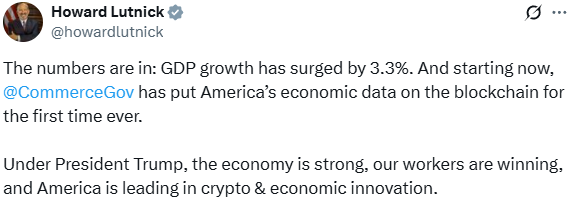
In a groundbreaking move, the U.S. Department of Commerce has begun publishing official economic data directly onto public blockchains.
At its core, the initiative treats economic data as a public good, a resource that should be open, verifiable, and equally accessible to all.
Through partnerships with two leading oracle providers, Chainlink and Pyth, core indicators such as gross domestic product (GDP), real personal consumption expenditures, and private domestic sales are now verifiable on 9 blockchain networks, including:
- Bitcoin
- Ethereum
- Solana
- TRON
- Stellar
- Avalanche
- Arbitrum One
- Polygon
- Optimism
This initiative reflects the Trump administration’s push toward greater transparency in government spending and accountability.
Instead of filtering through agency reports, news outlets, or data aggregators, citizens and institutions can now access official statistics directly from blockchain infrastructure—immutable, timestamped, and globally available.
For blockchain advocates, the significance is twofold: government adoption of decentralized technology is no longer theoretical, and trusted economic data has become programmable within decentralized finance (DeFi) ecosystems.
Why Putting GDP On-Chain Matters: From Transparency to Trust
Gross domestic product or GDP, a nation’s total economic output, has always been a political and financial touchstone. Markets move, policies shift, and businesses plan around its quarterly updates.
But traditional publication methods rely on centralized servers and intermediaries—making them vulnerable to manipulation, selective access, or delays.
Publishing GDP and related metrics on-chain offers several benefits:
- Immutability: Once the Bureau of Economic Analysis (BEA) releases GDP data and it’s recorded on a blockchain, the figures can’t be altered retroactively.
- Equal access: Traders on Wall Street and individual citizens in rural America get the data at the same time, without privileged access for certain institutions.
- Programmability: DeFi applications can directly integrate economic indicators into smart contracts. For instance, lending protocols could adjust collateral requirements based on GDP growth trends.
- Auditability: Anyone can verify that the data posted matches the BEA’s official release, reducing opportunities for misinformation.
In this sense, the blockchain doesn’t just distribute numbers—it creates a shared foundation of trust in economic reporting.
The Role of Oracles: Chainlink and Pyth
At the heart of this initiative are blockchain, middleware that bridges real-world data with decentralized networks.
Oracles solve a key problem: blockchains are self-contained and cannot natively access external information.
- Chainlink is already a dominant oracle provider in DeFi, powering price feeds for billions in assets. Under this partnership, it will distribute BEA data on real GDP, personal consumption expenditures, and private domestic sales.
- Pyth, originally focused on high-frequency trading data, is tasked with publishing GDP statistics from the Department of Commerce.
Together, these oracles ensure data integrity using cryptographic proofs and decentralized validation.
Their role isn’t just technical—they’re now custodians of government transparency, chosen to handle some of the most sensitive economic figures in the world.
Blockchain as Public Infrastructure: The Department of Commerce’s On-Chain Data Initiative
For years, blockchain advocates pitched decentralized tech as a way to improve public services. Critics often dismissed it as hype.
But the Department of Commerce’s adoption signals a shift: blockchain is being recognized as a serious infrastructure for distributing public information.

This isn’t the first time governments have experimented with blockchain, but it is among the most impactful. Earlier efforts focused on land registries, supply chains, or digital IDs. Economic data—arguably the backbone of democratic accountability—marks a more central and politically sensitive use case.
The Department of Commerce said: “Publishing GDP on-chain is not just about embracing new technology—it’s about giving citizens the tools to hold us accountable with verifiable, tamper-proof data.”
If successful, other agencies could follow. Inflation measures from the Bureau of Labor Statistics, budget allocations from the Treasury, or even census data could be next.
How On-Chain GDP Data Powers DeFi Innovation
On-chain GDP data doesn’t just benefit transparency advocates. It has direct implications for decentralized finance.
- Programmable macro data: Imagine a DeFi lending protocol that adjusts interest rates based on GDP growth: if the economy slows, rates could rise to offset higher risks. Or synthetic asset platforms could launch derivatives that track GDP trends directly, giving investors new ways to hedge against macroeconomic shocks.
- Tokenized asset settlement: Stablecoin issuers and tokenized funds could peg payouts or performance benchmarks to official GDP figures, all sourced transparently from Chainlink and Pyth.
- Algorithmic governance: Decentralized autonomous organizations (DAOs) may incorporate macroeconomic metrics into treasury management. For example, a DAO managing billions in assets could rebalance risk exposure based on quarterly GDP updates.
For Wall Street, the integration is equally meaningful. Hedge funds already use high-frequency feeds from Pyth.
With government data now available, algorithmic trading strategies can consume official statistics instantly—without waiting for them to trickle through legacy newswires.
Risks and Limitations of Publishing GDP On-Chain
Despite the promise, putting GDP on the blockchain isn’t without risks.
- Data integrity at source: If the BEA’s initial data is wrong (as sometimes happens with revisions), blockchain only makes the error permanent until corrected with new updates.
- Over-reliance on oracles: Chainlink and Pyth are powerful, but their centrality creates new concentration risks. If they malfunction or face attacks, critical data feeds could be disrupted.
- Interpretation challenges: Economic data is nuanced. Making raw numbers available doesn’t guarantee that citizens understand their significance without context.
- Regulatory sensitivity: Some lawmakers may balk at embedding government statistics in infrastructure originally designed for cryptocurrencies, which they still view with suspicion.
These caveats don’t negate the value, but they highlight the need for thoughtful rollout and safeguards.
A Model for Global Governments? On-Chain Data as Public Infrastructure
The U.S. isn’t alone in experimenting with blockchain for public transparency. Countries from Estonia to Singapore have tested distributed ledgers for public registries and finance.
But the scale and symbolism of putting data on-chain set this case apart.
If the experiment succeeds, it may inspire:
- Central banks: Publishing money supply, interest rates, or balance sheet data on-chain.
- Treasuries: Issuing bonds with payment schedules verifiable on blockchains.
- Statistical agencies worldwide: Using decentralized infrastructure for inflation, trade, or employment data.
In a world where trust in institutions is fragile, blockchain provides a technical solution for verifiability.
The Department of Commerce’s partnership could thus become a template for governments navigating both digital transformation and public skepticism.
The Bigger Picture: Trust, Transparency, and Accountability
Why does this matter beyond crypto and finance? Because information is power.
When only a few institutions control access to economic statistics, public trust erodes—especially in times of political tension.
Publishing GDP on-chain flips that paradigm. It empowers citizens, journalists, academics, and investors to verify data independently.
It removes ambiguity over whether numbers were “massaged” for political ends. And it does so in a way that’s globally accessible, not limited to those with expensive terminals or institutional subscriptions.
Industry Leaders Hail US Government’s First On-Chain Data Release
Douro Labs CEO, Michael Cahill, welcomed the initiative.
“Today is a historic day,” he said.
“For the first time ever, official U.S. government data has been published to the blockchain for use in smart contracts and it was done over the Pyth Network. Making the data instantly accessible to over 600 connected applications across more than 100 blockchains.”
“Secretary Howard W. Lutnick and his team are pushing the boundaries of innovation as they modernize and position the United States to be the worldwide blockchain leader,” he added.
According to Jonathon Chambless, founder of LV8RLABS, “This collaboration marks a significant step in bridging traditional government data with the world of decentralized finance.”
“This partnership is a strong signal of the growing adoption of blockchain technology by government agencies and highlights the crucial role of oracles like Chainlink in connecting blockchains with real-world data.”
Conclusion
The Department of Commerce’s decision to publish GDP and related economic indicators on public blockchains is more than a technical milestone. It represents a cultural and political one.
Blockchain, once dismissed as niche, is now being trusted to handle some of the nation’s most important data.
Chainlink and Pyth are proving that oracles are not just for DeFi price feeds—they can be the infrastructure for government transparency.
The future could see a world where inflation rates, unemployment figures, and even election results are verified on-chain. Whether this vision unfolds smoothly will depend on regulation, adoption, and education. But one thing is clear: the line between government and decentralized technology has blurred.
GDP on the blockchain is no longer a metaphor. It’s a reality—and perhaps the first glimpse of a more open, accountable digital future.
FAQs
Publishing GDP on the blockchain means that official U.S. government economic data, such as gross domestic product, is uploaded directly to decentralized networks like Bitcoin and Ethereum. This ensures the information is immutable (cannot be changed), globally accessible, and verifiable by anyone.
The Department of Commerce selected oracle providers Chainlink and Pyth because they specialize in securely transmitting real-world data to blockchains. Chainlink distributes data like real GDP and consumer expenditures, while Pyth publishes GDP statistics directly. These oracles act as trusted bridges between traditional government databases and decentralized systems.
By making GDP data available on-chain, decentralized finance (DeFi) protocols can build products that automatically respond to macroeconomic trends. For example, lending platforms could adjust collateral requirements based on GDP growth, while synthetic assets or derivatives could track government-reported data in real time. Hedge funds and institutional traders may also plug these feeds into algorithmic strategies.
While blockchain adds transparency, challenges remain. Errors at the source (such as revisions to GDP numbers) still propagate onto the blockchain. Concentrating trust in just two oracle providers creates potential risks if they fail or are compromised. Additionally, raw numbers without context may confuse citizens, and some lawmakers remain cautious about embedding government data into crypto infrastructure.
The information provided in this article is for informational purposes only. It is not intended to be, nor should it be construed as, financial advice. We do not make any warranties regarding the completeness, reliability, or accuracy of this information. All investments involve risk, and past performance does not guarantee future results. We recommend consulting a financial advisor before making any investment decisions.

Giuseppe Ciccomascolo began his career as an investigative journalist in Italy, where he contributed to both local and national newspapers, focusing on various financial sectors.
Upon relocating to London, he worked as an analyst for Fitch's CapitalStructure and later as a Senior Reporter for Alliance News. In 2017, Giuseppe transitioned to covering cryptocurrency-related news, producing documentaries and articles on Bitcoin and other emerging digital currencies. He also played a pivotal role in establishing the academy for a cryptocurrency exchange website. Crypto remained his primary area of interest throughout his tenure as a writer for ThirdFloor.


 Easy
Easy