$82B in Dirty Crypto: How Money Laundering Moves Through Mixers, Bridges, Casinos and Cash-Outs
Share
Key Takeaways
Identified onchain money laundering exceeded $82 billion in 2025, up from roughly $10 billion in 2020, according to Chainalysis.
The $387.5 million Bitget hack in September 2026 shows how stolen crypto can quickly move through wallets, decentralized exchanges, bridges, Bitcoin conversions, and privacy infrastructure.
Blockchain transactions can be difficult to untangle, but they are not automatically anonymous. Investigators can follow permanent transaction histories and target exchanges, brokers, and other points where criminals attempt to cash out.
Crypto money laundering does not usually involve sending stolen Bitcoin to one anonymous wallet and watching the money disappear.
The reality is considerably more complicated.
Criminal proceeds can move through dozens or thousands of wallets, change cryptocurrencies several times, cross blockchains, pass through mixers or gambling platforms, and eventually reach an exchange, a peer-to-peer trader, or an over-the-counter broker.
The scale of that activity is growing.
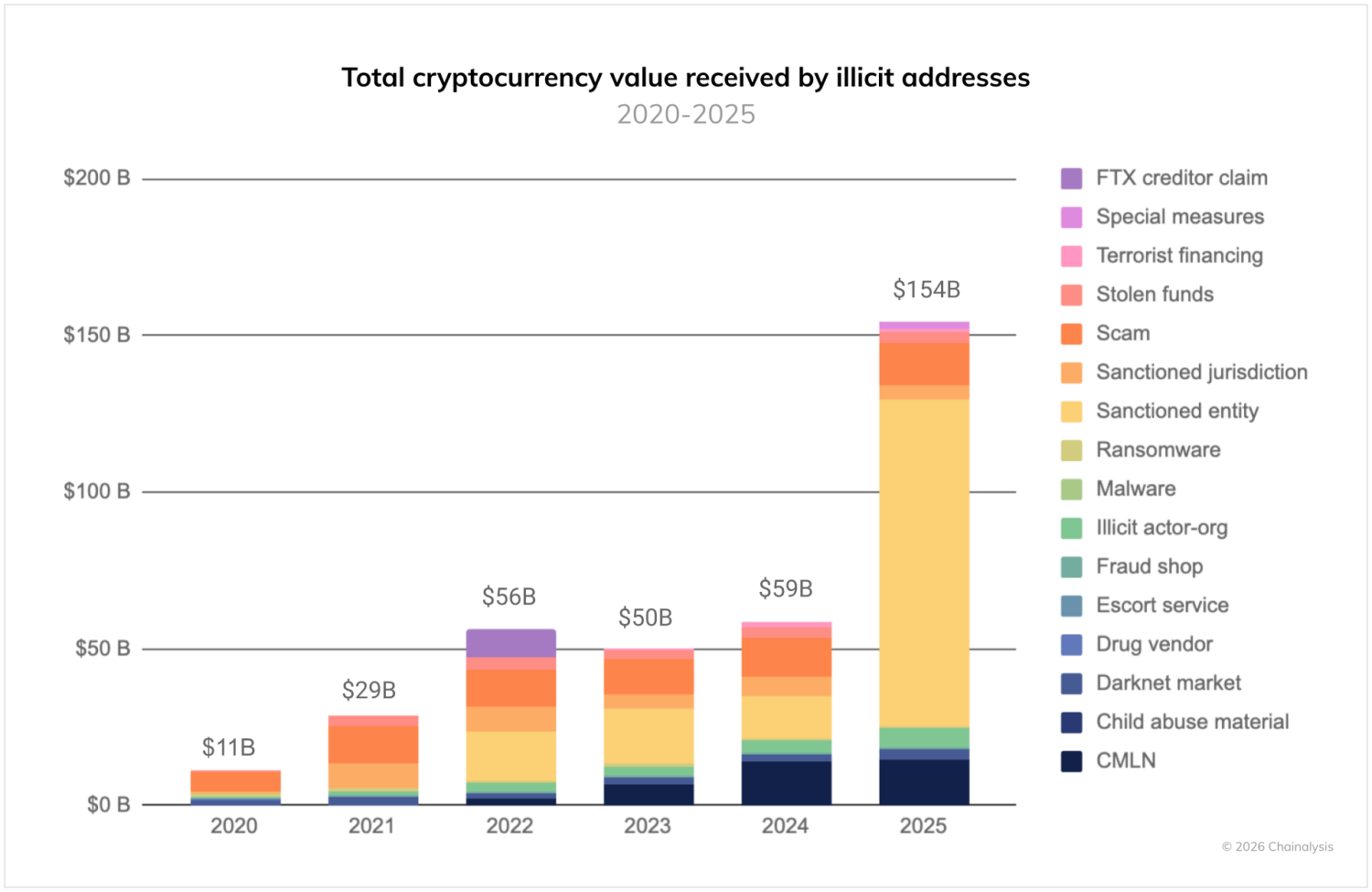
Identified onchain money laundering increased from roughly $10 billion in 2020 to more than $82 billion in 2025, according to Chainalysis.
Chinese language money-laundering networks alone received $16.1 billion in 2025, equivalent to approximately $44 million per day.
In 2025, illicit addresses received at least $154 billion. | Source: Chainalysis
The $82 billion figure does not mean $82 billion was stolen. It represents cryptocurrency that Chainalysis identified as flowing through wallets and services associated with money laundering.
So what happens after dirty money enters crypto?
Try Our Recommended Crypto Exchanges
Sponsored
Disclosure
We sometimes use affiliate links in our content, when clicking on those we might receive a commission at no extra cost to you. By using this website you agree to our terms and conditions and privacy policy.
Traditional money laundering is generally divided into three stages: placement, layering, and integration.
Crypto changes the infrastructure, but not necessarily the objective.
Criminal proceeds first enter the financial system. The money can originate from crypto hacks, investment scams, ransomware, fraud, drug trafficking, or other crimes.
Then comes layering.
This is where criminals attempt to create distance between the money and its original source. In crypto, that can mean transferring funds between wallets, swapping tokens, using decentralized exchanges, crossing blockchains, or interacting with services designed to obscure transaction histories.
Finally comes integration. The criminal attempts to turn the assets into money or other value that can be used without an obvious connection to the original crime.
Why Do Criminals Split Crypto Between Wallets?
Speed is critical after a major crypto theft.
Once a wallet is publicly linked to a hack, exchanges and compliance firms can begin monitoring it. Stablecoin issuers may also be able to freeze certain assets.
Criminals, therefore, have an incentive to move quickly.
Chainalysis found that some Chinese language laundering services processed large transactions in an average of just 1.6 minutes during the fourth quarter of 2025. More than 1,799 active wallets were linked to those networks during the year.
A large balance can also be fragmented among many addresses.
Instead of moving $20 million directly from one wallet to another, for example, funds might be divided into smaller amounts and sent along multiple routes.
However, creating more wallets does not erase the blockchain record.
That is where additional laundering techniques become useful.
How Mixers and Cross-Chain Bridges Complicate the Trail
Crypto mixers can make transaction tracing more difficult by obscuring the relationship between incoming and outgoing funds.
Mixers also have legitimate privacy uses, meaning that interaction with one does not, by itself, prove money laundering.
Criminals can additionally use cross-chain bridges.
A stolen asset on Ethereum, for example, might be swapped into another cryptocurrency, transferred onto another blockchain, and exchanged again.
How money laundering works via crypto mixers. | Source: Syntheticdrugs
The value has not disappeared, but investigators now have to reconstruct activity involving multiple tokens, protocols and blockchains.
FATF has identified mixers and chain hopping among the techniques used to obscure illicit virtual asset flows.
The September 2026 Bitget hack shows what this process can look like in practice.
Bitget’s $387.5M Hack Shows How Fast Stolen Crypto Can Move
Bitget suffered one of the largest crypto attacks of 2026 on Sept. 24.
The exchange initially reported approximately $351.6 million in unauthorized transfers, then raised the estimate to roughly $387.5 million after reviewing additional wallets.
Assets affected included ETH, XRP, USDT, USDC, ZEC, BNB, AVAX, and TRX across several blockchains.
The stolen crypto did not simply sit in the attacker’s wallets.
Chainalysis found that approximately $387 million left Bitget through 23 initial transfers, with assets landing across Ethereum, XRP Ledger, Zcash and Tron.
The subsequent activity involved swaps and cross-chain infrastructure as the stolen assets were fragmented and transformed.
How a Security Product Became the Way Into Bitget's $388M Hack: Uneasy Money
A security product meant to protect @bitget became the way in for a $388M hack, @pablosabbatella explains. 🔐
Bitquery’s investigation showed some TRX moving to Ethereum before passing through services including THORChain and Chainflip and ultimately being converted into Bitcoin.
By Sept. 25, investigators had identified at least 126.71 BTC generated across 66 swaps.
The stolen XRP moved even faster.
By Sept. 29, Bitquery estimated that 90.5% of the stolen XRP had been converted into Bitcoin.
Privacy infrastructure added another obstacle. Around 3,259 stolen ZEC entered Zcash’s private pool, after which its destination was no longer publicly visible through the same transparent transaction trail.
The Bitget case clearly demonstrates the modern laundering challenge.
Stolen crypto can move from a wallet to a decentralized exchange, cross to another blockchain, be converted into another asset, and enter privacy infrastructure in a relatively short period.
Each additional step creates another layer for investigators to reconstruct.
Stablecoins Create a Race Between Hackers and Issuers
Stablecoins have become increasingly important to both legitimate crypto markets and illicit activity.
FATF reported that stablecoins accounted for 84% of illicit virtual asset transaction volume in 2025, citing Chainalysis data.
Their appeal is straightforward.
Stablecoins can move globally while avoiding the price volatility associated with assets such as Bitcoin and Ether.
However, major centralized stablecoins also have a feature that criminals may want to avoid.
Issuers can potentially freeze tokens linked to identified illicit addresses.
That creates a race after a hack.
Attackers may attempt to convert stolen stablecoins into native crypto assets before issuers can intervene, while investigators try to identify the relevant addresses as quickly as possible.
During the Bitget incident, stolen stablecoins were rapidly swapped into ETH, reducing the attacker’s exposure to assets that could potentially be frozen.
Why Are Crypto Casinos Used for Money Laundering?
Gambling services can provide another layer between criminal proceeds and their final destination.
Money does not necessarily need to be gambled away.
Funds can enter a gambling platform, undergo limited activity, and then be withdrawn, potentially creating another transaction history for investigators to examine.
FATF warned in September 2026 that criminals can exploit gaming and gambling businesses through methods including limited genuine gambling, multiple accounts, fragmented transactions and different payment mechanisms.
Chainalysis also identified gambling-related services among the major categories operating within Chinese-language money laundering networks.
That does not mean crypto gambling itself constitutes money laundering.
Investigators instead look at the complete transaction pattern, including the source of funds, connected wallets, and where assets travel after leaving the platform.
2026 Crypto Hacks Are Creating New Laundering Trails
Bitget is only one part of the picture.
The Liquid Network suffered another major security incident in September 2026 when approximately 4,000 BTC, then worth around $320 million, was removed from federation reserves.
Much of the Bitcoin was subsequently recovered, meaning the incident should not be treated as evidence that the entire amount was successfully laundered.
4,000 bitcoin:native just left Liquid Network after a massive exploit:
– The hackers are claiming they’re white hats.
– They exploited a bug that allowed unbacked L-BTC to be treated as real BTC,
then withdrew around 4,000 BTC worth ~$320M through SideSwap.
The attack nevertheless demonstrated the scale of assets that investigators may suddenly have to monitor.
Before Bitget, approximately $1.73 billion had already been stolen across 333 crypto incidents during 2026, according to TRM Labs figures cited by the Financial Times.
Bitget also revived comparisons with the enormous $1.5 billion Bybit hack in February 2025.
The FBI attributed the theft to North Korea. FATF later described how DPRK-linked actors used decentralized exchanges, cross-chain bridges, mixers, and more than 125,000 Ethereum wallets while moving the stolen assets.
Chainalysis has also attributed the Bitget attack to DPRK actors. If that attribution is correct, the incident pushed North Korean cryptocurrency theft above $1 billion in 2026 alone.
How Does Dirty Crypto Eventually Become Cash?
Moving cryptocurrency between wallets is only part of successful money laundering.
Eventually, criminals usually need to extract usable value.
That makes exchanges, peer-to-peer traders, and OTC brokers particularly important.
US authorities said Cambodia-based Huione Group laundered at least $4 billion in illicit proceeds between August 2021 and January 2025, including assets linked to North Korean cyber theft and investment scams.
In another case, Europol announced in 2026 that authorities had dismantled the AudiA6 laundering service, suspected of processing more than €336 million between 2022 and 2025.
Customers could allegedly provide stolen cryptocurrency and receive supposedly cleaned funds within roughly an hour. Operators charged commissions ranging from 3% to 10%.
Crypto laundering, in other words, has developed its own professional service economy.
Can Laundered Crypto Really Become Untraceable?
Not necessarily.
This is the central contradiction facing crypto money launderers.
Blockchain networks allow enormous amounts of value to cross borders quickly. Yet transparent blockchains can also preserve transaction histories indefinitely.
Investigators do not always have to identify the criminal while the money is moving.
If a wallet is connected to an attack months later, its previous transactions may still be analyzed, allowing investigators to reconstruct parts of the laundering chain.
The challenge in 2026 is therefore increasingly about speed versus traceability.
Criminals can split assets between hundreds of wallets, change tokens, cross blockchains, and enter privacy systems within hours.
Investigators are simultaneously using blockchain analytics, exchange records, stablecoin freezes and traditional financial intelligence to reconnect those transactions.
Dirty crypto can change wallets. It can change tokens. It can cross blockchains and pass through mixers, casinos, and brokers.
What it cannot easily do is erase every trace of how it got there.
Disclaimer:
The information provided in this article is for informational purposes only. It is not intended to be, nor should it be construed as, financial advice. We do not make any warranties regarding the completeness, reliability, or accuracy of this information. All investments involve risk, and past performance does not guarantee future results. We recommend consulting a financial advisor before making any investment decisions.
Dr. Guneet Kaur is a senior editor at CCN.com and a Science Fellow at Exponential Science. She is a fintech and blockchain expert with extensive experience in digital finance education, blockchain ecosystems, and cryptocurrency markets. She has worked with global media such as Cointelegraph, as well as education and blockchain platforms, to design and lead strategic content and learning initiatives. As an educator and assessor for top-tier executive programs, she bridges real-world fintech trends with academic insight.
Dr. Kaur is also a published researcher and peer reviewer across fintech and data science journals, including Financial Innovation Journal and International Journal of Big Data Intelligence and Applications. Her work spans data-driven analysis, Web3 innovation, and technical content development. With a strong foundation in both industry and academia, she translates complex financial technologies into practical applications, empowering learners, professionals, and institutions across the rapidly evolving digital finance landscape.


 Easy












 Do Stablecoins Meet the Definition of Money? Experts Weigh In