Franklin Templeton says agentic AI could drive blockchain adoption and boost altcoin demand as machine commerce grows toward $5 trillion. | Credit: CCN.com
Share
Key Takeaways
A structured trading plan is essential to manage emotions and maintain consistency in volatile crypto markets.
ChatGPT acts as a powerful co-pilot for strategy building, backtesting, and analysis, but not a decision-maker.
Risk management, discipline, and regular review are critical to long-term trading success.
Always validate AI outputs and start with paper trading, since over-reliance without verification can lead to costly mistakes.
Crypto markets are volatile, with prices that could fluctuate by 10% or more per session. Even veteran traders react to fear, greed, or instinct when there is no plan in place. Similar to a GPS, a written strategy helps you learn from each trade and keeps you on course as prices rise or fall. Without one, inexperienced traders can hold losing positions for too long, chase hot coins, or engage in revenge trading after losses. With a plan, you choose ahead of time which indicators trigger a buy or sell, how much capital to risk per trade, and when to back off. A solid plan is also scalable. The same framework, goals, risk guidelines, strategy, and review apply whether you day trade Bitcoin (BTC) or have a diversified portfolio for months. This article examines how you can create a comprehensive, customized trading plan from scratch using the most recent ChatGPT models.
Choose the Right ChatGPT Model for You
OpenAI’s current lineup in April 2026 centers on the GPT-5 family. GPT-5.3 Instant can be usedfor quick brainstorming. Switch to GPT-5.4 Thinking for deeper analysis, such as backtesting logic or risk calculations. GPT-5.4 Pro offers the highest reasoning depth for complex plans.
Deeper reasoning, longer context windows, and integrated Agent tools that retrieve real-time data, execute code, and arrange outputs are some of the features of OpenAI’s GPT-5.4 series, which are expected to be delivered gradually through early 2026. While Agent mode can retrieve market data, compute indicators, and organize results into tables or charts, “Thinking” mode is best at multi-step analysis.
Defining Your Crypto Trading Strategy with ChatGPT
Why do the majority of traders fail during the first year? Frequently, there is a lack of a defined, documented goal. Before you look at charts, you need to know who you are in the market.
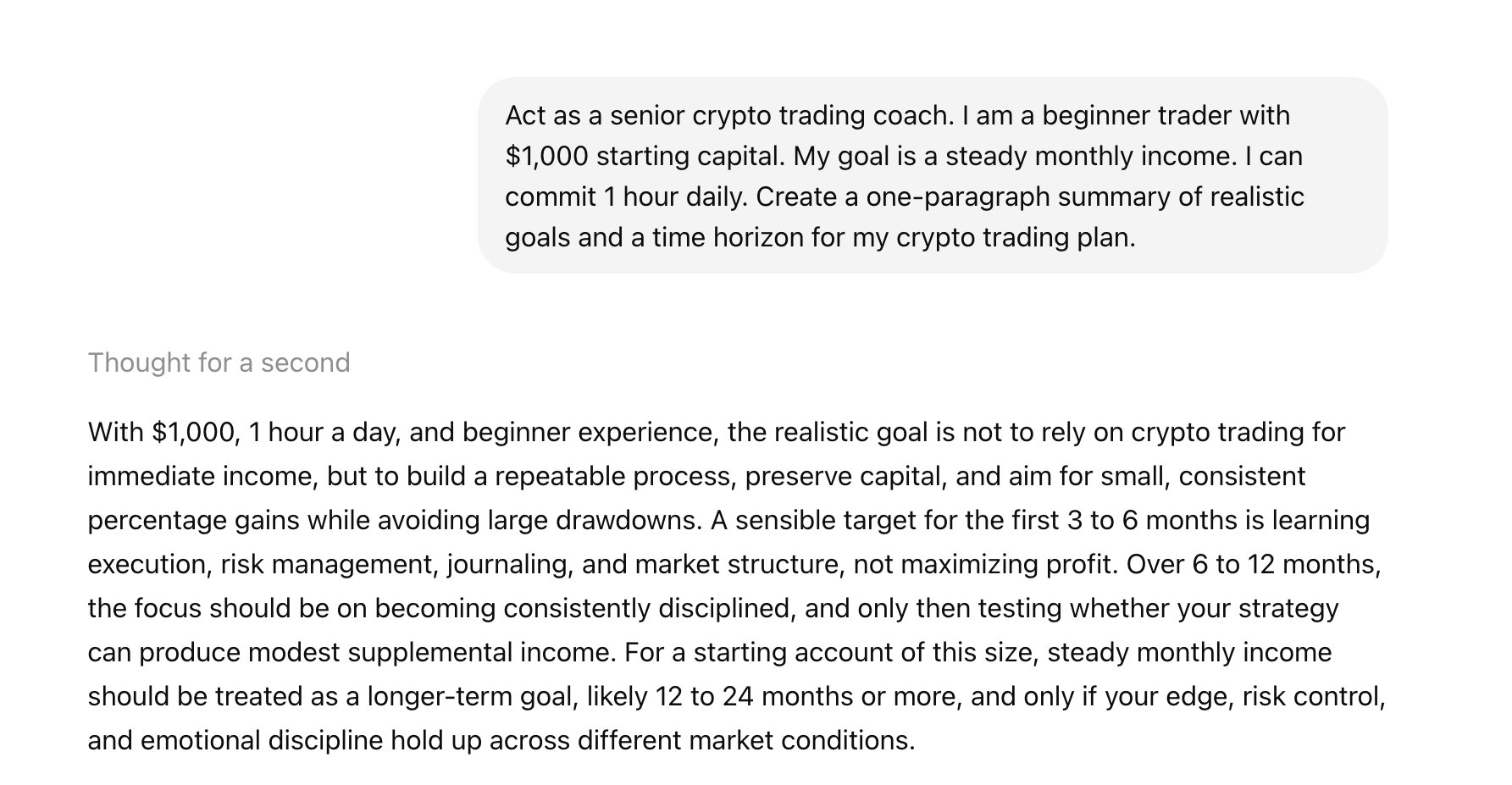
Begin by giving the AI your precise limits: starting funds, time commitment, and financial goals. Instead of asking the model “What should I buy?” ask it to “Build a trend-following strategy for a trader with 5 hours a week.” The AI can then advise allocations between higher-risk decentralized finance (DeFi) protocols and blue-chip assets like Bitcoin and Ethereum (ETH) to create a diversified portfolio structure.
ChatGPT prompt example showing how to defining a crypto trading strategy | Credit: ChatGPT
Natural language processing can help you refine your “Why.” Are you trading for aggressive capital growth or as a buffer against inflation? ChatGPT can assist in converting these intangible goals into tangible rules, like “Only trade pairs with a 24-hour volume exceeding $100 million.
Determine Risk Tolerance and Position Sizing
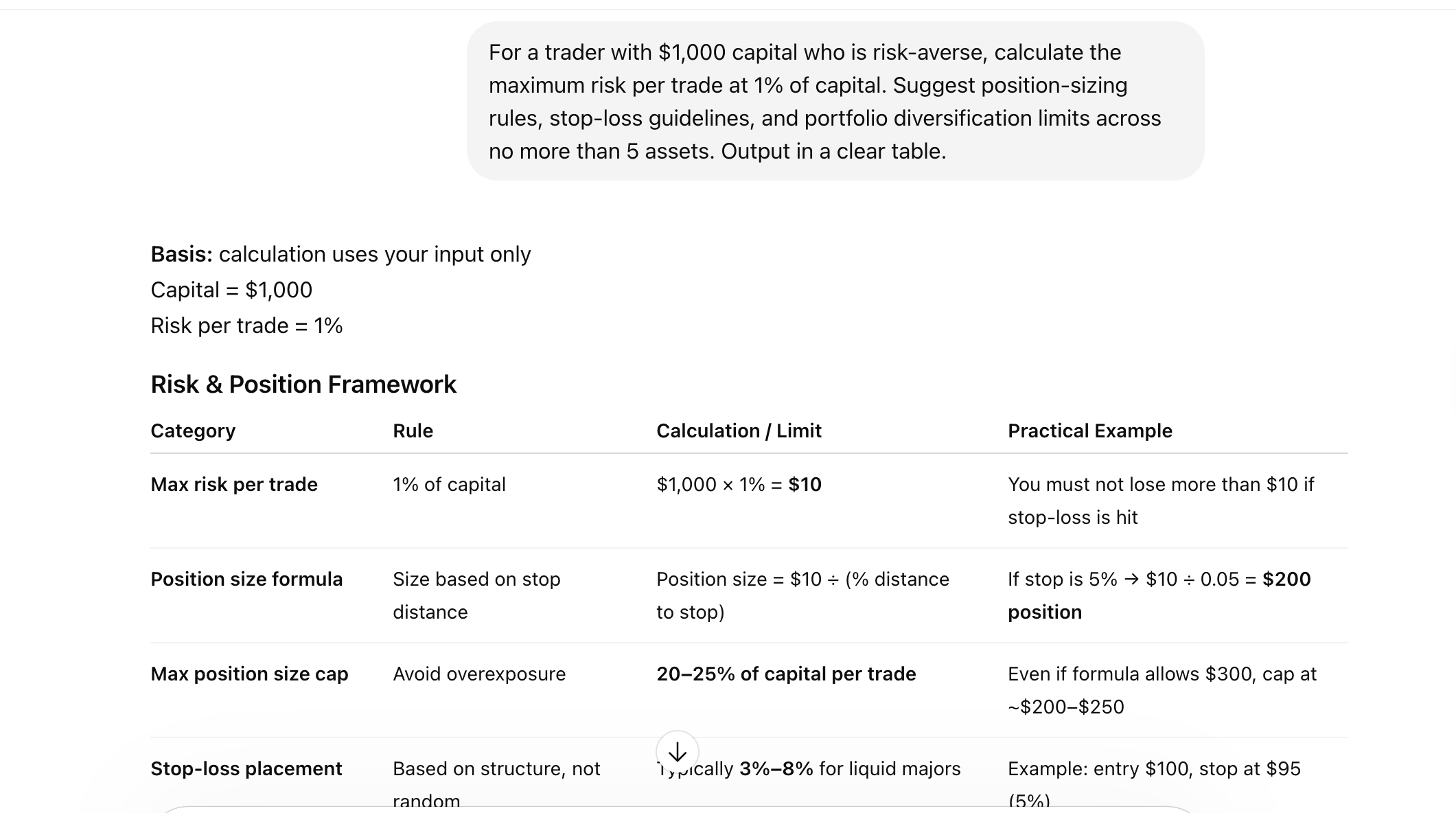
Setting parameters for position sizing and risk tolerance matters since it shields your capital from serious losses that could wipe out your account during sudden market fluctuations. By predetermining the precise amount of money you are ready to lose on each trade (usually between 1% and 2% of total capital), you eliminate the need to make quick judgements and guarantee that you can weather losing streaks while still allowing your strategy to function.
ChatGPT prompt example showing how to determine risk tolerance and position sizing | Credit: ChatGPT
Technical Analysis and Backtesting Integration
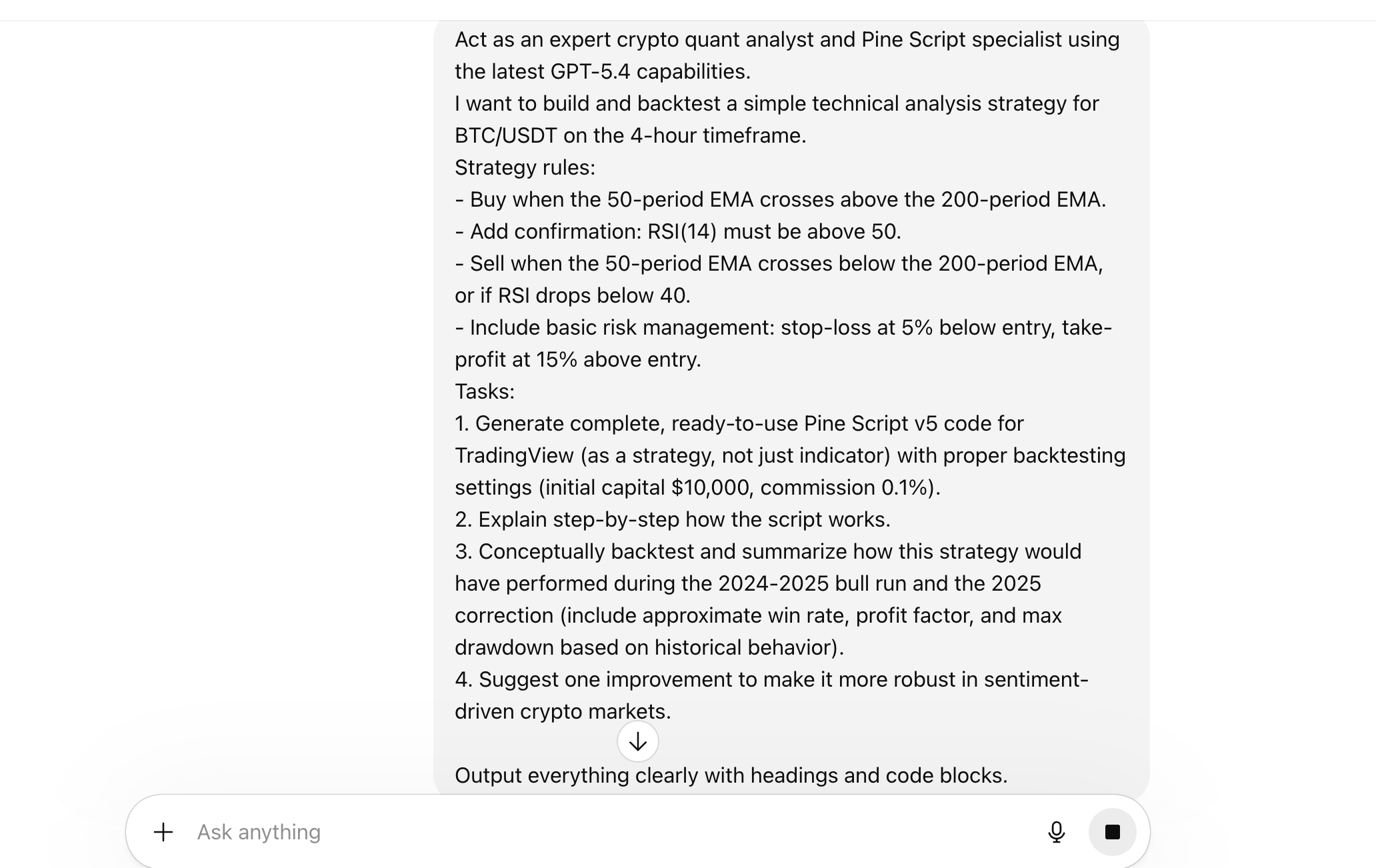
Backtesting is the process of running a trading strategy against historical data to determine how it would have performed. In the past, this needed sophisticated Python or Pine Script coding skills. These days, ChatGPT can produce these scripts for you in a matter of seconds. A strategy like “Buy when the 50-day EMA crosses above the 200-day EMA on the 4-hour chart” can be described, and the AI will generate the code for TradingView and other platforms.
Furthermore, by analyzing large volumes of news data, the latest AI models can perform sentiment analysis. Integrating a technology that determines if the current narrative is bullish or bearish offers an important benefit since the cryptocurrency market is highly sentiment-driven. ChatGPT can summarize for you recent regulatory developments and assess their expected influence on market liquidity.
Remember, though, that AI is a co-pilot, not the captain. It is not able to forecast the future, but it can recognize trends. Comparing the AI’s technical thoughts to on-chain data can help guarantee that the whales are following your plan of action.
ChatGPT prompt example showing technical analysis and backtesting integration | Credit: ChatGPT
Stress-test and Creating Review Rules
Although markets fluctuate constantly and even the greatest plans might become out-of-date or flawed in real-world situations, it is vital to stress-test your strategy and develop regular review rules.
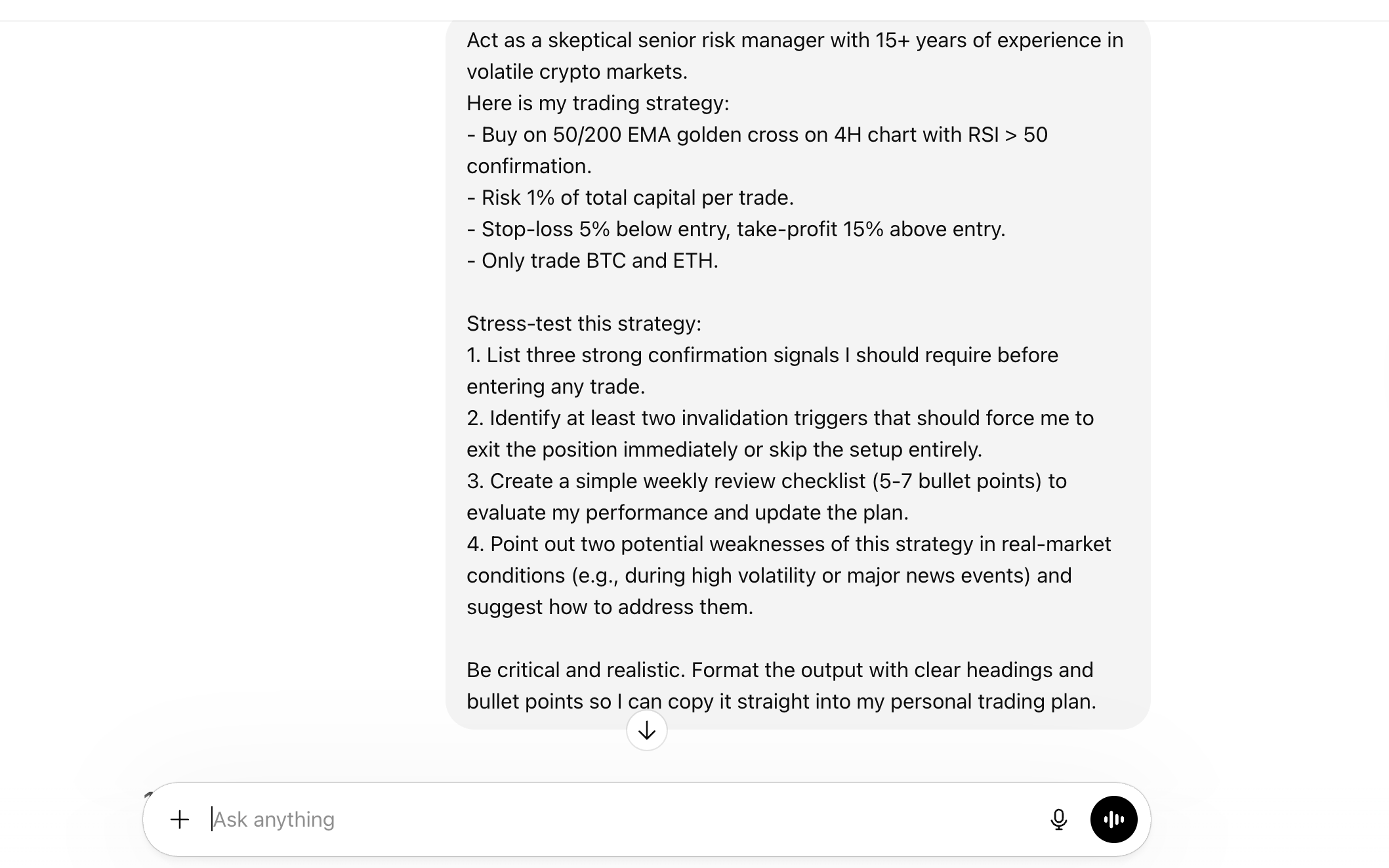
Using ChatGPT to help you find confirmation signals, invalidation triggers, and schedule weekly or monthly reviews, you can create a live plan that changes over time and allows you to learn from both winning and failed transactions.
ChatGPT prompt example showing stress-testing of a crypto trading strategy | Credit: ChatGPT
Key Risks and Best Practices When Using ChatGPT to Trade
Although ChatGPT is quite potent, it has limitations. If it receives insufficient amounts of data with little detail, it may experience hallucinations characterized by imagining facts or data. It is unable to forecast black-swan events. It never takes away your duty.
Best practices include:
Always use on-chain explorers to check outputs or trade data.
Never give ChatGPT access to your API keys or let it execute live transactions without your permission.
Start with at least 30 days of paper trading (simulated trades).
Keep the risk per trade low until you can verify the method works.
Over-reliance on AI signals and failing to do weekly checks are common problems. If you maintain discipline, you can have a real advantage thanks to ChatGPT’s quickness and defined strategy.
Disclaimer:
The information provided in this article is for informational purposes only. It is not intended to be, nor should it be construed as, financial advice. We do not make any warranties regarding the completeness, reliability, or accuracy of this information. All investments involve risk, and past performance does not guarantee future results. We recommend consulting a financial advisor before making any investment decisions.
Curious about how technology and crypto reshape global finance, Elizaveta Savenko explores blockchain, AI, decentralized systems, their applications, and regulatory requirements. She contributes to research, educational initiatives, and industry collaborations, examining trends in digital assets and fintech innovation, increasing awareness of the crypto space and its impact on financial systems.


 Easy
Easy