Rising T-bill yields could draw stablecoin cash into tokenized money market funds, but high minimums and redemption limits may slow the shift. | Credit: CCN.com
Share
Key Takeaways
Stablecoin supply has tended to fall as T-bill yields rise.
Tokenized money market funds offer Treasury income on-chain as they hold $17.1 billion in assets, equivalent to about 6% of stablecoin supply.
DefiLlama found a median yield of 4.07% across 98 pools, compared with 4.17% for three-month bills.
Higher US Treasury bill yields could pull cash out of stablecoins and into tokenized money market funds, giving crypto investors a way to earn interest while keeping their dollars on-chain.
Analyst Jamie Coutts said stablecoin supply has tended to shrink as T-bill yields rise, suggesting that holders are sensitive to the income they give up by keeping cash in tokens that typically pay no interest.
But tokenized money market funds held just $17.1 billion in assets, equivalent to about 6% of stablecoin supply, according to Coutts. High investment minimums and limits on who can hold or redeem fund tokens may keep much of that cash from moving.
New Trending Crypto Wallet Offers
Sponsored
Disclosure
We sometimes use affiliate links in our content, when clicking on those we might receive a commission at no extra cost to you. By using this website you agree to our terms and conditions and privacy policy.
Higher T-Bill Yields Raise the Cost of Holding Stablecoins
Coutts found a correlation of -0.62 between 90-day changes in stablecoin supply and Treasury bill yields since 2022. The figure suggests that stablecoin supply has tended to move in the opposite direction from bill yields.
Interest rates are one factor among several that influence stablecoin demand, and the relationship alone cannot show where cash goes when supply contracts.
The trade-off is straightforward for investors holding stablecoins as cash. When short-term government debt pays more, a dollar held in a non-yielding token gives up more potential income.
The frustrating part about the stablecoin drain is that the fix already exists.
Since 2022 stablecoin supply has moved inversely with T-bill yields (-0.62 correlation on 90-day changes). Rates aren't the only driver, but when bills pay more, stablecoins lose out because holders… pic.twitter.com/HG9NXwDABI
The three-month US Treasury bill yielded 4.17% when DefiLlama Research published its comparison of stablecoin yields on Nov. 12.
Tokenized money market funds can pass income from short-term government debt to investors through fund shares recorded on a blockchain.
Coutts said those shares can, in principle, settle around the clock and serve as collateral where platforms accept them. That could make it easier for investors to keep earning Treasury income while putting their holdings to work on-chain.
Most Large DeFi Lending Pools Offer a Modest Premium
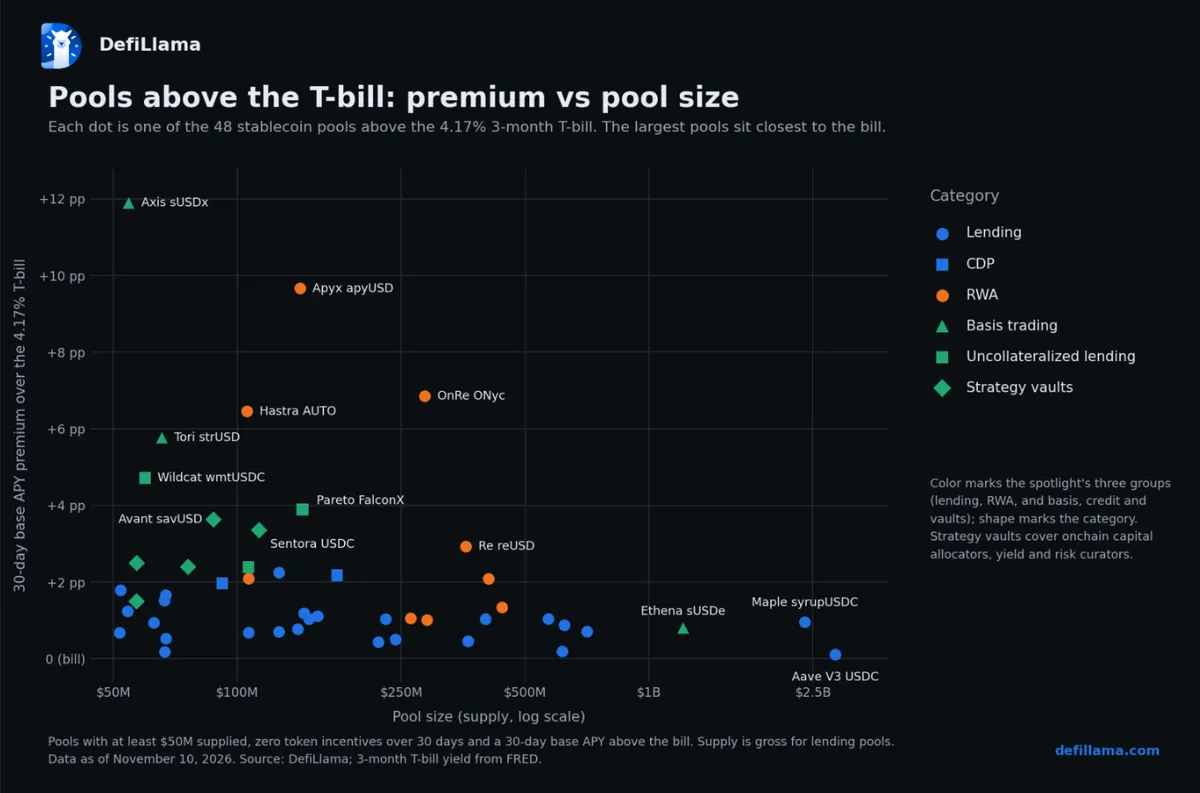
Stablecoin holders can also earn income by depositing tokens in decentralized finance protocols. DefiLlama examined 98 stablecoin pools with at least $50 million supplied and excluded those offering token incentives.
The median 30-day base annual percentage yield was 4.07%, slightly below the three-month bill benchmark. Forty-eight pools beat the bill, with a median yield of 5.38% among those that did.
Pools above the T-bill: premium vs pool size. | Credit: DeFiLlama Research
Lending accounted for $10.6 billion, or 69% of the capital in pools that beat the bill. Those lending pools offered an average premium of 0.65 percentage points, weighted by size.
Aave V3’s Ethereum USDC market, the largest pool in the sample at $2.8 billion, yielded 4.28%, just 0.11 percentage points above the Treasury benchmark.
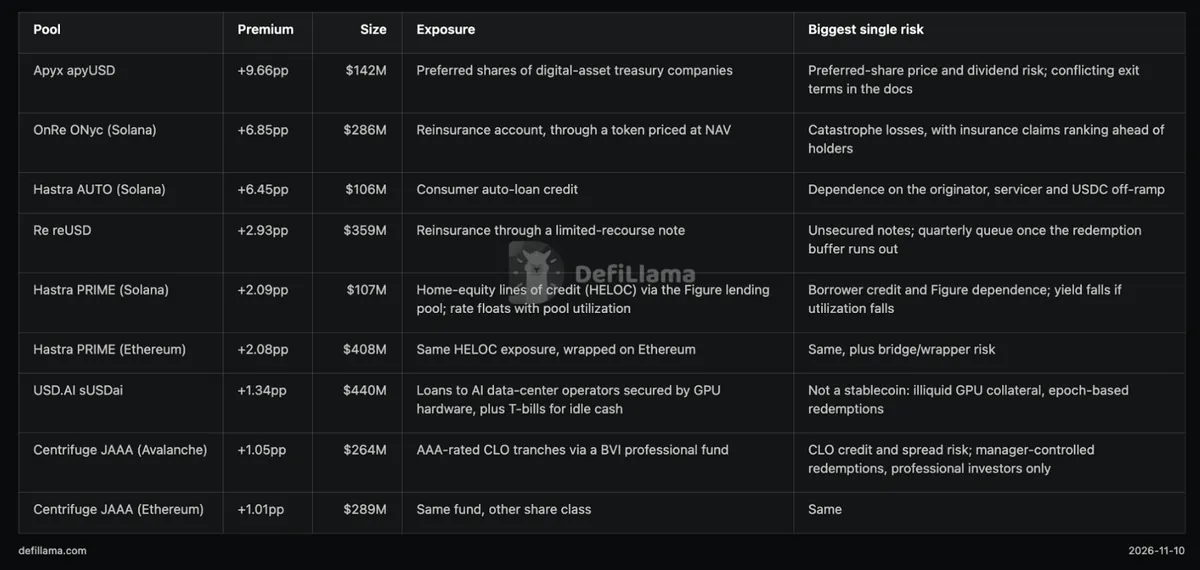
Some pools paid substantially more by taking exposure to credit, reinsurance, preferred shares or trading strategies. The source of the return matters because investors may be taking on borrower default, trading losses or delays in getting their money back, in addition to the risks of the smart contracts they use.
Investment Minimums and Redemptions Limit Adoption
Coutts cited minimum investments of $5 million for BlackRock’s tokenized fund and $1 million for JPMorgan’s as examples of the barriers facing smaller investors. Even products aimed at retail investors can require identity checks and approved wallets, and some process redemptions only on business days.
RWA is the second-largest category above the bill. | Credit: DeFiLlama Research
An investor may be able to transfer fund shares to an approved wallet but still have to wait until the next business day to redeem them for cash. That can make the shares less practical for traders who need dollars available immediately.
Whether tokenized money market funds capture that cash will depend on how many investors can buy the shares, use them as collateral and turn them back into spendable dollars when they need to.
Disclaimer:
The information provided in this article is for informational purposes only. It is not intended to be, nor should it be construed as, financial advice. We do not make any warranties regarding the completeness, reliability, or accuracy of this information. All investments involve risk, and past performance does not guarantee future results. We recommend consulting a financial advisor before making any investment decisions.
Giuseppe Ciccomascolo began his career as an investigative journalist in Italy, where he contributed to both local and national newspapers, focusing on various financial sectors.
Upon relocating to London, he worked as an analyst for Fitch's CapitalStructure and later as a Senior Reporter for Alliance News. In 2017, Giuseppe transitioned to covering cryptocurrency-related news, producing documentaries and articles on Bitcoin and other emerging digital currencies. He also played a pivotal role in establishing the academy for a cryptocurrency exchange website. Crypto remained his primary area of interest throughout his tenure as a writer for ThirdFloor.










 $230B Fixed-Income Giant Enters Aave Collateral Debate With Tokenized Fund