More specifically, who gets to decide which transactions make it onto Ethereum? And whether the network can remain politically neutral as institutional adoption accelerates.
These questions sit at the heart of Hegotá, Ethereum’s next planned hard fork after Glamsterdam.
While the upgrade is still evolving, one proposal has already emerged as its centerpiece: FOCIL, short of Fork-choice Enforced Inclusion Lists.
The name sounds deeply technical, but the implications are not.
Instead of relying on builders and relays to behave fairly, Ethereum validators would gain tools to decide if a specific transaction makes the cut collectively.
And for Ethereum, this is becoming increasingly important.
Over the past two years, the network has quietly become more dependent on a relatively small group of highly sophisticated block builders, relays, infrastructure providers, and now deep-pocketed institutions. Following the rise of MEV-boost after the merge, more than 90% of Ethereum blocks began flowing through outsourced builder infrastructure rather than being assembled directly by validators themselves.
This concentration has undoubtedly improved efficiency after the Merge, but it has also created a new concern.
Research covering Ethereum block auctions between October 2023 and March 2024 found that just three builders produced roughly 80% of all MEV-Boost blocks during the period.
Earlier relay data also showed Flashbots alone controlling more than 80% of the MEV-Boost relay market share shortly after the Merge, while the top three relays collectively handled most outsourced block production.
MEV refers to the extra profits builders can earn by carefully ordering transactions inside blocks, especially around arbitrage trades, liquidations, and high-frequency DeFi activity.
What happens if those entities begin filtering transactions? What if they decide a specific transaction shouldn’t make it to the network, be it for profit, value, or whatever?
FOCIL is Ethereum’s answer to that problem.
What Is Hegotá?
Hegotá, often written as “Hegota” in early discussions, is the planned Ethereum upgrade expected to follow Glamsterdam on the network’s roadmap.
No final mainnet activation date has been confirmed as of mid-May 2026, and several proposed features remain under discussion.
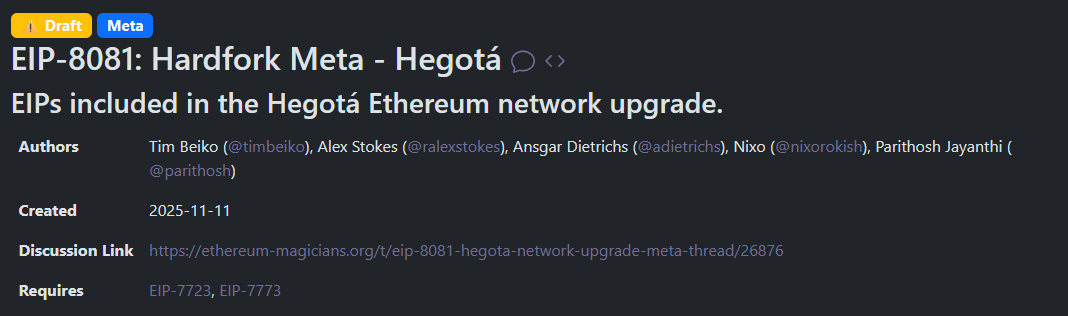
As of May 2026, the formal Meta EIP for the upgrade, EIP-8081, still sits in draft status. Source: Ethereum.org
Right now, the only proposal officially marked as ‘Scheduled for Inclusion’ is EIP-7805, better known as FOCIL.
That matters because many Ethereum roadmap discussions tend to blur together several parallel initiatives:
Account abstraction.
Statelessness.
PBS evolution.
ZK verification.
MEV reduction.
And censorship resistance.
Hegotá currently sits closest to the censorship-resistance side of Ethereum’s roadmap, particularly the section Vitalik Buterin has referred to as “The Scourge” — the broader effort to reduce centralization risks tied to MEV and block production.
In simple terms, Hegotá is shaping up less like a scaling fork and more like a neutrality fork.
Why Ethereum Is Suddenly Worried About Censorship
To understand why FOCIL matters, it helps to understand how Ethereum’s block production changed after the Merge.
Before Ethereum switched to proof-of-stake in 2022, miners handled everything themselves. They collected transactions, built blocks, and added them to the chain.
After the Merge, Ethereum gradually moved toward a more specialized system known as proposer-builder separation, or PBS.
Today, the process is usually split into three layers:
Validators propose blocks.
Builders assemble blocks.
Relays connect builders and validators.
This structure became deeply connected to MEV. The system improved efficiency significantly after the Merge.
Validators no longer needed to compete directly in sophisticated transaction optimization. Instead, specialized builders competed to create the most profitable blocks and paid validators for the right to propose them.
That concentration improved performance, but it also created a new concern.
If a small group of builders and relays controls most block construction, they gain increasing influence over which transactions reach the chain first and which ones may be delayed or excluded entirely.
Following the sanctions, several Ethereum relays and infrastructure providers began filtering transactions linked to sanctioned addresses in order to remain OFAC-compliant.
At one point, OFAC-compliant relays were processing the majority of Ethereum MEV-Boost blocks.
Ethereum itself never went offline. Users could still submit transactions. But critics argued that too much practical influence was quietly accumulating around a small number of builders, relays, and infrastructure providers sitting between users and the blockchain.
The easiest way to think about it is this: Today, builders largely decide what goes into blocks.
Under FOCIL, validators collectively gain a mechanism to say:
“These transactions were visible publicly and should not be excluded without good reason.”
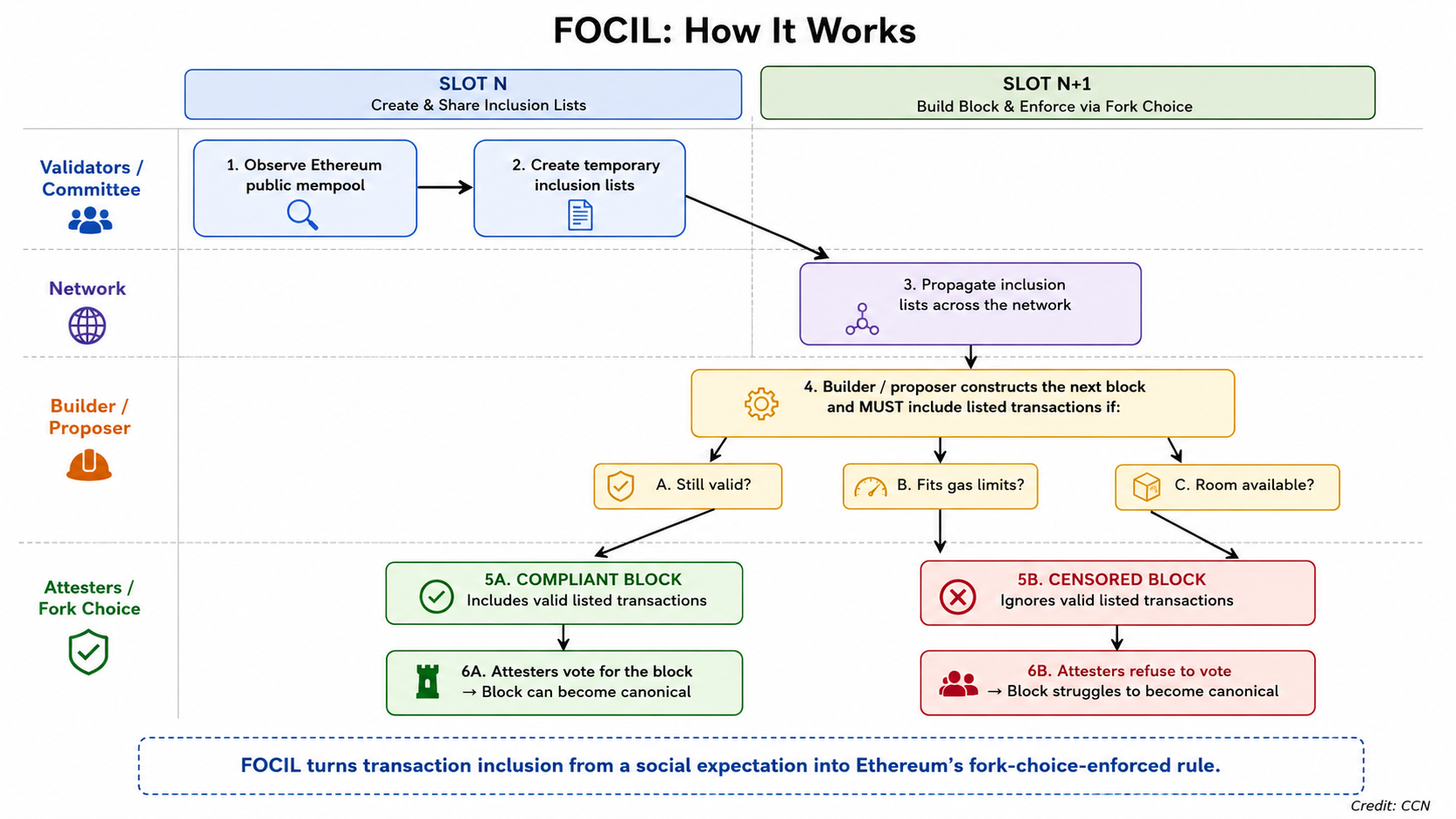
The process works across two consecutive slots.
During slot N, a committee of validators observes Ethereum’s public mempool and creates temporary inclusion lists containing valid pending transactions.
Those lists are then propagated across the network before the next block is built.
How FOCIL Works. Credit: CCN.
In slot N+1, the proposer or builder responsible for the next block must include those transactions if:
They are still valid.
They fit within block gas limits.
And there is room available.
The crucial difference is what happens next.
Under FOCIL, attesters (simply validators) can refuse to vote for blocks that ignore valid inclusion-list transactions.
That means censorship resistance moves beyond social norms and directly into Ethereum’s fork-choice logic.
A builder may technically still construct a block excluding transactions, but if validators refuse to attest to it, the block struggles to become canonical.
That is a big shift in how Ethereum treats transaction inclusion.
How FOCIL Actually Boosts Censorship Resistance
FOCIL completely changes the power dynamic on Ethereum by removing powerful block builders’ absolute veto power. It boosts censorship resistance through three main mechanisms:
From one dictator to ‘1-out-of-N’ honesty: Currently, a single dominant builder can choose to ignore your transaction. With FOCIL, a committee of 16 validators is chosen completely at random from all over the world to make the ‘must-include’ list. Only one single member of that committee needs to be honest and put your transaction on their list for it to be forced into a block. Censoring a transaction becomes nearly impossible because an attacker would have to corrupt every single randomly selected committee member.
Builders lose veto power, keep economic power: Builders can still organize transactions to maximize their profits, but they lose the power to quietly hide or suppress transactions they don’t like. If there is free space in a block, they are legally required by the network rules to fill it with the transactions from the committee’s list.
Automated punishment for censors: Because FOCIL is hardcoded into Ethereum’s core rules, enforcement is automatic. If a builder tries to submit a block that ignores the inclusion list, the rest of the Ethereum network will instantly recognize it as illegal and reject the block entirely. The builder loses all their rewards and transaction fees for that round, making censorship incredibly expensive and unprofitable.
There is also an important synergy between FOCIL and AA (EIP-8141, which is based on 7701):
8141 makes not just smart accounts (including multisig, quantum-resistant signatures, key changes, gas sponsorship) first-class citizens, it also can do the same for privacy protocols… https://t.co/wLCEuq66eI
In short, FOCIL ensures that as long as your transaction is valid and pays the minimum fee, it will get onto the blockchain almost immediately — no matter how powerful the entity trying to stop it is.
Example: How FOCIL Protects Regular Users
Imagine Alice and a massive, wealthy Trading Firm are both trying to buy the exact same rare digital collectible (NFT) that is up for sale. There is only one left.
Because the Trading Firm is so huge, they actually run and control one of the major Block Builders on Ethereum.
Without FOCIL (Today’s Risk)
Both Alice and the Trading Firm submit their orders at the exact same time.
The Trading Firm’s Block Builder looks at the waiting room. They see Alice’s transaction and think, ‘If we process Alice’s transaction first, she wins the NFT, and we lose out on the profit.’
Because they control the block, the Builder censors Alice by intentionally omitting her transaction from it, allowing the Trading Firm to buy the NFT instead.
Alice loses the opportunity purely because the Builder abused their power for financial gain.
With FOCIL (Fair Play)
Alice and the Trading Firm submit their orders.
A random Committee of 16 independent validators from around the world looks at the waiting room. They see Alice’s valid transaction sitting there and add it to the mandatory Inclusion List.
The Trading Firm’s Block Builder receives the list. They still want to cheat Alice, but FOCIL rules say: ‘If you have space in your block, you must include the transactions on this list.’
If the Builder tries to censor Alice and exclude her, the entire Ethereum network will automatically reject their block. The Trading Firm would lose all the money and rewards they would have made from that block.
To avoid losing money, the Builder is forced to be honest and include Alice’s transaction.
The Result: FOCIL ensures a level playing field. A powerful insider cannot abuse their position to block regular users from participating fairly in the network.
But FOCIL Is Not Magic
Despite the enthusiasm, FOCIL does not solve every censorship problem.
Private transactions are never broadcast publicly.
Invalid transactions.
Underfunded transactions.
Transactions with incorrect nonces.
or transactions that exceed available block space.
It also does not dictate transaction ordering.
Builders still maintain flexibility around where transactions appear within a block, which helps avoid introducing new MEV-related manipulation opportunities.
Importantly, FOCIL also does not eliminate centralization.
Builders remain economically important. Relays still matter. MEV still exists.
The proposal simply reduces the extent to which those entities can exercise unilateral censorship power.
Technical Challenges Are Significant
One reason Hegotá remains in draft status is that implementing FOCIL is not simple.
Builders must receive inclusion lists quickly enough to produce compliant blocks without disrupting Ethereum’s existing slot timing.
Bandwidth is another concern.
The proposal introduces additional gossip traffic across the network, particularly when validators equivocate or simultaneously propagate multiple lists.
There are also computational efficiency concerns around validating inclusion-list transactions during block construction.
Ethereum developers are still actively researching how to minimize those overhead costs.
Legal and Regulatory Questions Could Eventually Surface
FOCIL also introduces questions that extend beyond engineering.
If Ethereum becomes harder to censor at the protocol level, some validators or operators in stricter jurisdictions may face legal pressure around sanctioned transactions.
That issue became more visible after the Tornado Cash sanctions debate, when portions of the Ethereum infrastructure briefly leaned heavily toward OFAC-compliant transaction filtering.
FOCIL does not explicitly override laws or regulations.
But it does make systematic transaction filtering operationally harder, which could create future tension between Ethereum’s neutrality goals and regional compliance expectations.
That debate is likely far from over.
How Hegotá Fits Ethereum’s New Vision
Ethereum’s roadmap today is increasingly focused on balancing two competing realities:
Scaling efficiently while preserving decentralization and neutrality.
That balancing act is becoming harder as institutional adoption grows.
Large financial firms entering blockchain markets want:
Reliability.
Predictable settlement.
Regulatory clarity.
and scalable infrastructure.
But Ethereum’s original community also wants:
Permissionless access.
Censorship resistance.
and credible neutrality.
FOCIL sits directly in the middle of those priorities.
The proposal attempts to modernize Ethereum’s infrastructure without quietly turning the network into something controlled by a small group of dominant users.
That is why many researchers see Hegotá as more than just another upgrade.
It is Ethereum trying to reinforce one of its foundational principles before the network scales much further.
When Will Hegotá Actually Go Live?
That part remains uncertain.
As of May 2026:
EIP-8081 remains in draft form.
No finalized activation epoch exists.
Sepolia and mainnet activation tables remain blank.
and broader implementation work is still ongoing.
Most Ethereum discussions broadly point toward a late-2026 or second-half-2026 rollout after Glamsterdam.
But nothing has been formally finalized yet.
And in Ethereum governance, proposed timelines frequently evolve.
Hegotá is Ethereum’s upcoming network upgrade focused primarily on improving censorship resistance through FOCIL.
What does FOCIL stand for in Ethereum?
FOCIL stands for Fork-choice Enforced Inclusion Lists, a mechanism designed to make transaction censorship harder.
How does FOCIL improve Ethereum censorship resistance?
FOCIL allows validator committees to help enforce transaction inclusion rather than leaving decisions solely to block builders.
When will Ethereum’s Hegota upgrade launch?
Hegotá is expected sometime in late 2026, though no official mainnet activation date has been finalized yet.
What is EIP-7805?
EIP-7805 is the Ethereum proposal that introduces FOCIL and its inclusion-list system to the network.
Disclaimer:
The information provided in this article is for informational purposes only. It is not intended to be, nor should it be construed as, financial advice. We do not make any warranties regarding the completeness, reliability, or accuracy of this information. All investments involve risk, and past performance does not guarantee future results. We recommend consulting a financial advisor before making any investment decisions.
Insha Zia is the News Editor at CCN. Based in Dubai, United Arab Emirates, he ensures the CCN newsroom provides value to readers by educating, informing, and engaging them with accurate and timely coverage.
Before joining CCN, Insha was a Senior Journalist at DailyCoin, where his career in crypto journalism took off. At DailyCoin he garnered ample experience by covering some of the biggest news in the crypto industry, especially in the Cardano ecosystem, and maintain solid relations with KOLs in the industry.
Insha has worked as a ghostwriter and a developer for three years. He has co-authored numerous articles in reputable publications, including Hackernoon, Yahoo Finance, and Nasdaq. He also has experience as a Solidity Developer and a Data Analyst.
Insha’s developer and journalist backgrounds go hand in hand when educating readers on technically complex concepts within the crypto space. He values accuracy, transparency, and delivering valuable insights to his readers.
Insha firmly believes education can propel the mass adoption of the crypto space. He is committed to giving CCN readers a greater understanding of the technology using his technical background.
Insha earned a Bachelor of Science in Computer Systems Engineering at the University of Engineering and Technology, Peshawar, in 2022. His technical foundation includes expertise in quantitative and qualitative research, data analysis, programming languages, and cybersecurity.
His comprehensive skill set enables him to communicate complex concepts to crypto readers with authority and clarity, making his articles both informative and engaging for his audience.
Insha is determined to take CCN to the top of the industry. When he’s not working on his next article or editing, Insha enjoys playing video games, mainly in FPS and MMORPG genres. He also loves playing soccer and has supported Arsenal since he was six.


 Easy
Easy