Key Takeaways
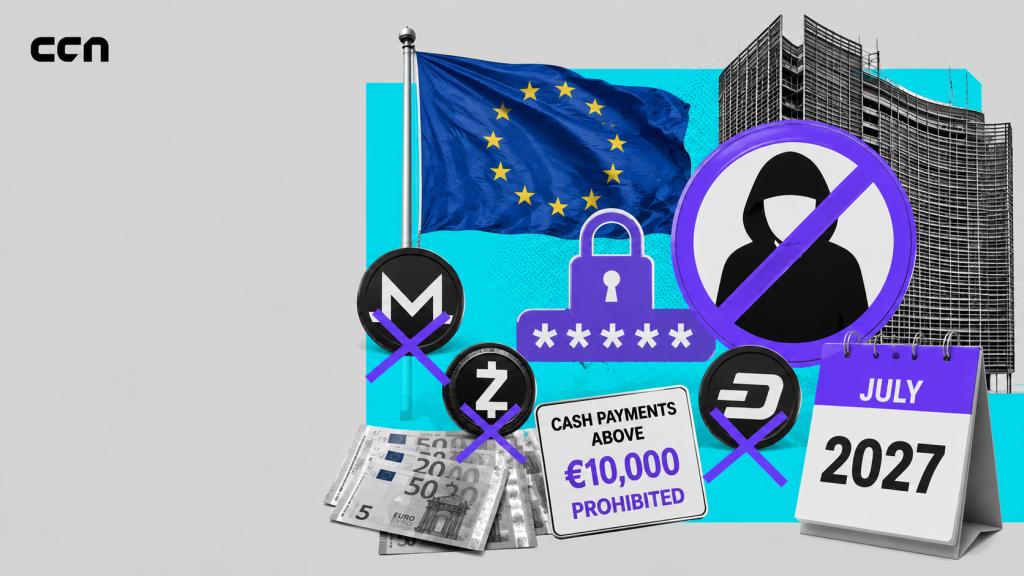
- Cash payments above €10,000 are banned across the EU, while transactions of €3,000 or more require identity checks.
- Crypto platforms must delist privacy coins like Monero, Zcash, and Dash, though self-custody wallets remain unaffected.
- A new EU anti-money laundering authority will oversee compliance across the bloc.
The European Union’s Regulation 2024/1624 becomes applicable from July 10, 2027, representing the most significant transformation in EU anti-money laundering prevention since the first AML Directive was introduced in 1991.
The regulation replaces the directive-based 6th AMLD with a directly applicable single rulebook, eliminating the need for national implementation and creating harmonized standards across the European single market for the first time.
The regulation widens the EU’s AML net to include sectors well outside traditional finance, designating professional football clubs, agents, and luxury goods traders as obliged entities.
Top-flight clubs must apply AML checks across investors, sponsors, and transfer deals. Dealers in high-value goods, including cars, boats, and aircraft, must report large transactions to Financial Intelligence Units.
Cash Cap: €10,000 Across the Bloc, €3,000 Triggers Due Diligence
Commercial cash payments exceeding €10,000 will no longer be permitted anywhere in the EU from July 2027. The measure establishes a common EU-wide limit while allowing member states to maintain stricter national rules.
Cash transactions of €3,000 or more require obliged entities such as traders and service providers to perform customer due diligence, including mandatory identity verification, before completing the transaction. The €10,000 limit does not apply to deposits or payments made at banks, payment institutions, or electronic money issuers.
Privacy Coins Banned on Regulated Platforms; Self-Custody Untouched
The regulation explicitly prohibits regulated platforms from supporting anonymity-enhancing coins or any accounts or services that enable greater transaction obfuscation.
The rule does not outlaw the ownership or private use of privacy-focused crypto assets, but it effectively prevents regulated platforms from listing, custodying, or facilitating services involving them.
Privacy coins targeted include Monero, Zcash, and Dash, which are designed to obscure transaction details. Regulated exchanges must retire these assets from their product lines before the July 2027 deadline or face significant fines and operational restrictions from AMLA.
Peer-to-peer Bitcoin transactions conducted without an intermediary do not trigger direct identity verification under EU law. The identification obligations apply to crypto-asset service providers, not to every blockchain transaction.
Under the separate Travel Rule framework, Regulation 2023/1113, regulated providers must transmit sender and recipient information for crypto transfers, with additional verification checks applying to transfers involving self-hosted wallets of €1,000 or more when a regulated intermediary facilitates the transaction.
KYC Drops to €1,000 for Occasional Users
The revised framework significantly lowers the threshold for mandatory identity verification. From July 2027, any single transaction of €1,000 or more will require crypto-asset service providers to collect and verify customer identification documents, applying to both fiat-to-crypto and crypto-to-crypto transactions.
This aligns the crypto sector with traditional financial regulations where banks and payment providers must verify customer identities at similar thresholds.
The digital euro timing raises political questions
The scheduled AML laws take effect one year after the EU’s broader MiCA crypto regulatory framework, set to take effect on July 1, 2026. The European Central Bank’s digital euro is set to formally begin its testing phase in mid-2027, with individual holdings capped at €3,000 to €4,000.
By restricting privacy coins and imposing stricter KYC requirements while rolling out a state-backed digital euro, regulators are removing competing alternatives just as the ECB’s own product approaches launch, a sequence critics argue is more than coincidental.
The information provided in this article is for informational purposes only. It is not intended to be, nor should it be construed as, financial advice. We do not make any warranties regarding the completeness, reliability, or accuracy of this information. All investments involve risk, and past performance does not guarantee future results. We recommend consulting a financial advisor before making any investment decisions.

Dr. Guneet Kaur is a senior editor at CCN.com and a Science Fellow at Exponential Science. She is a fintech and blockchain expert with extensive experience in digital finance education, blockchain ecosystems, and cryptocurrency markets. She has worked with global media such as Cointelegraph, as well as education and blockchain platforms, to design and lead strategic content and learning initiatives. As an educator and assessor for top-tier executive programs, she bridges real-world fintech trends with academic insight.
Dr. Kaur is also a published researcher and peer reviewer across fintech and data science journals, including Financial Innovation Journal and International Journal of Big Data Intelligence and Applications. Her work spans data-driven analysis, Web3 innovation, and technical content development. With a strong foundation in both industry and academia, she translates complex financial technologies into practical applications, empowering learners, professionals, and institutions across the rapidly evolving digital finance landscape.