Key Takeaways
- Many companies hide ransom payments, often made in crypto, to avoid reputational damage or regulatory scrutiny.
- 2024 saw 5,289 reported ransomware incidents worldwide, up 15% from 2023.
- Experts stress that stopping ransomware requires more prevention techniques.
Ransomware attacks reached 5,289 reported cases worldwide in 2024, up 15% from the previous year and more than double the total in 2022.
However, the true scale of the crisis may be obscured, as many victim companies reportedly refuse to disclose when they pay attackers.
Top Trending Crypto Articles
The Culture of Secrecy
Earlier this year, James Babbage, director general at the U.K.’s National Crime Agency, told BBC’s Panorama that “it is the paying of ransoms which fuels this crime.”
A culture of secrecy may be helping to fuel a cycle of ransomware attacks.
Adnan Malik, head of data protection at Barings Law, told The Epoch Times that companies “do not openly declare they have paid a ransom,” often to avoid reputational harm or regulatory scrutiny.
This can be easily concealed through cryptocurrency payments, which are the most common form of payment in ransomware cases.
Andy Jenkinson, a fellow of the Cyber Theory Institute, told The Epoch Times that “ransoms are almost always paid in Bitcoin and other cryptocurrencies, which are harder to trace than bank transfers.”
While blockchain transactions are public, tracing them to a specific organization often requires sophisticated investigative work, which is made more difficult by mixers and other obfuscation techniques.
Ransomware Attacks Grow, But Payments Decrease
Ransomware incidents surged again in 2024, hitting 5,289 reported cases worldwide—a 15% year-on-year increase, according to U.S. law enforcement data.
While that’s a sharp slowdown from the 77% spike in 2023, it still marks more than a doubling of global incidents since 2022.
The U.S. has remained the epicenter of the threat, accounting for roughly half of all attacks, driven by what authorities describe as a “broad range of profitable targets.”
Authorities partly credit the slowdown in growth to coordinated international crackdowns.
Operation Cronos, launched in February 2024, targeted the LockBit network, one of the world’s most prolific ransomware operations, leading to arrests, the freezing of over 200 cryptocurrency accounts, and the seizure of more than 7,000 decryption keys.
Still, the disruption failed to significantly reduce the overall volume of ransomware events.
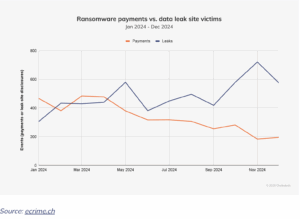
- Ransomware payments decreased | Credit: Chainalysis
Chainalysis data also showed that while reported incidents climbed, the total value of ransom payments fell 35% year-over-year to $813.55 million, suggesting more victims refused to pay or negotiated lower settlements.
This shift may highlight a growing disconnect between the frequency of attacks and attacker revenue.
Ransomware Can Be Stopped, But Silence Complicates Things
While global law enforcement operations have dented ransomware revenues, many cybersecurity experts stress that lasting progress depends on preventing attacks from succeeding in the first place.
Jason Soroko, Senior Fellow at Sectigo and co-host of the award-winning Root Causes podcast, told CCN that the battle against ransomware should start with identity security.
“Stopping ransomware relies on combining identity-first principles with least-privilege data access security, all while leveraging a variety of cybersecurity best practices and technologies,” Soroko said.
By “identity-first,” Soroko means putting user authentication and verification at the heart of a security strategy.
“An identity-first approach that leverages proven identity security technologies such as public key infrastructure (PKI) helps to protect identity through the usage of strong phishing resistant credentials,” he explained.
Soroko argues that this is not just about technology, but about giving security teams full oversight of who is inside the system at any given time.
However, the effectiveness of this is undermined when victims remain silent.
In 2023, British authorities warned that it’s “the attacks we don’t hear about… that aren’t reported to us and pass quietly by, pushed to one side, the ransoms paid to make them go away,” that cause the most damage.
“If attacks are covered up, the criminals enjoy greater success, and more attacks take place,” the National Cyber Security Centre (NCSC) said.
For Soroko, the conversation about ransomware has been too focused on the ransom payment itself.
“A growing number of cybersecurity experts have now figured out that ransomware is not solely a malware problem, it is a data access and identity problem,” he told CCN.
“The lasting damage of ransomware attacks lies not in the transactions forced upon by the bad actor but in the cost of lost business, disruption to operations, and clean-up.”
U.K. To Ban Ransom Payments
In July, the UK government announced plans to ban public sector bodies and critical infrastructure operators from paying ransom demands.
Under the new measures, all businesses not covered by the ban will be required to alert the government if they plan to pay a ransom.
“The government could then provide those businesses with advice and support, including notifying them if any such payment would risk breaking the law by sending money to sanctioned cyber criminal groups, many of whom are based in Russia,” the UK government said.
NCSC Director of National Resilience Jonathon Ellison said: “These new measures help undermine the criminal ecosystem that is causing harm across our economy.
“Ransomware remains a serious and evolving threat, and organisations must not become complacent.”
Top Trending Crypto Articles

Kurt Robson is a London-based reporter at CCN, specialising in the fast-moving worlds of crypto and emerging technology. He began his career covering local news in Cornwall after graduating from Falmouth University with First Class Honours in Journalism. There, he cut his teeth on everything from council meetings to missing swans.
He quickly rose through the ranks to become a frontline journalist at several of the UK’s leading national newspapers. Over the years, he has interviewed musicians and celebrities, reported from courtrooms and crime scenes, and secured multiple front-page exclusives.
Following the upheaval of the COVID-19 pandemic, Kurt shifted his focus to technology journalism—just ahead of the AI boom. With a natural curiosity and a trained eye for emerging trends, he has found a new rhythm in reporting on innovation.
At CCN, Kurt's work focuses on the cutting edge of crypto, blockchain, AI, and the evolving digital world. Drawing on his background in people-first reporting and his deep interest in disruptive tech, Kurt delivers stories that are insightful, entertaining, and human-centric.