Stablecoin supply currently sits around $300.3B and the Bank for International Settlements estimates that 2025 transaction volume reached $28T. Yet McKinsey and Artemis data put genuine organic payment activity at roughly $390B a year, which the firm describes as roughly 0.02% of global payments volumes. An asset class that has cleared almost every adoption milestone set by its proponents is still barely used for the thing it was built to do.
The Number That Describes Commerce
Gross on-chain volume isn’t an accurate measurement of payments. Visa’s adjusted methodology strips out addresses exceeding 1,000 monthly transactions or $10M in monthly volume, filtering out bot activity and internal exchange rebalancing. That filter reduces trailing twelve-month volume from a raw $100.3T to $14.6T.
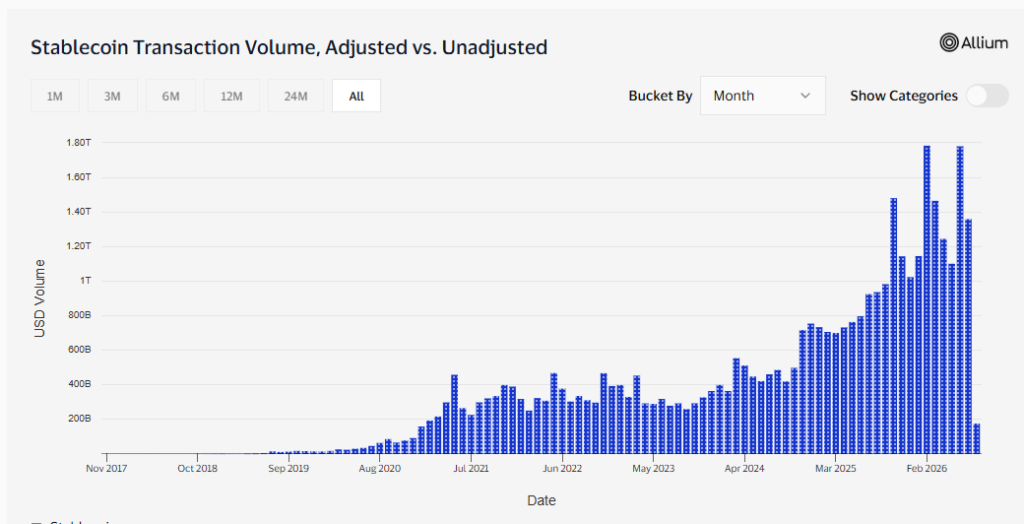
The BIS makes the same point, noting that values net of same-party transfers are far lower and putting $28T at “less than three business weeks of settlement volumes of the largest US wholesale payment systems.” Against that $28T estimate, the $390B payments figure represents just 1.4% of transfer volume.
That organic payment activity reveals where the money actually moves. Approximately $226B is B2B settlement, with payroll and remittances accounting for roughly $90B. Regionally, Asia captures approximately $245B while Latin America and Africa each sit under $1B.
“The requests that reach us rarely mention coins at all,” says Daniel Stolberg, Co-Founder at Utorg a stablecoin infrastructure company operating across 130+ countries. “They mention corridors, licenses, and banks. A company knows it wants to settle in stablecoins. What it does not have is a way to get money in at one end, out at the other, and a regulator comfortable with everything in between.”
This composition indicates that volume concentrates heavily where somebody has already built the necessary connective layer.
Four Chokepoints Between a Stablecoin and a Payment
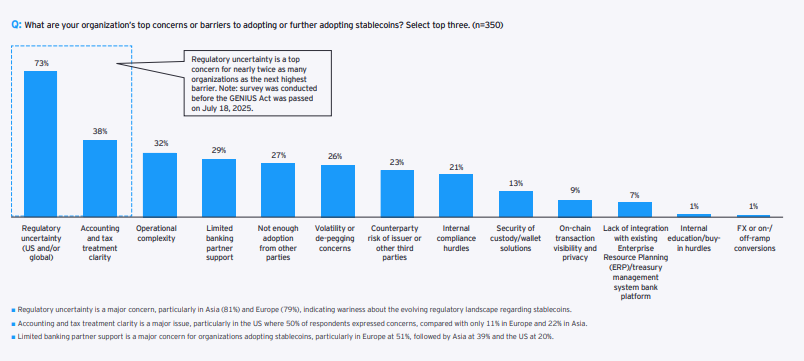
The intent gap is substantial. 13% of respondents to EY-Parthenon’s stablecoin survey currently use them, while 54% of non-users plan adoption within twelve months. Four constraints explain why intent runs so far ahead of usage.
Ramps present the most immediate friction. The BIS notes that stablecoin performance as a cross-border instrument “is uneven once fees, spreads and on-/off-ramp costs are considered.” The World Bank puts the global average cost of a $200 remittance at 6.36%, with bank channels at 14.99% and digital services at 4.59%. The UN target is 3% by 2030, and the Committee on Payments and Market Infrastructures assessed in May 2026 that “it is unlikely that the G20 targets will be fully met by 2027.”
Banking relationships create another distinct bottleneck. Active correspondent banking relationships fell roughly 25% between 2011 and 2020. EY-Parthenon found 29% of corporates cite limited banking partner support as an adoption barrier, with 81% rating it critical or important.
Licensed custody and integration complexity form the remaining barriers. GENIUS Act implementing rules remain proposals as of August 2026, so the licensed US stablecoin layer legally isn’t built yet. Utorg’s four product lines map onto these constraints one for one. Integration is the barrier regulation won’t fix: 36% of respondents told EY that adoption would require major systems changes.
What the Incumbents Are Actually Buying
The largest payment companies are buying their way past these gaps. Stripe closed its acquisition of Bridge for $1.1B in February 2025. Mastercard completed its BVNK acquisition on 3 August 2026, announced at up to $1.8B. Zerohash raised at a valuation above $1.5B.
None of these transactions bought a stablecoin. Every buyer acquired ramps, orchestration, and licensing. Jorn Lambert, Mastercard’s Chief Product Officer, framed the next phase of payments around how well the different rails connect to each other.
When the last mile works, behavior shifts. Utorg’s analysis of its own card usage data shows a VIP tier of 12.5% of users generating over 53% of total volume, at roughly four times the platform average spend. Around 90% of their large transactions are travel and shopping, on top of roughly two card purchases a day. The median active user age sits in the early thirties, which cuts against the assumption that crypto cards skew young.
“When the last mile works, people stop treating the balance as something they are holding and start treating it as money,” Stolberg says. “Our highest-volume users are booking flights and paying for dinner with a crypto card, several times a day.”
Global crypto card spending hit an $18B annualized rate in late 2025, a 106% compound annual growth rate. That volume roughly matches all P2P stablecoin transfer volume, which grew only 5%.
What Has to Get Built First
The headline supply and gross transfer volume figures don’t accurately describe commerce.
The number worth tracking is the payments figure, and it won’t move much until ramps, banking access, licensed custody, and settlement stop functioning as four separate projects for every business that wants them. Future adoption may increasingly depend on the quiet buildout of this connective layer, turning token infrastructure into payment rails ordinary enterprises can actually use.
Disclaimer:
We occasionally work with brands we trust to bring you deeply researched content. This article was developed in collaboration with a trusted partner

With over half a decade of experience commentating on the cryptocurrency market and even more as a trader and investor, Jay has developed a robust knowledge base that enables him to dive deep into the inner workings of crypto platforms and the broader market to deliver unique, user-focused insight.
Jay's work has spanned public relations firms, crypto projects, affiliate sites, and news outlets.